

Home Fertility Test Guide: How They Work and What to Expect
Dr. Adeyinka AdegbosinYou're standing in a pharmacy aisle, looking at rows of pink boxes and wondering whether you need ovulation strips, a basal thermometer or a finger-prick hormone kit. The packaging may promise clarity, but each test answers a different question. The most useful way to approach a home fertility test is as a source of timing information and personal insight, not as a stand-alone diagnosis.
That distinction matters in Australia, where people are often trying to understand fertility while delaying parenthood or deciding when to seek professional advice. The average age of women giving birth increased from 29.9 years in 2008 to 30.7 years in 2018, and the average age of first-time mothers rose from 28.2 to 29.3 years over the same period, according to Australian fertility and age information from Fertility Society Australia. Home testing can help you understand when ovulation may be approaching, but it can't tell you whether conception will happen.
What a Home Fertility Test Actually Is
A shopper called Mia might choose a box labelled “fertility test” because she wants to know whether she can become pregnant. After reading the instructions, she discovers that one kit predicts an approaching hormonal event, another records a temperature pattern, and a third estimates a marker associated with ovarian reserve. They all relate to fertility, but they don't measure the same thing.
A home fertility test is a consumer product that you use yourself to measure a hormone, temperature or other reproductive signal. Most products fit into three broad groups:
- Timing-based tests look for signs associated with ovulation in the current cycle.
- Reserve-based tests estimate a biological marker linked to ovarian reserve, which describes the remaining pool of developing follicles rather than whether conception will occur now.
- Combined digital systems bring together readings such as basal body temperature, urine results and symptom records in an app.
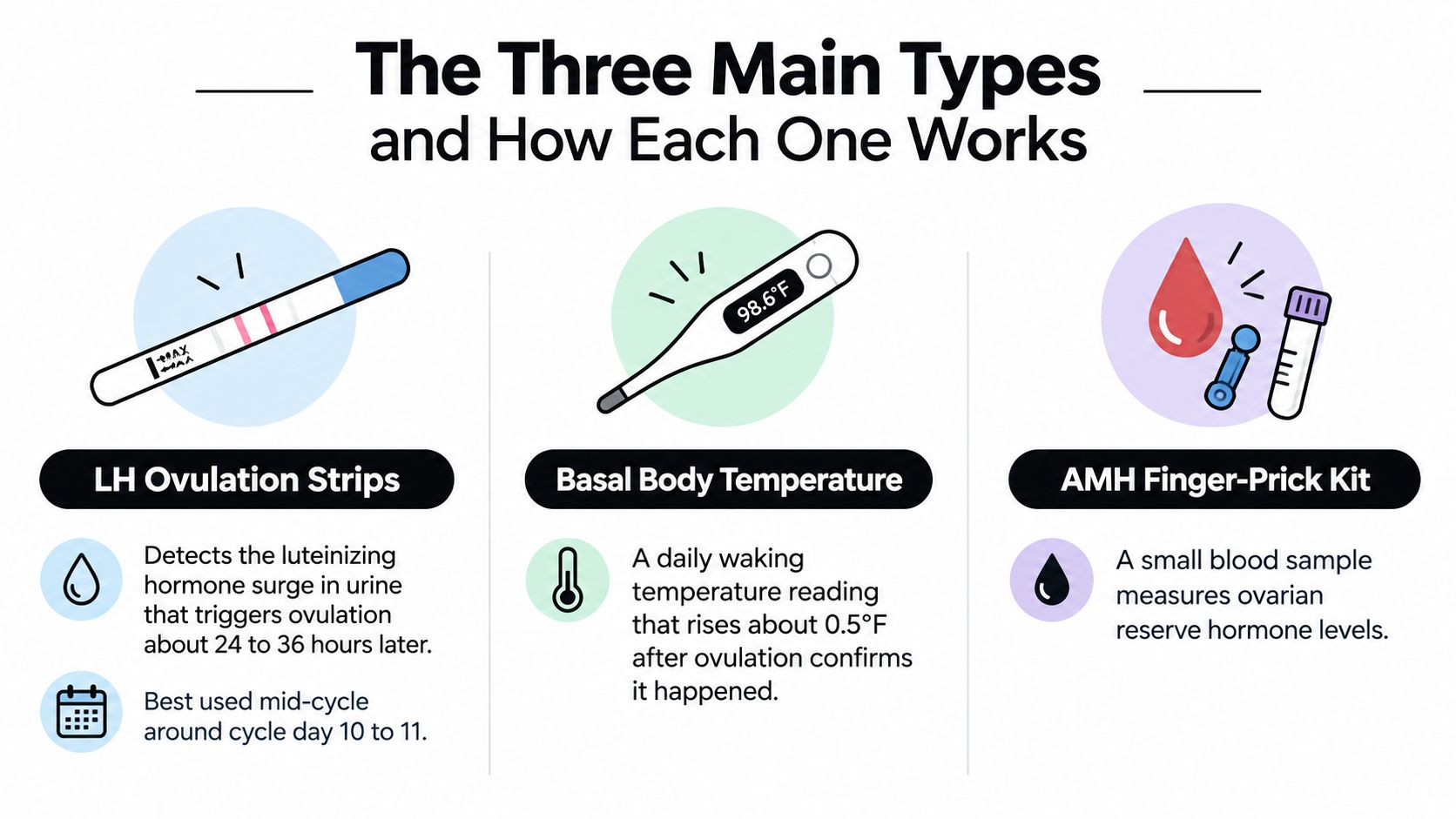
An ovulation strip measures luteinising hormone, usually called LH, in urine. A basal thermometer records your waking temperature over time. An AMH kit uses a small sample to measure anti-Müllerian hormone, or AMH. These tools can turn an invisible process into a chart or a result you can discuss with a partner or GP.
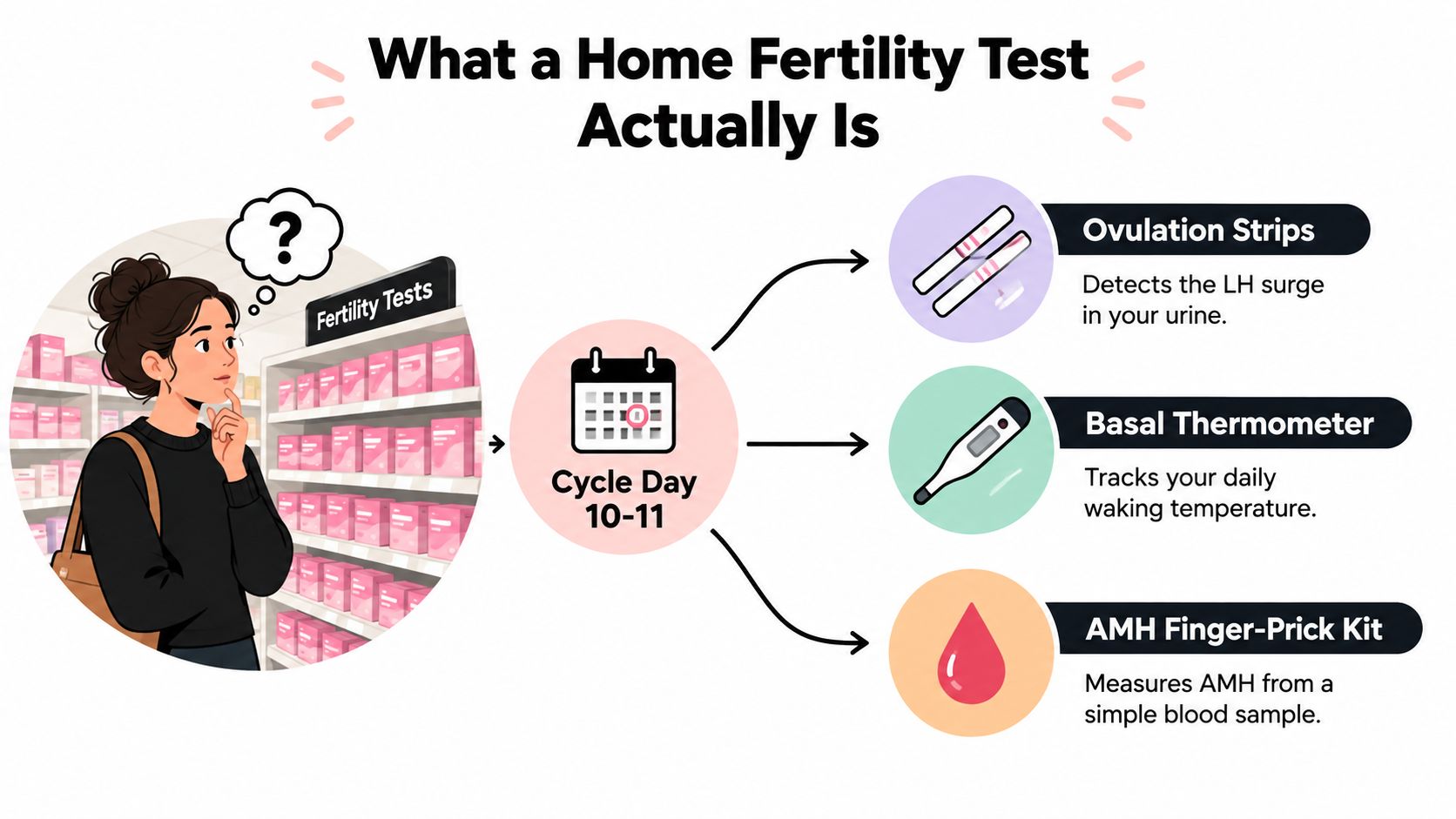
The useful question isn't “Am I fertile?” It's “What does this particular test measure, and what decision can it help me make?”
A home result is a signal, not a complete assessment. It doesn't diagnose infertility, confirm egg quality, assess sperm health or show whether the fallopian tubes are open. It also can't guarantee pregnancy. For a helpful introduction to luteal phase and ovulation clues, look for resources that explain how several observations fit together rather than treating one reading as definitive.
Australia's reproductive history also helps explain why people seek accessible cycle information. Assisted reproductive technology accounted for 4.1% of babies conceived in 2010 and 4.9% in 2017, with ART representing almost one in five babies born to women aged 40 to 44 in 2017, according to research on ART and reproductive change in Australia. Home testing sits at the early, informational end of that journey. It can help someone recognise a likely fertile window before a healthcare conversation, but it can't replace that conversation when concerns persist.
The Three Main Types and How Each One Works
LH ovulation strips
An LH strip uses urine to detect a rise in luteinising hormone, the hormonal signal associated with impending ovulation. Australian Therapeutic Goods Administration testing describes the LH surge as typically preceding ovulation by approximately 36 hours, although urinary LH becomes detectable after the surge is measurable in blood and secretion happens in pulses rather than as a smooth, predictable climb. The TGA explanation of LH self-test performance explains why a single daily test can miss a brief or variable surge.
In practical terms, a positive strip tells you that ovulation may be approaching. It doesn't prove that an egg was released. A person with an irregular cycle may need to test across a broader part of the cycle instead of relying on one calendar prediction.
Basal body temperature
Basal body temperature, or BBT, is your temperature at rest, measured under consistent conditions soon after waking. After ovulation, progesterone can produce a sustained rise. Australian fertility-awareness material describes this rise as approximately 0.2 to 0.5°C, as outlined in RACGP guidance on fertility assistance and ovulation monitoring.
The important word is after. A temperature chart usually helps confirm that ovulation may already have happened. For example, a series of lower readings followed by a sustained higher pattern can give retrospective support to an LH result. Illness, broken sleep, alcohol and changes in measurement time can make the chart harder to interpret, so consistency matters more than a single reading.
AMH finger-prick kits
An AMH kit measures anti-Müllerian hormone, a marker associated with ovarian reserve. In plain language, it offers a snapshot related to the pool of follicles in the ovaries. It isn't an ovulation-timing test and doesn't predict whether conception will happen in a particular cycle.
That makes AMH useful for a different conversation. Someone considering future fertility planning may want to discuss the result with a clinician, while someone trying to identify fertile days needs a timing-based approach such as LH testing or cycle observations. A home AMH result should be interpreted alongside age, menstrual history, medical history and other clinical information. A single number can't describe the whole reproductive system.
How to Run an LH Strip and Read the Result
Read the instructions supplied with your kit first. Different brands can vary in how long the strip should be dipped, how long the result takes to develop and how long the result remains valid.
A simple routine looks like this:
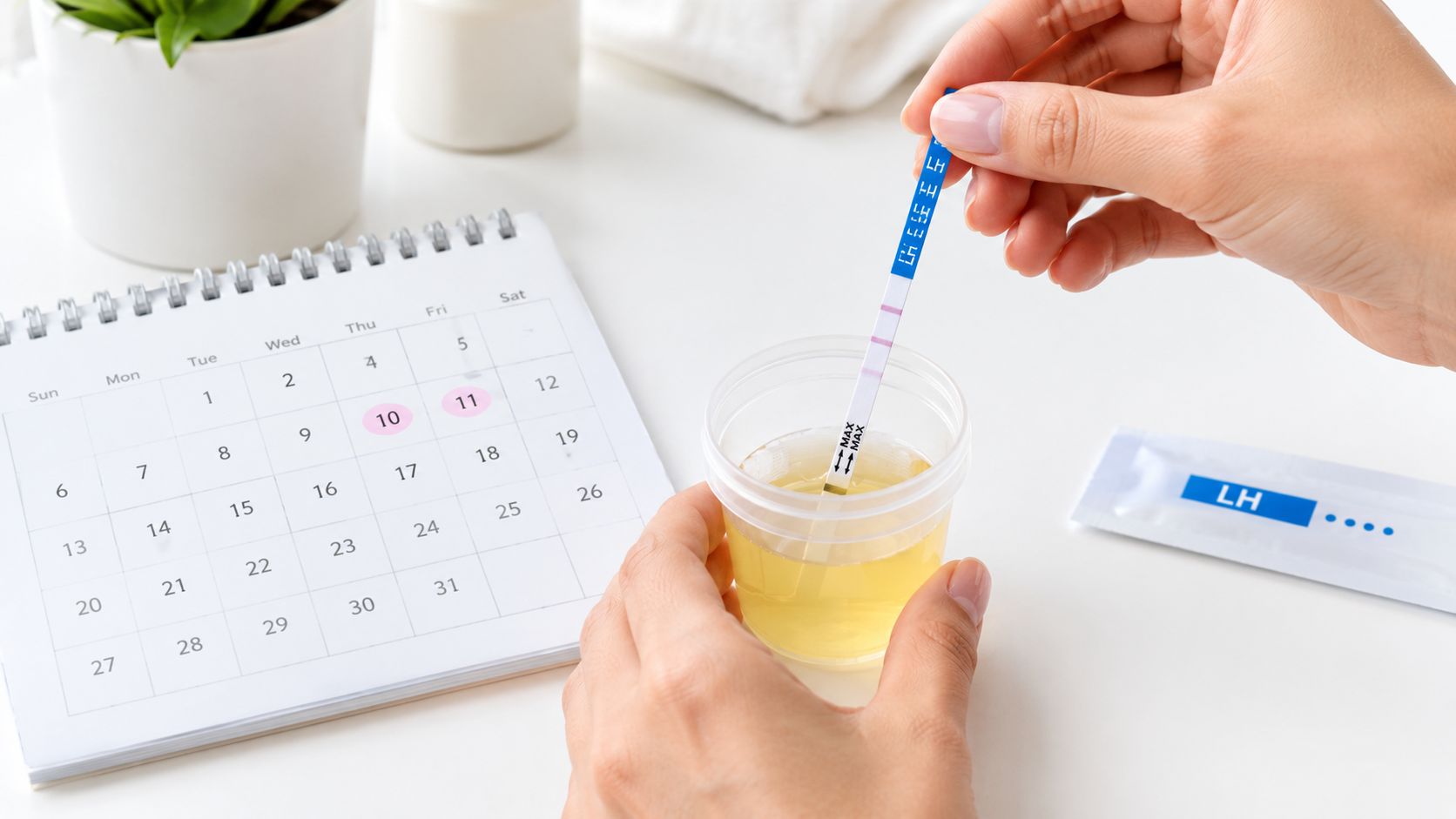
- Choose a testing window. Start several days before you expect ovulation, using your usual cycle pattern as a guide. If your cycles vary, begin earlier and continue for longer rather than treating an app prediction as an exact appointment.
- Collect urine carefully. Follow the product instructions about the preferred sample. Avoid drinking unusually large amounts of water immediately beforehand, because diluted urine can make a hormone signal harder to detect.
- Use the strip exactly as directed. Dip it only to the marked line and for the stated time. Lay it flat while the result develops.
- Check the control line. A visible control line usually shows that the test has run correctly. If it doesn't appear, treat the test as invalid and follow the packaging instructions.
- Compare the lines within the reading window. On many line-based tests, the result is considered positive when the test line is as dark as or darker than the control line. A faint line isn't automatically a positive surge.
A positive result is a prediction of likely timing, not proof that ovulation occurred. The TGA also notes that hCG can cause a positive result in some testing circumstances, so an unexpected positive deserves caution during possible early pregnancy, after hCG-containing fertility treatment or when a procedure depends on precise ovulation timing. For conception timing, the TGA says intercourse every 2 to 3 days is generally more reliable than relying exclusively on one LH result.
Common mistakes include reading the strip after the stated window, testing only on a fixed calendar day, using heavily diluted urine and assuming every visible second line means “positive”. You can find a practical walkthrough of how to use LH test strips before beginning.
The Venus Ovulation Predictor Test Kit is one at-home strip option. Its product information describes a simple urine-strip format, results in under ten minutes and compatibility with manual logging or fertility apps. Those features may make record-keeping easier, but they don't change the basic interpretation: a positive LH result predicts timing and doesn't diagnose infertility.
Accuracy, Timing, and What the Numbers Really Mean
People often ask which home fertility test is the most accurate. That question needs a second question attached: accurate for measuring what? An LH strip can be useful for detecting an LH signal, BBT can help identify a later temperature shift, and AMH can provide a reserve-related marker. Their results aren't interchangeable.
The TGA's testing of one self-test device illustrates why laboratory performance and everyday interpretation aren't identical. The device met sensitivity requirements at 50 mIU/mL LH, but failed specificity testing at 200 mIU/mL because hCG produced a positive result. That doesn't mean every product behaves identically, but it does show why an unexpected result needs context.
| Test type | What it measures | Accuracy in real-world use | Best use | Time to act on result |
|---|---|---|---|---|
| LH strip | Urinary LH surge | Can be affected by surge length, urine dilution, cycle variation and hCG interference | Forecasting a likely fertile window | Same cycle, once a valid positive appears |
| BBT | Waking temperature pattern after ovulation | Can be affected by sleep disruption, illness and inconsistent readings | Supporting retrospective confirmation | Usually after a sustained pattern develops |
| AMH kit | AMH, a marker associated with ovarian reserve | Needs clinical context and isn't a direct measure of current conception chances | Starting a discussion about ovarian reserve | Usually after professional interpretation |
The practical comparison is about speed versus scope. LH offers a prospective clue, so you may use it during the current cycle. BBT builds evidence gradually and generally tells you more about what has already happened. AMH isn't designed to identify the fertile window at all.
For a further explanation of what an LH result can and can't show, see this guide to the LH surge test. The most meaningful result is the one that matches your question. If the question is “When might ovulation be near?”, use a timing signal. If it's “Has ovulation likely occurred?”, combine the pattern with appropriate clinical advice. If it's “Why aren't we conceiving?”, a home kit is too narrow to answer.
What Home Tests Can and Cannot Tell You
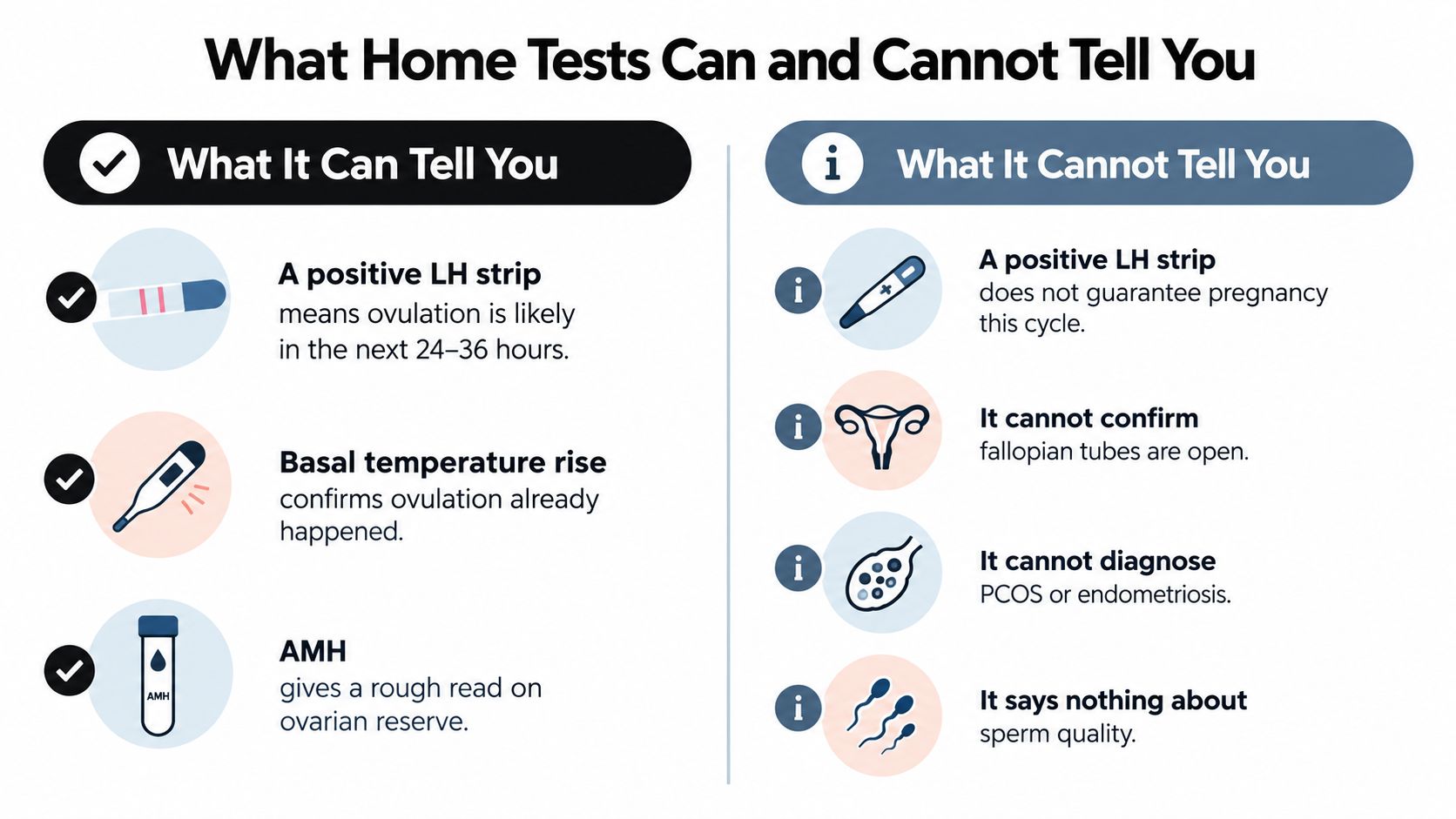
A positive ovulation strip can feel like a turning point. It may indicate that an LH surge has been detected and that ovulation is likely to follow, but it doesn't mean pregnancy is guaranteed in that cycle.
It doesn't assess the egg's quality, sperm health, the condition of the uterus or whether the fallopian tubes are open. It also doesn't confirm implantation. The TGA specifically describes LH testing as a prediction tool and notes that a positive result shouldn't be treated as confirmation of ovulation.
What an at-home result may help with
- Cycle timing: An LH result can point to a likely approaching fertile window.
- Pattern awareness: BBT can show a sustained shift that supports the possibility that ovulation has already occurred.
- A clinical conversation: AMH or repeated cycle results can give you specific questions to take to a GP.
- Shared planning: A clear record can help partners discuss timing without depending entirely on an app's estimate.
What remains outside the kit
A home test can't diagnose blocked tubes, endometriosis, fibroids, sperm factors or every cause of irregular ovulation. It also can't assess the adequacy of progesterone during the luteal phase, the stage after ovulation, without appropriate clinical testing.
The distinction between detecting a signal and explaining a health problem is easy to lose when an app turns a result into a coloured label. For a broader, plain-language overview of in-home lab tests explained, pay attention to how sample collection and professional interpretation affect the meaning of a result.
Australian guidance cautions that LH testing, temperature tracking and cervical-mucus observations may not always be reliable. In regular cycles, ovulation occurs in at least 90% of cycles, yet home monitoring can still be unnecessary or confusing for some people, particularly when results increase anxiety rather than improve understanding. If repeated results don't match your cycle experience, don't respond by buying more tests automatically. Bring the record to a GP and ask which clinical test answers the unanswered question.
When a Home Test Is Not Enough
Another packet of strips may feel easier than booking an appointment, especially when you haven't yet decided whether your concern is “serious enough”. But the point of home testing is to support a decision, not to postpone care indefinitely.
Arrange a GP conversation when:
- Your cycles are irregular or absent. A fixed testing day or an app prediction may miss ovulation when cycle length changes substantially.
- You repeatedly get no clear result. Several cycles without a convincing LH surge or temperature rise deserve clinical interpretation.
- You have a known reproductive condition. PCOS, endometriosis, previous pelvic surgery or other conditions can change how useful home signals are.
- You experience recurrent pregnancy loss. A home timing tool can't investigate the wider causes.
- Your partner has relevant health history. A person tracking ovulation can't use an LH strip to assess sperm count, movement or other male-factor concerns.
- Trying to conceive has become prolonged or distressing. Persistent difficulty is a reason to seek assessment rather than just intensify tracking.
For irregular cycles, Australian clinical guidance identifies serum hormone tracking, sometimes combined with transvaginal ultrasound, as more reliable for detecting ovulation than relying only on home observations. Mid-luteal progesterone testing may also help confirm ovulation, but timing should follow the individual cycle rather than automatically using a standard “day 21” test. A test scheduled at the wrong point in a cycle longer than 35 days can be inaccurate, as described in Australian guidance on investigating infertility.
A useful referral trigger is not a particular brand of test. It's a pattern that remains unexplained after sensible home tracking.
A GP can review both partners, the cycle history and any medicines or conditions. That matters because fertility usually involves more than one signal, and an ovulation test cannot answer questions about sperm, tubes, the uterus or the broader hormonal picture.
Buying, Apps, and Privacy Considerations
A good purchase begins with the information on the box. Look for clear instructions, an expiry date, batch details, manufacturer information and a precise description of what the product measures. If a brand mentions regulatory clearance or compliance, check that the statement applies to the specific device and its intended use. A sales page may contain several claims with different levels of relevance.
Connected tools can reduce routine recording. A Bluetooth basal thermometer may transfer each waking temperature automatically, and an app may combine LH results, symptoms and cervical mucus in one chart. This works like a shared notebook that performs some of the copying for you. The prediction still requires interpretation, so it should not replace attention to an unexpected pattern or clinical advice.
Before buying, decide whether the tool answers a timing question or appears to promise diagnosis. A linked product page, such as the Venus AI Smart Scale, should not be treated as evidence that a device measures ovulation or diagnoses fertility. Check the product's stated purpose and measurements rather than assuming that more health data will produce a more accurate fertility interpretation.
Privacy deserves the same attention as price and ease of use. Cycle dates, hormone results and intercourse timing can reveal pregnancy intentions, sexual activity and health information. Before connecting a test to an app, check:
- Data storage: Find out whether records stay on the phone or move to cloud servers.
- Data sharing: Read for references to partners, analytics providers, advertisers or other third parties.
- Deletion controls: Confirm that you can delete records and close the account.
- Account access: Check shared access and the handling of exported data.
- Practical value: Decide whether automated charting justifies the additional data footprint.
A guide to data security and privacy can make these checks part of buying the test.
A paper chart, an ordinary thermometer and carefully recorded observations may be enough. Choose the least complicated system that answers your immediate timing question, and keep the raw readings if you later visit a GP.
Venus Health Co. offers app-connected tools for home health tracking, including LH testing and basal body temperature recording. Visit Venus Health Co. to review available options, then use home results as timing aids and seek clinical guidance when the pattern remains unclear.