

Family Planning Australia Options and Local Support
Dr. Adeyinka AdegbosinYou might be on the pill now, thinking about a baby next year, and unsure when to stop one plan and start another. Or you're tracking your cycle each morning while juggling shift work, a long drive to your GP, and conflicting signals. Family planning in Australia rarely fits one stage of life.
Starting Your Family Planning Journey
Sam wants to avoid pregnancy now but hopes to conceive later. Alex, with the same broad goal, has irregular cycles, works nights, and lives far from specialist care. Their next steps won't look alike, even though their intention sounds identical on paper.
That difference is the starting point for family planning in Australia. It's not a one-time choice between contraception and conception. It's an evolving process that can move from prevention, to a pause while you decide, to preconception care, to trying to conceive, and sometimes back again after a baby or a change in health.

Start With Your Current Intention
Ask what you need in the next few months, not forever. Are you preventing pregnancy, preparing to conceive, actively trying, or unsure? Each answer changes which options deserve discussion, what records are useful, and how urgent an appointment is.
A useful plan begins with the outcome, timeframe and personal circumstances you actually have, not the circumstances a generic guide assumes.
Know Where Tracking Stops
Consumer cycle tracking can organise your observations. It can store period dates, temperature readings, test results and symptoms in one place. It can't prescribe contraception, assess your fertility, investigate pain or persistent irregularity, or tell you why conception hasn't happened.
Professional care fills that gap. A GP or reproductive health clinician can take your history, check whether a method suits you medically, arrange tests where appropriate, and refer you onward. If you keep that boundary clear from the start, tracking becomes helpful background for a consultation rather than a substitute for one.
Two practical questions help you frame your next step:
- What's my timeframe: Do I need protection today, or am I planning for a change months ahead?
- What's my access reality: Can I attend in person easily, or do I need to plan around travel, cost, work and appointment availability?
Understanding Australian Reproductive Trends
Population figures explain the setting you're planning in. They don't predict what will happen for you.
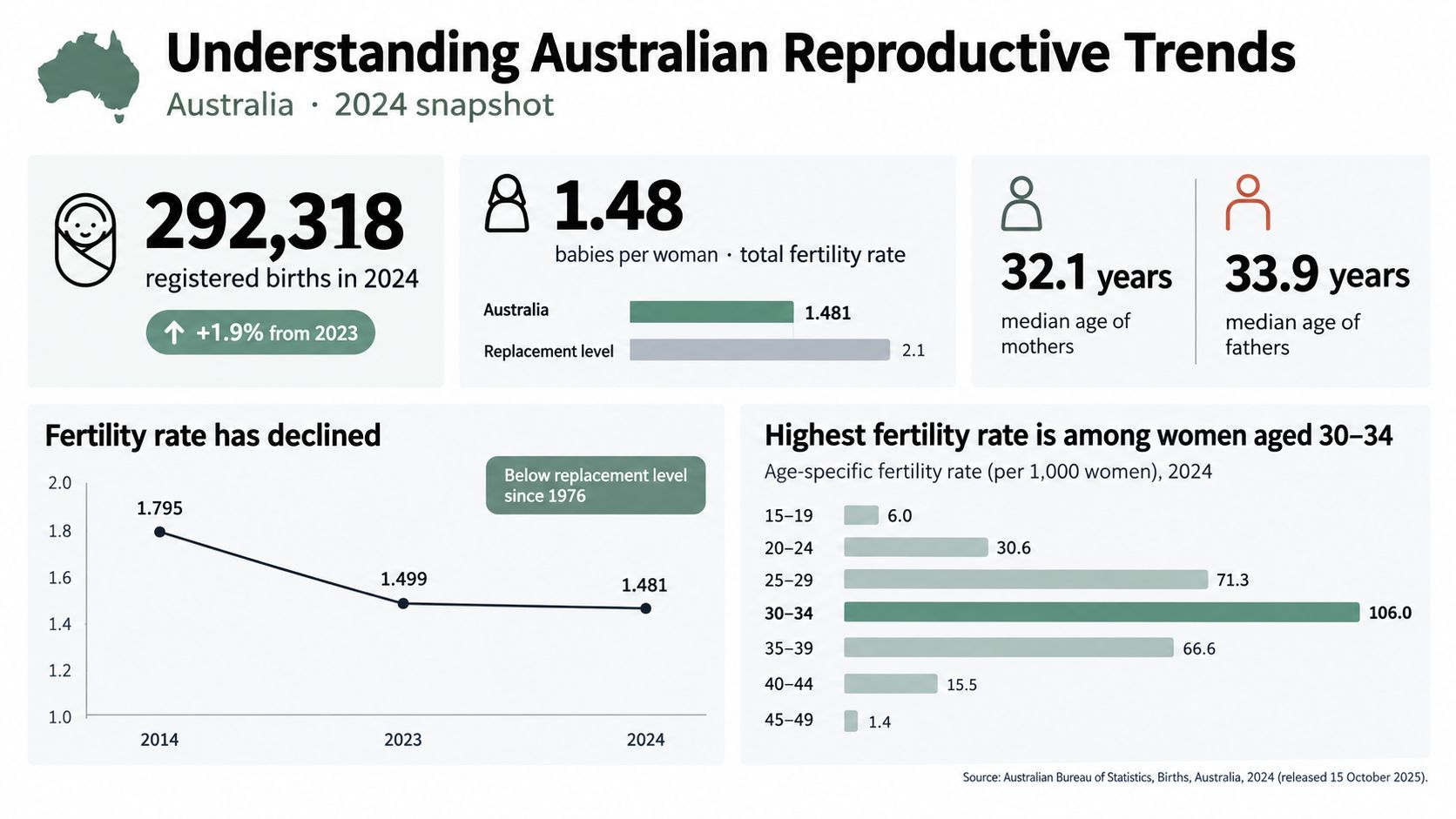
The Australian Bureau of Statistics recorded 286,998 registered births in 2023, down 4.6% from 300,684 in 2022, while the total fertility rate fell from 1.63 to 1.50 babies per woman ABS data on the continuing decline in the birth rate. Women aged 30 to 34 had the highest fertility rate in 2023, and Australia's fertility rate has remained below the estimated replacement level of about 2.1 babies per woman since 1976, according to that same release.
What Later Childbearing Changes in Practice
When childbearing is concentrated at older ages, more people need contraception that works reliably for years, then a clear plan for stopping it. Others need preconception care, fertility assessment, or a conversation about timing that accounts for health, work and finances. These aren't separate topics. They're often consecutive chapters for the same person.
Later planning also means reproductive decisions can sit alongside other life stages. If you're reading about longer-term hormonal health as well, these perimenopause eating plan suggestions cover nutrition considerations for a different phase, which helps illustrate why advice should always match your current stage rather than a generic age bracket.
Why Averages Can Mislead You
A total fertility rate describes a population pattern. It isn't a personal deadline, a judgement about your choices, or a forecast of your ability to conceive. Turning it into alarm doesn't help you decide anything useful.
Use the trend differently:
- Talk earlier: If you know you want children later, ask your GP what, if anything, is worth checking now.
- Review contraception properly: A method chosen years ago may not match your current health or intentions.
- Plan the transition: Stopping contraception, starting preconception care and trying to conceive are distinct steps, and each may need its own appointment.
Practical rule: Let national trends prompt a timely conversation, then let your own history guide the decision.
That distinction matters because family planning in Australia now commonly spans a wider age range than many people expect, with prevention, preparation and assessment overlapping across adulthood.
Comparing Contraception and Awareness Options
People often compare methods as if there's one winner. There isn't. You're weighing effectiveness, effort, reversibility, side effects, future pregnancy plans and how a method fits your body and routine.
Australian longitudinal evidence shows how those choices shift with age. Among women born in 1989 to 1995, oral contraceptive use declined from 60% to 34% and condom use from 45% to 31% across five surveys as participants moved from ages 18 to 30 into their mid to late twenties, while long-acting reversible contraception use increased Australian Longitudinal Study on Women's Health reproductive health findings. That shift likely reflects changing intentions as people move closer to planning pregnancies.
Family-Planning Options at a Glance
| Option | Primary purpose | Reversibility | Routine effort | Key question for a clinician |
|---|---|---|---|---|
| Long-acting reversible contraception, including intrauterine devices and implants | Pregnancy prevention | Reversible after removal | Low day to day, procedure based | How might bleeding patterns change, and what happens when I want it removed? |
| Hormonal contraception, including oral contraceptives | Pregnancy prevention | Reversible after stopping | Daily or regular user action | Does my medical history affect suitability, and what side effects should I watch for? |
| Barrier methods, including condoms | Pregnancy prevention and protection during sex | Immediately reversible | Needed each time | How do I use this correctly and consistently? |
| Fertility awareness using cycle signals | Identifying fertile and less fertile days | No device to reverse | Daily observation and interpretation | How do I learn this properly, and what are its limits for my cycles? |
| Sterilisation | Permanent pregnancy prevention | Intended to be permanent | Procedure based | Am I certain I don't want future pregnancies, and what are the alternatives? |
| Emergency contraception | Reducing pregnancy risk after unprotected sex or contraceptive failure | Not a regular method | One-off, time sensitive | How quickly do I need advice, and what regular method should follow? |
Where People Get Confused
Natural doesn't mean simple. Fertility awareness depends on correct measurement, careful interpretation and your circumstances. Irregular cycles, illness, postpartum changes, disrupted sleep and some medications can make signals harder to read.
Cycle data also isn't automatically contraception. If you're considering temperature tracking for prevention, read about the basal body temperature method of contraception and its requirements before relying on it, and discuss training and backup methods with a clinician. An app prediction alone shouldn't be treated as equivalent protection.
Bring structured questions to your appointment:
- Future timing: When might I want to conceive, and how quickly can fertility return after stopping?
- Bleeding changes: How could this method affect periods, and would that suit me?
- Ease of use: Can I realistically maintain the routine this option requires?
- Health fit: Do my medications or conditions change what's suitable?
Document method changes in your records. Hormonal contraception and IUD use can affect how bleeding patterns and ovulation indicators are interpreted, so your clinician needs that context.
Using Cycle and Fertility Tracking Tools
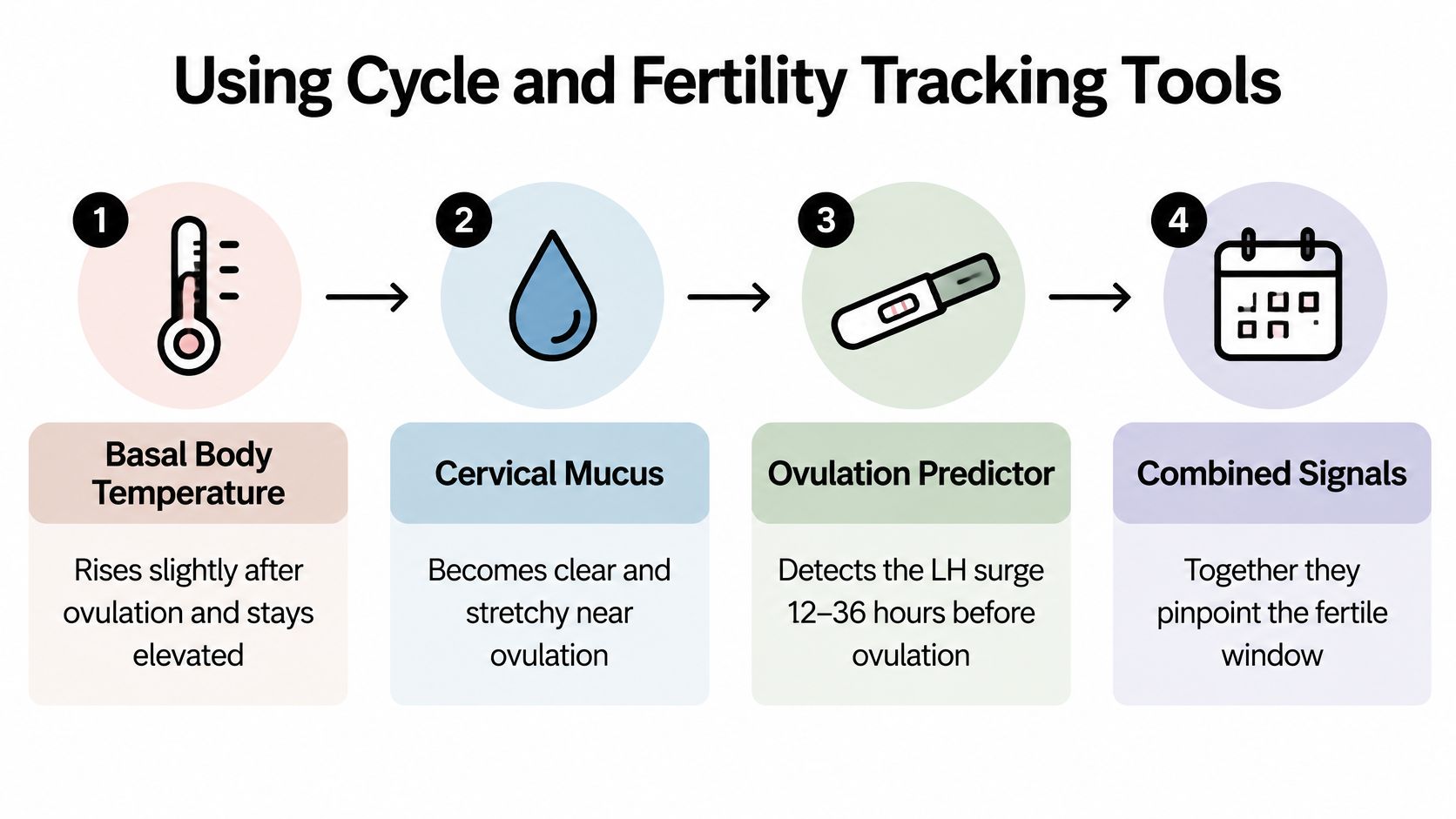
No single signal tells the whole story. Tracking works best when you combine signals and understand what each one can and can't show.
That knowledge gap is real in Australia. A general practice survey found that only 2.1% of respondents correctly identified the fertile period, although 37.1% were actively trying to improve their fertility awareness knowledge and 4.3% were using fertility awareness alone or alongside condoms or withdrawal Australian survey of fertility awareness knowledge and practice.
How the Signals Fit Together
Take someone preparing to conceive over one cycle:
- Menstrual history gives context. Past cycle lengths suggest when testing might be useful, but they don't confirm ovulation this month.
- Cervical mucus changes across the cycle and can signal approaching fertility. It's a prospective clue, not proof.
- LH tests detect a hormone surge associated with upcoming ovulation. A positive result helps with timing, but it doesn't guarantee an egg was released.
- Basal body temperature typically shifts after ovulation. That makes it useful for looking back at a pattern, not for predicting your fertile days in advance.
This is the distinction readers most often miss. Predicting ovulation and confirming it afterwards are different jobs, and different tools do each one.
When Signals Conflict
Your temperature may look unsettled after a poor night's sleep, illness or shift work. Mucus observations may be harder to interpret postpartum, and medications can affect readings or test results. When signals disagree, record what happened rather than forcing an interpretation.
For general background on building a consistent routine, you can find UK cycle tracking tips that cover everyday logging habits, then adapt the routine to Australian services and your clinician's advice. If you're comparing apps, this overview of choosing a fertility app in Australia is a useful starting point for what features to check.
Some people use a connected thermometer to reduce manual entry. The Venus Smart Basal Thermometer for Ovulation - Bluetooth BBT Tracker with App automatically syncs basal temperature readings by Bluetooth and allows LH results and other cycle inputs to be logged in its app. That's an organisational aid, not a diagnostic tool, contraceptive substitute or replacement for clinical assessment.
If cycles stay very irregular, ovulation patterns persistently don't appear, or conception isn't happening, take your records to your GP instead of tracking indefinitely on your own.
Navigating Fertility Services and Programs
Before you book anything, name the question you're asking. That single step prevents a lot of wasted appointments.
Are you seeking contraceptive counselling, preconception support, or assessment after trying to conceive without success? Each leads to a different conversation, different information to bring, and sometimes a different service.
Start With Your GP
Your GP is the central starting point for most family planning in Australia decisions. They can discuss contraceptive methods, review your health before conception, consider your cycle history, and refer you to fertility or specialist services after assessment where appropriate.
That front door matters because unplanned pregnancy remains common and some effective options are underused. Australian primary care evidence reports that approximately one-third of women experience an unplanned pregnancy during their lifetime, with higher rates among rural and socioeconomically disadvantaged populations, and only 6.9% of contraception consultations involve long-acting reversible contraception RACGP review of reproductive health in Australian primary care.
A good GP conversation should support informed method comparison and referral. Tracking alone shouldn't be presented as providing equivalent pregnancy prevention to contraception.
Verify Practical Details Yourself
Program names, funding arrangements, eligibility rules and costs can change and vary by location and provider. Don't rely on a blog post, including this one, for current figures. Before booking, confirm:
- Referral requirements: Do I need a GP referral, and what should it include?
- Costs: What's covered publicly, what might I pay privately, and are there additional fees for procedures, tests or follow up?
- Waiting times: How long until an appointment, and does timing affect my options?
- Location: Can any appointments happen by telehealth, or must I travel?
Prepare a Concise Brief for Your Appointment
Bring your cycle history, current and past contraception, relevant medications, prior test results, and a clear statement of whether you're trying to conceive or actively preventing pregnancy. Add notes on persistent irregularity, pain, postpartum changes or anything that has changed recently.
Ask directly when you should return if things don't progress. Clear escalation prompts matter most when cycles are persistently irregular, conception hasn't occurred within the timeframe your clinician advises for your situation, or travel makes follow up difficult.
Finding Local and Culturally Safe Care
It's tempting to assume everyone can book the same appointment, in the same timeframe, at a similar cost. In Australia, that assumption breaks down quickly.
ABS data for 2023 showed a total fertility rate of 1.57 babies per woman in Western Australia and 1.55 in both New South Wales and the Northern Territory, while the Australian Capital Territory recorded 1.31, and the rate for Aboriginal and Torres Strait Islander women was 2.17 compared with 1.50 for all Australian women ABS methodology for births data in Australia. A national average can't represent every community, and services need to account for geography, community circumstances, access and culturally appropriate care.
Plan Around Postcode, Not Just Preference
For rural, regional and remote patients, the constraints are often travel, provider shortages, delayed appointments and out-of-pocket costs. Better information alone doesn't solve that. Timing, transport, provider availability and state based funding policies can determine which options are available to you.
Ask these questions before you commit to a plan:
- Telehealth or in person: Which parts can be done remotely, and which need examination, testing or a procedure?
- Records and referrals: What should I send ahead so one trip achieves as much as possible?
- Total logistics: How will time off work, transport, accommodation and follow up affect timing?
- Backup plan: If my preferred provider isn't available locally, what's the next pathway?
Preparing your questions in advance helps you use a scarce appointment well. This efficient clinic consultation advice is worth reviewing before a GP visit, especially if you've travelled a long way and can't easily return next week.
Ask for Care That Fits You
Culturally safe care means you can communicate clearly, feel respected, and raise concerns without being dismissed. You can ask about an interpreter, request support that suits your needs, and expect explanations in plain language. You're also entitled to ask why a test or method is being recommended and what alternatives exist.
If you're pregnant or planning support around birth, these perinatal support services may help you think through the next stage. For contraception or preconception care, your GP or local reproductive health service remains the place to confirm what's available near you.
Before you travel: Confirm the appointment type, cost, referral and records needed with the service directly.
Planning Around Real Life Scenarios
Two people can share a goal and still need different questions. These scenarios show how intention, health and access change the conversation. They're illustrations, not medical advice.

Scenario One, Not Planning Pregnancy Yet
Mia doesn't want pregnancy now but may in a few years. She compares a long-acting option with a user-controlled method she can stop herself. With her GP, she discusses effectiveness, likely bleeding changes, removal or stopping arrangements, and how her future conception plans affect the choice.
Her decision isn't about finding the best method in general. It's about matching effort, reversibility and side effects to her health and timeline.
Scenario Two, Trying to Conceive
Jordan is tracking basal temperature, LH results and menstrual history to understand cycle timing. The records help identify a likely window, but they don't guarantee conception in any given cycle. Jordan and their GP agree in advance when to review progress if pregnancy doesn't occur, rather than endlessly adding more tests at home.
The short video below offers another way to think through planning conversations before you see a clinician.
The Same Decision, a Different Postcode
Now place either scenario in a regional town. A 2024 Victorian access report found that people in highly disadvantaged regional areas were 300% more likely to seek abortion after nine weeks than people in low disadvantage metropolitan areas, while more than one-quarter of high disadvantage regional and rural local government areas had no listed IUD or hormonal implant providers Australian submission on universal access to reproductive healthcare.
In that setting, appointment timing, travel and provider availability become part of the clinical plan itself. Preferences, health history, relationship context, culture and access can all change the right questions.
Building Your Personal Action Plan
Start by writing one sentence about your immediate aim. You're preventing pregnancy, preparing to conceive, seeking fertility assessment, or unsure. That sentence tells you which appointment to book and which records to prepare.
Your Four-Part Checklist
- Goal and timeframe: What do I want now, and when might that change?
- Method and cycle questions: What am I using or tracking, what's unclear, and where do signals conflict?
- Medical context: Which medications, conditions, past pregnancies, tests or symptoms should my clinician know about?
- Access details: Where can I be seen, what will it cost, do I need a referral, and how will travel or waiting times affect timing?
Take that list to your GP or reproductive health service. Confirm local program eligibility, costs and waiting times directly with the service, because those details change and vary across Australia.
Use Home Tools With Clear Limits
Consistent records can make your consultation more productive. They can show patterns across cycles and help you explain what's been happening. They don't diagnose why a cycle is irregular, confirm fertility, or replace contraception when you're trying to prevent pregnancy.
Good information improves your questions and helps you find the right pathway sooner. Personalised clinical assessment is the appropriate next step when choices interact with your health, cycles stay persistently difficult to interpret, pain or other symptoms concern you, or conception isn't progressing as expected.
Your plan doesn't need to solve every future stage today. It needs a clear current intention, a realistic route to care in your area, and a review point if circumstances change. That's family planning in Australia organised around your life, not around rigid categories.
If you're building consistent cycle records to share with your clinician, Venus Health Co. offers app-connected home tools including a Bluetooth basal thermometer and LH testing options that log temperature and cycle signals in one place. Visit Venus Health Co. to explore the tools and decide whether they fit alongside the professional care plan you've outlined.