

Basal Body Temperature Method of Contraception: A Guide
Dr. Adeyinka AdegbosinYou're standing in the bathroom before sunrise, a basal thermometer within reach, wondering whether a non-hormonal contraceptive method can fit into ordinary life. You want to avoid relying on period dates alone, but you also don't want to mistake an attractive chart for reliable protection.
The basal body temperature method of contraception can help you understand your cycle, but it isn't a passive form of birth control. It's a learning-intensive habit built around daily measurements, careful chart interpretation and a clear plan for days when pregnancy is possible. BBT is a retrospective signal. It usually confirms that ovulation has already happened rather than warning you several days beforehand.
What the Basal Body Temperature Method of Contraception Actually Is
Mia decides to try the basal body temperature method of contraception because she wants a non-hormonal option. Each morning, she measures her temperature before getting up, records it, and uses the developing chart to guide decisions about pregnancy prevention. The routine sounds simple. The interpretation and shared decisions are more demanding.
Basal body temperature, or BBT, is your resting temperature measured under consistent conditions, usually immediately after waking. After ovulation, progesterone produces a small rise in resting temperature. Recording readings across a cycle can help you identify when ovulation probably occurred and when the fertile phase may be ending. Australian guidance defines BBT as the lowest temperature measured on waking, before getting out of bed or beginning other activities, with a typical post-ovulation rise of about 0.2 to 0.5°C (Australian guidance on fertility-awareness contraception).
A workable routine requires more than taking a reading. Mia needs to measure consistently, recognise temperatures affected by illness or disrupted sleep, follow the rules of her chosen method, and agree with her partner on condoms or abstinence when pregnancy is possible. The method suits people who can maintain that learning-intensive habit, rather than people looking for contraception that works without daily attention.
As noted above, the post-ovulation rise is why BBT cannot predict the fertile window in advance. Calendar or rhythm methods estimate fertility from previous cycle dates, while BBT records a physical change in the body. BBT alone also cannot show every fertility cue early in the cycle, so an uncertain chart needs a backup plan rather than optimistic interpretation.
BBT is one part of fertility awareness
Some people combine temperature with cervical mucus observations, cervical-position changes, or luteinising hormone testing. Cervical mucus may change before the temperature rise, giving a combined approach earlier information than temperature alone. For a plain-language introduction to the wider approach, read this guide to fertility-awareness methods.
The wider category matters in Australia because surveys generally report fertility-awareness methods as a group, not BBT alone. One nationally representative survey reported that 4.4% of Australian women used fertility-awareness methods for contraception, while later reporting described broader “natural” approaches that included methods beyond BBT. That figure should not be treated as a measure of BBT's individual use or effectiveness.
How BBT Reflects Ovulation and Why That Matters
A chart may show a clear change only after the fertile event has passed. Before ovulation, basal temperatures generally remain within a person's lower usual range. After ovulation, the corpus luteum produces progesterone. This hormone acts on the hypothalamus, the brain region involved in temperature regulation, and nudges resting temperature upward.
Progesterone's thermogenic effect on the hypothalamus explains why the shift is small and sustained, which is why interpretation relies on pattern, not a single value. Over several readings, the chart may form a biphasic pattern: a lower-temperature phase followed by a group of higher readings.
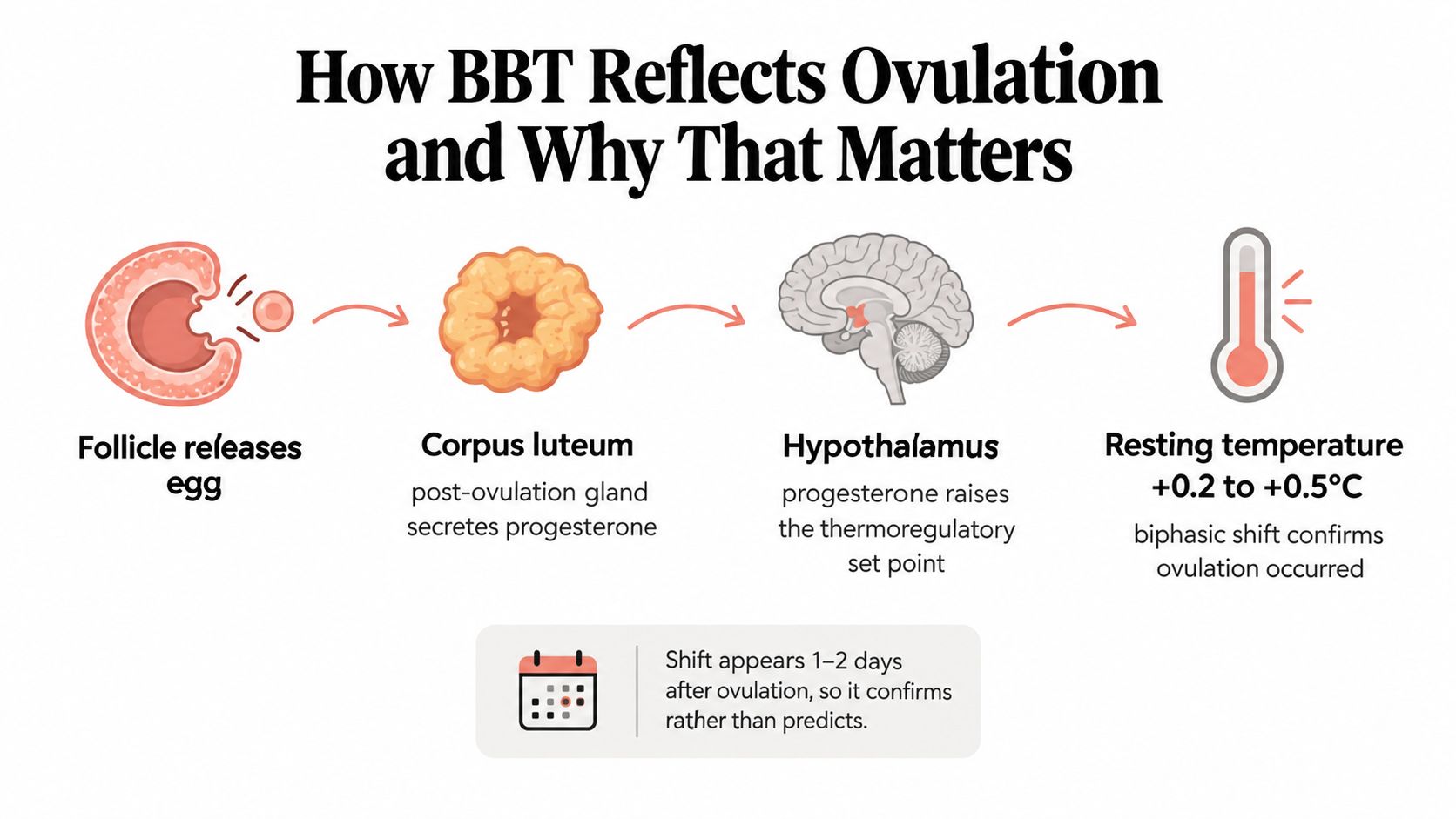
The temperature rise comes after the event
The timing is the point many new users misunderstand. BBT is a retrospective sign. It can support the conclusion that ovulation probably occurred, but it does not reliably announce that ovulation is about to happen. A chart needs enough consistent readings for a sustained pattern to become meaningful, and illness, poor sleep, alcohol, travel, or other disruptions can make that pattern unclear.
For contraception, the days before a confirmed shift still carry uncertainty. Apply the rules of the fertility-awareness system you are using, and treat an unclear chart as potentially fertile. If avoiding pregnancy matters, use condoms or avoid penis-in-vagina sex until those rules indicate that the fertile interval has ended.
Why a thermometer isn't the whole method
A thermometer supplies one observation each day. The method requires a record that can be interpreted over time, which makes BBT a learning-intensive habit rather than a set-and-forget contraceptive device. A temperature spike after illness or broken sleep may reflect those conditions instead of ovulation, while one low reading cannot establish that fertility has started or finished.
The Venus Smart Basal Thermometer for Ovulation, Bluetooth BBT Tracker with App is one device designed to record BBT and sync readings with an app. Automatic recording can reduce missed manual entries, but it cannot replace suitable measuring conditions or cautious interpretation. For a plain explanation of what the measurement represents, see this guide to basal body temperature.
Real Effectiveness and the Gap Between Perfect and Typical Use
A person can own a reliable thermometer, follow the morning routine, and still use BBT unsafely if they misread the chart. The method's real-world performance depends on more than taking a temperature. It requires learning the rules, recognising unreliable readings, and following a clear plan whenever fertility is uncertain.
Australian guidance places fertility-awareness contraception across a broad effectiveness range when used correctly. The lower end may reflect missed observations, incorrect interpretation, or unprotected sex during days that should have been treated as potentially fertile. A well-trained user may chart consistently, identify disrupted temperatures, apply the chosen rules, and use condoms or avoid penis-in-vagina sex during the fertile interval. Typical use is less orderly because illness, changing schedules, confusing charts, or a decision to take a chance can alter the result.
Table source: Family Planning NSW guidance on fertility-awareness methods
| Method or approach | Perfect-use failure rate | Typical-use failure rate |
|---|---|---|
| Fertility-awareness methods as a group | Approximately 1 to 25 pregnancies per 100 users in a year, depending on method and use | Around 25 pregnancies per 100 users in the first year in broader Australian clinical information |
| BBT alone | No reliable Australian BBT-only figure is established | No reliable Australian BBT-only figure is established |
| Combined fertility-awareness methods | Varies by method, instruction and adherence | Varies by method, instruction and adherence |
| Condoms and hormonal options | Not quantified in the supplied Australian sources | Not quantified in the supplied Australian sources |
Why BBT-specific figures are limited
Research and clinical information often group BBT with cervical mucus observation, calendar tracking, or combined symptothermal methods. A result for the whole category therefore cannot be presented as the failure rate of BBT alone. Estimates can also differ according to training, participant selection, follow-up, and adherence.
BBT has a further limitation: it generally confirms that ovulation has occurred after the temperature shift, rather than predicting the start of fertility. A combined method may use earlier signs to identify changing fertility. BBT can still contribute useful information, but the user needs a conservative rule for the uncertain days in each cycle.
Practical rule: Treat the broad effectiveness range as a reminder that instruction, interpretation, consistent use, and partner cooperation matter as much as the thermometer.
An ovulation test provides a different signal. The Venus Ovulation Predictor Test Kit detects the LH surge and can be recorded alongside temperature. An LH result still requires careful interpretation, and it does not turn BBT into a guaranteed contraceptive system. Anyone choosing BBT should decide in advance what backup method will be used when readings are missing, disturbed, or difficult to interpret.
How to Track BBT Correctly Every Day
A reliable chart begins with the routine around the measurement. Place the thermometer beside your bed, choose one measurement site, and take your temperature when you wake from your main sleep period. Measure before getting out of bed, drinking, eating, exercising, checking messages, or starting another morning activity.
Use the same thermometer, body site, and approximate timing each day. Because the temperature shift is small, consistent technique matters more than chasing extra decimal places. Oral, vaginal, and rectal methods appear in different protocols, but their readings are not directly interchangeable. Choose one method and keep using it.
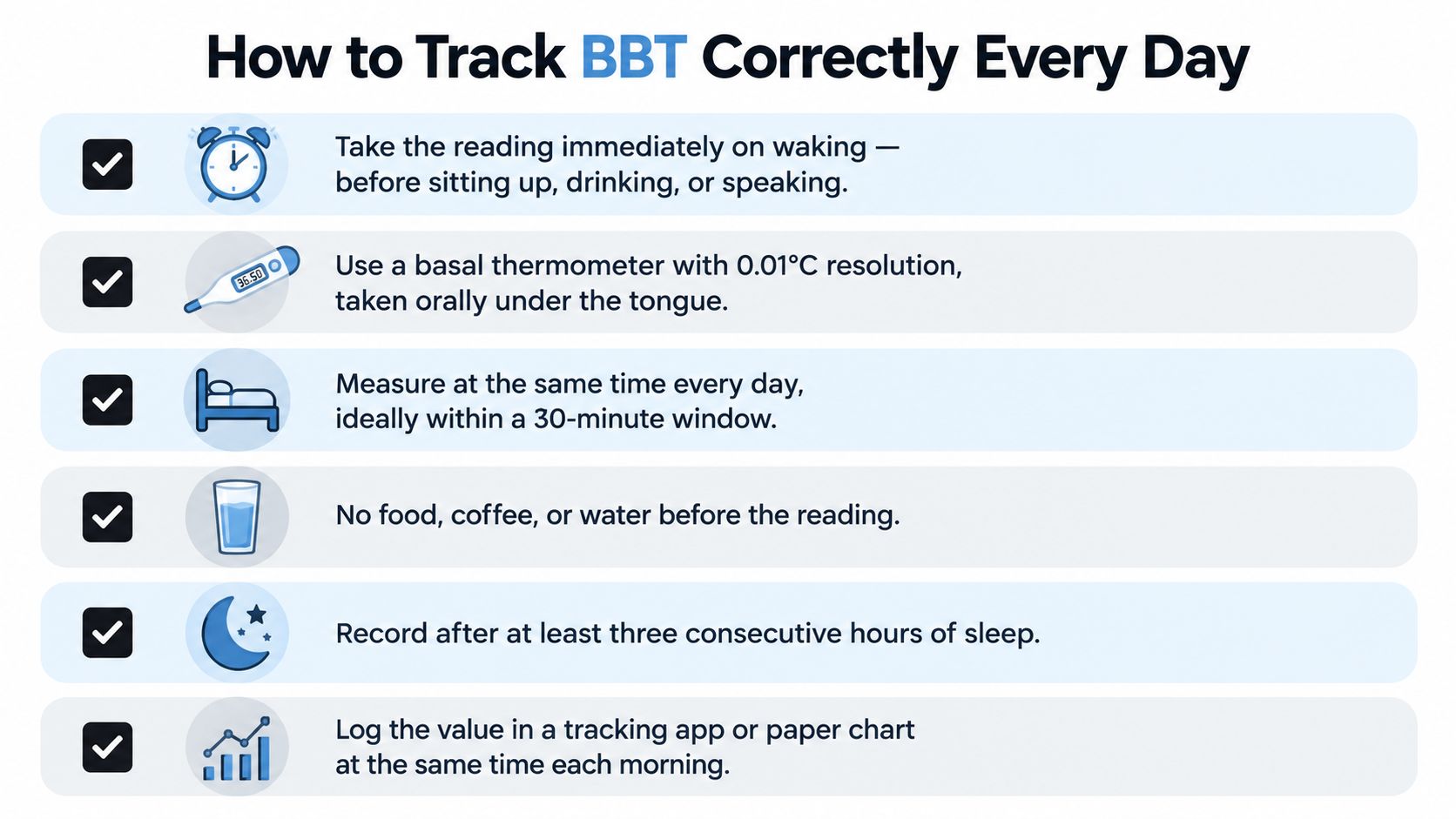
A calm morning protocol
- Wake and measure immediately. Do not sit up to check messages first. Movement and wakefulness can make the result less comparable with earlier readings.
- Keep the conditions familiar. Measure at about the same time and from the same site whenever possible. If your schedule changes, record the actual time and mark the reading as unusual rather than treating it as routine data.
- Record the result straight away. Use paper or an app. Add notes about illness, alcohol, broken sleep, travel, a late night, or a noticeably different wake time.
- Keep imperfect readings. An unusual result may still help explain the wider pattern. Mark it as disturbed instead of deleting it automatically.
A BBT thermometer guide demonstrates the measurement routine. Practise the steps until they become automatic, because BBT is a learning-intensive habit, not a reading that interprets itself.
Interpreting the chart
Some fertility-awareness systems draw a cover line above earlier readings and wait for a sustained higher pattern. The rules differ by method and instructor, so do not combine instructions from separate systems. BBT usually confirms that ovulation has already occurred. It is therefore a retrospective signal, not a dependable warning that fertility is about to begin.
An app can organise temperatures, but it cannot know that a fever or poor sleep affected a result unless you record that context. During the first few cycles, a trained instructor can review the chart and help identify which readings are usable. Decide in advance what backup method you will use when data are missing, disturbed, or difficult to interpret.
Who BBT Contraception Suits and Who It Doesn't
BBT tends to suit people who enjoy structured tracking and can make a daily measurement part of their routine. It also requires a partner who understands that a fertile or uncertain day may mean using a barrier or avoiding sex that could cause pregnancy.
A good fit isn't defined by motivation alone. Sleep, health, cycle variation and household circumstances all affect whether the chart will be interpretable.
| Factor | Good fit for BBT contraception | Poor fit for BBT contraception |
|---|---|---|
| Daily routine | A stable wake-and-sleep pattern | Rotating shifts or frequently changing sleep |
| Cycle pattern | A recognisable, reasonably consistent pattern | Irregular cycles or frequent unexplained changes |
| Partner support | Both partners follow the agreed rules | A partner resists condoms or fertile-day abstinence |
| Learning style | Willingness to study rules and review charts | Expectation that an app will make every decision |
| Life stage | Enough routine to measure consistently | Newborn care, postpartum disruption or perimenopausal change |
| Health context | No known factor likely to distort readings | Illness, medication or a condition affecting temperature or cycles |
Healthdirect notes that fertility-awareness approaches are generally unsuitable when cycles are irregular and depend on both partners following instructions carefully (Healthdirect information on fertility awareness). That doesn't mean someone with an irregular cycle can't learn about their body. It means BBT may be a poor choice as the sole contraceptive strategy without clinical advice and a dependable backup.
Circumstances that deserve extra caution
Newborn care is a difficult setting because night waking can make readings inconsistent. Rotating shifts and time-zone travel create similar problems. PCOS, thyroid conditions, postpartum changes, perimenopause and recent hormonal contraception can also make patterns harder to interpret. If PCOS is part of your decision, a separate resource such as Trim's PCOS birth control guide may help you compare broader contraceptive considerations, but it isn't a substitute for personalised medical advice.
You might also track general wellness data with a device such as the Venus AI Smart Scale, which provides body-composition measurements and app-based health reports. That information isn't a fertility sign and shouldn't be used to fill gaps in a BBT chart.
A realistic test: If you can't commit to consistent readings and a pre-agreed backup plan, choose a contraceptive method that doesn't depend on those conditions.
Common Pitfalls and Misconceptions That Lead to Unintended Pregnancy
The most dangerous misunderstanding is believing that a temperature rise predicts ovulation. It generally appears after ovulation, so unprotected sex on the day you suspect ovulation can still occur during a potentially fertile period. A later high temperature can't retroactively make that earlier decision safe.
Another common mistake is treating one high reading as confirmation. A late night, alcohol, fever, poor sleep or an unusual measurement time can raise the temperature independently of ovulation. The chart needs a sustained shift, and the user needs to consider the circumstances surrounding each reading.
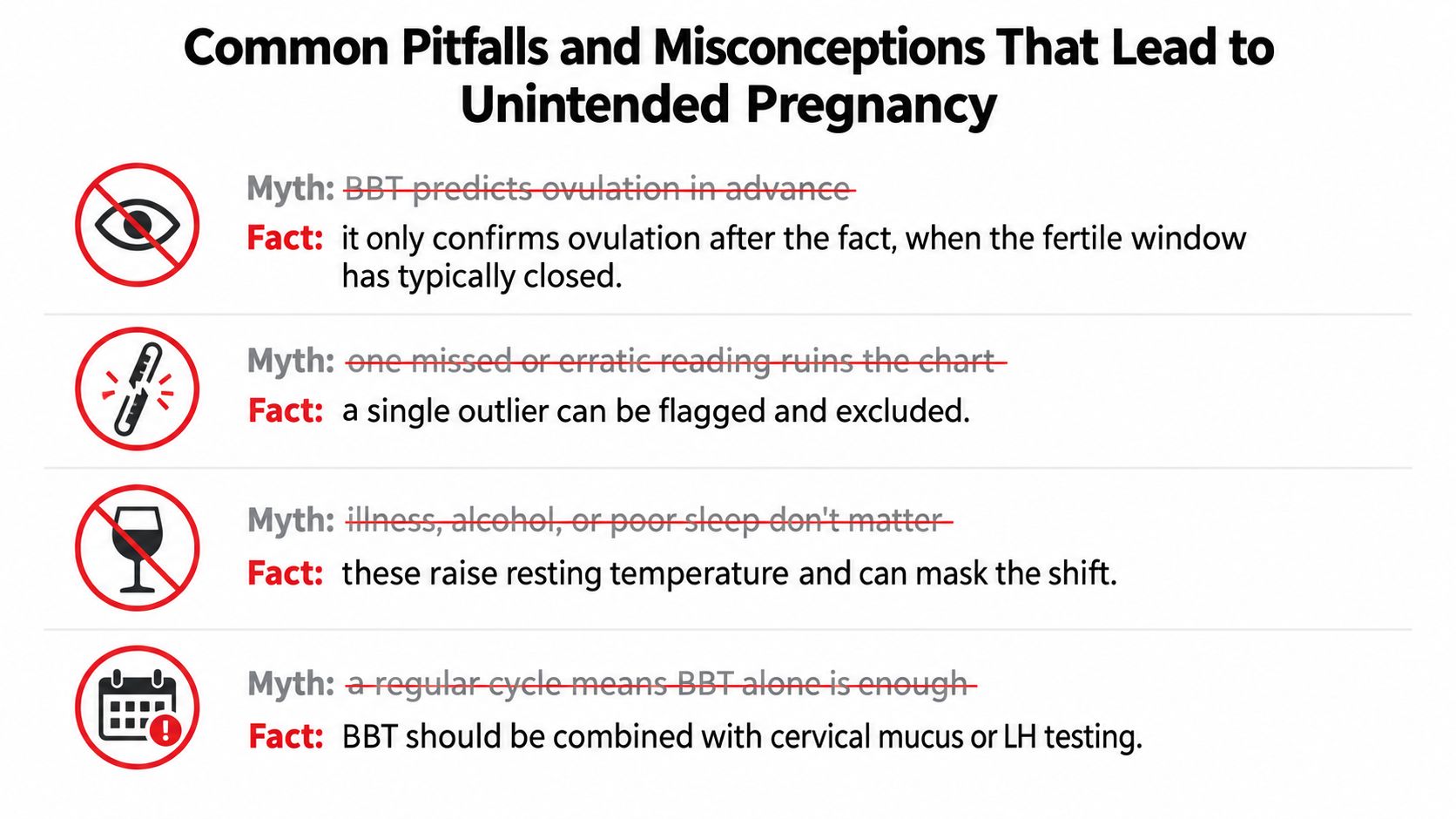
Four assumptions to retire
- “A dip proves implantation.” A single temperature drop isn't a reliable pregnancy or implantation test. Don't change contraceptive decisions based on a dramatic-looking dip.
- “One rise proves ovulation.” One outlier may be caused by illness, alcohol or sleep disruption. Look for the sustained pattern required by your chosen method.
- “Regular periods make BBT foolproof.” A regular cycle doesn't remove the need for early fertility signs, careful measurement or a plan for uncertain days.
- “The app knows what happened.” Apps can chart data and apply algorithms, but they can't correct a measurement taken after getting out of bed or distinguish every illness-related change from a hormonal shift.
Switching thermometers or measurement sites halfway through a cycle can create an artificial change. Weekend lie-ins can also make readings less comparable if they happen at a substantially different time. If you wake earlier than usual, measure then and record the context rather than taking a second reading later.
BBT doesn't protect against sexually transmitted infections. Condoms may therefore be relevant for reasons beyond pregnancy prevention, and emergency contraception or a clinician consultation may be appropriate after unprotected sex during an uncertain fertile window.
Building a Safer BBT Practice and When to Talk to a Clinician
A safer practice starts with humility. Use BBT to learn your pattern, not to force a clear answer from ambiguous data. During the learning phase, use a backup contraceptive method, and continue using it whenever the chart is disrupted or the fertile phase hasn't been closed according to your method's rules.
Track more than temperature. Record bleeding, sleep, illness, alcohol, travel, medication changes and cervical mucus if you're using a method that includes it. A second signal can help you identify fertility earlier than BBT alone, while a clinician or qualified instructor can help you avoid mixing rules from unrelated systems.
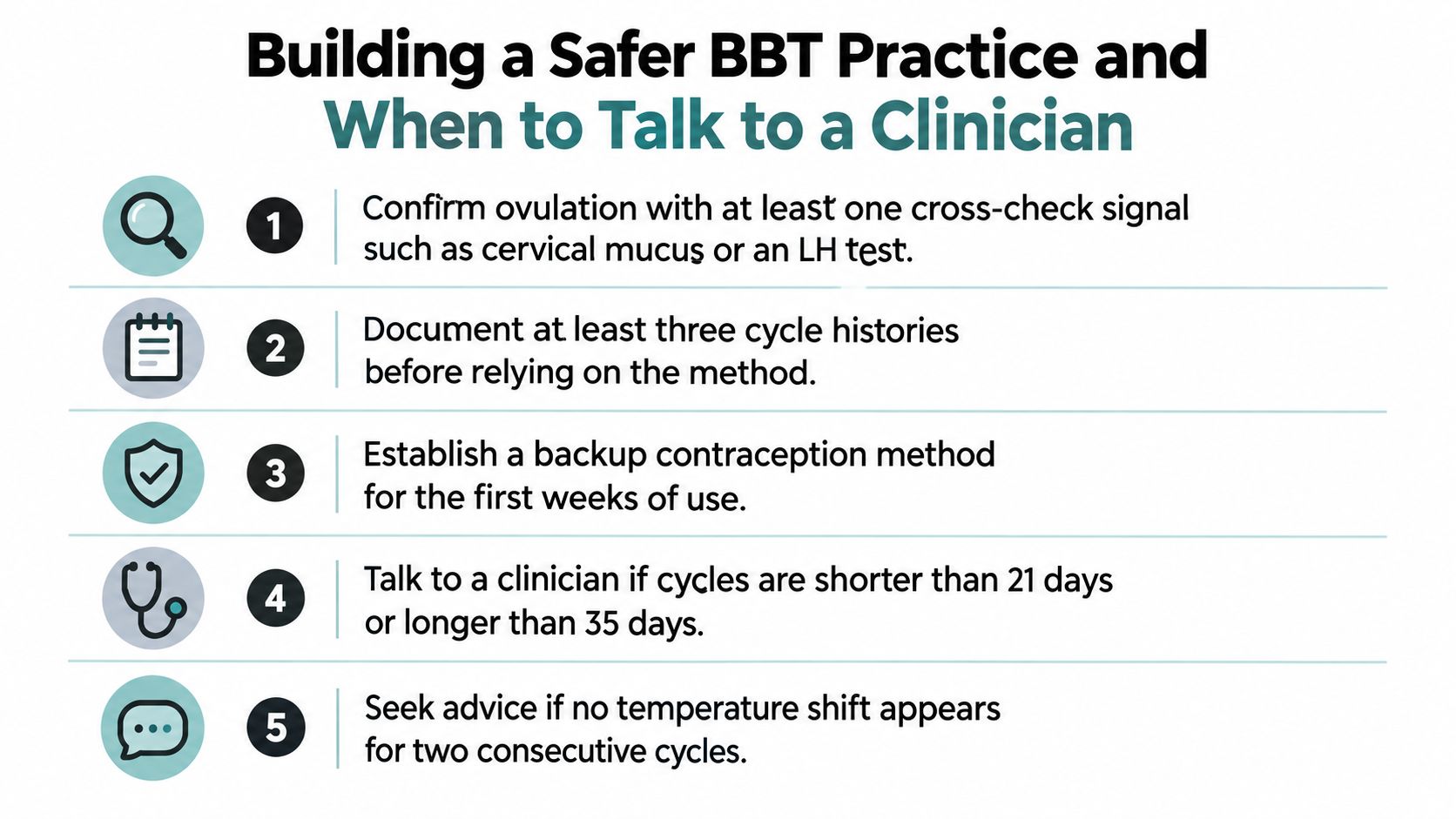
A monthly self-audit
At the end of each cycle, ask:
- Did I measure before getting out of bed?
- Did I note disturbed readings rather than ignoring them?
- Did I apply one consistent set of rules?
- Did I use condoms or abstinence whenever the chart was uncertain?
- Did my partner understand the plan?
- Was the temperature shift clear, or am I trying to interpret noise?
Seek professional advice if your cycles change substantially, you don't see a recognisable shift, you're postpartum or perimenopausal, you've recently stopped hormonal contraception, or you're unsure whether a reading reflects illness rather than ovulation. Talk to a clinician about conditions and medicines that may affect temperature or cycle regularity.
Australian guidance describes fertility-awareness methods as highly dependent on correct, consistent use and notes that high-quality evidence varies by method, training and adherence (Family Planning NSW fertility-awareness factsheet). That supports a practical conclusion: instruction isn't an optional extra if you intend to rely on this approach for pregnancy prevention.
The basal body temperature method of contraception can be meaningful for someone who wants a detailed relationship with their cycle and can follow a structured routine. It isn't suitable for everyone, and it should never be sold to yourself as a simple thermometer-based prediction tool.
Venus Health Co. offers a Bluetooth basal thermometer that records morning BBT and syncs readings with the Venus app, where users can also log LH results, symptoms and cervical mucus. If you want to build a more organised fertility-awareness routine, visit Venus Health Co. to explore its home health tools and cycle-tracking options.