

Menstrual Cycle Calculator: How to Read the Dates
Dr. Adeyinka AdegbosinIf a menstrual cycle calculator gives everyone one ovulation date, whose cycle is it calculating? A tidy calendar can look reassuring, but the useful result is a range based on your own recent cycles, with a clear explanation of what could move it.
You don't need to become a hormone specialist to read that range. Start with the first day of your period, count your cycle carefully, and keep calendar estimates separate from the signals you measure this month. Equally useful, know when symptoms deserve attention and when entering more personal information isn't worth the privacy trade-off.
Work Out Your Period and Fertile Dates
Start with the date your last period began and your usual cycle length. A menstrual cycle calculator uses these inputs to project your next period, an estimated ovulation day and a possible fertile stretch. These are different outputs, not interchangeable promises.
Day 1 is the first day of menstrual bleeding. Cycle length runs from that day to the day before your next period starts. Period length means how long you bleed, so don't enter your bleeding duration in the cycle-length box.
Count the cycle before calculating the dates
Write down consecutive period start dates, then count the days between them. Keep each completed cycle length rather than just remembering whether your periods felt regular. If you only know one completed cycle, you can enter it, but label the result provisional.
Where possible, use at least six months of cycle history; Healthdirect's fertility-awareness guidance describes calendar estimates based on previous cycles and a fertile interval extending from five days before ovulation to one or two days afterwards. More history helps you see your pattern, but it doesn't make a changing cycle predictable.
For a simple worked calculation, subtract 14 from the assumed cycle length to estimate an ovulation day. This is a calendar convention, not a measurement of your personal post-ovulation phase. In the hypothetical 28-day row below, that gives ovulation near day 14, a planning band of days 9 to 16, and the next period on day 29.
Estimated ovulation and fertile window by cycle length
The following rows are worked calendar examples, calculated using cycle length minus 14, then shading five days before and two days after that estimate. Count the endpoints inclusively: this produces eight marked calendar dates, rather than an exact seven-day biological window.
| Cycle length | Estimated ovulation | Fertile window | Next period from day 1 |
|---|---|---|---|
| 21 days | Day 7 | Days 2–9 | Day 22 |
| 24 days | Day 10 | Days 5–12 | Day 25 |
| 26 days | Day 12 | Days 7–14 | Day 27 |
| 28 days | Day 14 | Days 9–16 | Day 29 |
| 30 days | Day 16 | Days 11–18 | Day 31 |
| 32 days | Day 18 | Days 13–20 | Day 33 |
| 35 days | Day 21 | Days 16–23 | Day 36 |
A shorter assumed cycle pulls the dates forward. A longer one moves them back. None of these rows proves that an egg will be released, and the shaded band mustn't be used as a stand-alone contraceptive method.
If you're planning a pregnancy, our guide to the best time to conceive can help you use the dates without treating the middle of the band as an appointment you must meet.
On your calendar, write next period estimate = last period start date + average cycle length. Then circle a fertile band lightly enough to change it when this cycle gives you more information.
Why Your Own Cycle Beats a 28 Day Default
Think of a menstrual cycle calculator as a train timetable built from previous departures. It can help you plan, but it isn't a live view of what's happening today. If your usual departure time differs from the timetable's default, the printed prediction starts from the wrong assumption.
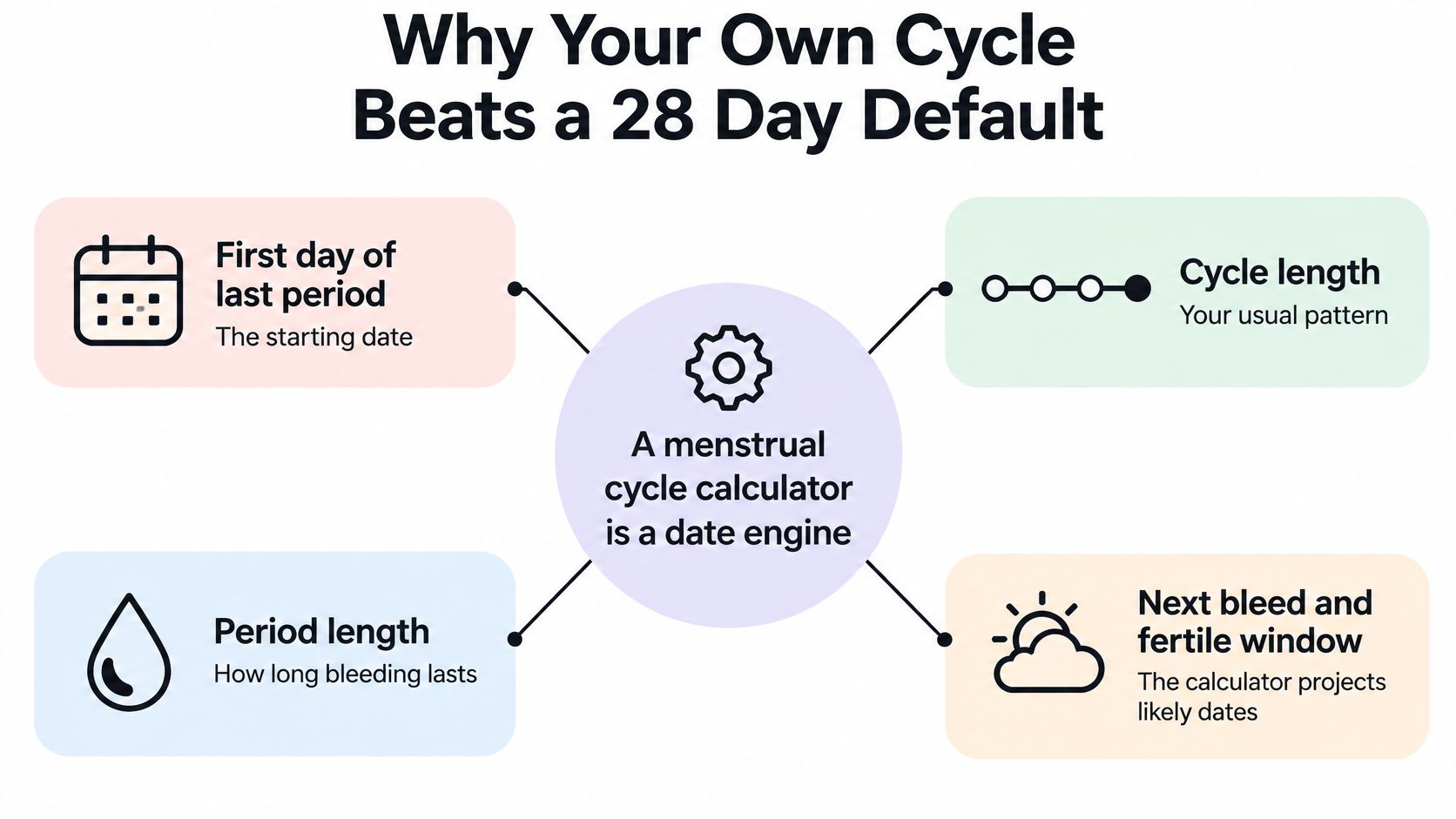
A calculator is a date engine. It takes your last period start date, a cycle length or collection of past lengths, and sometimes your bleeding duration, then projects likely future dates. A tool that asks for personal information should use it, rather than returning the same standard pattern.
The default isn't a personal baseline
In a survey of 323 women attending three Australian general practices, 58.8% reported regular cycles of 27–35 days, while 16.4% reported cycles of 26 days or fewer, according to the Australian general-practice fertility-awareness study. Those findings describe the women surveyed, not a prediction for every Australian reader. They do show why one preset length won't suit everyone.
Say your recent cycles consistently run longer than the app's preset. Accepting that preset can put both the next-period estimate and the suggested fertile stretch too early. Changing the input isn't customising a cosmetic setting; it's changing the basis of the calculation.
This diagram separates the information you supply from the dates the calculator produces.
Check what the calculator knows
Before accepting its output, look for:
- Your actual start date. Confirm that you haven't selected the end of your period.
- Your recent cycle lengths. Check whether you've entered records or accepted a preset.
- Your shortest and longest cycles. An average alone can hide a wide spread.
- The amount of history available. A new account shouldn't look as certain as an established record.
For broader reading about hormone-related concerns, the hormonal wellness insights from Longevity Medical Institute offer additional context. General hormone information, however, doesn't validate an app's personal ovulation prediction.
Practical rule: Enter your own recent lengths before accepting any default, and keep the original period dates so you can check the calculation.
How Cycle Length Becomes a Prediction
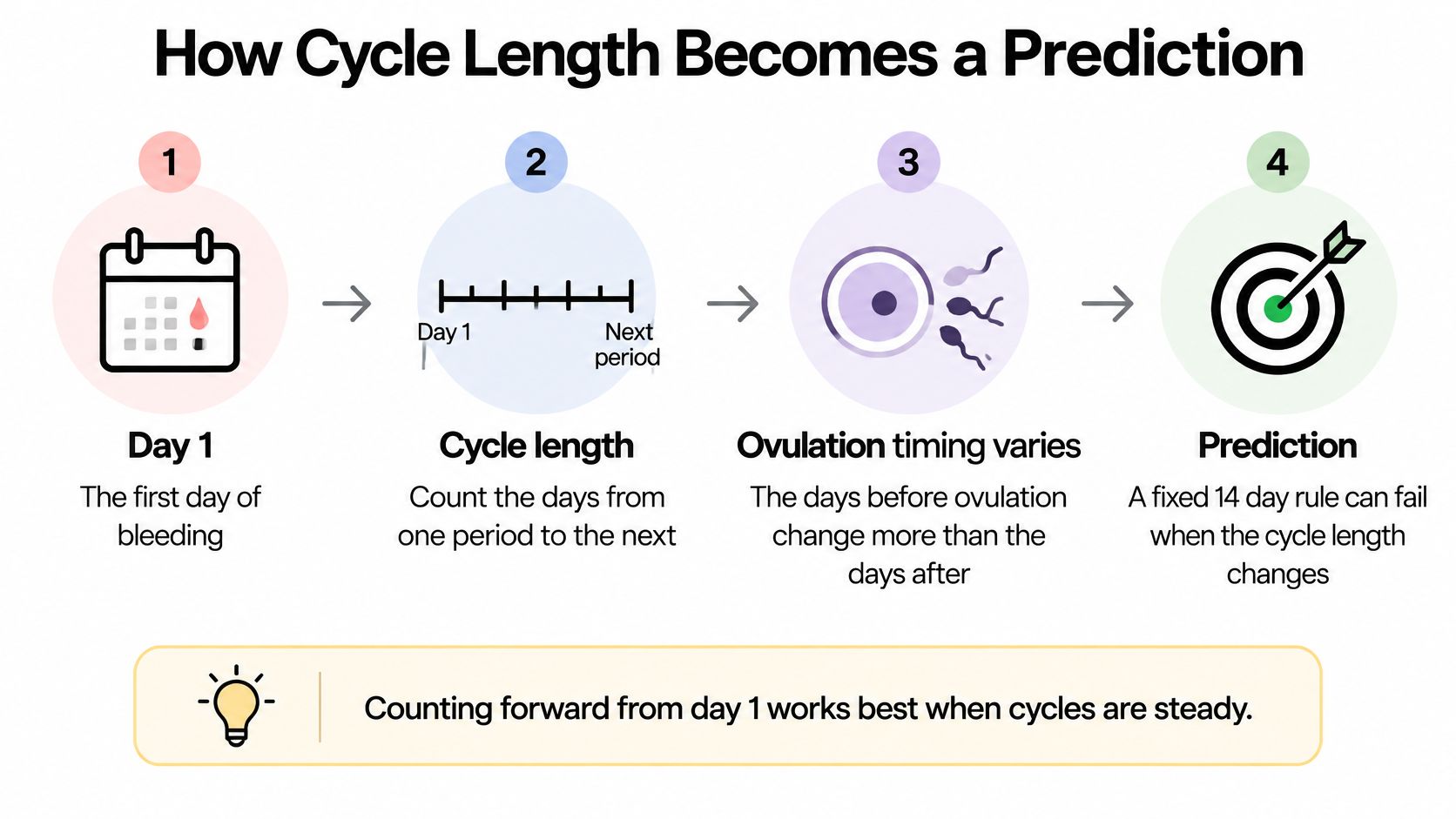
The days between menstruation and ovulation can vary more than the days after ovulation. That's why counting a fixed distance forward from the start of bleeding can mislead you. When ovulation shifts, the expected period can shift too.
A useful calculator keeps two separate layers: a record of completed cycles and a prediction for the cycle underway. The first contains observed dates. The second contains assumptions that may need updating.
Use the spread, not just the average
An Australian sexual-health guide from SHQ describes a calendar method using preferably six months of records: subtract 20 from the shortest cycle to identify the first potentially fertile day, and 10 from the longest cycle to identify the last. This produces a broader interval than a simple midpoint calculation.
The table contains worked examples of that arithmetic. These are method-derived spans, not measured fertile windows or declarations that the remaining days are safe for unprotected sex.
Fertile span from six months of cycle lengths
| Cycles recorded | First fertile day | Last fertile day | What a single ovulation day hides |
|---|---|---|---|
| 26–31 days | Day 6 | Day 21 | A 16-day span, not one date |
| 27–29 days | Day 7 | Day 19 | Still much wider than a peak day |
| 28 days every cycle | Day 8 | Day 18 | Even a steady cycle stays a band |
| 21–35 days | Day 1 | Day 25 | The window covers nearly the whole cycle |
Notice that this method gives different boundaries from the simple illustrative table. That's because it answers a different question: how broadly should potential fertility be marked using the shortest and longest recorded cycles? It isn't trying to pinpoint egg release.
The process diagram shows where a recorded fact becomes a forecast.
Read a range honestly
For someone with a broad spread of lengths, a broad shaded band is more honest than a sharply highlighted centre date. It may be less convenient, but narrowing the graphic without additional evidence doesn't narrow the biological uncertainty.
A calculator should also explain what its range represents. An observed shortest-to-longest interval isn't automatically a statistical confidence interval. Without a validated prediction model, a percentage attached to the range can imply more certainty than the records support.
Look for an interface that distinguishes confirmed period dates, predicted bleeding dates and estimated fertile dates. You should be able to tell which entries came from you and which the software generated.
Store the history, print a range, and don't turn the middle of that range into a diagnosis.
When a Neat Date Stops Being Reliable
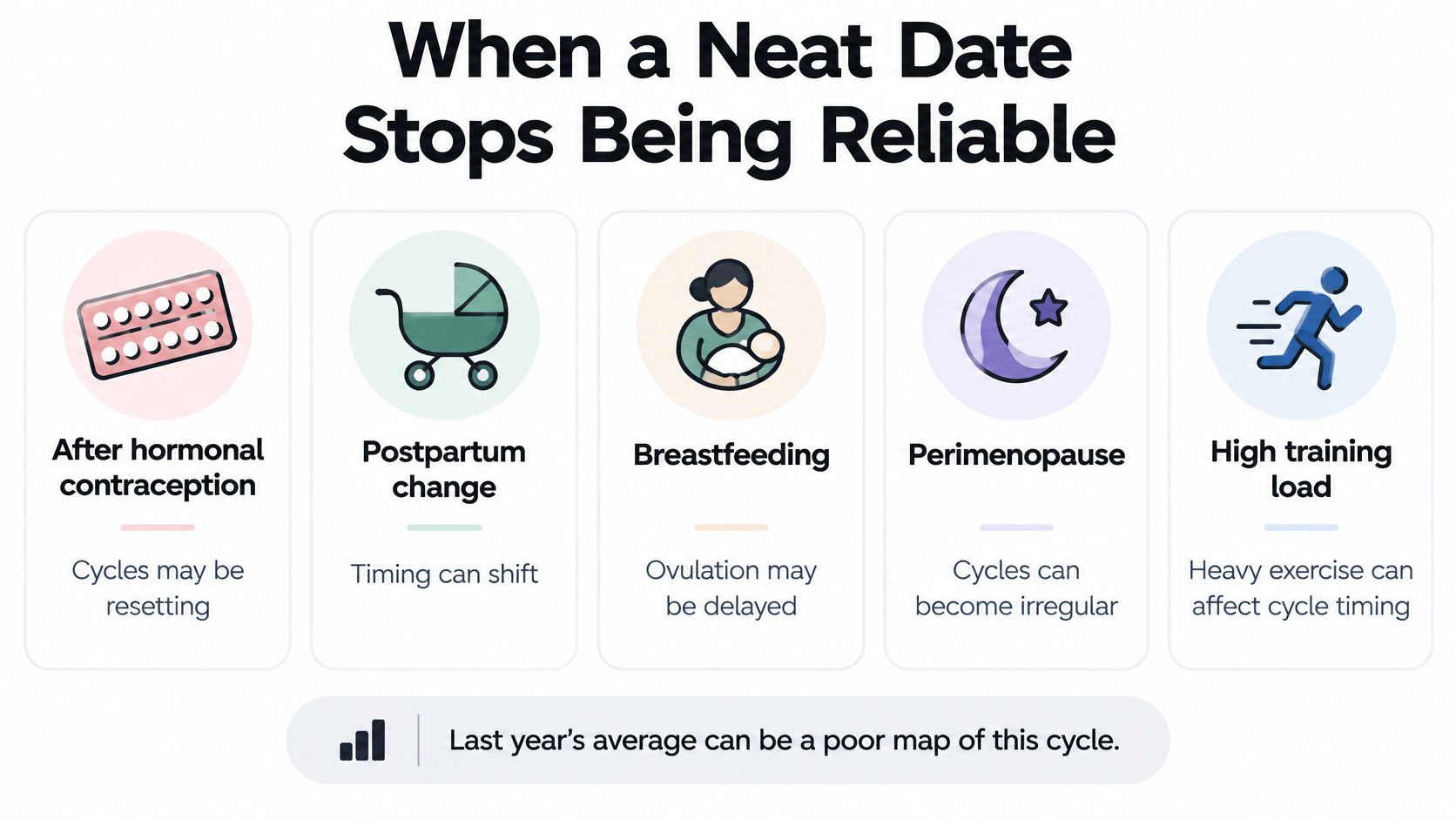
After stopping hormonal contraception, during postpartum changes or breastfeeding, and around perimenopause, an older average may be a poor guide to your current cycle. High training loads, insufficient energy intake and suspected ovulatory disorders also deserve attention when your pattern changes. A sensible calculator should widen its estimate or acknowledge that it can't narrow the timing usefully.
That doesn't mean every changed cycle signals illness. It means your recent circumstances belong beside your calendar history when you interpret the result.
These are some of the situations in which a familiar pattern may shift.
Predictable timing doesn't cancel symptoms
A period arriving when expected doesn't establish that everything is healthy. The Australian Institute of Health and Welfare's endometriosis summary estimates that 14% of Australian women born in 1973–1978 had endometriosis by ages 44–49. A calculator cannot diagnose that condition, and regular dates don't rule it out.
Symptoms are also common enough that a date-only record misses an important part of menstrual health. In 2025, 77% of 1,238 Australian women of reproductive age reported bothersome menstrual symptoms, according to a cross-sectional study published through Western Sydney University researchers. Common doesn't mean you have to tolerate symptoms that disrupt your life.
Record what would change your next step
Useful symptom prompts include:
- Persistent pelvic pain. Note whether it affects work, exercise, sleep or daily activities.
- Pain with sex or period-related bowel or bladder symptoms. Describe when it happens rather than trying to name a condition.
- Unusually heavy or worsening bleeding. Record flooding, frequent protection changes and any effect on your wellbeing.
- Missing periods or a clear change in pattern. Include relevant contraception changes, pregnancy possibility and training changes.
If a period is missed and pregnancy is possible, use a pregnancy test rather than interpreting the calculator as an answer. Discuss persistent pain, disruptive bleeding or a sustained change in timing with a GP. Seek urgent assessment for severe pain, very heavy bleeding or bleeding accompanied by faintness.
Our guide to tracking ovulation with irregular periods offers practical tracking context, but repeated testing shouldn't delay care. Bring your dates and symptoms to a qualified Australian health professional, who can decide whether investigations are appropriate.
Who Can See the Dates You Enter
Who holds the information behind your next-period prediction? Period dates, pregnancy intentions, symptoms and fertility observations are sensitive health information. Before you enter them, you should be able to understand where they go and what else they may be used for.
In June 2025, Nine's Australian reporting on fertility-app privacy described findings involving 12 popular fertility apps, including misleading privacy messages and limited meaningful control over advertising or research uses. A reassuring welcome screen isn't a substitute for specific answers.
Ask for a plain-English data map
Check the policy and settings for:
- Collection. Does the tool need only period dates, or does it also collect hormone results, temperature, symptoms and pregnancy intentions?
- Storage. Do entries stay on your device, or are they sent elsewhere?
- Retention and deletion. How long are records kept, and what happens when you delete your account?
- Sharing. Which other organisations receive information, and for what purpose?
- Advertising and research. Can you decline these secondary uses separately?
- Withdrawal. Can you change your consent without losing basic cycle calculations?
A tool asking for extensive health details should explain why each field is needed. You shouldn't have to guess whether an optional symptom note changes the calculation or just adds more information to your profile.
Separate privacy promises from clinical promises
For a starting point when reviewing our information, read our data security and privacy guide. Assess what is stated explicitly rather than inferring protections from the appearance of an app.
For readers interested in how developers approach these responsibilities, Zee Palm's discussion of health data compliance for wellness startups provides additional background. Its discussion of US requirements isn't a substitute for checking the protections relevant to an Australian service.
Privacy language and fertility language need separate scrutiny. Calling an output a fertility score doesn't establish that ovulation occurred, just as calling information secure doesn't explain every permitted use.
Before signing up, read the data map, decline unwanted secondary uses where possible, and enter only what you need. A paper calendar is a reasonable choice if a digital tool's terms don't suit you.
Track Maya's Cycle With LH and Temperature Signals
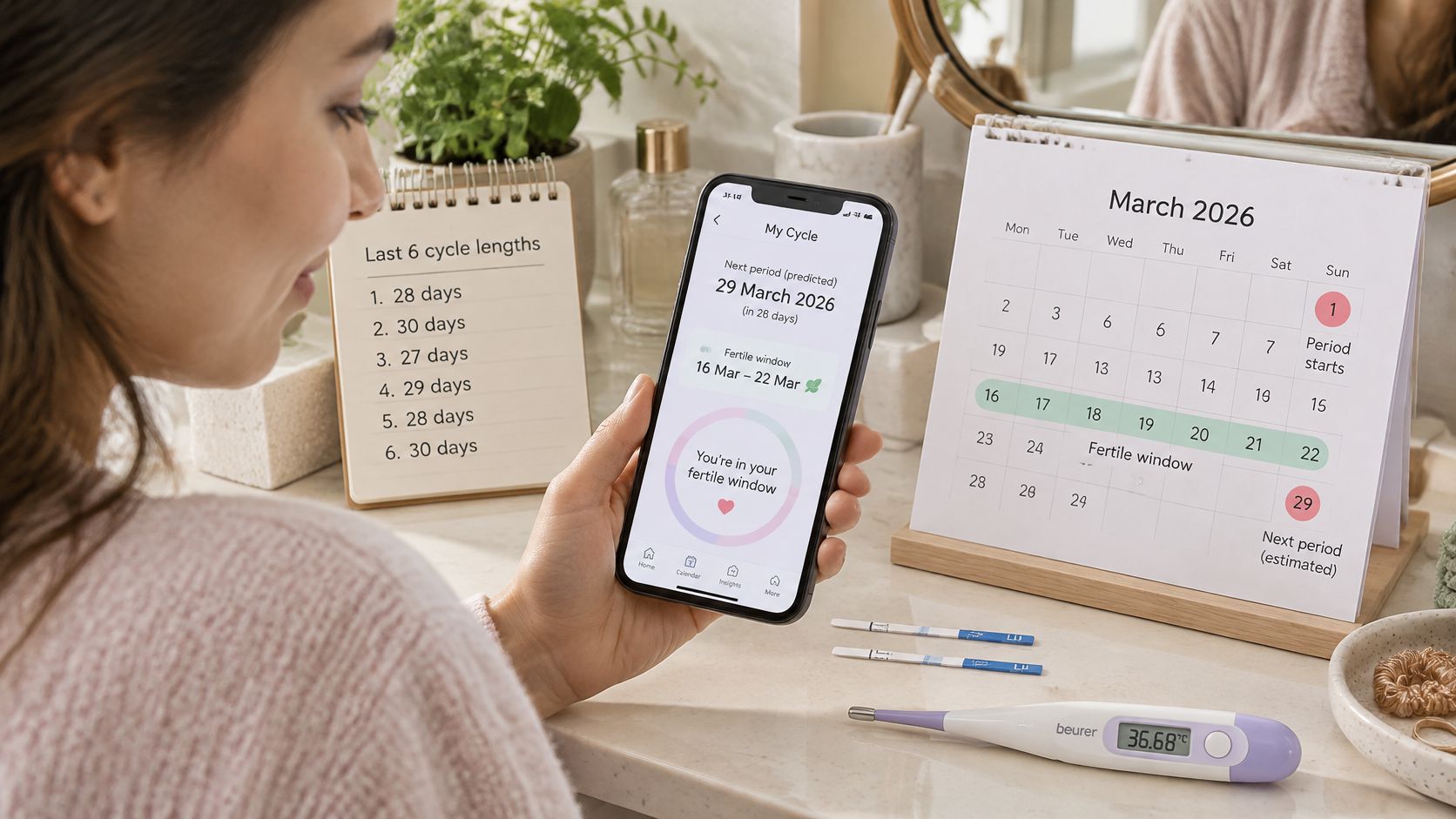
Maya's last six cycles lasted 27 to 30 days, averaging about 28 days. Her current period begins on 1 March 2026. She marks the first day on paper, then uses her calendar and cycle signs together to plan what to watch for.
Start March with a provisional plan
An average-based calculation puts Maya's next period near 29 March and gives an illustrative fertile band of 9 to 16 March. A calendar method using her shortest and longest cycles instead gives a broader range, days 7 to 20. These are estimates from different methods, not confirmed ovulation dates, so she records which method produced each range.
The calendar proposes; this cycle's signs help you revise the plan.
If cycle length is unknown, start testing 11 days after the last period began, based on an average 28-day cycle. If Maya uses her known cycle length, she can follow the cycle-length-based chart to find the recommended test start date. Her shorter cycles mean she chooses the earlier starting point that applies to her, rather than waiting for the average-based estimate.
Read the strip without overreading it
Maya follows the kit instructions for collecting and reading each sample, tests at a similar time each day, and records the result promptly.
- A negative result: The test has not detected the hormone shift in that sample. The fertile window has not begun yet, so Maya continues testing daily until she gets a positive result.
- A positive result: The test has detected the hormonal change associated with the most fertile window, and ovulation may occur soon. It signals a change to watch for, not a guarantee of egg release or conception.
For someone trying to conceive, the calendar range helps organise timing, while an LH result adds information about the current cycle. For someone avoiding pregnancy, neither an estimated calendar range nor an isolated test result establishes a safe day.
The following video offers an additional way to learn about cycle tracking.
Add temperature as a backward-looking signal
Maya takes her basal temperature on waking, before getting up, and uses a consistent method. She notes disrupted sleep or illness beside a reading so an unusual point is not mistaken for a clear pattern.
A sustained temperature shift can help her recognise ovulation retrospectively. It cannot reliably predict in advance when ovulation will happen, and one higher reading is not enough to settle the question. If her charts and test results remain difficult to interpret over several cycles, she can discuss the record with her clinician.
At the end of the cycle, Maya saves the actual period start date, her original predicted ranges, test dates, and any unusual pain or bleeding. She can also note sleep and energy if those details help explain how she felt. Keeping the original forecast lets her see how useful it was without losing the uncertainty she started with.
For a digital temperature record, the Venus Smart Basal Thermometer for Ovulation - Bluetooth BBT Tracker with App syncs readings to the Venus Health App by Bluetooth. The separate One Step LH Ovulation Test Kit integrates with the Venus App for fertility charting. Paper works too. Neither a tracking format nor a test diagnoses a condition or replaces individual contraception advice.
Venus Health Co. offers at-home tools for tracking reproductive health and ovulation. Explore Venus Health Co. if you want an app-connected option, and begin with your own recent cycles rather than a default date.