

How to Track Ovulation with Irregular Periods
Dr. Adeyinka AdegbosinYou've opened your fertility app, watched the predicted fertile window move, and still don't know whether your body has ovulated. One month your period arrives early, the next it seems to disappear, and a calendar estimate offers confidence without much certainty. That uncertainty is frustrating, especially when you're trying to conceive or understand what your hormones are doing.
Learning how to track ovulation with irregular periods requires a different mindset. Instead of asking an app to guess a date from previous bleeding, combine real-time signals, including luteinising hormone (LH), basal body temperature (BBT), cervical mucus, and symptoms. The result is a clearer picture of whether ovulation is approaching, has happened, or may not be occurring in that cycle.
Why Calendar Apps Fail Irregular Cycles
Calendar tracking works backwards from an expected period. Ovulation usually happens about 14 days before the next period, according to Australian health guidance on female infertility. If your next period is unpredictable, however, the calculation has no dependable endpoint.
A calendar app can still record useful information, but its fertile-window prediction may be based mainly on your previous cycle lengths. If those lengths shift substantially, the app may place ovulation too early, too late, or not at all. Healthdirect's guidance on irregular periods recommends keeping a diary or app record, but recording bleeding is different from confirming ovulation.
Irregular or absent periods can also mean that ovulation itself is irregular or absent. That distinction matters. A late period doesn't necessarily mean ovulation happened late, and bleeding doesn't always prove that an egg was released.
Replace prediction with detection
Think of calendar data as a map of what has happened, not a promise about what will happen next. Your cycle history may help you estimate a broad range, but physiological signals provide more useful information in the current cycle.
The practical shift looks like this:
- Use period dates for context: Record the first and last day of bleeding, along with spotting or unusual bleeding.
- Watch for rising fertility signals: Cervical mucus and an LH surge can indicate that hormonal activity is changing.
- Confirm afterwards: A sustained BBT rise can support the conclusion that ovulation occurred.
- Escalate when signals stay absent: Repeated cycles without a clear pattern deserve clinical discussion rather than endless app predictions.
The Australian healthdirect guidance states that fertility awareness isn't recommended for people with irregular periods. That doesn't mean tracking is pointless. It means a calendar-only method isn't a suitable foundation, particularly if you're using fertility awareness to avoid pregnancy.
Practical rule: Let your body's signals adjust the calendar, not the other way around.
The best free period tracker app can help you organise dates and observations, but no app should replace clinical assessment or multi-signal tracking when cycles are unpredictable. If you're trying to conceive and can't identify a likely fertile window, Australian fertility guidance suggests having sex every 2 to 3 days to improve the chance of conception, as outlined by Your Fertility's Australian resources.
Mastering Basal Body Temperature Tracking
BBT is most useful as a confirmation signal. It doesn't usually tell you that ovulation is about to happen. Instead, progesterone released after ovulation generally produces a sustained rise in resting temperature, allowing you to look back and identify a likely shift.
This makes BBT particularly valuable when cycle length varies. You don't need to know whether the current cycle will be short or long before you begin. You need a consistent morning routine that captures the pattern your body produces.
Follow the same morning protocol
Take your temperature immediately after waking, before sitting up, talking, drinking water, or checking your phone. Pregnancy Birth and Baby's fertility awareness guidance advises taking BBT at the same time each day and in the same location.
Use this routine:
- Keep the thermometer beside the bed. Make the reading easy to take before you move around.
- Measure at the same time where possible. A substantial change in timing can make readings harder to compare.
- Use the same measurement location. Don't switch between oral, vaginal, or another method from day to day.
- Record the result immediately. Add notes for illness, disrupted sleep, alcohol, or anything else that may make a reading less representative.
- Continue through the whole cycle. Stopping after a negative LH test can mean missing a later ovulation.
The pattern matters more than one isolated number. A single higher temperature may reflect poor sleep or illness rather than ovulation. Look for a sustained rise compared with the earlier baseline.
Recognise confirmation, not prediction
According to Pregnancy Birth and Baby, the fertile window ends only after 3 consecutive higher temperatures. That gives BBT an important limitation: it can help confirm ovulation after the shift, but it can't reliably give advance notice by itself.
A useful chart might show lower, relatively stable readings, followed by a group of higher readings that stays high. If the rise is inconsistent, disappears quickly, or occurs during illness, mark the disruption instead of forcing an interpretation.
The guide to taking basal body temperature for ovulation can help you refine the routine. If manual entry becomes difficult, the Venus Smart Basal Thermometer for Ovulation, Bluetooth BBT Tracker with App records BBT readings and syncs them to a phone via Bluetooth. Its product information also describes app access for logging LH tests, symptoms, and cervical mucus.
A connected thermometer doesn't make an irregular cycle predictable. It can, however, reduce forgotten readings and transcription mistakes, leaving you with a more complete chart to review yourself or discuss with a clinician.
Timing and Interpreting LH Ovulation Tests
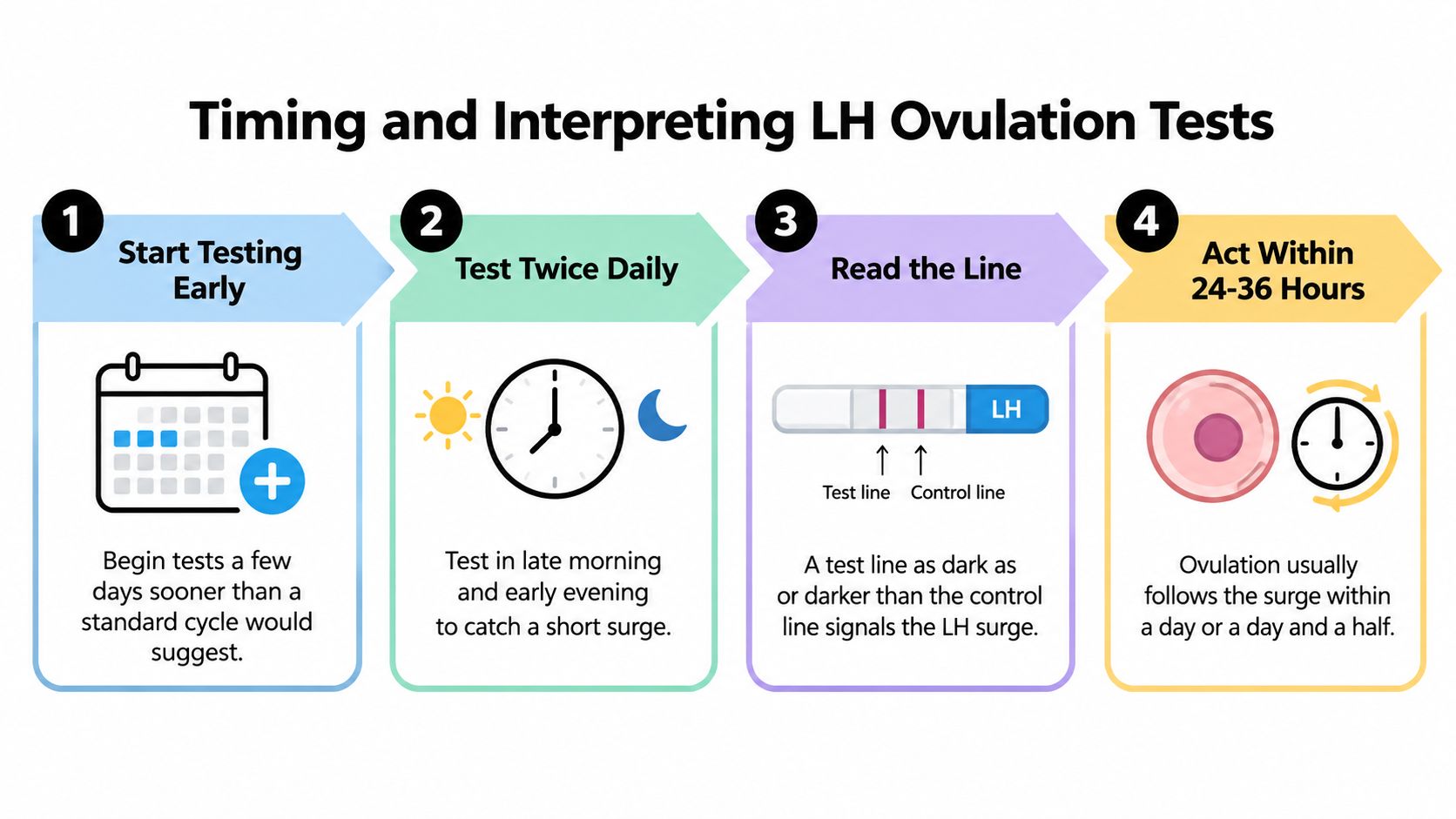
LH tests detect a rise in luteinising hormone in urine. A positive result usually predicts ovulation within 24 to 36 hours, according to the Better Health Channel's information about ovulation testing. With irregular periods, the challenge is knowing when to begin and how to interpret repeated faint or fluctuating lines.
Use your observations to decide when testing should become more frequent. If cervical mucus becomes wetter, clearer, or more slippery, that may be a useful prompt to start or intensify LH testing. Don't wait for an app to identify a precise cycle day if your cycle doesn't follow a reliable pattern.
Read the result consistently
Follow the instructions supplied with your test, including the recommended urine collection and reading time. A line that is visible isn't automatically a positive result. In many line-based tests, the test line needs to be as dark as or darker than the control line, but the product instructions take priority.
A faint line often reflects baseline hormone levels rather than a surge. With irregular cycles, you may see changing line intensity before a clear positive. Record the result rather than treating each faint line as proof that ovulation is imminent.
The best time to use an ovulation test depends on your routine and the instructions for your kit. If you suspect a short surge, testing at consistent times across the day may help you avoid missing it. Some people choose morning and later-day testing, but repeated testing can become expensive, so use cervical mucus changes and prior results to guide when you increase frequency.
The Venus Ovulation Predictor Test Kit is described as an at-home LH strip test with results available in under 10 minutes and a stated prediction window of 24 to 36 hours before ovulation. Treat any test as one part of the picture, especially if you have PCOS or often see high LH without a clear BBT shift.
Know what a negative means
A negative result doesn't prove that ovulation won't happen. The surge may be delayed, too brief to catch, or absent in that cycle. Continue observing your mucus and BBT, and seek clinical advice if you repeatedly see no convincing surge or temperature shift.
RACGP guidance cautions that home testing of LH, temperature, and mucus may not always be reliable. Combining signals reduces the risk of building your conclusion around one ambiguous strip.
Logging Secondary Biomarkers and Symptoms
Cervical mucus gives you a day-to-day view of rising oestrogen activity. As ovulation approaches, some people notice mucus becoming wetter, clearer, and more slippery, with a texture often compared with raw egg white. You may also notice more discharge than usual.
Record what you observe instead of trying to make it fit a textbook description. A simple entry such as “dry”, “sticky”, “creamy”, “watery”, or “slippery” can reveal a progression over time. If you don't notice a clear change, record that too. Absence of a familiar sign is useful information when you review the cycle.
Use symptoms as supporting evidence
Some people experience one-sided pelvic discomfort, breast tenderness, mood changes, or a change in libido around ovulation. Others feel nothing noticeable. Symptoms can support your chart, but they can't confirm that an egg was released on their own.
RACGP guidance notes that LH, temperature, and mucus home testing may not always be reliable. The strength comes from comparing signals:
- Mucus changes first: More fertile-looking mucus may suggest that oestrogen is rising.
- LH changes next: A positive test can indicate that ovulation may be approaching.
- BBT follows: A sustained higher-temperature pattern can help confirm that ovulation occurred.
- Symptoms add context: Pain or breast tenderness may support the timeline, but shouldn't override conflicting data.
This approach also helps you separate a possible fertile phase from a possible anovulatory pattern. For example, repeated slippery mucus without a positive LH result or sustained BBT rise is worth logging and discussing, rather than labelling as confirmed ovulation.
Keep the record easy to maintain
Choose an app or paper chart that lets you enter period dates, BBT, LH results, mucus, symptoms, sleep, illness, and medication changes. Consistency matters more than decoration. A record you update daily will be more useful than a detailed chart you abandon after a difficult week.
A body-composition device isn't an ovulation test, but someone already monitoring broader health data may use the Venus AI Smart Scale to track weight and body-composition information in the Venus app. Keep that information separate from direct ovulation signals. Weight trends can provide personal context, but they don't confirm whether ovulation occurred.
Leveraging App-Connected Fertility Ecosystems
A paper chart can work well if you remember the thermometer, write down every LH result, and interpret the pattern consistently. An app-connected system offers a different trade-off: less manual entry, more automatic organisation, and a single place to compare several signals.
The Venus Health Co. ecosystem, for example, combines Bluetooth BBT readings with app entries for LH tests, symptoms, and cervical mucus. Its product information describes a daily Fertility Score and visual BBT curve. Those features may help organise information, but they shouldn't turn an estimate into a diagnosis.
Compare the workflow, not just the features
| Tracking approach | What you do | Main limitation |
|---|---|---|
| Period calendar | Enter bleeding dates and review estimated fertile days | It struggles when the next period can't be predicted |
| Manual BBT chart | Take a morning reading and enter it yourself | Missed entries and transcription errors can interrupt the pattern |
| LH strips plus notes | Test when signs suggest fertility may be rising and record each result | A surge may be delayed, brief, or difficult to interpret |
| Connected BBT and app | Measure BBT, allow automatic syncing, and add LH and symptom data | The app still needs human and clinical interpretation |
A useful ecosystem should make the underlying data visible. Look for the actual BBT curve, the dates of LH tests, and the observations behind any score. If a platform only shows a fertile label without explaining which signals produced it, you have less information to question or discuss with your healthcare professional.
Manual tracking can be the right choice if you want a low-tech routine or don't want to purchase extra equipment. Automatic syncing may suit people who find daily data entry difficult, but no device removes the need to measure under consistent conditions.
This video demonstrates how connected health data can be organised within an app-based workflow.
Consider privacy, data access, and cost before committing to a platform. A subscription-free option may be easier to maintain over an extended period, especially when irregular cycles make tracking take longer. Check what remains available without recurring payments and whether you can export or show your data to a clinician.
When to Seek Clinical Hormone Testing
Home tracking can show patterns, but it can't explain every pattern. If your bleeding is irregular because ovulation is inconsistent, a calendar may keep moving the estimate without answering the central question: is ovulation happening?
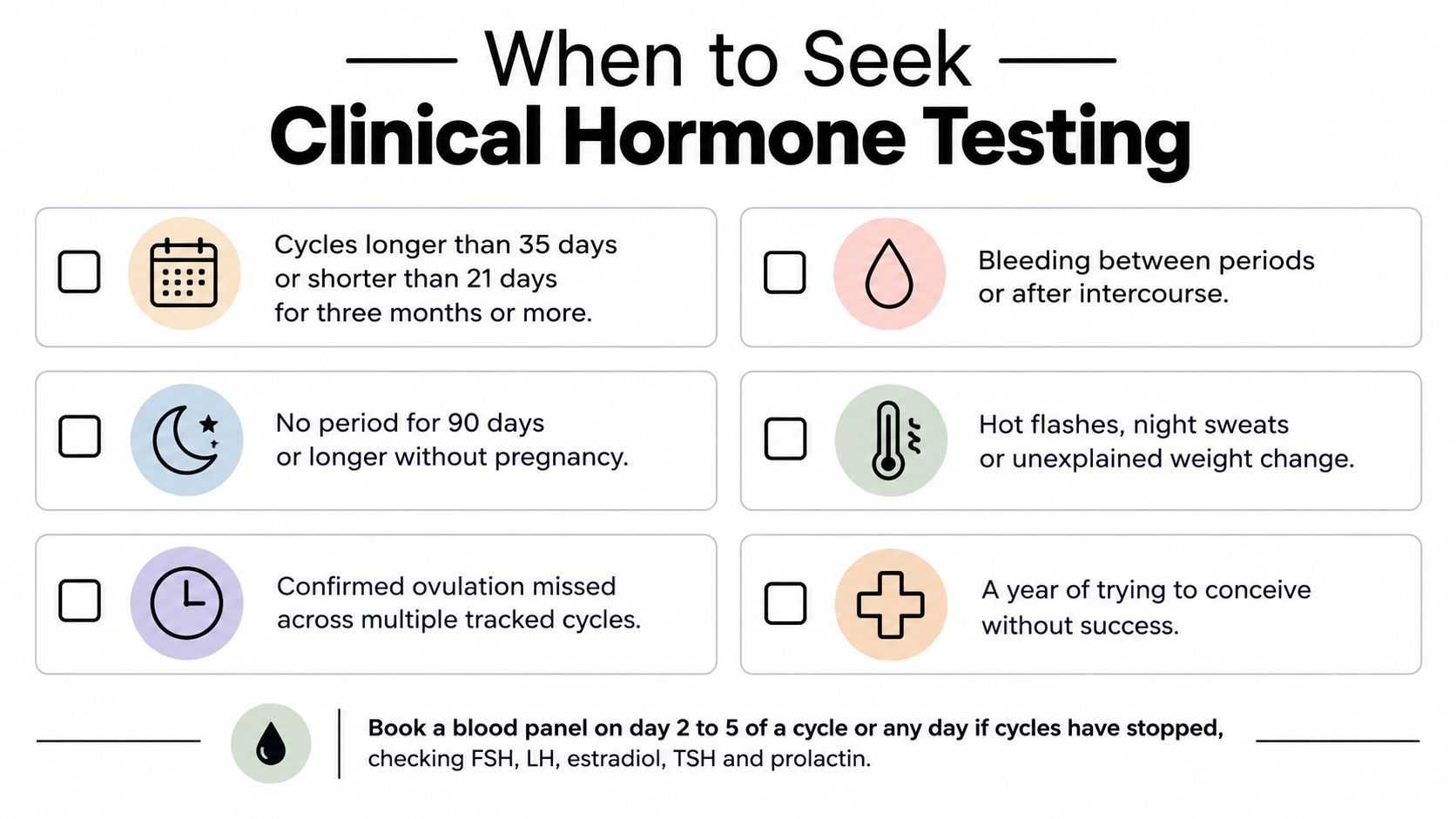
Seek medical advice sooner if you have prolonged or very infrequent cycles, bleeding between periods or after intercourse, or other symptoms that concern you. You don't need to wait until tracking feels perfect. Bring the chart you have, including gaps and confusing results.
Understand why day 21 can be misleading
Australian O&G guidance explains that women with prolonged irregular menstrual cycles may need progesterone testing at day 21 and then repeated weekly, while serum hormone tracking or ultrasound monitoring can provide more reliable ovulation detection. The timing of progesterone testing matters because the useful sample is generally taken around the middle of the luteal phase, not automatically on the same calendar day for everyone.
Australian Prescriber identifies serum progesterone as the most appropriate test for detecting ovulation. It recommends drawing it about 7 days before the predicted period, assuming a 14-day luteal phase, while also noting that blood or urinary LH tests aren't useful in general practice for confirming ovulation, as explained in Australian Prescriber's fertility testing guidance.
If your cycles are too infrequent or erratic to estimate that timing, clinicians may use a broader endocrine assessment. RACGP guidance describes testing day 2 to 3 FSH, LH, oestradiol, thyroid function, prolactin, and androgens when PCOS is suspected. For very infrequent periods, this blood testing can be performed at any time.
Treat missing signals as information
A useful escalation plan looks like this:
- Start a complete home record. Log bleeding, BBT, LH, mucus, symptoms, sleep disruption, illness, and relevant medication changes.
- Look for convergence. A mucus change and LH rise followed by three higher BBT readings is more informative than any single observation.
- Book an appointment when patterns remain unclear. Repeated cycles without a convincing LH surge or sustained temperature shift deserve assessment.
- Ask about confirmation methods. Discuss progesterone timing, broader hormone testing, or ultrasound monitoring rather than assuming a standard calendar day will apply.
A 2015 RACGP survey found that only 2.1% of Australian women correctly identified the fertile window, highlighting why structured education and clinician guidance matter. The same RACGP material notes that rhythm-based fertility awareness is accurate for less than 30% of women, while temperature and mucus methods are more accurate. These figures reinforce the need to avoid calendar-only decisions, not to blame yourself when the method fails.
For broader context on reproductive and endocrine wellbeing, you may find information about balanced hormones for vitality useful, but online resources can't replace an individual assessment. If you're trying to conceive while waiting for guidance and cycle timing remains unclear, Australian fertility advice supports intercourse every 2 to 3 days, which can reduce dependence on a single predicted fertile date.
Venus Health Co. offers app-connected BBT tracking, LH result logging, cervical mucus and symptom recording, and broader health-data organisation for people who want a clearer daily record. Visit Venus Health Co. to explore the fertility tracking tools and choose a routine that complements, rather than replaces, care from your healthcare professional.