

How Long Does Ovulation Bloating Last in a Cycle
Dr. Adeyinka AdegbosinOvulation itself usually lasts 16 to 32 hours, and bloating linked to it generally clusters around 1 to 2 days, although Australian guidance doesn't set a medically fixed duration for the bloating. Bloating that lasts through the second half of your cycle is a broader pattern, not ongoing ovulation.
So why do so many descriptions treat a brief egg-release event and a long stretch of abdominal fullness as the same thing? The sensation can feel identical, but when it starts, what comes with it and whether it settles help you make sense of it.
You don't need to diagnose yourself from your waistband. You need a useful way to distinguish a short, familiar episode from premenstrual bloating or symptoms worth discussing with your GP.
How Long Ovulation Bloating Usually Lasts
How long should ovulation bloating last before you treat it as a different pattern? The useful answer is a short cluster of about 1 to 2 days around ovulation, while recognising that Australian guidance does not set a medical duration for the bloating itself.
Victoria's Better Health Channel states that ovulation usually lasts about 16 to 32 hours, can involve abdominal bloating, and typically occurs about two weeks before the next period. That gives a practical frame: fullness can begin before egg release and linger afterwards, so the first or last uncomfortable hour will not name the moment ovulation happened.
The evidence gap is simple: clinical guidance describes the ovulation event, while bloating is a sensation with several possible causes.
Use timing as a first sort
How long bloating tends to last by cycle phase
| Pattern | Usual timing | How long bloating may last | What it more likely means |
|---|---|---|---|
| Ovulation-linked fullness | Around the expected ovulatory window, roughly two weeks before the next period | A brief 1 to 2 day cluster, sometimes starting beforehand | A short mid-cycle episode that can sit near ovulation without proving the exact day |
| Longer or recurrent fullness | Through the luteal phase, into bleeding, or across much of the month | Several days, recurring, or persistent | A broader cycle, digestive or pelvic pattern rather than ovulation itself |
The ovulation row describes a contained episode: fullness near the expected fertile window, then a return to feeling more like yourself. The contrast row matters because a longer story does not mean ovulation is still happening.
Your next period is a better anchor than a universal cycle day
A calendar app's predicted midpoint is an estimate; your ovary does not have to keep that appointment. Looking back from your next period can help you recognise whether fullness repeatedly falls near your personal ovulatory window. If bloating tends to land in the few days around the two-week mark, it fits an ovulation-linked pattern more neatly than fullness that carries through the luteal phase or returns all month.
Bloating alone cannot name the ovulation day. Constipation, food intolerance, irritable bowel syndrome and other digestive problems can produce a similar sensation, while persistent or escalating fullness can also belong with PMS, gut trouble or endometriosis.
Practical rule: Use duration to describe the pattern, not to diagnose its cause.
A brief, mild episode that settles is different from fullness that becomes progressively worse or never properly clears. Use the timing to decide what to track next, rather than reading the calendar as a diagnosis.
Why Your Belly Feels Full at Ovulation
Hormones move through a sequence rather than switching on and off. Oestrogen climbs towards ovulation, a luteinising hormone surge helps trigger egg release, and progesterone becomes more prominent in the days afterwards. Each phase can shift how your abdomen feels, and the effects overlap rather than arriving in tidy 24-hour blocks.
The hormonal sequence is easier to understand when you see the phases together.
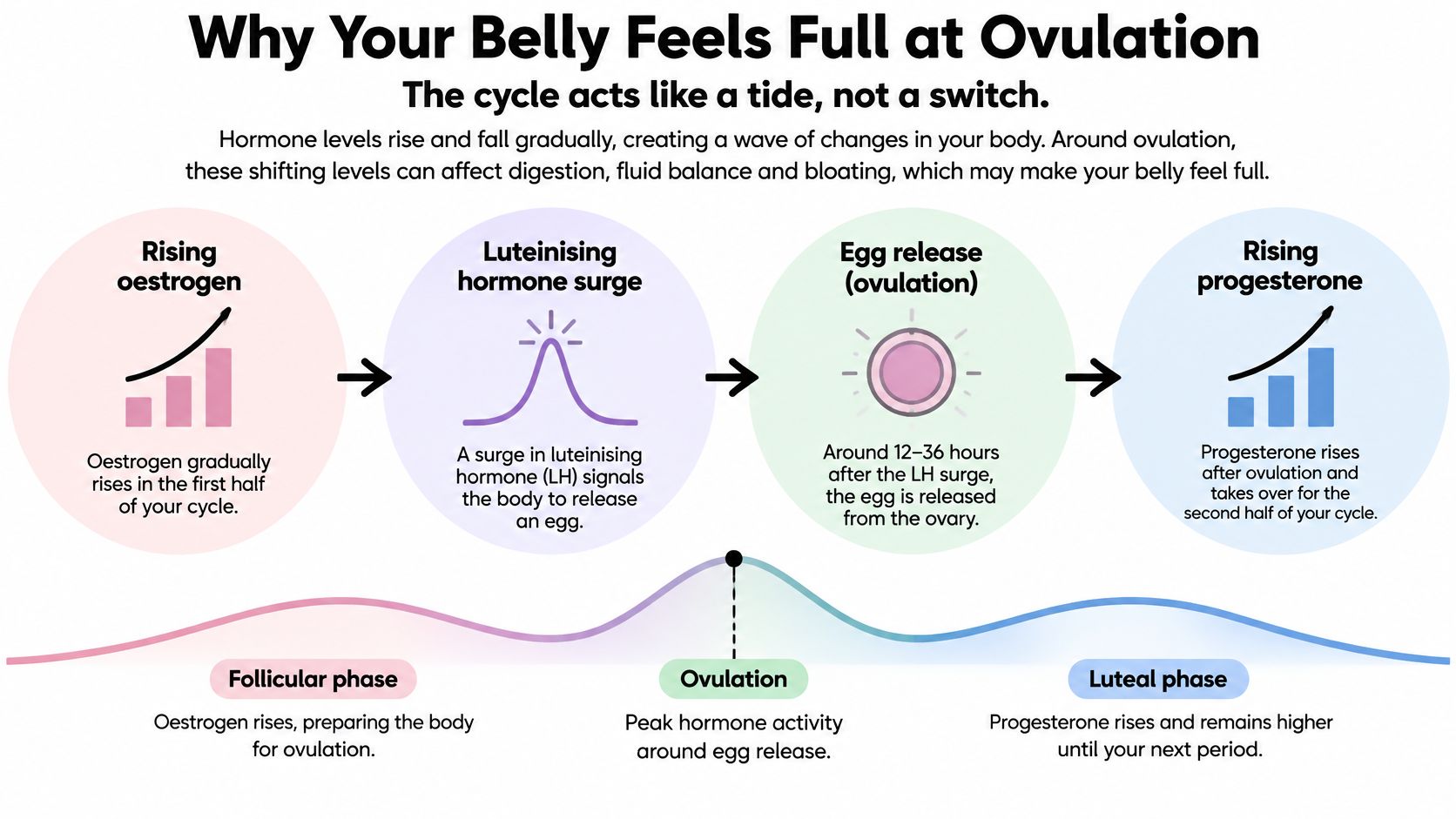
That overlap explains a common mix-up. You might notice pressure, tightness or visible abdominal distension around the same days, yet each sensation can start and finish on its own schedule. One snug waistband does not confirm that an egg has just been released.
Separate the sensation from its possible cause
The cycle-related context described in healthdirect's female reproductive system guidance helps explain why abdominal fullness may coincide with hormonal changes without being a reliable ovulation marker. Three contributors tend to blur together:
- Gut movement. Slower bowel transit lets food sit longer, so pressure builds by the afternoon even when your meals haven't changed.
- Fluid balance. Shifting hormones can leave tissues feeling puffy or heavy, similar to the fullness many people notice before a period.
- Bowel sensitivity. An ordinary amount of gas can feel like significant distension when your gut is more reactive, so the discomfort is real even when little has visibly changed.
A one-sided twinge, breast tenderness or a change in cervical mucus can appear around the same time. Together, they may help you recognise a personal pattern, but they still aren't a diagnosis.
Bloating is a clue to record, not a date stamp for egg release.
Describe what you feel before you name it
Bowel change and gas can produce the same feeling on their own. Two days of slower digestion plus trapped wind can mimic cycle-related fullness almost exactly, and both can be happening at once. A cycle-related shift and a backed-up bowel don't cancel each other out.
This is why a familiar sensation deserves a neutral description before a confident explanation. Write down lower abdominal pressure with harder stools, for example, rather than automatically recording ovulation confirmed.
The accompanying video provides another way to visualise the reproductive cycle.
If you're estimating ovulation, LH testing and a sustained basal-temperature shift provide more useful timing information than waistband tightness. LH testing looks for the hormonal surge before expected egg release, while temperature tracking helps you interpret the pattern afterwards.
Neither approach explains persistent bloating. Fertility tracking and investigating abdominal symptoms answer different questions, even when you record both in the same diary.
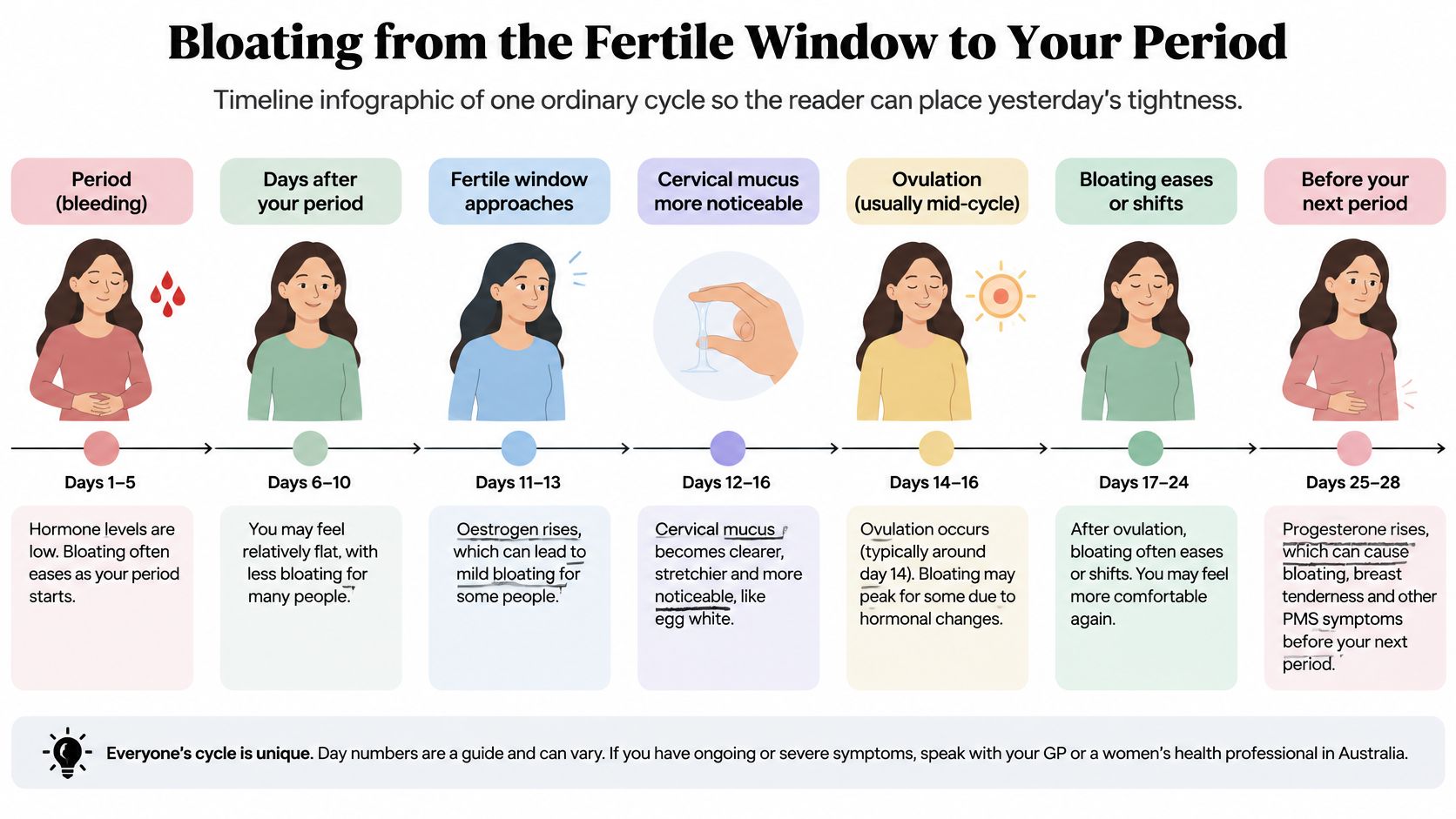
Bloating from the Fertile Window to Your Period
Say your period finishes and your abdomen feels comfortable again. You don't think much about your jeans, your meals feel ordinary, and there's no particular pressure to record.
As your fertile window approaches, you notice more slippery cervical mucus. Around the same time, you develop lower abdominal fullness and a mild twinge on one side. Then those sensations settle.
This timeline shows how that short episode can sit within a much longer cycle.
The next episode may belong to a different phase
Later, you feel puffy again. This time, your breasts are tender, your mood feels different and your period is approaching. Although the abdominal sensation resembles the earlier episode, the timing suggests a premenstrual pattern, not that egg release has continued.
You might also have no obvious gap between the sensations. Fullness can start around the fertile window and remain noticeable afterwards, making it difficult to tell whether you're experiencing one continuous symptom or overlapping contributors.
That uncertainty isn't a failure to understand your body. Symptoms don't arrive with labels.
Read the whole sequence
A useful cycle record includes comfortable days as well as uncomfortable ones. If you only record the days you feel swollen, you lose the information that shows when symptoms resolve.
Our guide to signs ovulation is over can help you consider the wider sequence rather than relying on abdominal sensations.
For tonight's entry, focus on a few observable details:
- Cycle position: Record where you are relative to your last period, without treating an app prediction as confirmation.
- Symptom course: Note whether fullness is new, fading or unchanged since earlier entries.
- Bowel pattern: Include constipation, looser stools or a change in how easily you pass a bowel motion.
- Resolution: Record when you feel comfortable again, including whether that happens before or after bleeding starts.
In the example cycle, the early fullness settles and a later episode appears before menstruation. In another person's cycle, the abdomen might stay comfortable throughout. You don't need bloating to demonstrate a healthy or fertile cycle, and its absence isn't a reason to assume ovulation didn't occur.
Telling Ovulation Bloating Apart from PMS and Other Causes
Ovulation bloating is a label, not a diagnosis. Cycle apps and fertility forums often apply it to any puffiness that appears between periods, and that habit can blur a useful distinction between an ovulation-associated episode, PMS, and symptoms coming from the bowel or pelvis.
Healthdirect's PMS guidance lists bloating as a common physical symptom, places PMS in the second half of the menstrual cycle, and says symptoms usually stop shortly after menstruation begins. No Australian guideline fixes a medical duration for ovulation bloating itself, which is why the honest answer is a short cluster around ovulation rather than a fixed number of days.
Because timing alone can suggest a pattern without proving a cause, the more reliable question is what travels with the swelling. Bloating works a bit like a word whose meaning depends on the sentence around it: the same sensation reads differently depending on its companion symptoms and the moment it resolves.
Compare the company your bloating keeps
Ovulation bloating versus other reasons you feel swollen
| Clue | Ovulation bloating | PMS or luteal bloating | Digestive or pelvic causes |
|---|---|---|---|
| What else you may notice | One-sided ache, breast tenderness, cervical mucus changes | Mood changes, breast tenderness, pre-period cramps | Constipation, food triggers, painful bowel movements or sex, unusual bleeding |
| How it resolves | Eases as the brief episode ends, well before the period | Usually settles shortly after menstruation begins | May not follow menstruation at all |
| What it can and cannot prove | May coincide with ovulation, but can't date egg release | Suggests a broader premenstrual pattern rather than a single event | Requires review when frequent, severe or progressive |
A few clues in that table deserve a second look, because none of them belongs exclusively to one column. Breast tenderness appears in both the ovulation and PMS columns, so it can't separate the two on its own. Constipation doesn't automatically establish IBS, and a one-sided ache doesn't automatically establish ovulation pain. What separates the columns is the combination: which companions show up together, and whether the whole cluster resolves.
Mood symptoms deserve their own description rather than being bundled into abdominal discomfort. If premenstrual emotional changes are substantial, our explanation of PMDD versus PMS can help you prepare for a conversation with your clinician.
Example of a short mid-cycle cluster
A mid-cycle record might read like this: tight jeans and a mild left-sided twinge near the expected fertile window, then a return to your usual bowel pattern and a comfortable abdomen well before the next phase begins.
That sequence is compatible with an ovulation-associated episode, especially if the same cluster recurs across cycles. It still doesn't establish the exact day an egg was released.
The reassuring features are the mildness, the complete resolution and the absence of progressive symptoms. The useful record is not just bloated at ovulation, but mild lower abdominal fullness, brief left-sided ache, then completely settled.
Example of a longer premenstrual pattern
Another person feels comfortable around the expected fertile window but becomes bloated closer to their period. Breast tenderness and familiar mood changes develop alongside it, and the fullness eases after bleeding begins.
Calling that prolonged ovulation would confuse the symptom with the event. A luteal or PMS pattern is a better description to discuss with a clinician.
That doesn't mean you have to put up with symptoms that disrupt work, sleep or exercise. A symptom can fit a recognised cycle pattern and still deserve treatment or support.
Example of cyclical symptoms that need assessment
A different person has monthly bloating with painful bowel movements, pain during sex, heavy periods and fatigue. Their abdominal pressure doesn't properly clear after menstruation.
A predictable calendar doesn't make that combination harmless. Endometriosis symptoms can fluctuate with hormonal phases, so recurrence at a similar point each month shouldn't be used to dismiss them.
The Australian Government's endometriosis information states that the condition affects at least one in seven girls and women in Australia and lists bloating alongside symptoms such as abdominal pain, heavy periods and fatigue. These symptoms don't diagnose endometriosis, but they give you a clear reason to seek assessment.
A regular pattern isn't a guarantee of a benign cause. Describe how symptoms affect you, not just when they arrive.
Give your GP a description they can use
The most useful thing you can hand a clinician is a description of impact rather than a fertility label. A plain entry such as full after lunch, difficult bowel motion, pelvic pain during sex, still uncomfortable after period ended communicates more than ovulation bloating ever could, because it separates what you observed from what you assumed.
You don't need to measure your abdomen or change your diet to make that record worthwhile. Describing whether symptoms interfere with work, sleep, sex or exercise gives your GP the clinical picture that timing alone cannot.
Seek medical review rather than continuing to self-label symptoms when fullness is severe, persists beyond your period, or occurs with significant pain, vomiting, unexplained weight change, fever, or bowel or bladder bleeding. Don't postpone that appointment to collect a more complete diary.
Ways to Ease a Short Bloating Episode
Home comfort measures are for a familiar, mild episode that settles, not a new swollen abdomen or pain that stops you walking normally. If the pattern has changed, assessment matters more than trying another remedy.
Keep the approach simple and pay attention to what feels comfortable.
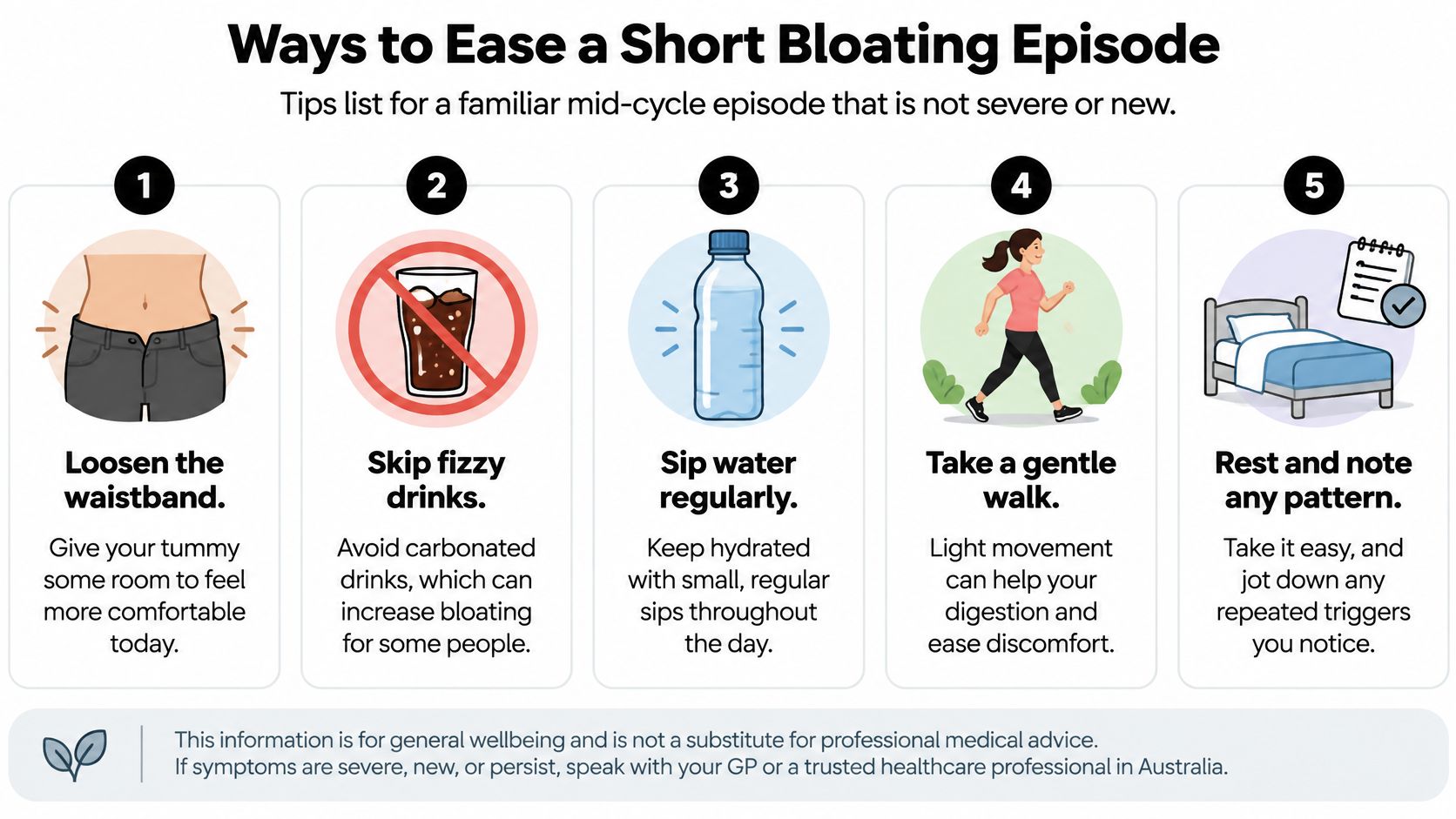
Try gentle same-day measures
- Loosen your waistband. Choose clothing that doesn't press on a tender abdomen. Removing pressure won't identify the cause, but it can make sitting and moving more comfortable.
- Take an easy walk if it feels comfortable. Gentle movement may help when gas contributes to fullness. Don't force exercise through pelvic pain or treat a workout as a test of whether symptoms are serious.
- Sip water and avoid an unusually large meal. Smaller, comfortable portions may be easier to tolerate than a heavy late meal. There's no need to force excessive amounts of water.
- Keep fibre steady. Continue familiar fruit, vegetables and whole grains rather than suddenly adding a large fibre supplement or dramatically changing your meals. Sudden dietary experiments can make it harder to identify what's bothering you.
- Notice your established triggers. If fizzy drinks, salty takeaway or sugar alcohols reliably worsen your fullness, ease off them during the episode. Avoid eliminating whole food groups just because a generic bloating list names them.
- Use gentle warmth for comfort. Wrap a warm heat pack in fabric and protect your skin. Note whether the discomfort is central or one-sided, but don't use relief from heat as evidence of a diagnosis.
- Write a brief entry. Record what you ate, your bowel pattern and whether the pressure eased. That gives you something concrete to compare when symptoms return.
Know what comfort measures can't do
If you're looking for additional practical reading, GutRx's guide to find quick relief from bloating discusses general bloating strategies. Keep the distinction clear: digestive comfort advice isn't confirmation that your symptoms come from ovulation.
These steps don't move ovulation, treat endometriosis or resolve an ovarian cyst. They also aren't a substitute for an individual IBS assessment.
If the usual measures stop helping, or you need them repeatedly to get through ordinary activities, arrange a review rather than steadily expanding your home-treatment routine.
When to Book a Check and What to Track Next
Book a GP appointment when bloating extends well beyond your familiar mid-cycle pattern, continues after your period, returns throughout the month or gradually worsens. Pelvic pain, abnormal bleeding, urinary symptoms, feeling full unusually quickly after small meals, or sustained bowel changes strengthen the reason to seek assessment.
Healthdirect's ovarian cyst guidance includes bloating and abdominal or pelvic symptoms among possible presentations. Many cysts cause no symptoms, and simple cysts often resolve without treatment, so fullness alone doesn't tell you whether a cyst is present.
Get urgent help for acute symptoms
- Sudden severe pain or faintness: Seek urgent care rather than assuming it's ovulation.
- Heavy bleeding or persistent vomiting: Get prompt medical assessment, especially with abdominal or pelvic pain.
- Bowel or bladder bleeding: Don't explain it away as an ordinary cycle symptom; seek medical advice promptly.
Track fertility separately from discomfort
For a short, settling pattern, use LH results or basal-temperature information to estimate ovulation rather than treating bloating as a test. A positive LH result indicates a hormonal surge associated with approaching ovulation, not pregnancy or guaranteed egg release.
Our Venus Ovulation Predictor Test Kit is an at-home option for recording that hormone shift. Results can be logged manually or in your preferred fertility app alongside symptom notes.
If your cycle dates are unpredictable, our guide to tracking ovulation with irregular periods explains how to approach timing. Bring your diary to your appointment, including the comfortable days and the symptoms that affect daily life.
Venus Health Co. offers at-home LH ovulation testing, Bluetooth basal-temperature tracking and app-based cycle records to help you put symptoms in context without relying on bloating alone. Visit Venus Health Co. to explore the tracking tools and choose a practical way to record your next cycle.