

PMDD vs PMS: Symptoms, Diagnosis and Treatment Compared
Dr. Adeyinka Adegbosin51% of respondents in a Butterfly Foundation survey of 1,002 Australian women and non-binary people said periods, PMS, PMDD or related menstrual symptoms negatively affected how they felt about their bodies, according to the foundation's January 2025 survey. Premenstrual symptoms can affect much more than physical comfort. But that doesn't mean every difficult premenstrual experience is PMDD.
The most useful way to understand PMDD vs PMS is to ask when symptoms happen and what they stop you doing. A clinician needs that context, not just a list of symptoms or an app's prediction.
Why PMDD and PMS Are Often Confused
You might call it PMS when you feel bloated, exhausted or unusually irritable before your period. The same label can also get used when someone feels depressed, can't manage work or experiences repeated relationship conflict.
That broad everyday use hides an important clinical distinction. Premenstrual syndrome (PMS) covers recurring physical, emotional and behavioural symptoms before menstruation. Premenstrual dysphoric disorder (PMDD) requires a particular pattern of prominent mood symptoms and substantial disruption to daily life.
Shared symptoms don't mean identical conditions
Both conditions can involve fatigue, appetite changes, breast tenderness and irritability. PMDD isn't identified by one unmistakable symptom, and severe physical discomfort alone doesn't establish the diagnosis.
- Timing matters: A clinician needs to know whether symptoms improve meaningfully after menstruation begins.
- Impact matters: Missing work, withdrawing socially or struggling with routine responsibilities deserves assessment, not dismissal as ordinary PMS.
- Other explanations matter: Persistent depression or anxiety shouldn't automatically be attributed to your cycle.
Life stage belongs in that conversation too. If you're also wondering about mood changes around menopause, menopause guidance from Total Mental Wellness offers a separate resource to discuss with your clinician.
The practical question isn't whether your PMS is bad. It's which explanation fits your symptoms, and what should happen next?
PMDD and PMS at a Glance
| Feature | PMS | PMDD |
|---|---|---|
| Core definition | Recurring physical, emotional or behavioural symptoms before menstruation | Severe premenstrual disorder with prominent mood symptoms and functional impairment |
| Prevalence | PMS symptoms are experienced by up to 50% of women globally, according to an Australian obstetrics and gynaecology review, which estimates PMDD affects approximately 3–8% of women of reproductive age | Less common than PMS, as quantified in the same review |
| Symptom threshold | Broad criteria may include a small number of symptoms | A specified symptom count, including a core mood symptom |
| Timing | After ovulation and before menstruation, easing with bleeding | Predominantly the final premenstrual week, improving within days after bleeding begins |
| Functional impact | May cause discomfort without marked disability | Markedly interferes with work, study, social activities or relationships |
| Diagnostic process | Clinical history and assessment of the symptom pattern | Clinical assessment supported by prospective daily records |
| Blood test | None confirms the condition | None confirms the condition |
| Typical next step | Self-care, appropriate symptom relief and monitoring | Clinician review and an individual treatment plan, potentially including medication |
The functional impact row most changes what you should do. Feeling uncomfortable while continuing your usual activities isn't the same as being unable to complete a shift, attend classes or maintain relationships during recurring symptomatic days.
That doesn't mean PMS is trivial. Someone can need treatment for distressing symptoms without meeting PMDD criteria. Equally, being able to force yourself through work doesn't prove symptoms are mild, especially if doing so leaves you unable to manage anything else.
Why prevalence estimates differ
PMS is a broad label, and different definitions capture different experiences. A survey asking whether someone ever has premenstrual bloating will identify a much larger group than an assessment requiring recurrent mood symptoms, a clear recovery interval and significant impairment.
Practical rule: Don't use how common PMS is to decide whether your own symptoms deserve care.
A pattern that repeatedly disrupts your life and then improves after bleeding begins is worth raising with a clinician. A manageable, cyclical pattern may fit PMS more closely, but a comparison table can't make that determination for you.
Symptom Timelines and Severity Compared
The menstrual cycle provides a timeline for interpreting symptoms, not a rigid appointment schedule. Your cycle doesn't have to match an illustration for your symptoms to deserve attention.
This visual shows the relationship between cycle phases and premenstrual symptoms.
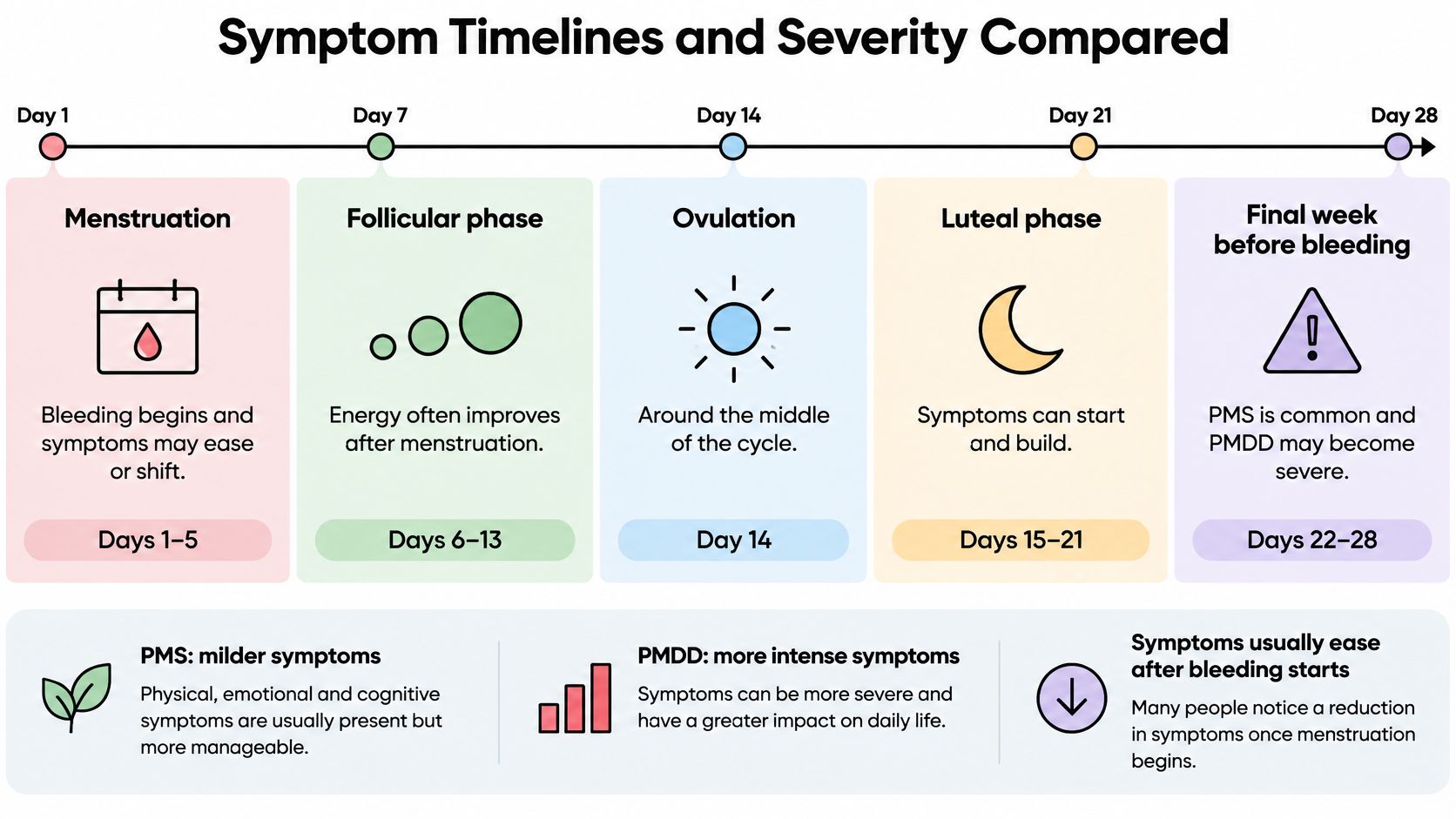
Follow the sequence rather than fixed dates
Menstruation begins with bleeding. Premenstrual symptoms generally start easing around this transition, although period pain or other menstrual symptoms can still be present.
The follicular phase starts with menstruation and continues towards ovulation. For someone being assessed for PMDD, the relatively well interval matters: a clinician looks for a meaningful contrast between symptomatic and lower-symptom days.
After ovulation, the luteal phase continues until the next period. PMS symptoms may develop during this phase, while the characteristic PMDD pattern becomes particularly apparent close to the next bleed. Our guide to luteal-phase mood changes can help you describe what you notice without assigning yourself a diagnosis.
The following is a hypothetical 28-day cycle, not a timetable to use for predicting your own ovulation.
| Cycle phase | PMS pattern | PMDD pattern |
|---|---|---|
| Menstruation, example days 1–5 | Premenstrual symptoms ease as bleeding starts | Mood symptoms lift shortly after bleeding begins |
| Ovulation, example day 14 | Symptoms may develop after ovulation | Core symptoms are generally minimal or absent before the premenstrual rise |
| Final 5–7 days before bleeding in this example | Bloating, tenderness and irritability may remain manageable | Marked mood symptoms interfere with work, study or relationships |
Describe severity through everyday consequences
Rather than relying only on mild, moderate or severe, record what happened.
- Noticeable but workable: Say you have bloating and tender breasts before your period, but you can still complete your usual activities.
- Disruptive: You need extra breaks, postpone exercise or struggle to concentrate on routine tasks.
- Markedly impairing: You cancel plans, repeatedly argue with your partner, miss shifts or feel unable to manage ordinary responsibilities.
These examples illustrate impact, not diagnostic categories. A missed shift alone doesn't establish PMDD, and symptoms don't have to cause every possible consequence to be serious.
Healthdirect's Australian PMS guidance estimates that about 8 in every 100 women experience PMDD. The actionable distinction for an individual is still the repeating relationship between symptoms, cycle phase and daily functioning.
Symptoms that remain strong throughout the cycle, or improve only briefly, need assessment for another or co-occurring condition.
Diagnostic Criteria Side by Side
PMDD assessment brings together symptom type, cycle-phase timing, recurrence and impairment. A clinician considers how these features fit together and whether another explanation may account for the symptoms.
The Therapeutic Goods Administration's PMDD treatment guideline describes a threshold of at least five of 11 symptoms, including at least one core mood symptom. Daily symptom records across at least two cycles can support a clinician's assessment by showing whether symptoms follow a recurring pattern.
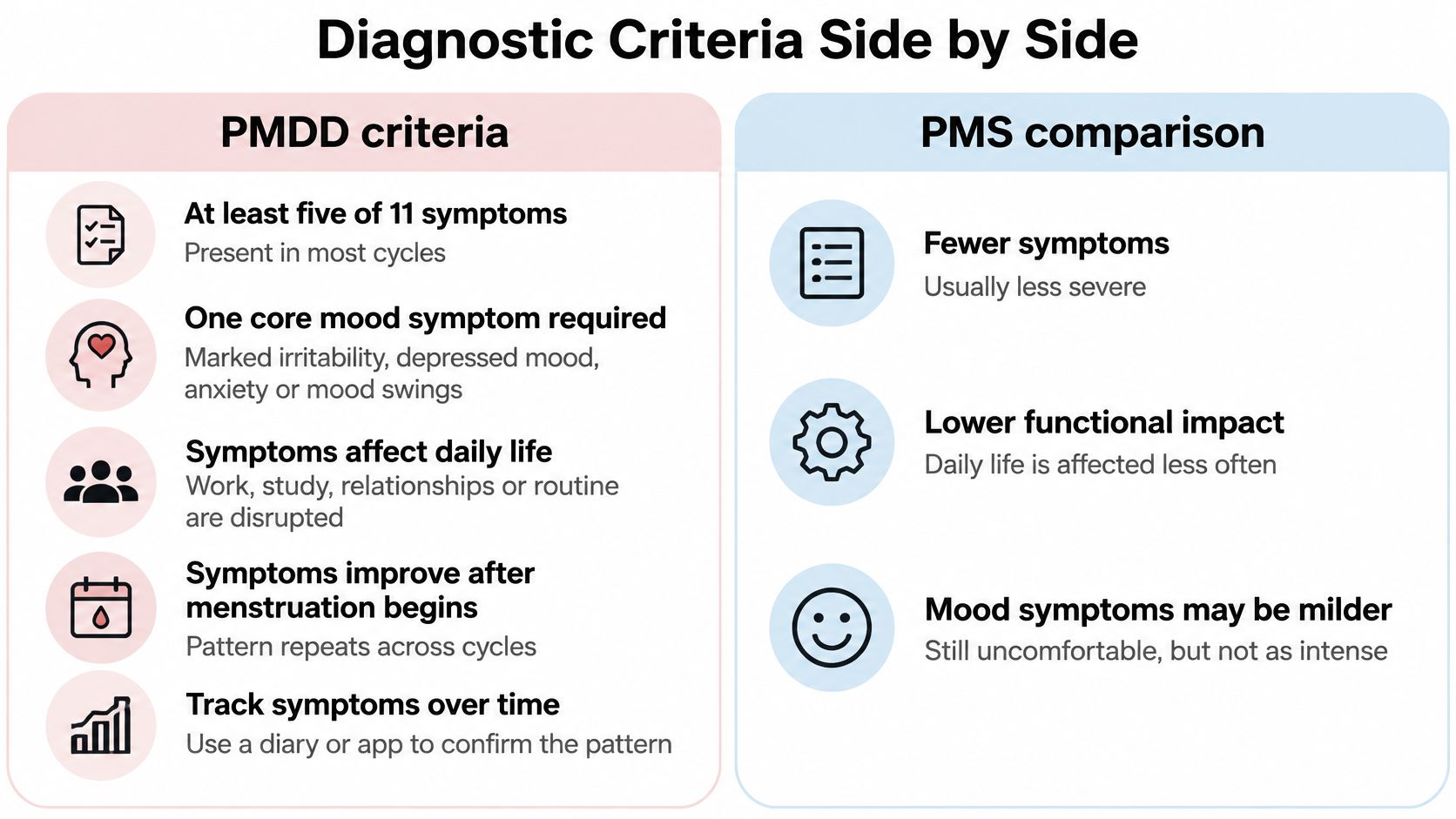
Check the symptom groups
Core mood symptoms include:
- Marked emotional changes: pronounced mood swings, sudden sadness or increased sensitivity to rejection.
- Marked irritability or anger: this may involve more conflict with others.
- Marked depressed mood: hopelessness or strongly self-critical thoughts may occur.
- Marked anxiety or tension: feeling persistently keyed up or on edge during the symptomatic window.
Other categories include reduced interest in usual activities, difficulty concentrating, low energy, appetite changes, altered sleep, feeling overwhelmed or out of control, and physical symptoms such as breast tenderness or bloating. These physical symptoms contribute to the overall picture, but cannot meet the symptom threshold alone.
A diary makes the mood criteria more concrete. For example, on each day you feel unusually irritable, record the date, where you are in your cycle, how strong the feeling is, and whether it affects an activity or relationship. Include days when the symptom is absent, too, so the record shows the contrast.
Check the pattern and impairment
For PMDD, symptoms should cluster before menstruation, improve shortly after bleeding begins, and become minimal or absent during the following week. The pattern should recur across cycles, rather than appear only during an isolated stressful month.
Impairment is part of the diagnostic picture. A clinician may ask how symptoms affect work, education, social activities, responsibilities at home and relationships, including tasks you avoid or can complete only with unusual difficulty. PMS is assessed more broadly through symptom history and timing, without the same required combination of core mood symptoms and marked functional interference.
A symptom record helps organise observations, while clinical assessment considers whether another condition better explains them.
Consider what else needs assessment
Depression or anxiety may continue throughout the month and intensify before menstruation. That pattern can call for a different assessment from symptoms that largely ease between premenstrual episodes.
Hormone-level testing does not reliably distinguish PMS from PMDD, as described in the Australian-adopted PMDD guideline resource. A GP may still arrange investigations if another cause is suspected.
Prospective recording means noting symptoms as they happen, including well days. This gives the clinician a clearer view of the difficult window alongside your usual baseline, while supporting rather than replacing their assessment.
Causes and Treatment Options Compared
PMS and PMDD are associated with changes in oestrogen and progesterone across the menstrual cycle. Current understanding points to differences in how some people respond to these normal fluctuations, rather than a simple pattern of unusually high or low hormone levels. A menstrual-cycle hormones graph can show how hormone levels change across the cycle, though it cannot explain an individual's symptoms or diagnose a condition.
PMDD is linked with an altered response to hormonal fluctuations, and serotonin-related brain signalling may be involved. These proposed mechanisms help explain why treatment can target mood symptoms as well as physical discomfort.
Match treatment to symptoms and circumstances
Self-care and targeted symptom relief may be enough for some people with PMS. PMDD more often calls for a clinician-led plan that takes symptom timing and functional impairment into account and may combine medication, psychological support and practical changes.
| Option | Typical use for PMS | Typical use for PMDD | Notes |
|---|---|---|---|
| Lifestyle measures, including exercise, a sleep routine and reducing alcohol, caffeine and salt | Initial self-care approaches | Support alongside clinical treatment | Try a consistent bedtime or regular exercise routine, then note whether sleep, symptoms or daily functioning change |
| SSRIs, prescribed continuously or during the luteal phase | A prescriber may consider them for severe symptoms | A first-line medication option | A prescriber sets the schedule and reviews mood, response and side effects |
| Combined hormonal contraception | A clinician may discuss it when contraception is also wanted or symptoms are troublesome | A clinician may consider it after reviewing health history and treatment goals | Discuss previous responses to hormones, contraception needs and pregnancy plans |
| Cognitive behavioural therapy | A clinician may suggest it for coping with symptom-related difficulties | A psychological treatment option | Ask your GP about referral and local access |
| GnRH analogues with add-back therapy | Rarely used | Specialist option for severe symptoms that haven't responded to other treatments | Suppresses ovarian activity and requires monitoring |
SSRIs are selective serotonin reuptake inhibitors. An antidepressant is a recognised clinical option for PMDD and reflects the severity of symptoms, not whether they are real. For appointment preparation, Refresh Psychiatry & Therapy's resource can help you compare antidepressants for PMDD. Use it as a discussion aid with your clinician, not to choose a drug, change a dose or start intermittent treatment independently.
Agree on a review plan
Treatment choices depend on mood history, other medicines, contraception preferences and whether you're trying to conceive. Tell your prescriber about previous medication reactions and any history of unusually high mood or reduced need for sleep.
- Define the goal: Fewer cancelled commitments, improved concentration or less relationship conflict can be meaningful outcomes.
- Record changes: Note when treatment starts and whether symptoms or daily functioning improve.
- Ask about follow-up: Know when you'll review benefits, side effects and alternatives.
Lifestyle changes are one part of care, not a measure of effort. If you already exercise, keep a regular sleep schedule and eat adequately, but remain significantly impaired, discuss medical options with a clinician. Judge any change by whether it improves your symptoms or makes daily activities easier.
Fertility and Everyday Life Impact
In a study of 1,238 Australian women of reproductive age, 77% reported bothersome menstrual symptoms and 44% reported missing work or study because of them, according to the Western Sydney University publication. The findings cover menstrual symptoms broadly, not PMDD alone.
For example, if symptoms disrupt concentration during a symptomatic week, you might ask to move a deadline or arrange flexibility for an appointment. That concrete effect on daily functioning matters more than the label alone.

Separate fertility questions from symptom questions
Neither PMS nor PMDD is generally recognised as a cause of infertility. Evidence directly linking PMDD with fertility outcomes is limited, so symptoms cannot tell you whether you will conceive or whether ovulation occurred.
Treatment choices may affect plans to conceive. Hormonal contraception prevents pregnancy while used, and ovarian-suppression treatment affects ovulation. Discuss these options before making changes, particularly to psychiatric medication.
Ovulation tracking addresses a different question from PMDD assessment. The Venus Ovulation Predictor Test Kit is an at-home tool for tracking ovulation-related signals. It does not test for a premenstrual mood disorder or guarantee pregnancy.
Make daily support concrete
Planning support can help with specific needs during symptomatic days. At work or study, explain the practical difficulty, such as reduced concentration or needing flexibility for appointments, without feeling obliged to disclose every symptom. At home, agree on help with meals, childcare or demanding tasks. In relationships, discuss the pattern during a relatively well interval and agree on how to pause conversations if they begin to escalate.
For context on menstrual experiences, the following video discusses symptoms and their everyday effects:
Questions about stress-related hormone screening are separate from assessing PMDD. Vital iQ Health's cortisol testing guidance for health screening covers that topic. Feeling stressed does not establish a cortisol disorder, and cortisol testing does not diagnose PMDD.
Confirm the Pattern Before You Act
Start recording before trying to interpret every fluctuation. A simple diary you complete consistently is more useful for a clinical conversation than an elaborate dashboard with missing symptom entries.
You don't need a device to begin. Paper, a spreadsheet or an app can all hold the observations your clinician needs.
Build a usable daily record
- Begin now and continue across consecutive cycles. Record both difficult and relatively well days rather than writing only when symptoms peak.
- Mark bleeding dates. Cycle length is counted from the first day of a period to the day before the next period starts.
- Rate symptoms consistently. Use the same scale each day for irritability, low mood, anxiety, energy, sleep and physical discomfort.
- Describe impairment separately. Add concrete notes such as leaving work early, cancelling a class or struggling to prepare dinner.
- Include context. Note medication changes, illness, stressful events and sleep disruption, without assuming any one factor explains everything.
- Bring the record into care. Ask the clinician whether the pattern fits PMDD, PMS, premenstrual worsening of another condition or something else.
Choose tools for recording, not diagnosing
Our guide to choosing a period tracker app can help you consider how you'll log and review symptoms. Prioritise something you'll use and can show at an appointment.
The Venus Smart Basal Thermometer for Ovulation - Bluetooth BBT Tracker with App syncs basal temperature readings to an app that also supports symptom and LH logging. Temperature information can add cycle context, but it doesn't measure mood severity or establish PMDD.
Decision point: A recurring premenstrual pattern that clearly interferes with your life warrants clinical assessment, regardless of what a tracking tool labels it.
When results fluctuate day to day, we recommend tracking over several cycles for greater insight. Don't postpone care to finish a perfect record, especially if symptoms are already severe.
When to Seek Care and What to Bring to a GP
Book a GP appointment when symptoms regularly distress you, affect sleep or interfere with work, study, relationships or home responsibilities. Seek review too if self-care hasn't helped, the pattern is changing or symptoms remain present outside the premenstrual window.
Seek urgent help for suicidal thoughts, thoughts of self-harm or concerns that you can't keep yourself safe. In Australia, call 000 for immediate danger or Lifeline on 13 11 14 for crisis support; you don't need to establish whether PMDD is responsible before reaching out.
Bring evidence of the impact
A short, organised summary can make the appointment easier to use.
- Your daily record: Include symptom-free days and specific examples of disruption, not just symptom intensity.
- Cycle dates: Bring bleeding dates and note irregular or missing periods.
- Medicines and supplements: Include prescriptions, contraception, non-prescription products and recent changes.
- Your main concern: Explain what you most need help with, whether that's depressed mood, conflict, missed work or feeling unsafe.
Ask how the GP will consider depression, anxiety, thyroid problems, medication effects and other mood conditions. Also ask what treatment options are appropriate, how improvement will be assessed and when follow-up should occur.
If your symptoms are dismissed
An Australian study of people seeking PMDD care found respondents had consulted an average of 5.1 healthcare providers, while 44.9% reported that a healthcare professional had asked them to track symptoms across any part of the cycle. Participants also described dismissal and limited clinician awareness.
A symptom record is a discussion tool, not something you should have to produce repeatedly to prove you deserve support. If a clinician doesn't take the impairment seriously or explain the assessment, asking for a second opinion is reasonable.
You can request referral to a women's health clinician, gynaecologist or mental health service when symptoms are severe, atypical or unresponsive to treatment. Before leaving, ask for a clear next step: an assessment plan, a treatment discussion or a follow-up appointment.
Venus Health Co. offers app-connected basal temperature tracking and tools for logging cycle information, LH results and symptoms. Visit Venus Health Co. to explore ways to organise your records for a clinician discussion, while keeping PMS and PMDD diagnosis firmly within medical care.