

Can You Get Dna Test During Pregnancy
Dr. Adeyinka AdegbosinYes, you can get a DNA test during pregnancy, with NIPT available from 10 weeks and non-invasive prenatal paternity testing available from about 7 to 10 weeks, depending on the provider. You may be asking about the baby's chromosomes, or you may be asking who the biological father is, and those are two different tests.
You might be sitting in a clinic with a list of questions that sounds simple: “Can you get DNA testing before the baby is born?” The answer is yes, but the right test depends on what you're trying to find out. A test for Down syndrome and other chromosomal conditions isn't the same as a test for biological parentage, even though both may involve a blood sample from the pregnant person.
Yes, You Can Get a DNA Test During Pregnancy
The first step is to separate the two possible questions.
If you want to understand the baby's chance of having certain chromosomal conditions, you're asking about prenatal screening or diagnosis. The usual starting point is non-invasive prenatal testing, or NIPT. It uses cell-free DNA in the pregnant person's blood to screen for conditions such as trisomy 21, trisomy 18 and trisomy 13. NIPT can be performed from 10 weeks' gestation in Australia, but it's a screening test, not a diagnosis. A higher-risk result needs confirmation through a diagnostic procedure such as chorionic villus sampling or amniocentesis. The Victorian Department of Health's prenatal screening guidance explains this distinction clearly.
If you want to establish who the biological father is before birth, you're asking about prenatal paternity testing. A non-invasive test uses the pregnant person's blood and a DNA sample from the alleged father. It answers a relationship question, not a medical screening question.
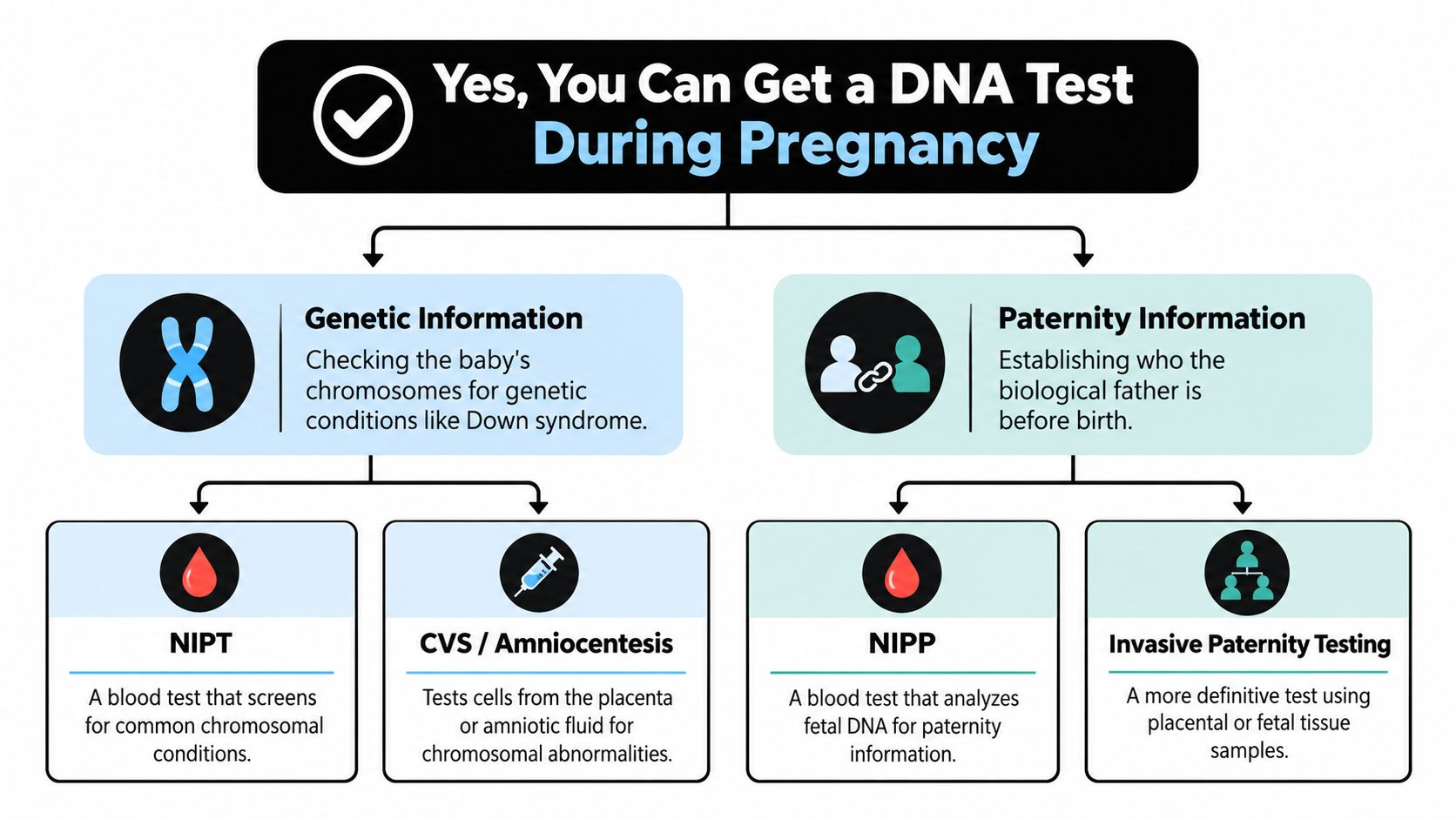
The simplest way to sort out your options
A standard blood draw is used for NIPT and for non-invasive prenatal paternity testing. It doesn't mean the tests are interchangeable. The laboratory looks for different information, compares different DNA profiles and produces a different type of report.
More involved procedures can collect a direct sample from the pregnancy. CVS samples placental tissue, while amniocentesis samples amniotic fluid. These procedures are used for medical diagnosis and can sometimes be used for paternity testing, but they're not usually chosen for a relationship question alone because they require an invasive procedure.
Your decision usually comes down to four practical points:
- Purpose: Are you checking chromosomal risk or biological parentage?
- Timing: How many weeks pregnant are you?
- Certainty: Do you need a screening estimate or diagnostic confirmation?
- Use of the result: Is the result for personal reassurance, or might it be needed for legal, child support or immigration purposes?
That last question matters more than many people expect. A scientifically accurate home result may not meet Australian legal requirements if nobody verified who provided the sample.
How Fetal DNA Ends Up in the Mother's Blood
The blood test works because the placenta releases tiny fragments of DNA into the pregnant person's bloodstream as it develops. These fragments circulate alongside the mother's own DNA. A laboratory can separate and analyse the cell-free fetal DNA, although the material comes mainly from the placenta rather than from a direct sample taken from the baby.
Think of the bloodstream as a moving mixture. Most of the DNA belongs to the mother, while a smaller portion comes from the pregnancy. The laboratory needs enough of that pregnancy-related DNA, often called the fetal fraction, to interpret the sample reliably.
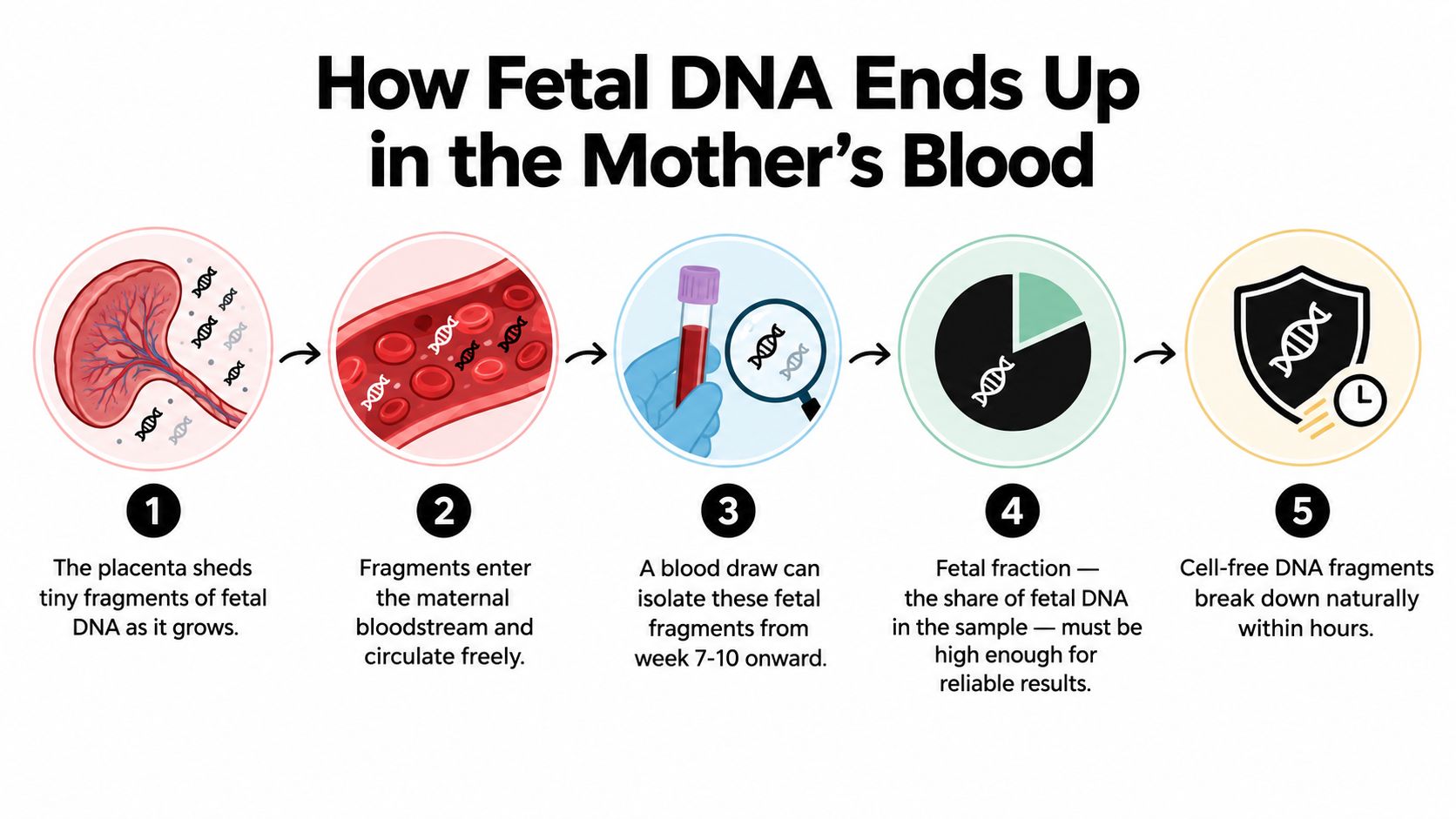
NIPT is usually offered from 10 weeks' gestation because fetal DNA is more reliably detectable at that point. Pregnancy Birth and Baby explains that NIPT analyses cell-free fetal DNA in maternal blood and is generally available from 10 weeks. The same timing issue matters for prenatal paternity testing. If the sample contains too little fetal DNA, the laboratory may not be able to produce a dependable result.
Why a blood draw is different from CVS or amniocentesis
A blood draw collects DNA fragments that are already circulating outside the uterus. It doesn't require a needle to enter the pregnancy, which is why non-invasive tests avoid the procedure-related risks associated with sampling placental tissue or amniotic fluid.
CVS and amniocentesis work differently. A clinician uses a needle-based procedure to collect material directly from the pregnancy. That direct sample can answer broader or more specific diagnostic questions, but it also means discussing the procedure, its benefits and its risks with an obstetrician or specialist.
The blood sample itself doesn't touch the baby's environment. That doesn't make every result conclusive, however. A non-invasive test can still be limited by fetal fraction, gestational age, the type of question being asked and the laboratory's testing process.
The Three Medical DNA Tests and When Each Happens
Medical prenatal testing becomes easier to understand when you place the options in order of how directly they sample the pregnancy.
NIPT comes first for many people. It involves a blood draw from the pregnant person and analyses cell-free fetal DNA. It screens for common chromosomal conditions, including trisomy 21, trisomy 18 and trisomy 13. A low-risk result is reassuring, but it doesn't rule out every genetic or structural condition. A high-risk result isn't a diagnosis, either. Your care team will discuss whether you need diagnostic testing.
Chorionic villus sampling, or CVS, collects a small sample of placental tissue. Because the sample comes directly from the placenta, the laboratory can perform diagnostic testing for a wider range of conditions than a screening test can assess. CVS is arranged through an obstetrician or specialist service when there's a specific medical reason to seek a confirmed answer.
Amniocentesis collects a sample of amniotic fluid. The fluid contains cells from the pregnancy that can be analysed for diagnostic purposes. Like CVS, it's an invasive procedure and isn't a more detailed version of NIPT. It's used when the clinical question calls for diagnostic testing or when a screening result needs confirmation.
Practical rule: A screening result estimates chance. A diagnostic test examines a direct pregnancy sample to confirm whether a condition is present.
Three prenatal DNA tests at a glance
| Test | When in pregnancy | Sample taken | Looks for | Screen or diagnose |
|---|---|---|---|---|
| NIPT | From 10 weeks | Maternal blood | Common chromosomal conditions | Screens |
| CVS | Timing decided by the specialist service | Placental tissue | A wider range of genetic and chromosomal conditions | Diagnoses |
| Amniocentesis | Timing decided by the specialist service | Amniotic fluid | A wider range of genetic and chromosomal conditions | Diagnoses |
The timing of your ultrasound also matters. NIPT doesn't replace ultrasound assessment, and a six-week pregnancy scan serves a different purpose from later screening and diagnostic procedures. Your clinician may recommend ultrasound alongside screening because imaging can identify structural concerns that DNA screening doesn't assess.
The key point is not that one test is universally better. NIPT offers early, non-invasive screening, while CVS and amniocentesis provide a route to diagnostic confirmation when the situation calls for it.
Prenatal Paternity Testing and How It Differs from NIPT
A low-risk NIPT result can tell you that the screening pattern for certain chromosomal conditions is reassuring. It cannot tell you who the biological father is. NIPT and prenatal paternity testing may both use maternal blood, but they answer completely different questions.
Non-invasive prenatal paternity testing, sometimes called NIPP, compares fetal DNA fragments found in the mother's blood with DNA from the alleged father, usually collected with a cheek swab. Australian guidance describes this approach as carrying no risk to the pregnancy because it doesn't require CVS or amniocentesis. Providers may offer testing from around 7 to 10 weeks, depending on their process and the pregnancy.
The other route is invasive paternity testing. A laboratory can use DNA obtained through CVS or amniocentesis, but that means accepting the same procedural considerations as any invasive diagnostic test. If paternity is the only question, ask why an invasive method is being proposed and whether a non-invasive option is suitable.
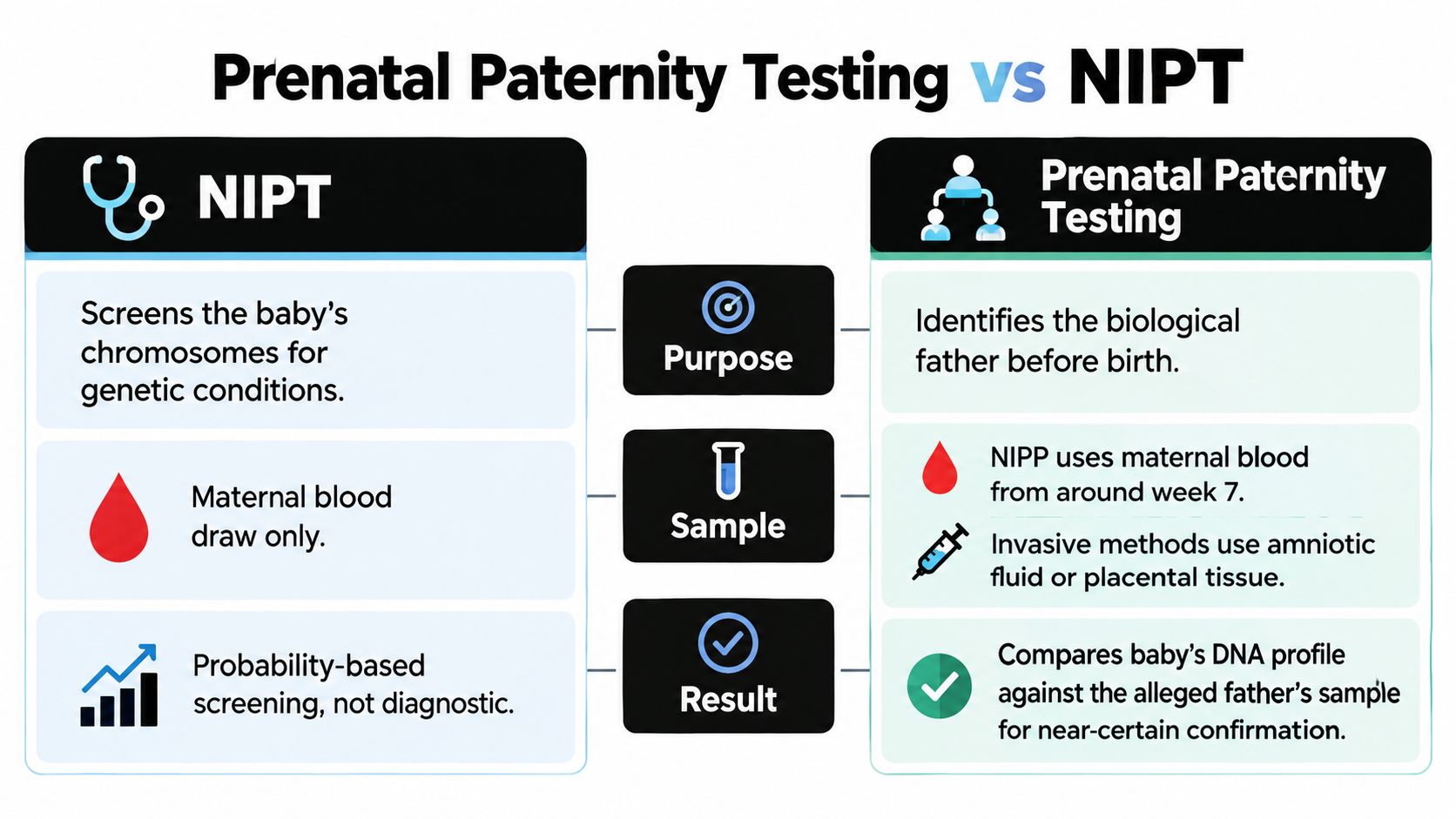
What a paternity result means
A paternity report compares genetic markers from the pregnancy and the alleged father. When the man tested is the biological father, providers may report a very high probability of paternity, while a man who isn't the father may be excluded. The exact wording and threshold depend on the laboratory.
A very high probability is not the same as a diagnosis of a chromosomal condition. It answers the parentage question based on the DNA profiles tested. It also doesn't settle every legal issue, such as parental responsibility, birth registration or financial arrangements.
The phrase “no risk to the pregnancy” needs careful interpretation. For NIPP, the pregnancy sample comes from a maternal blood draw, so the procedure-related risk associated with placing a needle near the placenta or amniotic sac doesn't apply. The blood draw can still cause ordinary short-term discomfort, bruising or light-headedness, and the test may not be available for every pregnancy. Some providers exclude IVF, twin or multiple pregnancies, and adequate fetal DNA must be present in the sample. Pregnancy Birth and Baby outlines these practical limits and the difference between prenatal paternity testing and NIPT.
Accuracy and Risk Compared Across All Prenatal DNA Tests
People often ask for one “most accurate” test, but accuracy only makes sense alongside the question being asked. NIPT is designed to screen for particular chromosomal conditions. A paternity test compares parentage. CVS and amniocentesis answer diagnostic questions using direct samples.
For NIPT, the important limitation is the difference between high accuracy for selected screening targets and complete genetic certainty. A low-risk result doesn't guarantee that the baby has no genetic condition, while a high-risk result still requires confirmation before major decisions are made.
Non-invasive prenatal paternity testing is also highly dependent on the quality and sufficiency of the samples, the alleged father tested and the laboratory's methods. A test can't answer whether another possible father is the biological parent if that person hasn't been tested.
Accuracy and risk by prenatal DNA test
| Test | Accuracy or detection rate | Procedure-related miscarriage risk | Result type |
|---|---|---|---|
| NIPT | High screening accuracy for common chromosomal conditions | No invasive sampling procedure | Probability-based screening |
| CVS | Diagnostic testing for the conditions examined | Small but real procedure-related risk | Diagnostic |
| Amniocentesis | Diagnostic testing for the conditions examined | Small but real procedure-related risk | Diagnostic |
| Non-invasive prenatal paternity testing | May provide a very high probability of paternity when the tested man is the biological father | No procedure inside the uterus | Parentage report |
The trade-off is straightforward. Non-invasive tests avoid an invasive procedure but may provide screening information rather than diagnosis, depending on the test. Invasive tests can provide diagnostic information but require a procedure with risks that your clinician must explain.
You also need to consider what you'd do with the result. If a high-risk screening result wouldn't change your decisions, you may choose not to screen. If you would want diagnostic certainty, ask about the pathway before having NIPT. Counselling is particularly important when the possible result could affect pregnancy management, preparation for birth or decisions about further testing.
How to Get a Prenatal DNA Test in Australia
Start by naming the question to your GP, midwife or obstetrician. Say whether you want chromosomal screening, diagnostic testing or prenatal paternity testing. That simple distinction helps the clinician direct you to the right service rather than treating every DNA test as the same product.
For NIPT, your provider will confirm your gestational age, explain which conditions the test covers and discuss how you'll receive the result. NIPT is commonly self-funded in Australia. A review of its introduction and uptake found that women were spending about AU$18 million per year on self-funded screening, with the test costing around AU$450 and not attracting a Medicare rebate at that time, as reported in this Australian review of NIPT. Fees and rebate arrangements can change, so check the current position with your provider.
The practical pathway
- Book a discussion. Ask a GP, midwife or obstetrician which test matches your purpose and gestational age.
- Clarify the result. Find out whether the test screens, diagnoses or establishes parentage.
- Ask what happens next. Before NIPT, ask what follow-up would be offered after a higher-risk result.
- Check legal requirements. If paternity may be used in court, child support, immigration or another official process, arrange a legally collected test from the beginning.
- Confirm the laboratory. Ask whether the service is NATA-accredited for the type of legal DNA testing you need.
CVS and amniocentesis are specialist procedures. Your obstetrician or maternal-fetal medicine team can explain why one may be offered, what sample will be taken and how the result will affect care. You'll want time to ask questions, especially if the test follows a high-risk screening result.
Support can also include practical and emotional care around pregnancy decisions. A service such as Venus perinatal support services may be relevant for people looking for broader support alongside their clinical appointments.
Why Home DNA Kits Are Not Legally Recognised in Australia
A home DNA kit and a legal DNA test may use similar biological material, but the collection process is different. A legal test requires a documented chain of custody, which shows who provided each sample and how the samples moved from collection to the laboratory.
An accredited collector checks each participant's identity, witnesses the sample collection and seals the samples in a way that can be documented. The laboratory can then link the report to the people who were tested.
A home kit breaks that chain. Even if the laboratory analysis is scientifically sound, the laboratory may not be able to prove that the alleged father, rather than another person, supplied the cheek swab. That's why a private result may not be accepted for official purposes.
A home result can answer a personal question. It doesn't automatically answer a legal question.
If you think you might need the result for family law, child support, Centrelink or immigration, tell the provider before samples are collected. You may need an accredited collection process from the start, or you may have to repeat the test under formal chain-of-custody conditions. The Australian genetics guidance also highlights that the place of NIPT in clinical care remains an evolving area, so ask your clinician to explain how the result fits into your broader care plan. You can read more about the difference between private and formal testing in this guide to an at-home fertility test in Australia.
Choosing the Right Test for Your Situation
Use your goal as the starting point.
- You're concerned about chromosomal conditions: Ask about NIPT first. If the result is higher risk, discuss CVS or amniocentesis for confirmation.
- You need parentage evidence that may be used legally: Arrange prenatal paternity testing with verified identity checks and chain of custody.
- You want private reassurance: A non-invasive prenatal paternity test may fit, but plan for a legally collected retest if official use becomes necessary.
Take these questions to your appointment:
- What exactly am I trying to find out?
- Will anyone need this result for a legal or government purpose?
- What decision would follow from a high-risk screening result?
A test is a tool, not a verdict. The most helpful choice is the one that gives you information you understand and a clear next step.
Venus Health Co. offers home health tools for fertility tracking and everyday wellness, including app-connected monitoring that helps you organise personal health information alongside professional care. Visit Venus Health Co. to explore its fertility and wellness options before your next appointment.