

At-Home Fertility Test Australia: Your 2026 Guide
Dr. Adeyinka AdegbosinYou're standing in a Chemist Warehouse aisle, or scrolling through an Amazon AU search, trying to work out whether you need a packet of urine strips, a smart thermometer, an AMH kit or a full hormone monitor. Every product promises clarity. Very few explain which fertility question they answer.
For an Australian buyer, the decision comes down to two checks. Are you trying to identify the fertile window, estimate ovarian reserve, confirm ovulation, or investigate sperm health? And is the product legitimately supplied for use in Australia under the TGA framework? This guide separates those questions, the devices that address them, and the marketing claims that go further than the evidence.
| Test type | Main signal | What it can tell you | Main limitation |
|---|---|---|---|
| LH urine strips | Luteinising hormone surge | The fertile window may be approaching | Doesn't directly confirm ovulation |
| Basal body temperature | Post-ovulation temperature pattern | Ovulation likely occurred | Confirmation comes after the fertile window |
| AMH or laboratory hormone kit | Ovarian reserve or selected hormones | A biomarker snapshot | Doesn't predict natural conception timing |
| Semen test | Sperm concentration or movement | A screening signal for male fertility | Doesn't provide a validated infertility threshold |
| App-connected monitor | Several cycle signals | A more organised pattern across a cycle | Costs more and still needs interpretation |
Where Most Australians Start With At-Home Fertility Testing
The typical starting point isn't a fertility clinic. It's a phone search late at night, a pharmacy shelf after work, or a partner asking whether the box with the digital reader is really worth the extra money. The choice feels urgent because the underlying problem usually is. You want to time intercourse better, understand a confusing cycle, or reduce the anxiety of waiting without buying a device that turns every morning into another source of stress.
Start with the question, not the product
A positive LH strip answers a timing question. It detects a urine luteinising hormone surge that generally precedes ovulation. It doesn't count eggs, diagnose infertility or prove that an egg was released. Australian clinical guidance explains that the LH surge typically occurs the day before ovulation, while regular-cycle ovulation occurs in at least 90% of cycles. That's why routine home monitoring often isn't necessary for people with regular cycles, although it can still help with timing or reassurance. Australian guidance and TGA context
AMH answers a different question. It estimates ovarian reserve, often described in consumer marketing as an “egg count”, but it doesn't identify the days when conception is most likely. A progesterone result is different again, because it helps confirm that ovulation occurred when timed appropriately through a clinician or pathology service.
Practical rule: Buy the test that answers your current question. Don't buy an AMH kit because you actually need ovulation timing.
The second check is regulatory. The TGA has created a cautious framework for self-tests, particularly where incorrect results could affect health decisions. Australian buyers should look for a product that is supplied through a legitimate Australian channel and has clear medical-device information, rather than assuming that an overseas bestseller is automatically lawful or suitable here.
Male-factor testing belongs in the same conversation. If sperm health is part of the concern, a focused guide to sperm health analysis can help explain what semen testing measures before you spend money on a home kit. The Australian advice is blunt: home semen tests are registered with the TGA, but there isn't a validated fertility cut-off unless sperm are completely absent or immotile.
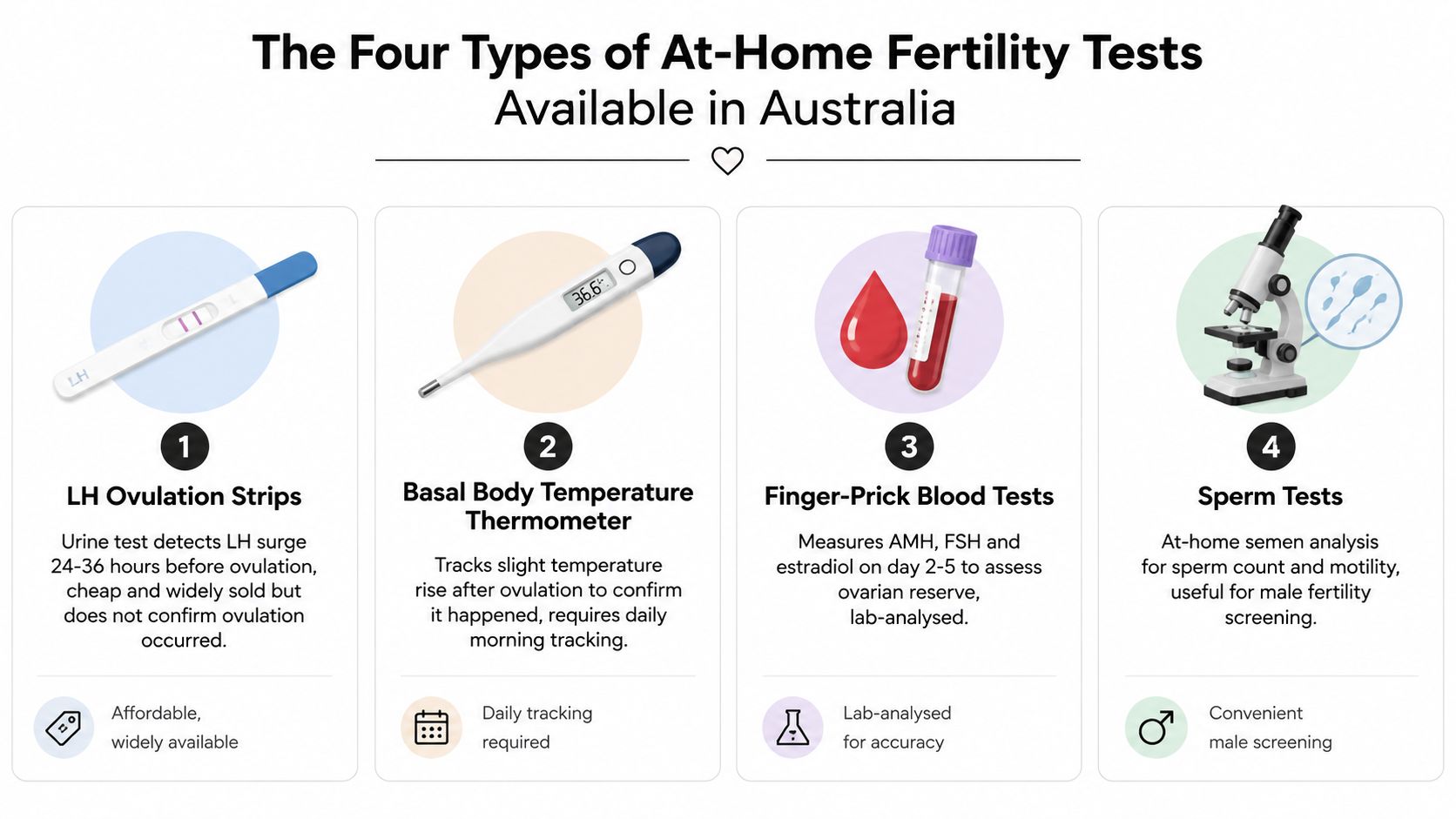
The Four Types of At-Home Fertility Tests Available in Australia
Australian shoppers usually encounter four broad categories. They overlap in the apps and advertising, but they don't measure the same biology.
LH ovulation strips
These are urine tests for luteinising hormone, or LH. A positive result signals that the body is producing the hormone surge associated with imminent ovulation. Australian retail products are widely available through pharmacies and online sellers, and a Venus product page describes strips designed to identify the fertile window 24–36 hours before ovulation. Read about how ovulation strips work
The limitation matters more than the convenience. The 2019 BMJ Global Health review found that ovulation predictor kits detect the LH surge, not ovulation itself, and that two randomised controlled trials found no difference in time to pregnancy between users and non-users. Other trials found either no difference in clinical pregnancy rates or higher self-reported pregnancy rates among users, so the evidence is mixed rather than a guaranteed conception benefit. BMJ Global Health review of home ovulation predictor kits
The Venus Ovulation Predictor Test Kit is an example of a simple strip format. Its supplied product information says it produces results in under 10 minutes, needs no prescription and can be logged manually or in a preferred fertility app. Treat those features as usability benefits, not proof that a positive result guarantees pregnancy.
Basal body temperature
A basal thermometer tracks the small temperature pattern that follows ovulation. It can support confirmation after the event, but it can't reliably give you the fertile window in advance on its own. Daily readings also require a consistent routine, usually before getting out of bed.
That makes BBT a useful companion to LH testing, not a replacement for it. A smart device can remove manual charting, but it can't turn a post-ovulation signal into a forecast.
Laboratory hormone kits
Finger-prick or laboratory kits may measure AMH and, depending on the service, other reproductive hormones. AMH is an ovarian-reserve marker, not a fertile-window test. Australian consumer coverage describes growing access to at-home AMH kits, but the central issue remains interpretation. A result can be directionally useful while still being unable to tell you when conception will occur.
Progesterone is used differently. Australian clinical guidance places progesterone testing around seven days before the predicted period, rather than automatically calling every cycle day 21. Day 21 is only appropriate when the cycle is 28 days long.
App-connected fertility monitors
These systems may combine quantitative urine hormones, BBT, symptoms and algorithmic cycle predictions. They offer a more coherent record than isolated strips, but they also move the user into a more expensive hardware and consumables ecosystem. An app can organise signals; it can't diagnose every cause of delayed conception.
The TGA has also highlighted why specificity matters. One ovulation self-test passed LH sensitivity testing at 50 mIU/mL but failed specificity testing at 200 mIU/mL because it returned a positive result in the presence of hCG. TGA-referenced device information A technically impressive interface doesn't remove the need to check assay performance and intended use.
Comparing Accuracy, Cost and Effort Across Each Option
Accuracy depends on the question you are asking. LH strips detect a hormone surge, BBT records a temperature pattern after ovulation, and AMH estimates ovarian reserve. Treating any of them as a universal fertility test leads to the wrong purchase.
Australian retail prices change with pack size, retailer, laboratory service and subscription structure, so a fixed cost comparison would mislead. Compare the ongoing effort and the type of answer each test can provide.
| Test type | What it measures | AU retail cost (approx.) | Accuracy vs lab/clinic | Daily effort | Best use |
|---|---|---|---|---|---|
| LH strips | Urine LH surge | Varies by pack and retailer | Detects LH, not ovulation itself | Testing around the expected fertile window | Identifying a possible fertile window |
| BBT thermometer | Temperature pattern after ovulation | Varies by device | Supports post-ovulation confirmation | Daily morning reading | Checking whether a temperature shift followed a surge |
| AMH kit | AMH and sometimes other hormones | Varies by laboratory service | Measures a biomarker, but interpretation needs context | One collection plus laboratory processing | An ovarian-reserve snapshot |
| App-connected monitor | Urine hormones and/or temperature | Device and refill costs vary | Depends on each assay and algorithm | Regular testing, logging or both | Building a longer record from several signals |
Accuracy depends on timing and interpretation
An LH result is an early signal, not proof that ovulation occurred. It can help identify when to have intercourse, but it cannot confirm that an egg was released. A positive result may also be difficult to interpret when hormone patterns are irregular.
BBT answers a different question. A sustained temperature rise can support confirmation after ovulation, but it usually arrives too late to identify the fertile days on its own. A smart BBT thermometer guide can reduce recording work, while the Venus Smart Basal Thermometer for Ovulation, Bluetooth BBT Tracker with App is described as syncing readings to an app and combining BBT with logged LH results, symptoms and cervical mucus. That makes the routine easier to maintain. It does not change what BBT measures.
AMH belongs in a separate category. It is an ovarian-reserve marker, not a fertile-window test. A result can provide a reserve snapshot, but it cannot tell you whether you ovulated this month or when conception will occur. A “normal” result is not fertility clearance, and a low result is not the same as infertility. Interpretation should account for ovulation, sperm, fallopian tubes, egg quality, fertilisation and implantation.
Daily effort is part of test quality
Simple LH strips keep hardware costs low, but they require testing at the right point in the cycle and careful reading. Missing the surge can make a negative result unhelpful. BBT requires less decision-making during the day, yet it depends on a consistent morning routine and enough readings to reveal a pattern.
Connected monitors organise more information, but they add device, refill and logging demands. Their algorithm can present a clearer record, while the result still depends on the underlying assay and the quality of the data entered. Do not pay for a premium system if regular testing will stop after one cycle.
AMH is the least demanding day to day, because collection happens once before laboratory processing. Its convenience can encourage overinterpretation, so choose a service that provides clinical context rather than a result screen alone.
How to Choose the Right Test for Your Cycle and Stage of Life
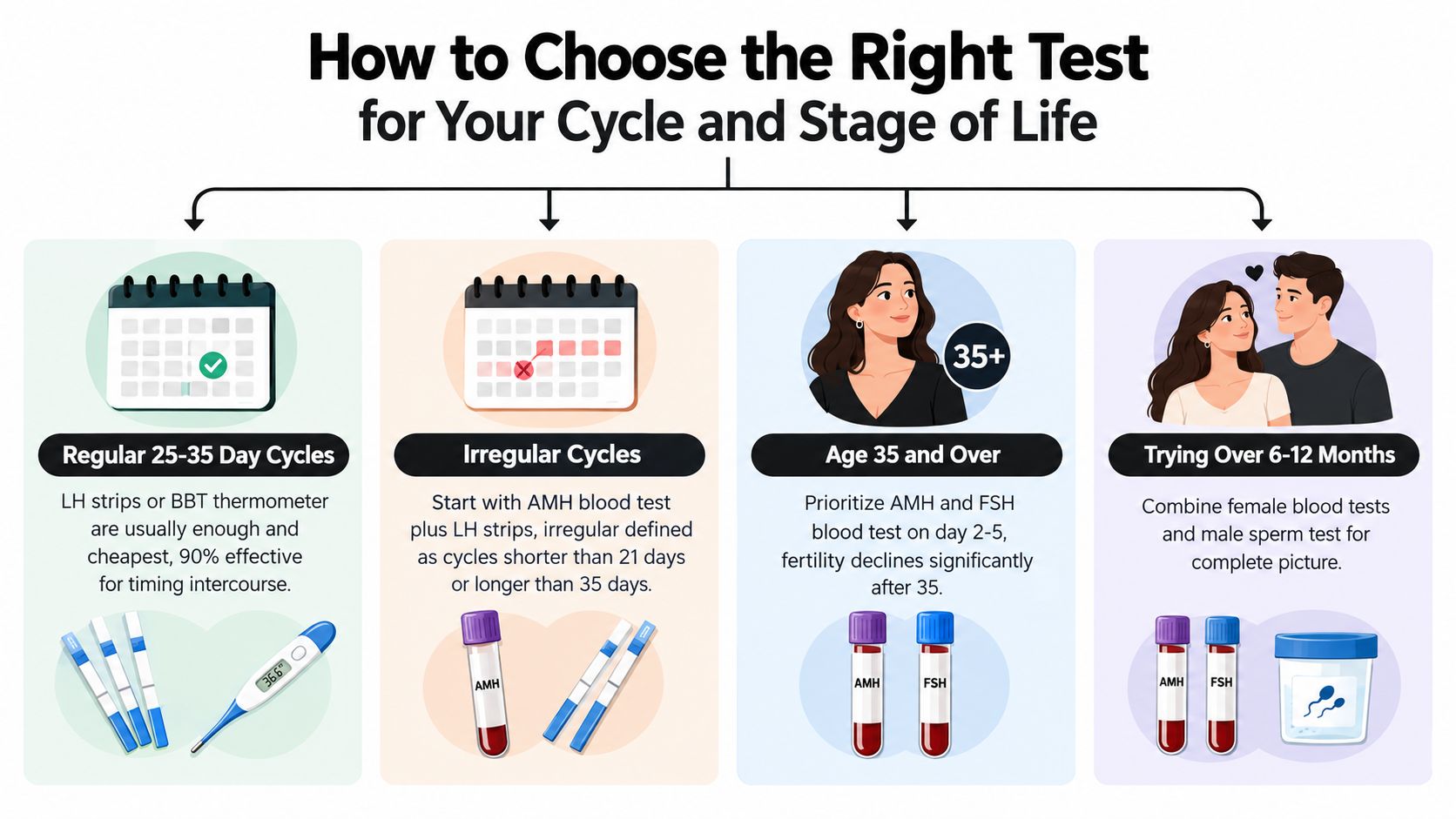
Your cycle pattern should decide the starting point. A generic instruction such as “begin on day 10” assumes a regularity that many Australian users don't have.
Predictable cycles
For regular cycles, start with LH strips when the main goal is timing intercourse. Australian retail instructions vary by cycle length. Some products advise starting as early as day 5 for very short cycles, while others suggest beginning 17 days before the expected next period for cycles longer than 40 days. Follow the instructions for your actual kit rather than copying a chart from another brand.
BBT is the better add-on when you want to know whether the LH signal was followed by a temperature pattern. You don't need a laboratory-style dashboard for this. You need a reliable reading routine and enough patience to see a pattern.
Variable cycles, PCOS or a recent pill
Don't rely on a single positive or negative strip when your cycles are unpredictable. PCOS and other hormonal patterns can make LH results difficult to interpret, so a GP-ordered blood panel or a monitor that follows more than one signal is a more sensible starting point.
After hormonal contraception, your cycle may not immediately resemble its old pattern. An AMH result won't tell you whether you ovulated this month, so buying AMH as the first response to a post-pill cycle is usually the wrong purchase.
Perimenopause and reserve questions
Perimenopause changes the value of casual home testing. If you're concerned about ovarian reserve or changing cycles, discuss AMH and early-cycle FSH with a GP instead of trying to interpret a lone strip result. Australian consumer information makes the distinction clear: AMH and ovulation tests belong to different categories, and neither single marker answers every fertility question. Australian explanation of fertility testing and AMH
For body-tracking enthusiasts, the Venus AI Smart Scale, Body Composition & Body Fat Scale is a separate wellness device that reports body-composition information. It shouldn't be treated as a fertility test or used to infer ovarian reserve.
A useful filter: If the product's result doesn't change what you'll do next, don't buy it yet.
Reading the Signals Together Without Misinterpreting Them
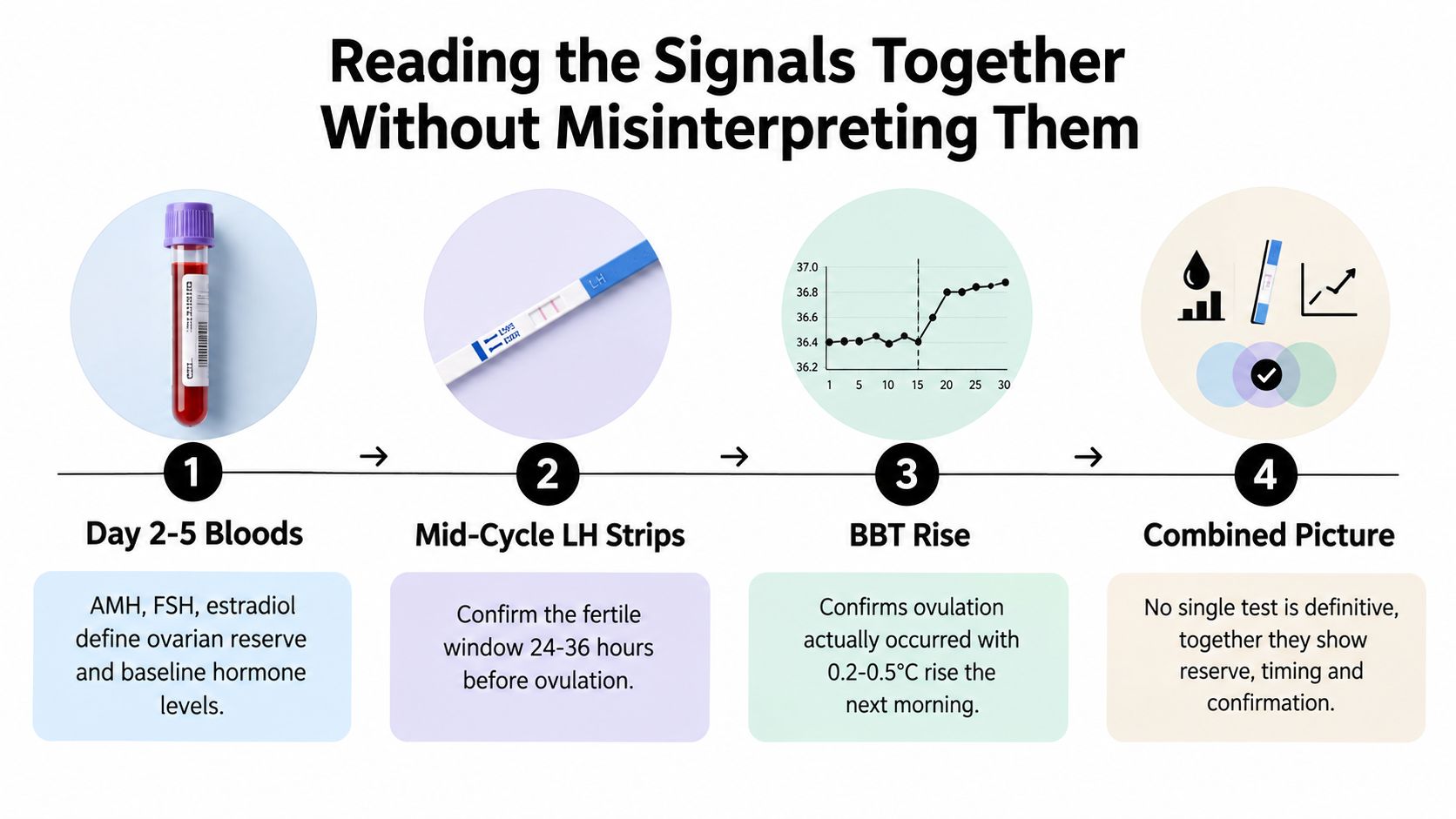
The strongest home-testing approach is sequential, not maximalist. Each signal has a job, and confusion starts when consumers ask one biomarker to do another biomarker's work.
Establish the baseline
AMH is useful for the ovarian-reserve question. FSH and estradiol may add early-cycle context when ordered and interpreted clinically. These blood markers don't tell you which day to have sex this month, and a reassuring AMH result can't rule out sperm, tubal or ovulation problems.
That distinction is the main gap in Australian consumer content. “Egg count” language makes AMH sound like a countdown clock, while fertile-window tools answer a timing question. A better test depends on the decision you need to make.
Follow the cycle
Use LH strips around the expected fertile window to identify the surge. Australian guidance describes this as a predictive signal, while progesterone is the more appropriate confirmation tool when a clinician needs to establish whether ovulation occurred. Australian fertility and ovulation guidance
BBT can add a retrospective pattern. If the temperature chart doesn't show the expected shift, or if LH results are repeatedly confusing, take that record to a GP rather than escalating endlessly to more strips.
Interpret combinations carefully
- Normal AMH: Suggests information about ovarian reserve, not a guaranteed conception timeline.
- Positive LH: Indicates an LH surge, not definitive proof of ovulation.
- LH surge with PCOS: May be difficult to interpret without the broader clinical picture.
- BBT rise: Supports post-ovulation confirmation, but doesn't pinpoint the fertile window on its own.
- Pregnancy test: Keep it conceptually separate from ovulation testing. The two tests answer different questions.
At-home AMH kits read the same broad biomarker as a pathology test, but a number without cycle history, age, symptoms and reproductive context may not lead to a useful decision. If your goal is confirmation rather than prediction, ask about appropriately timed progesterone testing instead of treating an LH strip as the final word.
The Best At-Home Fertility Test Pick for Common Scenarios
I wouldn't rank every product from “best” to “worst”. The right buy depends on whether you need a cheap timing signal, a confirmation pattern or clinical context.
| Scenario | Recommended test | Typical AU cost | Key trade-off |
|---|---|---|---|
| Simple timing in a predictable cycle | Australian pharmacy LH strips | Varies by pack | Cheap and practical, but doesn't confirm ovulation |
| Want confirmation as well as timing | LH strips plus BBT | Two separate purchases | More information, more daily effort |
| Irregular or difficult-to-read cycles | Multi-signal monitor or GP-led testing | Device and testing costs vary | Better context, but higher cost and more interpretation |
| Ovarian-reserve curiosity | TGA-registered AMH service with clinician follow-up | Laboratory price varies | Directional information, not a fertility verdict |
| Possible male-factor contribution | Semen analysis through an appropriate service | Provider price varies | Home screening may misclassify clinically important results |
| Persistent concern or delayed conception | GP assessment | Medicare and provider arrangements vary | Moves beyond consumer testing to a complete work-up |
My direct picks
Best budget choice: Buy a standard LH strip pack from an Australian pharmacy if your cycles are predictable and you're only trying to identify the fertile window. You don't need an app-connected reader for that narrow job.
Best combination: Pair LH strips with BBT when you want timing plus retrospective confirmation. This is more useful than paying for a premium algorithm that repackages the same two signals.
Best for irregular cycles: Move to clinician-led testing or a multi-signal monitor when standalone strips keep producing confusing results. A device can organise patterns, but it won't diagnose PCOS or explain every irregular cycle.
Best for ovarian reserve: Use a TGA-registered AMH kit only if you understand that it estimates reserve rather than conception timing. If the result will cause panic or false reassurance, see a GP first.
No home device replaces a broader fertility assessment when the pattern remains unexplained. The same applies when sperm health may be contributing. A technically polished app can't examine every part of reproduction.
Costs, Where to Buy and When to See a GP Instead
Australian availability is uneven, and prices change by retailer and pack size. You may find products at discount pharmacies, Priceline, TerryWhite, supermarket pharmacies, Big W, Amazon AU and specialist fertility retailers. A product listing alone does not confirm appropriate Australian supply or TGA status.
| Test type | Indicative price range in Australia | Where to buy in Australia | TGA compliance |
|---|---|---|---|
| LH strips | About $10–$25 per pack | Pharmacies, supermarket pharmacies and Australian online retailers | Check the product and supplier details |
| BBT thermometer | About $20–$100, depending on the device | Pharmacies, health retailers and brand websites | Check intended use and local supply |
| App-connected monitor | About $100–$300, plus recurring test costs | Specialist fertility retailers and brand websites | Verify Australian regulatory information |
| AMH or hormone kit | About $100–$250, depending on the laboratory service | TGA-registered online services or pathology channels | Do not assume an imported kit is compliant |
| Semen test | About $50–$200, depending on the service | Australian health retailers and registered providers | Registration does not equal a validated infertility cut-off |
These are buying guides, not fixed quotes. Check the current product page, delivery fee, refill price and whether the advertised amount covers the complete test.
What to check before paying
Look for a named Australian supplier, clear instructions, intended use, complaint contacts and medical-device information. Imported kits may be easy to order but harder to verify. Overseas regulatory status does not automatically establish Australian compliance.
Subscriptions need scrutiny. A reusable reader with recurring strips can cost more over time if you test frequently. A one-off laboratory kit may provide more context, but less cycle-by-cycle information. Read refill and cancellation terms before choosing an app-connected system.
AMH needs separate consideration because the result can carry emotional weight. This plain-English guide to AMH levels and age provides useful background, but it does not replace a clinician interpreting your result alongside your age, cycle history and other findings.
When to stop testing at home
Book a GP appointment if your cycles remain very short or long, your results repeatedly conflict, you receive a concerning hormone result, or you want faster answers. Seek clinical input instead of buying another box if you suspect PCOS, are entering perimenopause, or need both partners assessed.
Home testing should not continue indefinitely after repeated cycles of well-timed attempts without success. Ask for an assessment covering ovulation, ovarian reserve, sperm, tubes and the wider clinical history.
Choose the smallest useful test first. For timing, start with LH. For retrospective confirmation, add BBT. For ovarian reserve or persistent irregularity, involve a GP early rather than asking a consumer score to carry a clinical decision.
Venus Health Co. offers app-connected LH tracking and a Bluetooth basal thermometer that records BBT without manual charting. Visit Venus Health Co. to compare a simple strip, connected thermometer or broader tracking setup.