

Best Fitness Tracker for Women: A Practical 2026 Guide
Dr. Adeyinka AdegbosinYou're packing school lunches, looking for your trainers and checking a sleep score that doesn't match how tired you feel. Your watch says you're ready to train. Your body says otherwise. The best fitness tracker for women should help you make a sensible decision in that moment, not give you another target to feel guilty about.
Why Choosing the Right Tracker Is Harder in 2026
A tracker isn't useful because it records more of your day. It's useful when you understand its feedback and change something worthwhile, whether that's taking a walk between meetings, easing off after disrupted sleep or keeping an easy run easy.
That's why I wouldn't choose a device because it's marketed to women. A smaller case, different strap colour and cycle calendar don't establish whether its measurements suit your training, your body or your life stage.
A woman training for competition needs different feedback from someone rebuilding a routine around parenting. An older woman may value readable activity trends over detailed workout analytics. Neither needs a dashboard that turns every ordinary fluctuation into an alarm.
Start with behaviour, not branding
Australian evidence supports looking beyond specifications. In a 2024 study of older Indigenous women in rural, remote and regional New South Wales, 92% wanted to try wearable technology, and researchers reported that some participants used smartwatch step counts as motivation to become more active, according to UNSW's account of the wearable-health research.
That finding doesn't prove every tracker improves health. It does make a strong case for accessible feedback and practical motivation. A device that's comfortable, understandable and easy to use deserves serious consideration, even when its feature list looks modest.
A great tracker should disappear into your routine while making the next useful action obvious.
Choose the job before the device
Treat your tracker as a personal data system, not a judgement system. Heart-rate and sleep feedback can influence decisions that feel medical, so demand clear explanations of what's measured and what's estimated.
My buying priorities are activity tracking, heart-rate validation, sleep interpretation, body-composition integration, app usability, battery and fit. There's no universal winner across those priorities. There is a sensible winner for the job you need done.
Seven Criteria That Actually Matter
Which Criteria Matter Most by Reader
These are my recommended priorities, not measured product scores. Adjust them to your own goals.
| Criterion | Athlete | Busy Parent | Senior |
|---|---|---|---|
| Activity and intensity | Essential | High | High |
| Heart-rate validation | Essential | Useful | High |
| Sleep and recovery interpretation | High | High | Useful |
| Body-composition integration | Goal-dependent | Goal-dependent | Goal-dependent |
| App experience and ecosystem | High | Essential | Essential |
| Battery life | High | Essential | Essential |
| Physical fit and form | Essential | High | Essential |
Measurement that earns its place
Activity and intensity tracking should reflect what you do. A runner needs session feedback; a parent may need recognition of everyday movement. Don't choose a step-focused device if resistance training is your main activity.
Heart-rate accuracy matters most when you use readings to control effort. Look for independent testing of the exact model and activity, rather than accepting a general accuracy promise.
For sleep and recovery, favour an app that helps you interpret patterns without ordering you to train or rest. Your symptoms, workload and actual sleep experience belong in that decision too.
Body-composition integration becomes relevant when your question extends beyond movement. Check whether your chosen health app can display compatible scale data alongside your activity history, rather than making you maintain disconnected records.
Usability determines whether you keep wearing it
The app experience and ecosystem should make your main information easy to find. For cycle awareness, use this guide to choosing a period tracker app to sharpen your questions about logging and interpretation.
Battery life must fit your real charging habits. Ask what happens with your preferred features enabled, not just in the lowest-power configuration.
Physical fit and form deserve an actual trial. Check the clasp, readability, sleeve clearance and comfort during sleep or a workout.
- For tighter budgets: Tinymoose's best fitness tracker under 100 guide can help build a shortlist. Confirm Australian pricing, compatibility and evidence separately.
- For competing priorities: Protect the essentials first. Don't sacrifice a readable screen or secure fit to gain another wellness score.
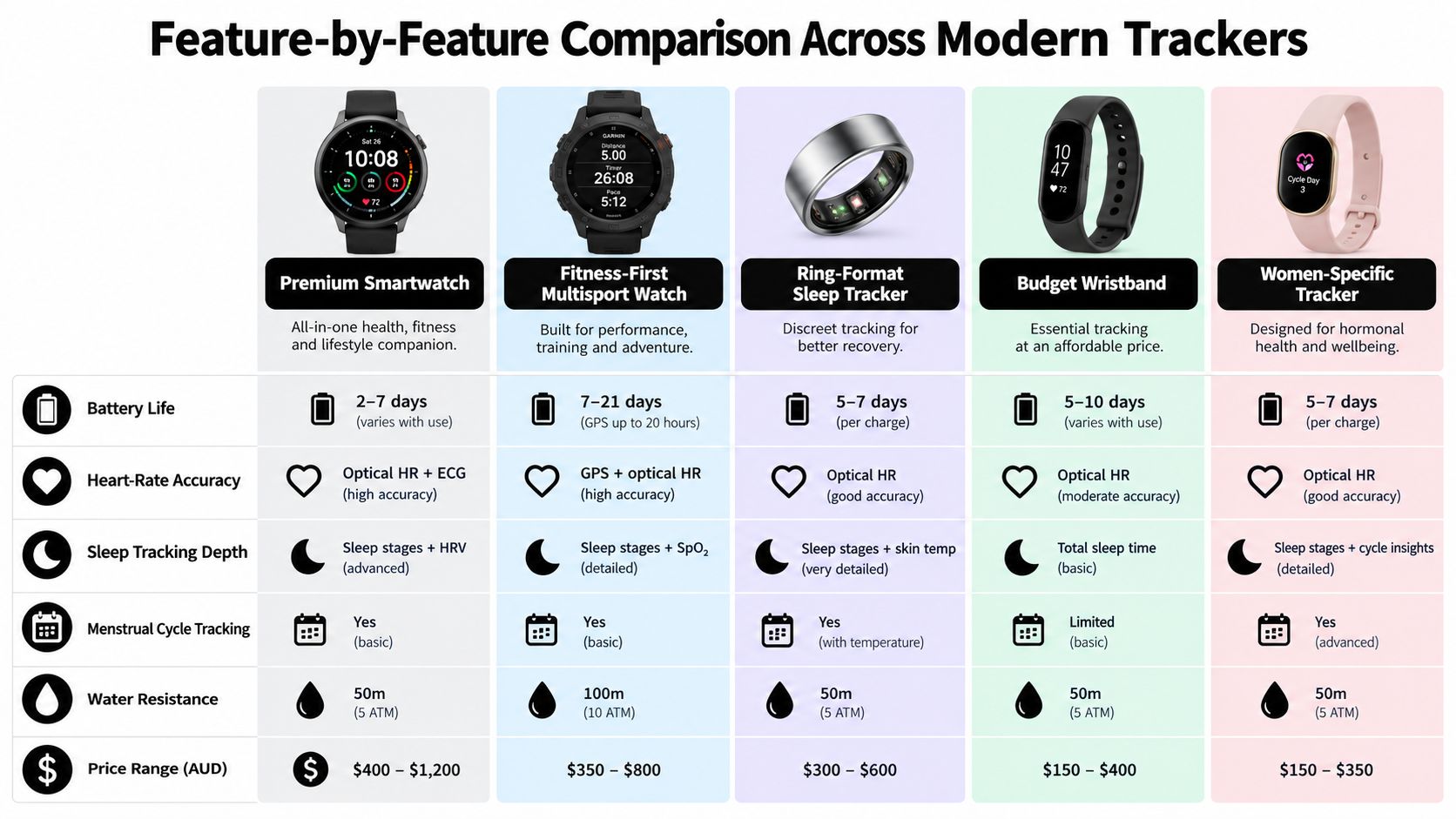
Feature-by-Feature Comparison Across Modern Trackers
Buy by archetype first, then investigate individual models. That prevents a polished product page from persuading you to pay for features unrelated to your goals.
Tracker Archetypes at a Glance
The table describes what I'd investigate in each category, not guaranteed specifications.
| Archetype | Heart-Rate Accuracy | Sleep Tracking | Battery | Ecosystem |
|---|---|---|---|---|
| Premium smartwatch | Demand model-specific validation | Check overnight summaries | Test your charging routine | Prioritise phone compatibility |
| Fitness-first multisport watch | Check sport testing and external-sensor support | Assess recovery interpretation | Check workout-mode endurance | Prioritise training exports |
| Ring-format sleep tracker | Verify evidence for intended use | Examine trends and uncertainty | Check charger practicality | Assess app dependence |
| Budget wristband | Don't assume price predicts accuracy | Inspect useful detail | Verify enabled-feature claims | Check sync reliability |
| Women-specific tracker | Evaluate sensors separately from branding | Check what's actually measured | Confirm under normal use | Examine cycle logging and export |
Use the visual comparison as a starting point, then confirm every specification against the model you're considering.
What Australian validation tells you
An AIS-funded study comparing six wearables with ECG found absolute heart-rate differences of approximately 0.7 to 5.4 beats per minute, according to the Australian Institute of Sport's wearable-accuracy guidance. That guidance also highlights the importance of accurate sleep and wake settings when sampling sleep-related heart-rate and heart-rate-variability data.
The buying lesson is model-specific. Those findings don't establish that every device from a tested manufacturer performs equally well, or that a newer model inherits an older model's validation.
Exercise testing matters too. CHOICE's fitness-tracker testing methodology compares active heart-rate readings with ECG during treadmill and exercise-bike sessions. Don't treat a resting comparison, or evidence from a different activity, as sufficient for your training.
Buying rule: Judge a tracker by your primary activity, not the length of its feature list.
Which category deserves your attention
Choose a premium smartwatch when everyday convenience is the main job. Scrutinise notifications, workout access and overnight charging rather than assuming the most expensive option is the easiest to live with.
Choose a multisport watch when training decisions dominate. Examine session controls, external-sensor compatibility and how the app presents training-load monitoring. Choose a ring-format tracker when unobtrusive overnight wear matters more than seeing workout data on your wrist, but check whether it suits gripping equipment.
A budget wristband is a sensible candidate for movement awareness. Browsing myhalo's smart band options gives you a concrete product to assess, but a listing isn't independent validation.
For a women-specific device, investigate the measurement method behind each feature. A cycle-labelled dashboard isn't automatically more informative than a general tracker with good logging.
Don't reduce your comparison to steps. ABS wrist-worn data collected in 2023 recorded adult averages of 4 minutes of vigorous activity, 1 hour 45 minutes of moderate activity and 11 hours 54 minutes of inactivity per day, excluding overnight sleep, as reported in its physical-activity measurement release. These are population observations, not personal targets, but they show why intensity and inactivity deserve attention.
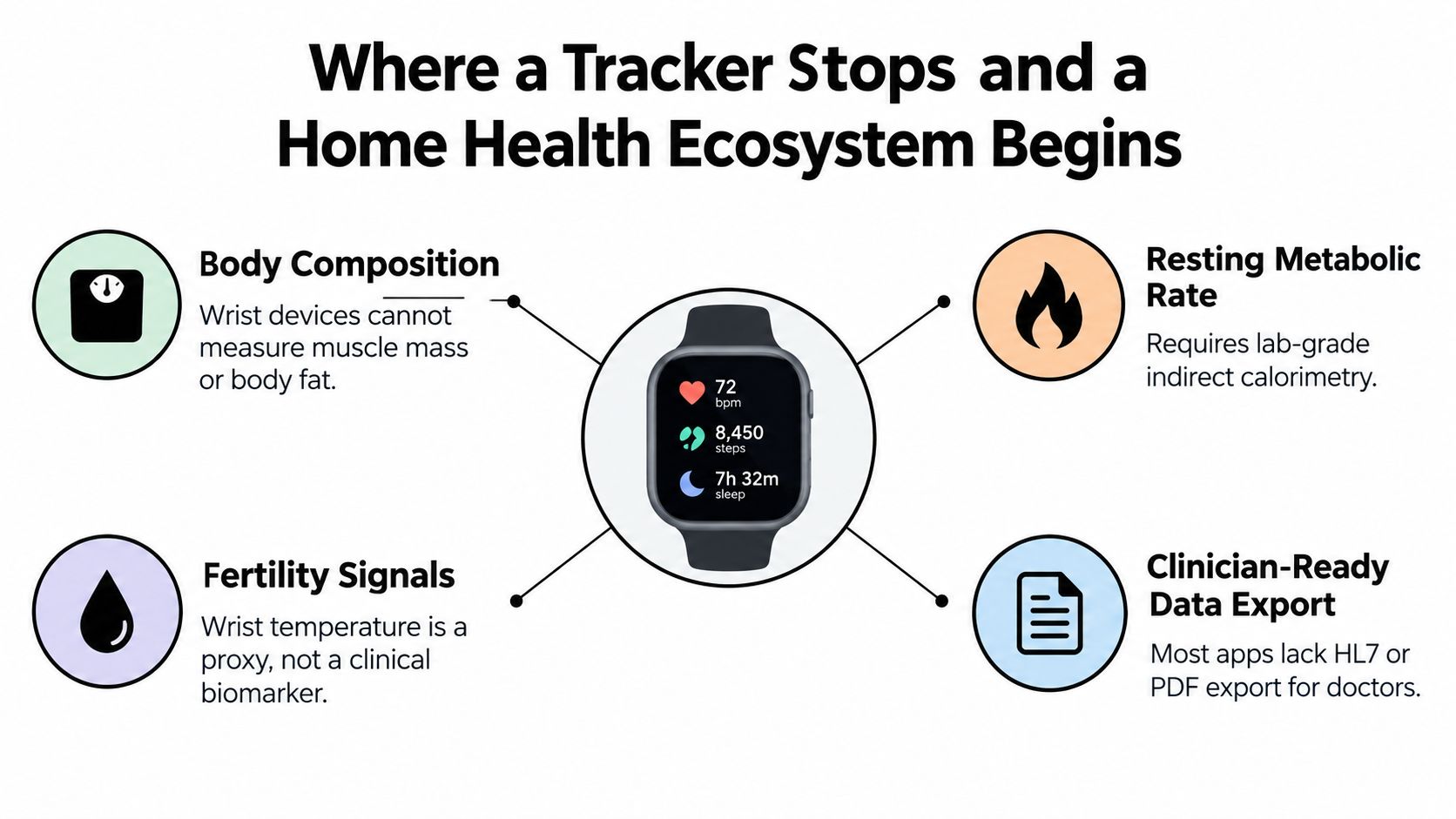
Where a Tracker Stops and a Home Health Ecosystem Begins
A better watch isn't always the answer to missing health information. If your goal includes body-composition tracking or fertility awareness, first identify the measurement you're missing.
A wrist-focused dashboard may answer questions about movement and training effort while leaving you without the body-composition or fertility records you want. Buying another watch won't necessarily solve that mismatch.
Use this distinction to separate convenient monitoring from questions that need dedicated measurement or clinical interpretation.
Add the measurement your goal requires
For body tracking, a compatible scale can give you a separate record of weight and body-composition outputs. My recommendation is to use those outputs for a consistent review routine, not to chase every change or let an automated risk flag become a diagnosis.
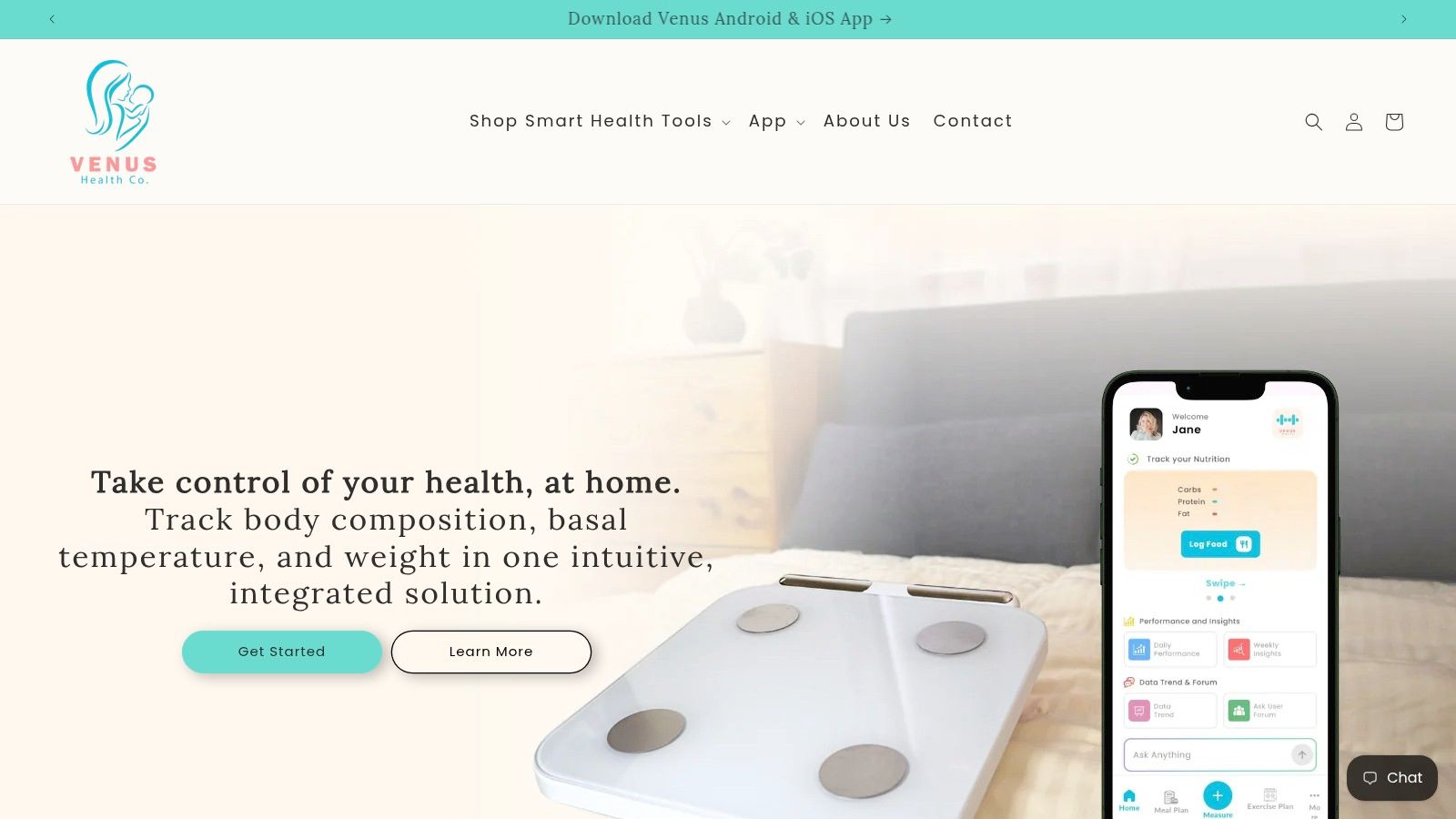
Venus Health Co. is one complementary option. Its Venus AI Smart Scale: Body Composition & Body Fat Scale lists app-connected body-composition tracking, wellness reports, weekly email briefs, AI coaching and nutrition logging. Those are manufacturer-listed functions, not independent proof of clinical accuracy.
The useful question is whether that reporting helps you choose a manageable action. Read the recommendations critically, check whether they fit your training and circumstances, and take health concerns to a clinician rather than asking an app to settle them.
Fertility awareness needs more than a prediction
A predicted period or ovulation date isn't the same as a reliable fertile-window determination. Assess whether a system supports bleeding records, cervical signs, temperature measurements, data export and clear uncertainty disclosures, especially with irregular cycles or postpartum changes.
The Venus Smart Basal Thermometer for Ovulation lists Bluetooth syncing of morning basal-body-temperature readings and app logging of LH results, symptoms and cervical mucus. That morning measurement routine is distinct from continuous wearable temperature monitoring.
An LH ovulation test kit can be another complementary tool, but don't interpret an accuracy statement as a guarantee of ovulation, conception or contraceptive reliability. A fitness tracker isn't necessarily a fertility diagnostic or contraceptive device.
- Check the connections: Confirm exactly which information transfers between devices and apps. “Compatible” doesn't necessarily mean every field appears together.
- Check the paperwork: Review privacy, export and return terms before connecting sensitive records.
- Keep the purpose clear: Add equipment to answer a specific question, not to collect more scores.
This overview of smart health devices can help you plan the home layer without replacing a watch that already does its job.
Recommended Picks by Use Case
My top picks are device types with essential requirements, not an unsupported ranking of current models. Choose the type below, then reject individual products that can't demonstrate the features you need.
The home layer is optional, not a requirement for getting value from a tracker.
Competitive female athletes
Top pick, a fitness-first multisport watch with independently validated optical heart rate and chest-strap pairing. Prioritise controls you can use during exertion, clear session records and evidence relevant to your sport.
For intervals, don't make optical heart-rate performance your only precision strategy. External-sensor support gives you another option when accurate effort monitoring is central to the session. The AIS findings discussed earlier explain why accepting a brand-wide accuracy claim isn't enough.
Your honest weakness is complexity. If you won't use the training tools, you'll spend money and attention on an elaborate dashboard.
For a tighter budget, consider a simpler fitness watch with the required sensor support and session functions. If body tracking is part of your goal, add the home measurement layer separately rather than upgrading for more recovery scores.
Verdict: Spend on training usefulness and validation before styling or general wellness extras.
Busy parents
Top pick, a phone-compatible smartwatch with a straightforward app and a charging routine you can maintain. Put automatic workout recognition, if available and suitable, ahead of specialist sports analytics.
Your device should make interrupted days easier to record. Check how it handles forgotten session starts, whether you can edit records and whether the morning summary is understandable without opening multiple screens.
The honest weakness is distraction. Turn off unnecessary notifications, achievement reminders and any prompt that makes disrupted sleep feel like a personal failure.
A budget wristband is the sensible alternative when your main aim is daily movement awareness. If you already own a Fitbit, inspect fit before replacing the whole device; Nothing But Bands' Fitbit watch bands collection offers replacement options to check against your exact model.
Verdict: Choose convenience you'll use, not capabilities you'll keep meaning to learn.
This video offers another way to explore the topic alongside your own shortlist.
Seniors and older adults
Top pick, a readable smartwatch with simple navigation and clearly explained alerts. If fall detection or heart notifications matter, confirm their availability, setup requirements and limitations for the exact Australian model.
Don't buy a safety feature without checking how it works. Who receives the notification? Does the wearer need a nearby phone? Can they operate the relevant controls comfortably?
The honest weakness is setup and maintenance. A feature-rich watch can become frustrating if menus, charging or account management require help the wearer doesn't reliably have.
A simple large-display fitness tracker is a reasonable budget alternative when activity trends, rather than safety alerts, are the priority. Optional home body tracking should be added only if it serves an agreed goal and the reporting is understandable.
Verdict: Readability and confident use beat sophistication.
A Five-Minute Decision Protocol
Start with a sentence: I want this device to help me change… Finish it with a behaviour, such as pacing runs, noticing long inactive stretches or reviewing sleep habits. If you can't finish the sentence, pause the purchase.
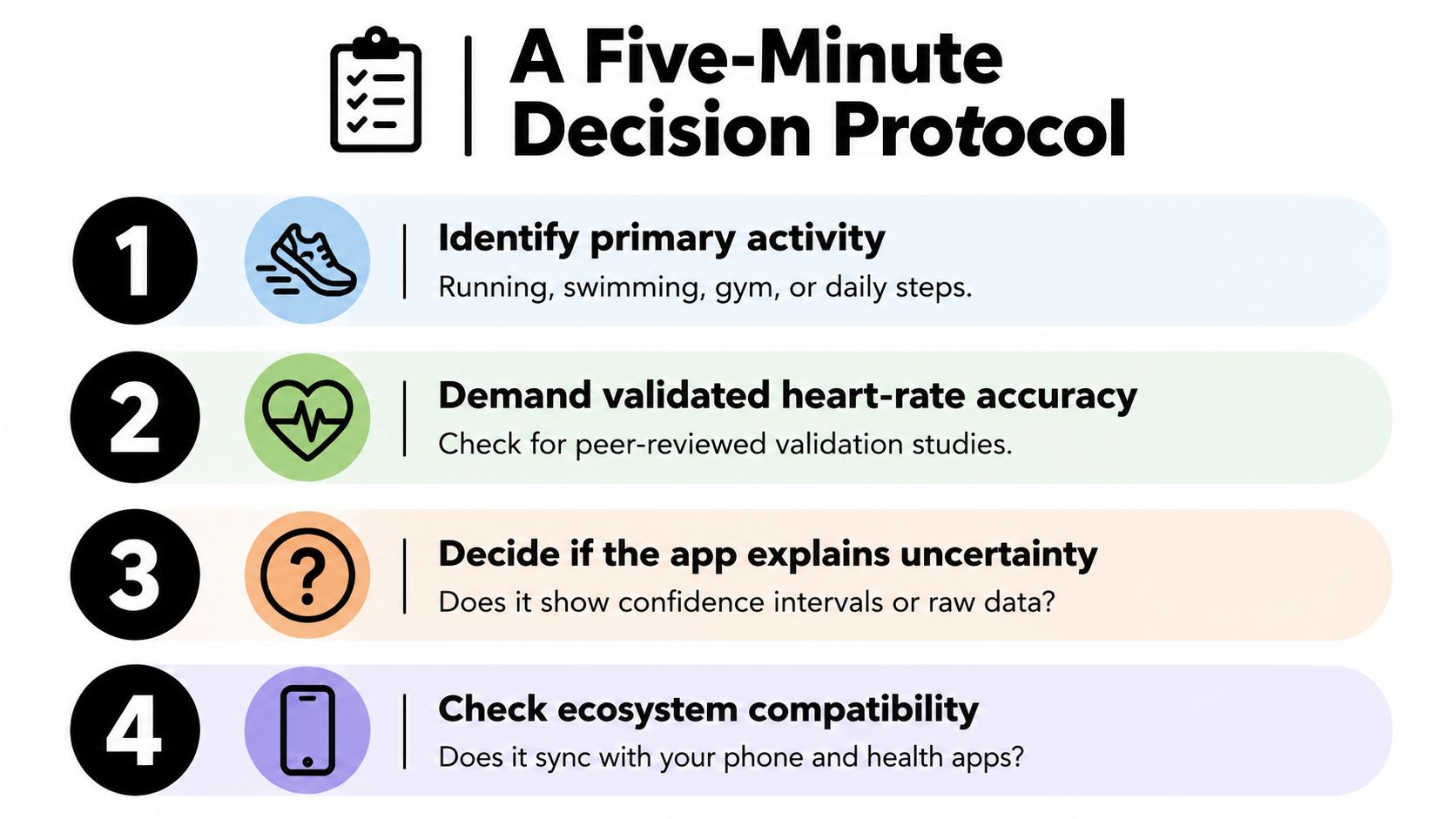
Then apply the checks below. Treat this as a quick shortlist filter, not a substitute for reading validation or product terms.
Reject the wrong fit early
- Name your primary activity: Look for relevant modes and evidence, not just a long activity menu.
- Inspect the measurement claims: Find testing for the exact model. An unexplained “accurate” label isn't enough.
- Preview the app: Check whether you can understand the main screen and distinguish estimates from measurements.
- Rehearse ownership: Work out when you'll charge it, how you'll wear it and where you'll review your records.
Try the physical scenario that matters most: reading it outdoors, sleeping with it, bending your wrist under load or operating it with the dexterity you have.
Mark your shortlist honestly
Use Yes, Partial or No for each candidate. The blank fields below are for your assessment, not implied product ratings.
| Criterion | Candidate A | Candidate B |
|---|---|---|
| Records my main activity usefully | To assess | To assess |
| Has relevant heart-rate validation | To assess | To assess |
| Explains sleep and recovery uncertainty | To assess | To assess |
| Connects to my planned body-tracking setup | To assess | To assess |
| Works with my phone and export needs | To assess | To assess |
| Fits my charging habits | To assess | To assess |
| Fits comfortably and remains readable | To assess | To assess |
Don't total the marks mechanically. A No against an essential requirement should outweigh several attractive extras.
Final filter: If the watch passes your essential checks but leaves body or cycle records fragmented, investigate a compatible scale or thermometer before buying a different watch.
The Honest Trade-Offs Most Reviews Skip
The best fitness tracker for women may produce fewer, better-explained metrics. I'd choose a useful activity trend over a mysterious readiness score, and an exportable record over an impressive dashboard I can't discuss with my doctor.
Privacy deserves the same attention as sensor performance. Among Australian activity-tracker users surveyed, 94% were open to sharing data with healthcare providers and 43% had already done so, according to RACGP's reporting on health-data sharing. Willingness to share isn't permission for unrestricted collection or reuse.
Ask who controls the record
Before connecting cycle, body and activity data, check the account settings and privacy policy.
- Sharing: Can you choose what another person receives?
- Export: Can you obtain an understandable record without granting full account access?
- Deletion: Can you remove sensitive entries and close the account?
- Interpretation: Does the app explain limitations rather than presenting every score as authoritative?
A unified app is convenient, but convenience isn't a reason to stop asking those questions.
Your body isn't an algorithm average
Pregnancy, perimenopause, disability, age and intensive training deserve context, not automatic judgement. Research discussing young Australian women's use of wearables and fitness apps raises relevant concerns about interpreting tracking across bodies and circumstances.
My advice is simple: don't let calorie, recovery or achievement scores overrule symptoms, adequate fuelling or professional guidance. Use unexpected patterns to start a conversation, not to diagnose yourself.
Combining activity records with body-composition outputs, BBT and LH records can make that conversation more organised. It doesn't turn a collection of consumer measurements into clinical certainty. Choose the smallest useful setup, understand its limits and keep control of what you share.
Venus Health Co. offers app-connected body-composition tracking and Bluetooth BBT tools to complement the movement data you collect on your wrist. Visit Venus Health Co. to compare the home-health options, check compatibility and choose the measurement that matches your goal.