

Smart Health Devices Explained: A Complete Guide
Dr. Adeyinka AdegbosinYou wake up, step on a smart scale, and see more than your weight. The device records a reading, sends it to an app, and helps you compare the result with previous weeks. Before breakfast, a connected thermometer can capture basal body temperature, while a fertility app brings together temperature, ovulation tests, and symptoms without a paper chart.
That convenience is useful, but smart health devices deserve more careful attention than a quick list of features. Their sensors have limits, their data may be sensitive, and an impressive app doesn't guarantee that information can be shared with an Australian healthcare provider. The right device can help you notice patterns and ask better questions, but it shouldn't replace clinical advice.
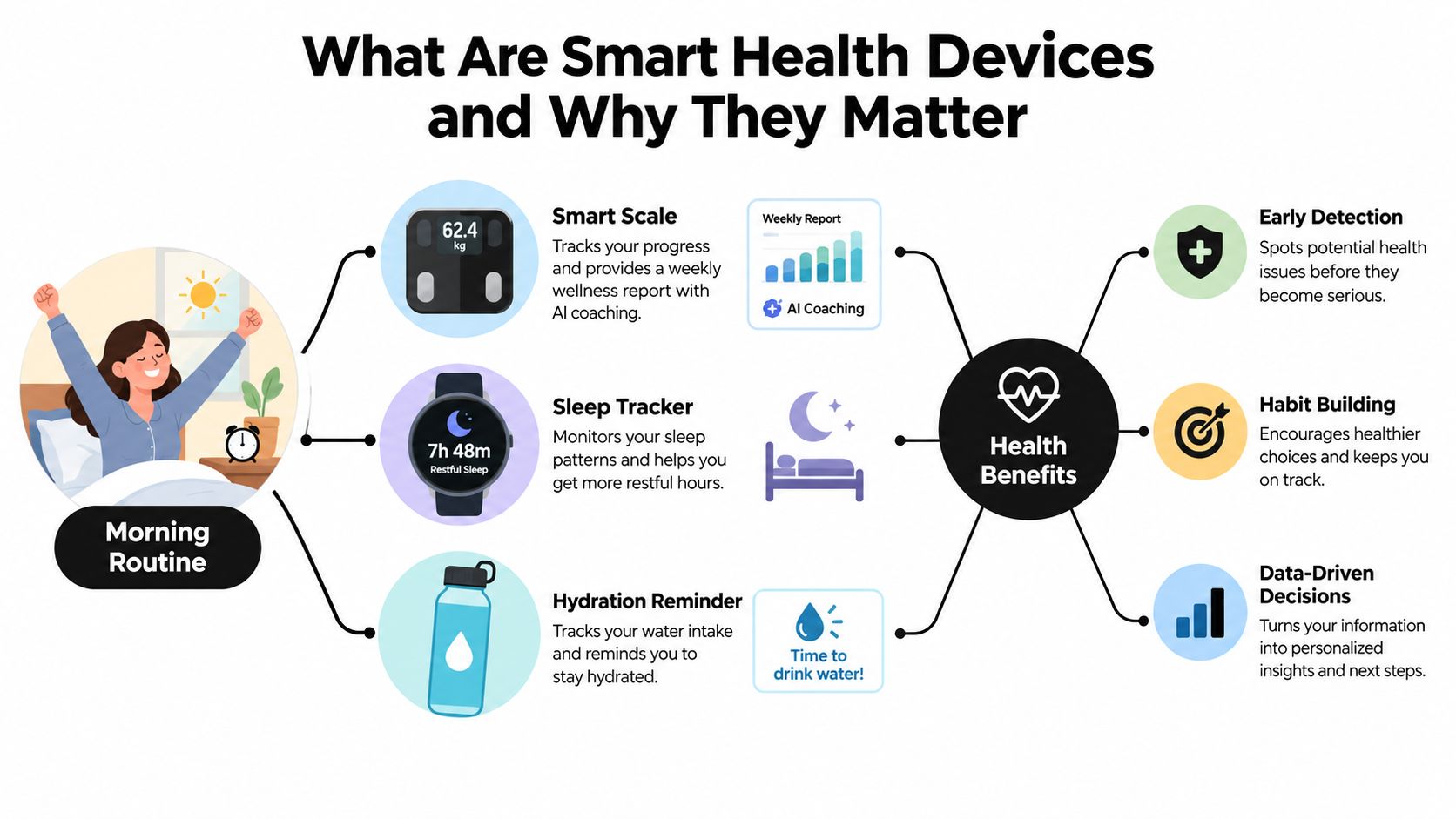
What Are Smart Health Devices and Why They Matter
A typical morning might involve several separate health tasks. You weigh yourself, remember whether yesterday's training affected your body, take your temperature before getting out of bed, and manually record an ovulation test. Each action is simple, but the information becomes difficult to compare when it sits across notebooks, spreadsheets, and different apps.
Smart health devices reduce that friction by combining a sensor, a digital connection, and software that stores readings over time. A smart scale can send measurements to an app through Bluetooth. A connected thermometer can record temperature without requiring manual entry. A wearable can collect movement or heart-related signals throughout the day and turn them into charts, alerts, or summaries.
The word “smart” doesn't mean that every reading is medically definitive. It usually means the device can capture information automatically, organise it chronologically, and help interpret patterns. Some products add coaching or automated summaries, while others make data easier to review.
Why connected monitoring matters in Australia
Home monitoring has become part of normal care behaviour in Australia, rather than remaining a niche experiment. Between 13 March 2020 and 31 July 2022, Australia delivered 118.2 million telehealth services to 18 million patients, with more than 95,000 practitioners using telehealth, according to Australian wearable market context. That figure relates to telehealth services, not the accuracy of consumer devices, but it shows why connected health information has become relevant to everyday care.
For a person managing weight, the value may come from seeing a steady direction instead of reacting to one unusual reading. For someone trying to conceive, automatic temperature records can make a daily routine easier to maintain. A busy parent may prefer a device that records in the background, while an older person may want information that can support a conversation with a doctor or family member.
A useful introduction to this approach is home health monitoring, particularly when several measurements need to be considered together.
Practical rule: Treat a smart device as a personal measurement assistant. It can organise evidence about your body, but it can't decide what a diagnosis means.
How Smart Health Devices Actually Work
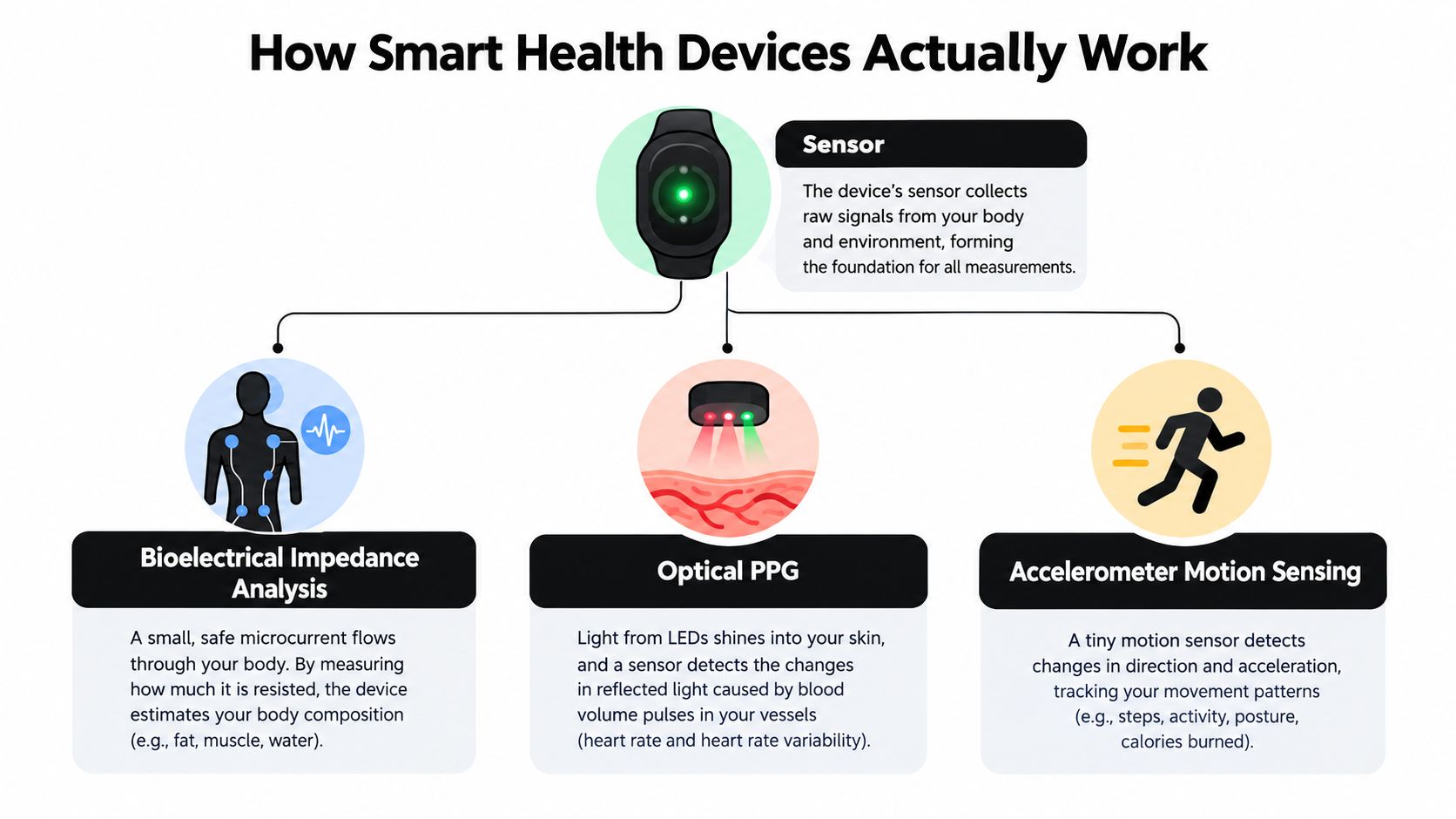
The easiest way to understand a smart device is to follow the signal from your body to the app. The sensor detects a physical change, the device converts it into an electrical signal, and software applies an algorithm to estimate a metric. That final number is therefore an estimation or interpretation, not a direct view of every process happening inside your body.
Three sensor systems you'll encounter
Bioelectrical impedance analysis, or BIA, is common in body-composition scales. The scale sends a very small electrical current through the body and measures resistance. Lean tissue generally conducts electricity differently from fat, so the software combines impedance with information such as height, age, and weight to estimate body fat, muscle, and hydration.
That estimate can change when hydration, food intake, exercise, or measurement timing changes. The scale isn't directly weighing your fat or muscle. It's interpreting how electrical flow behaves under particular conditions.
Skin-temperature sensors detect small changes at the skin surface. A basal body thermometer is designed to capture temperature patterns around the time of waking, while a wearable may monitor temperature continuously or periodically. In fertility tracking, the useful signal often comes from a pattern across several readings, not one isolated result.
Optical PPG sensors shine light into the skin and measure changes in reflected light as blood volume changes with each heartbeat. Wearables can use this signal to estimate heart rate and, in some devices, heart-rate variability. Movement, loose placement, skin contact, and activity can all affect the signal.
Accelerometers add another layer by detecting changes in motion and orientation. Software can use those patterns to estimate steps, activity, or periods of rest, although the interpretation depends on the device and the activity being performed.
The following video offers a visual explanation of how wearable sensors translate body signals into digital measurements.
Australian evidence illustrates why the distinction between a sensor and an estimate matters. Weight from a smart body-composition scale correlated very highly with DXA-derived weight in a large Melbourne-linked dataset, with r=0.975, but individual estimates for other measurements were less dependable. In an Australian-reviewed BIA study, body-fat estimates varied by -3.0 to 4.4 percentage points, while fat-free-mass estimates varied by -3.3 to 1.9 kg against a four-compartment criterion method. These findings are reported in Australian research on smart-scale measurement.
A device such as the Venus AI Smart Scale: Body Composition & Body Fat Scale combines Bluetooth syncing with a six-page wellness report, trend charts, nutrition tracking, and AI coaching. Those features can make measurements easier to interpret, but they don't remove the need to treat body-composition figures as estimates.
Clinical Accuracy and Data Reliability
Accuracy isn't a simple yes-or-no quality. A device can perform well for tracking a broad pattern across a group while producing a less reliable absolute estimate for one person on one day. That distinction explains why a smart scale may be useful for watching direction over time, yet unsuitable for making a clinical decision from a single body-fat reading.
Hydration is a practical example. If fluid levels change after exercise, a salty meal, illness, or a different measurement time, BIA results may shift even when body composition hasn't changed in the same way. Standardising your routine helps reduce noise, but it can't turn a consumer estimate into a diagnostic test.
When trends are more useful than a single number
Use home-device data for pattern recognition when the question is behavioural. Is your weight moving in the direction you expected? Does your temperature chart show a recurring cycle pattern? Does your resting measurement look different from your usual baseline?
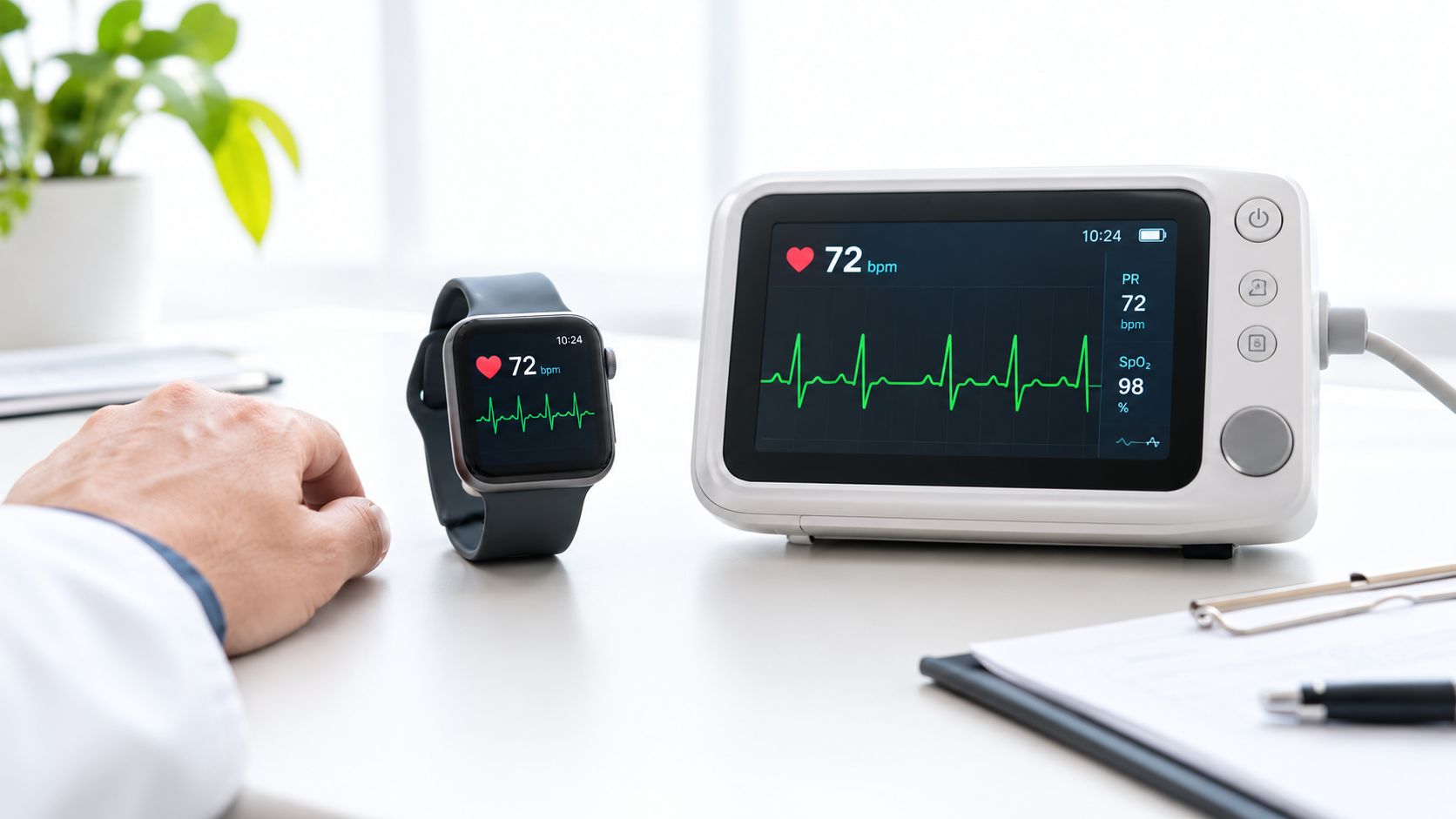
Use greater caution when the question is medical. A reading that suggests a heart rhythm problem, unusually low oxygen, a concerning blood-pressure result, or a rapid unexplained change should be discussed with a qualified clinician. Don't delay care while waiting for an app to produce a clearer graph.
Australian fertility-tracking evidence provides a more encouraging example of automated sensing. A review of skin-wearable temperature tracking found that changes in distal skin temperature and heart-rate variability over 2 to 5 hours predicted the luteinising hormone surge two days in advance for 100% of study participants, as described in evidence on skin wearables and temperature tracking. That result shows the potential of continuous sensing in the study context. It doesn't mean every device will perform identically for every user or cycle.
The Venus Smart Basal Thermometer for Ovulation, Bluetooth BBT Tracker with App is described as syncing basal temperature to a phone through Bluetooth and combining it with fertility-app records. If you're evaluating any thermometer, check how it measures, how readings are stored, and whether the product's regulatory claims apply to the specific use you're considering.
What to check before trusting a claim
- Regulatory language: Look for clearly explained claims such as FDA Cleared or CE Marked, and confirm what the clearance or marking covers.
- Validation details: Ask whether the comparison used a suitable reference method and whether the evidence concerns population averages or individual accuracy.
- Measurement conditions: Read the instructions for timing, placement, exercise, food, and hydration. These conditions affect consistency.
- Clinical boundaries: Confirm whether the device supports wellness tracking, screening, or a defined medical use. Those categories aren't interchangeable.
Privacy belongs in the accuracy conversation because unreliable data handling can undermine otherwise useful tracking. Before connecting an app, review consent options, sharing settings, export functions, and deletion controls. Practical guidance on managing fertility and health data can help users ask the right questions before they build a long-term record.
Device Categories and Who They're For
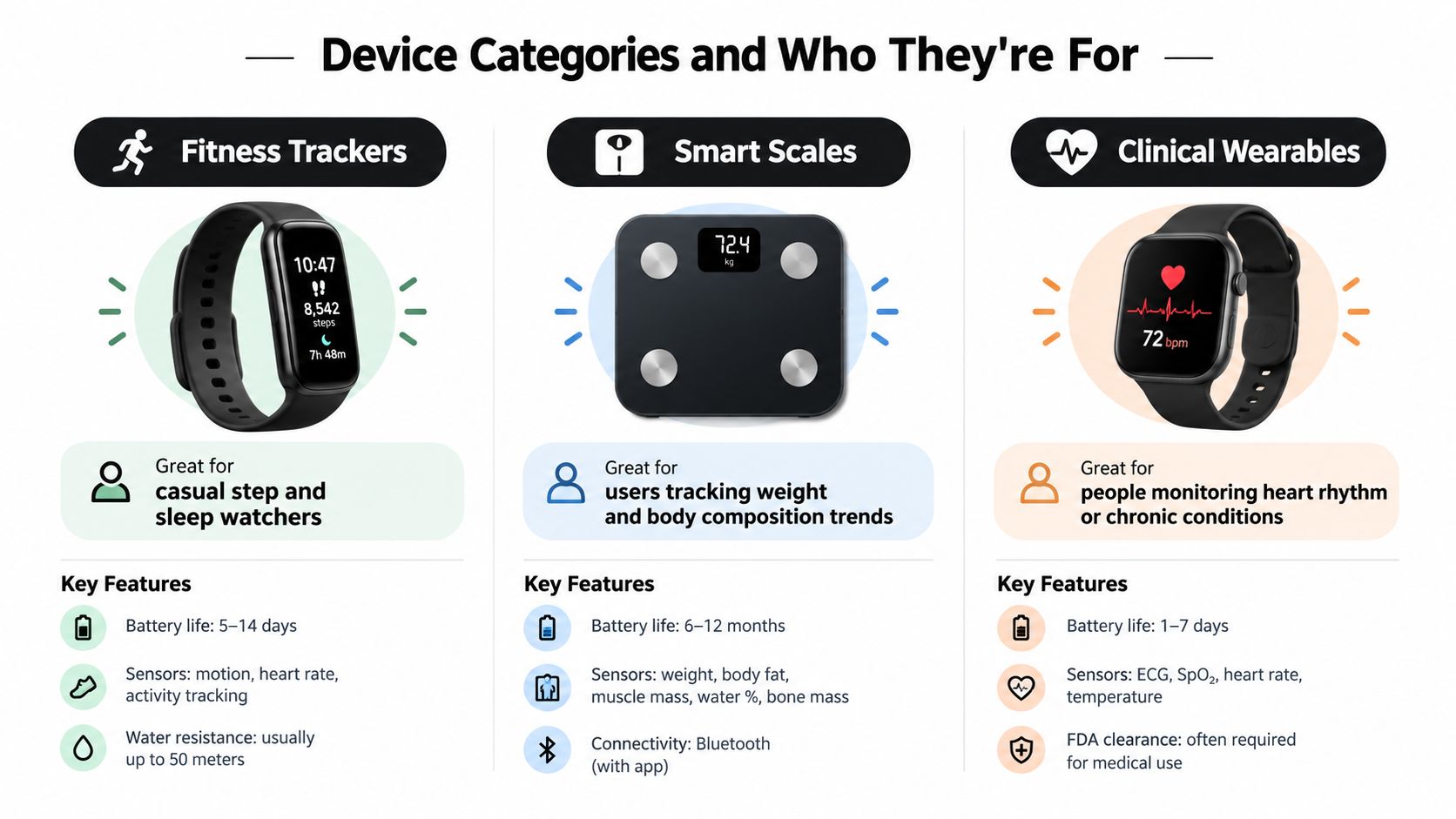
The best device depends on the decision you want to make. Someone training for an event needs different information from someone trying to understand a menstrual cycle, and a person managing a chronic condition may need stronger clinical oversight than a casual wellness user.
| Device category | Useful for | Main limitation |
|---|---|---|
| Fitness tracker or smartwatch | Movement, exercise routines, heart-rate patterns, and general activity | Estimates may vary during movement, and wellness scores aren't diagnoses |
| Smart scale | Weight and longer-term body-composition trends | BIA estimates can be affected by hydration and measurement conditions |
| Basal thermometer | People trying to conceive or tracking cycle patterns | Temperature usually confirms a transition after it occurs, so it works best with other fertility signals |
| Clinical wearable | People monitoring a defined heart or chronic-condition concern under care | Requires careful interpretation and may need a clinician or approved care pathway |
Athletes and fitness-focused users
Athletes often care less about a single body-fat estimate than about whether training, recovery, and nutrition are moving in a consistent direction. A smart scale can support a weekly routine by presenting weight and body-composition estimates alongside trends. The measurement becomes more useful when the athlete records it under similar conditions and avoids reacting to normal day-to-day variation.
A discreet wearable can suit someone who wants passive sleep or activity information without using a watch screen. Readers comparing this format can explore a smart ring with health tracking, then check whether its sensors and app support their actual goal rather than just collecting more metrics.
People trying to conceive
A Bluetooth basal thermometer reduces manual copying and can make daily measurements easier to maintain. Pairing temperature with LH tests, cervical-mucus observations, and symptoms gives a broader picture than relying on a predicted calendar date alone.
The Venus Ovulation Predictor Test Kit is described as a home LH test with 99% accuracy, a result in under 10 minutes, and a fertile-window indication 24 to 36 hours before ovulation begins, according to its product information. Those are product claims, so users should still follow the instructions and speak with a healthcare professional about irregular cycles, medication effects, or difficulty conceiving.
Seniors and people managing ongoing conditions
Older adults may benefit when a device removes repetitive recording and makes information easier to share with a care team. The priority isn't owning the most advanced product. It's choosing something with readable results, manageable setup, dependable connectivity, and a clear plan for what happens when a reading looks unusual.
For chronic-condition monitoring, ask a clinician which measurements matter and whether the device can fit into the existing care pathway. A consumer app can collect useful context, but it may not send information directly into a provider's system.
A practical discussion of how scales fit into home routines is available in digital weighing scales and health tracking.
Choosing, Using, and Interpreting Your Devices
Start with the health question, not the product category. “I want to lose weight” may call for a consistent trend record. “I want to understand ovulation” may require basal temperature, LH testing, and symptom notes. “My doctor wants home blood-pressure readings” requires a device and workflow chosen around that clinical instruction.
A reliable setup
- Check the intended use. Read what the manufacturer says the device measures and what it doesn't diagnose. Regulatory labels can be useful, but they don't automatically validate every feature in an app.
- Prefer automatic syncing where it helps. Bluetooth transfer can reduce missed entries and typing mistakes. Confirm whether the app works with your phone and whether you can export or share the data.
- Standardise body-composition readings. Measure at a similar time and under similar conditions. For many users, that means after using the bathroom and before eating, drinking, or exercising. Consistency makes comparisons more meaningful because fluid shifts are less likely to dominate the result.
- Build a fertility signal set. Basal temperature can help identify a post-ovulation pattern, while an LH test can provide an earlier signal. Symptoms and cervical-mucus observations add context, especially when cycles aren't predictable.
- Review trends at a sensible interval. A single change may reflect sleep, hydration, illness, exercise, or timing. Look for a repeated direction before changing a training, nutrition, or fertility plan.
A better question: Instead of asking, “Is this reading perfect?”, ask, “Is this reading consistent enough to help me make a sensible next decision?”
Privacy needs its own checklist. Fertility information, body-composition records, and chronic-condition readings can reveal intimate details about a person. Australian consumer research has identified problems with how fertility apps may handle sensitive user data, so choose services that explain consent in plain language, limit unnecessary sharing, and let you control access.
Check whether the app offers:
- Clear permissions: You should understand which data the app collects and why.
- Sharing controls: Look for settings that let you choose whether information goes to third parties, family members, or healthcare providers.
- Data portability: An export option reduces the risk of being trapped in one app ecosystem.
- Deletion options: Find out how to remove an account and associated records.
- Transparent subscriptions: Confirm which functions remain available without a recurring payment.
The same principles apply when organisations introduce connected devices at work. Teams considering employee wellness program ideas should explain participation clearly, avoid collecting unnecessary personal health data, and separate voluntary wellness activity from employment decisions.
If a device produces a concerning result, repeat it according to the instructions and contact a clinician when appropriate. Don't use an app's reassurance, score, or automated coaching as a reason to ignore symptoms.
The Future of Connected Home Health Monitoring
The next stage of smart health devices won't be defined only by smaller sensors or more polished dashboards. The bigger opportunity is interoperability, meaning that information can move safely from a personal device to the app, from the app to a care team, and back to the person in a form they can understand.
Australia's wearable medical devices market reached USD 1,854.5 million in 2024 and is forecast to reach USD 4,438.1 million by 2030, according to Australia wearable medical devices market projections. The same source identifies chronic disease management as the largest application segment in 2024, at 43.61% of revenue, and remote patient monitoring as the fastest-growing segment. These figures describe market activity, not proof that every product is clinically reliable.
From app data to usable care information
Australian public strategy work recognises the need for provider systems to collect and display data from personal devices, but practical implementation remains fragmented. A device may record a useful temperature, weight, or heart-rate trend while leaving the user with no straightforward way to place that information into a clinician's workflow.
That creates several questions for buyers:
- Can the data be exported in a usable format?
- Does the app connect with established health platforms?
- Can the user explain how a metric was produced?
- Has the manufacturer stated what the device is validated for?
- Does a clinician have a clear reason to act on the information?
AI coaching may help translate a chart into plain language, but it must remain transparent about uncertainty. A useful system should distinguish a measured signal from an estimated metric, and a pattern worth discussing from a diagnosis.
Equity matters as much as convenience
Connected monitoring shouldn't be designed only for urban consumers with reliable internet access, recent phones, and confidence with apps. A 2024 Australian study found that wearables were acceptable and feasible for older Indigenous adults aged 55 and over in remote locations for atrial fibrillation and blood-pressure detection, as reported in research on wearable use among older Indigenous adults. That finding points to a wider responsibility. Designers and healthcare organisations need to consider connectivity, digital literacy, cost, cultural fit, and the support available when a device raises a concern.
The most useful home-monitoring ecosystem will connect people, devices, apps, and clinicians without pretending that technology removes uncertainty. Choose tools that make your own data understandable today, while also checking whether the information can remain accessible and useful as Australian care pathways develop.
Venus Health Co. offers app-connected tools for home monitoring, including a body-composition smart scale, a Bluetooth basal thermometer, and an LH ovulation test kit. Visit Venus Health Co. to compare options for weight trends, fertility tracking, and organised health data.