

Why Am I Losing Body Fat but Not Weight Explained
Dr. Adeyinka AdegbosinYou've been eating thoughtfully, training consistently, and noticing encouraging changes. Your jeans fit more comfortably, your waist looks smaller, and your workouts feel stronger. Then you step on the scale and see almost the same number. It's understandable to wonder, “Why am I losing body fat but not weight?”
The answer often isn't that your progress has stopped. It's that the scale is measuring total mass, while your body is changing internally. Fat, muscle, water, glycogen, bone, food volume, and other tissues all contribute to the number you see. If fat decreases while muscle or water increases, total weight may remain stable even as your shape and body composition improve.
Australian evidence illustrates this disconnect clearly. In one Australian cohort reported through Macquarie University, people who completed body-composition testing achieved a mean fat-mass reduction of 3.7 kg, while percentage skeletal muscle mass increased by 0.8% and percentage fat mass fell by 1.4% (Better Health Channel guidance on BMI and body composition). The important lesson is simple: a flatter scale can coexist with real fat loss.
Introduction Why the Scale Can Mislead You
A person starts resistance training and makes moderate changes to their food intake. After several weeks, their trousers feel looser at the waist, their posture looks different, and lifting feels easier. The bathroom scale barely moves, so they conclude that the plan has failed.
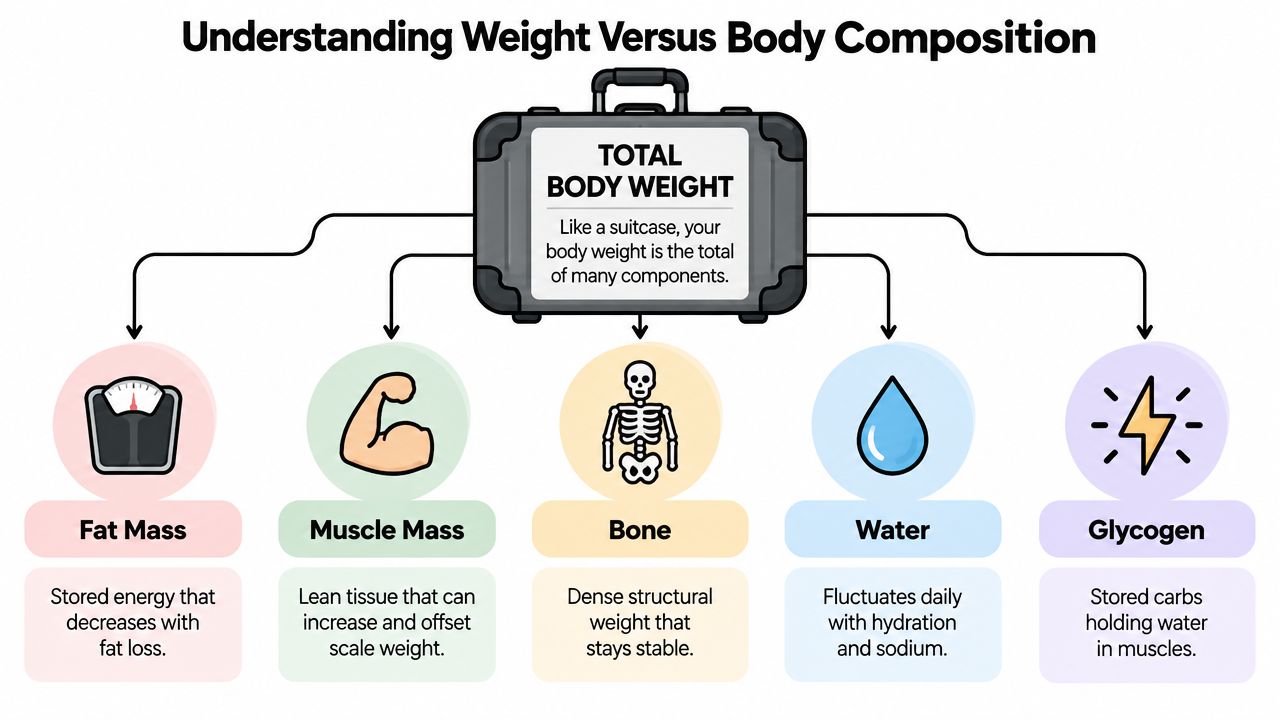
The scale is not a detailed report of those changes. It provides one total, like weighing a packed suitcase without showing whether it contains clothes, books, shoes, or water bottles. The total can remain similar while the contents change considerably.
Fat loss and weight loss are related, but they're not identical. Fat loss means stored fat has decreased. Weight loss means total body mass has decreased. Fat can decline while lean tissue is maintained or increased, muscle glycogen is replenished, training-related water is retained, or more food remains in the digestive system.
These factors can temporarily cover up progress on a single weigh-in. A measurement problem can therefore look like a progress problem. Repeated observations, such as waist measurements, progress photos, training performance, and body-composition readings taken under similar conditions, can show the broader trend more clearly.
Australian guidance also cautions against treating BMI as a complete measure of body composition. BMI categories commonly used by Australian health services place a healthy adult BMI between 18.5 and 24.9, but BMI cannot distinguish body fat from muscle mass (Better Health Channel). That limitation matters when your waist is changing or your strength is improving while total weight stays steady.
The useful question isn't only “How much do I weigh?” It's “What is changing inside that weight?”
A weekly view gives these changes room to appear, while daily numbers are easily influenced by water, glycogen, digestion, and recovery. Stable weight can accompany genuine recomposition, although a longer trend still helps you decide whether your approach needs review.
Understanding Weight Versus Body Composition
Your scale reports one total. Your body is made of several changing parts. Body weight is the sum of those components, while body composition describes how much of each component you carry.
Two suitcases can weigh the same while holding different contents. One might contain dense books, the other bulky clothing. Your body works similarly: people with comparable weight can have different proportions of fat, muscle, bone, water, and glycogen.
The main components are:
- Fat mass: Stored energy that can decrease when energy use exceeds energy intake over time.
- Muscle mass: Active lean tissue that resistance training and adequate nutrition can help maintain or increase.
- Bone: Dense structural tissue that contributes to weight but usually changes more slowly than fluid or glycogen.
- Water: A shifting component affected by hydration, sodium, digestion, recovery, and hormonal changes.
- Glycogen: Stored carbohydrate in the muscles and liver. Because it holds water, changes in carbohydrate intake or training can affect scale weight.
Why BMI and the scale have limits
A scale can show that total mass changed, but it cannot identify which component caused the change. Fat loss alongside preserved or increased muscle may leave the total nearly unchanged. A drop in water can lower the scale without showing whether fat changed.
BMI has a related limitation. Australian health guidance uses it as part of healthy-weight assessment, while noting that it doesn't differentiate between body fat and muscle mass. That makes BMI a broad screening measure, not a detailed progress dashboard.
A clearer picture comes from combining several signals:
- Scale trend, rather than one reading.
- Waist circumference, measured consistently.
- Body-fat percentage trend, interpreted cautiously.
- Strength and training performance.
- Clothing fit and everyday movement.
Daily readings can jump around, so a weekly view gives gradual changes more room to appear. Stride's guide to daily weight fluctuations and weight trends explains why individual weigh-ins can differ from the broader pattern.
A body-composition device can add context, but home measurements are estimates, not diagnostic tests. The Venus AI Smart Scale: Body Composition & Body Fat Scale is described as providing body fat, muscle mass, visceral fat, bone mass, hydration, and other metrics, with 30-day trend charts, segmental muscle mapping, and weekly summaries. Its practical value is comparing repeated readings under similar conditions, rather than treating one result as a final answer.
Why You Lose Body Fat Without Losing Weight
The most common explanation is recomposition, but “you're gaining muscle” is only part of the story. Several changes can overlap, and each can hide a reduction in fat on the scale.
Muscle preservation and gain
Resistance training gives your body a reason to retain lean tissue during fat loss. If you've recently started lifting, increased training quality, or improved your protein intake, the body may preserve muscle more effectively. In some circumstances, it can also build muscle while reducing fat.
An Australian study reported by the University of New South Wales found that strength training alone reduced total body fat by about 1.4% on average, described in the reporting article as roughly half a kilogram of fat for most participants (HealthTimes report on the UNSW systematic review and meta-analysis). A change that size can be real but still easy to obscure with short-term shifts in water, glycogen, and food volume.
Glycogen and water
Your muscles store glycogen, a form of stored carbohydrate used during training. When training volume or carbohydrate intake changes, glycogen stores can change too, and the associated water can move with them. That can make the scale look unchanged even while your fat stores are trending down.
Training also creates a recovery response. Sore muscles and temporary tissue swelling can add another layer of noise, especially after you introduce unfamiliar exercises or increase workload. This doesn't mean the workout has caused fat gain. It means the scale is recording several processes at once.
Recomposition in an Australian trial
A 16-week randomised trial that included Australian participants tested an energy-restricted, high-protein intervention. Participants reduced fat mass by 7.7 ± 3.2 kg, while lean mass increased by 0.50 ± 1.75 kg (Obesity journal trial). The figures show why fat-mass change and total body-mass change don't always match closely.
If muscle and other lean components are maintained while fat falls, the result may be a smaller waist, better clothing fit, and improved strength rather than a dramatic drop in scale weight. Food still being digested, a saltier meal, hormonal fluid shifts, and recovery from training can further mask the underlying trend.
You can also see this pattern in Australian obesity research. A Melbourne-based study found that participants in surgical and medical weight-loss programmes lost fat while preserving substantial fat-free mass, with the fat-free mass to fat-mass loss ratio remaining about 1:5.5 to 1:5.9 (PubMed record). The practical message is that fat reduction can occur alongside meaningful preservation of non-fat tissue.
Common Measurement Traps That Hide Your Progress
A single weigh-in is a snapshot, not a verdict. If you compare a Monday morning reading after a light dinner with a Friday evening reading after several meals, different hydration levels, and a training session, you're not comparing like with like.
The same problem appears when people weigh only occasionally. One reading may capture a temporary change in digestion or fluid balance rather than the direction of fat loss. A short two-to-four-week window can also be noisy, particularly when a new exercise routine changes recovery and glycogen storage.
Make the measurement repeatable
Use the same scale, on a firm floor, at a consistent time and under similar conditions. Many people choose the morning, after using the bathroom and before eating, but consistency matters more than choosing a supposedly perfect moment.
Your scale reading can be influenced by:
- Hydration: Drinking more or less changes total water mass.
- Sodium: A saltier meal can affect fluid retention.
- Hormonal changes: Fluid patterns can shift across the menstrual cycle.
- Digestion: Food and waste inside the digestive tract still contribute to scale weight.
- Exercise recovery: Recent training can temporarily alter fluid distribution.
Track readings in a way that lets you observe a trend rather than react to each result. Weekly averages are more informative than a single weekly number, because an average reduces the influence of an unusually high or low day.
For gyms running structured programmes, a weight loss challenge for gyms can work better when participants track waist measurements, training progress, and habits alongside weight. That approach keeps the focus on behaviour and body-composition signals rather than making one scale reading the entire scorecard.
Add non-scale markers
Measure your waist in the same place and under similar conditions. Record how particular clothes fit, note changes in strength, and take progress photos only if you're comfortable doing so. Body-fat percentage can add context, but it's best interpreted as a trend because home devices estimate rather than directly see your fat tissue.
If you're unsure how consumer devices estimate body fat and what can affect readings, review how accurate smart scales are before treating any individual result as definitive.
How to Track Real Fat Loss With Smart Tools
A useful tracking system should answer three questions:
- Is total weight trending down, stable, or up?
- Is body fat trending in the desired direction?
- Is lean tissue being maintained while fat changes?
Start with a repeatable weekly routine. Weigh under similar conditions, record the result, and compare the average across weeks rather than focusing on one number. Add waist circumference and a brief training note, such as whether your key lifts feel stable, stronger, or unusually difficult.
Read the pattern, not the isolated result
A simple decision guide can prevent overreaction:
| Pattern | Likely interpretation | Sensible response |
|---|---|---|
| Weight stable, body fat down, muscle stable | Likely recomposition | Continue the current approach and monitor the trend |
| Weight stable, waist down, strength improving | Progress may be occurring despite scale stability | Keep measuring consistently |
| Weight and body fat stable, waist stable | The current approach may need review | Check food intake, training consistency, recovery, and measurement conditions |
| Weight up briefly, body-fat trend unclear | Temporary fluctuation is possible | Wait for repeated readings before changing the plan |
| Unplanned weight loss with symptoms | May need clinical assessment | Speak with a qualified health professional |
A smart scale can organise several of these signals in one place. The Venus AI Smart Scale is described as measuring 12 body-composition metrics, syncing with the Venus Health App, creating 30-day trend charts, and generating weekly summaries with a prioritised action plan. Those features can help you see whether weight is stable because fat and lean mass are shifting in opposite directions, although home body-composition readings should still be interpreted as estimates.
For a clear explanation of practical body-fat measurement methods, see this guide to measuring body fat.
The tool matters less than the habit. Use the same device, follow the same routine, and give the trend enough time to become meaningful. The Venus Ovulation Predictor Test Kit belongs to a different health-tracking purpose, but it illustrates the same principle: repeated, consistently recorded measurements are more useful than one isolated result.
A short video can also help you understand how app-connected health measurements are presented:
Practical Steps to Align Fat Loss and Weight Goals
If you want fat loss to continue while making the scale easier to interpret, focus on the basics that support lean tissue and consistent recovery. Don't change everything at once. A complicated plan makes it harder to identify what's helping and easier to abandon a useful routine because one reading looks disappointing.
Build meals around protein and consistency
Include a meaningful protein source in regular meals, such as eggs, yoghurt, tofu, legumes, fish, poultry, or lean meat. The right amount depends on your body, health status, preferences, and training, so individual advice from a dietitian can be valuable.
Use food logging when you need more awareness, not punishment. A photo log, barcode scan, or simple written record can reveal portion patterns that are easy to overlook. If the scale is stable but your waist and body-fat trend are improving, don't slash food intake automatically. You may already be achieving the desired recomposition outcome.
Keep resistance training central
Progressive resistance training supports muscle retention and gives you a performance marker beyond body weight. Combine it with cardiovascular activity that you can recover from and repeat. Walking, cycling, swimming, or structured moderate-intensity sessions can all fit, depending on your fitness and medical circumstances.
For practical guidance on preserving lean tissue during fat loss, read how to maintain muscle while losing fat.
Protect recovery and your tracking routine
Sleep, stress, hydration, and regular meal patterns can affect how predictable your fluid balance feels. They won't eliminate normal variation, but a steadier routine makes your measurements easier to compare.
Review your trend after four to eight weeks, rather than changing your plan after a handful of readings. If you need broader guidance on shedding pounds healthily, look for advice that prioritises sustainable habits and overall health rather than rapid scale changes.
Choose one priority for the coming week, then measure whether you followed it. A reliable habit gives you better information than a dramatic short-term overhaul.
When Progress Is Real and When to Seek Advice
A steady scale can hide meaningful progress. If body fat is decreasing while your waist becomes smaller, clothes fit differently, or strength improves, your body composition may be changing in a positive direction. A scale can't separate fat from lean tissue or water, so a single weigh-in cannot show the whole picture.
Australian evidence adds useful context. The National Centre of Implementation Science in Obesity evidence hub reports that 67.1% of adults were living with overweight or obesity in 2022–24, and severe obesity, classified as class II or III, affected 12.9% of adults. These figures do not mean everyone needs a lower scale weight. They support using waist measurements, body-fat trends, and broader health markers alongside BMI.
Healthy adult BMI is generally listed as 18.5 to 24.9, yet BMI cannot distinguish muscle from fat (Better Health Channel). Use it as context rather than a complete definition of health or progress.
Seek medical advice for unintended weight loss, particularly loss exceeding 5%, which Queensland Health guidance identifies as important to investigate. Contact a health professional about persistent fatigue, worsening symptoms, unexplained changes, or concerning body-composition results.
Track measurements consistently and review weekly or monthly trends. Record waist and strength changes too. If the pattern remains unclear, app-connected tools from Venus Health Co. can place weight, fat, muscle, hydration, and other measurements side by side. Bring persistent or concerning changes to a qualified health professional.