

How to Maintain Muscle While Losing Fat
Dr. Adeyinka AdegbosinYou've tightened your food, added extra walking and watched the scales fall. Then Monday morning arrives, and the number is down sharply from the week before. Instead of feeling pleased, you wonder whether you've lost muscle along with fat.
That reaction is understandable, but a cut should never be judged by body weight alone. The target is less fat with as much strength and lean tissue retained as possible. That requires a moderate energy deficit, enough protein, a progressive resistance stimulus and recovery that supports performance. It also requires checking the trend week by week, rather than making decisions from one noisy weigh-in.
Why the Scale Lies During a Cut
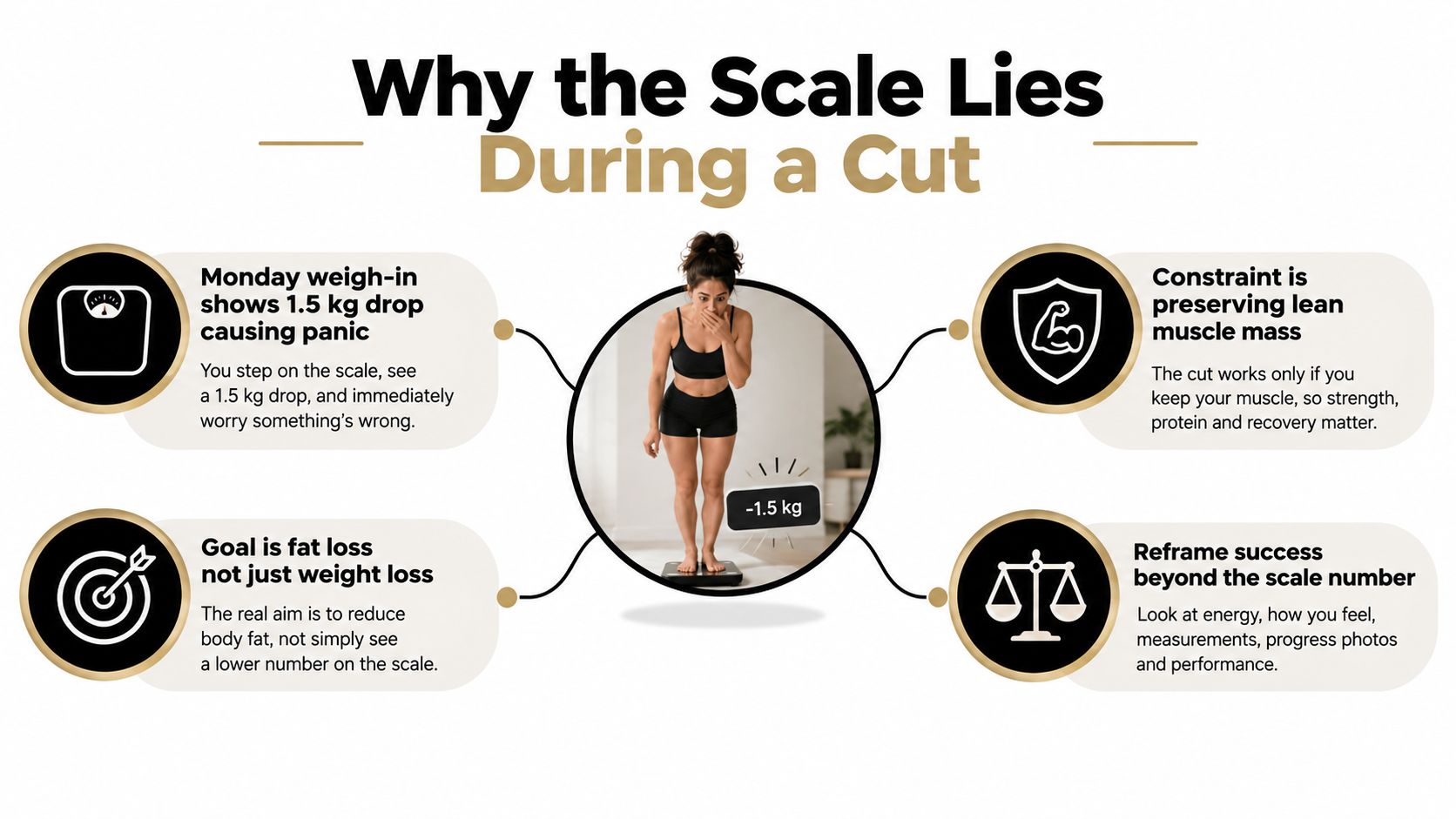
A client steps on the scale on Monday and sees a 1.5 kg drop from the previous week. Panic follows. They assume the cut is too aggressive and that muscle has disappeared overnight.
The first correction is simple: scale weight is not the same as fat mass. Your morning reading reflects water, glycogen, food still moving through the gut and fat tissue. A kilogram of fat loss can appear as anything from 0.4 kg to 1 kg on the scale, depending on those other variables. That range is a practical reminder that the scale is a useful signal, not a complete diagnosis.
Your body also has a reason to break down muscle during an energy deficit. Muscle tissue requires ongoing energy and protein turnover, so when food intake falls, the body looks for ways to meet its energy needs. If training becomes easy, protein is low and recovery deteriorates, the physiological argument for keeping that tissue becomes weaker.
Reframe the target
Think of recomposition as a fat-loss goal with a muscle-preservation constraint. A lower body weight is welcome, but it isn't sufficient evidence that the plan is working.
Track these signals together:
- Body composition trend: Is fat mass moving down while reported muscle mass remains broadly stable?
- Gym performance: Are your main lifts holding up, even if some sessions feel harder?
- Waist measurement: Is your waist shrinking without a corresponding collapse in strength?
- Recovery: Are sleep, appetite, mood and training readiness still manageable?
Resistance training is central because it gives your body a reason to retain the tissue you're asking it to keep. A 2021 University of New South Wales analysis found that strength training alone reduced total body fat by about 1.4% on average, roughly half a kilogram of fat mass for most participants, showing that lifting can contribute directly to fat loss rather than serving only as muscle protection (University of New South Wales analysis).
The three levers are straightforward: protein supplies building material, resistance training supplies the retention signal, and recovery allows you to respond. The rest of the process is monitoring whether those levers are producing the intended result.
Setting Your Calories and Protein Target
Start with a deficit you can train through. A practical opening point is roughly 300 to 500 kcal below maintenance per day, then adjust only after you've collected enough consistent data to see a trend. A simple estimate uses body weight in kilograms multiplied by 30 to 35 kcal, followed by the chosen deficit.
For example, a 75 kg person using the middle of that range might estimate maintenance around 2,400 kcal, then begin near 2,000 kcal. That isn't a laboratory measurement. It's a workable starting estimate that must be checked against body-composition trends, hunger and gym performance.
Protein deserves more precision. The Australian Sports Commission says athletes using weight-loss programmes may need 1.6 to 2.4 g/kg/day for “high quality weight loss”, meaning reduced fat mass with muscle retained (Australian Sports Commission protein guidance). For those cutting while lifting, a practical target within that range is 1.6 to 2.2 g/kg/day, with the upper end useful when the deficit is harder, training is demanding or body-fat levels are already relatively low.
The standard Australian healthy-adult baseline is lower, at 0.84 g/kg/day for men and 0.75 g/kg/day for women, according to Australia's MeasureUp nutrition resource, so a muscle-preservation phase needs a different target from general health nutrition. For a 75 kg person, the ASC range works out to approximately 120 to 180 g per day.
Make the target easy to hit
Spread protein across three or four meals rather than leaving the entire quota for dinner. A useful working figure is around 0.4 g/kg per meal across four meals, then fill the remainder according to appetite and schedule. If injury, rehabilitation or reduced training has complicated your intake, practical guidance on protein intake targets after injury can help you think through meal planning alongside clinical advice.
| Body Weight (kg) | Maintenance kcal (×32) | Cut kcal (-400) | Protein target (2.0 g/kg) | Protein grams per meal (×4) |
|---|---|---|---|---|
| 60 | 1,920 | 1,520 | 120 g | 30 g |
| 75 | 2,400 | 2,000 | 150 g | 37.5 g |
| 90 | 2,880 | 2,480 | 180 g | 45 g |
| 105 | 3,360 | 2,960 | 210 g | 52.5 g |

A larger deficit can create faster scale movement, but it also leaves less room for training quality, recovery and adequate food volume. The Australian Sports Commission range is a useful guardrail, not a reason to force extreme dieting. If you use an app-connected device such as the Venus AI Smart Scale: Body Composition & Body Fat Scale, treat its readings as trend data collected under consistent conditions, not as an unquestionable verdict from a single day.
Building a Resistance Program That Protects Muscle
Lifting during a cut isn't about completing random workouts to burn calories. Your programme needs to preserve the loads, movement patterns and effort that tell your body muscle remains necessary.
A busy client can use four sessions of 45 to 60 minutes in an upper and lower split. Each major muscle group receives a repeated stimulus across the week, while the split leaves room for work, family and normal Australian life.
A practical weekly template
| Day | Session | Main emphasis |
|---|---|---|
| Monday | Upper body | Bench press, row, overhead press, pull-up, arm accessories |
| Tuesday | Lower body | Squat, Romanian deadlift, split squat, calf and trunk work |
| Thursday | Upper body | Overhead press, pull-up, incline press, row, shoulder and arm accessories |
| Friday | Lower body | Deadlift, front squat, hip thrust, single-leg work, trunk work |
Use 6 to 12 repetitions for compound lifts such as the squat, deadlift, bench press, row, overhead press and pull-up. Take the final one or two work sets to within roughly two repetitions of technical failure. Accessories can sit in the 10 to 15 repetition range, where controlled execution makes it easier to create effort without turning every set into a joint-management problem.
Practical rule: Keep the weight challenging during a cut. If fatigue forces a change, remove a set before you dramatically reduce the load.
The most common mistake is lowering both volume and intensity as soon as calories fall. Reducing a little volume can be sensible, but turning every session into light maintenance work removes the signal you need. A hard set performed with sound technique gives your nervous system a reason to retain the muscle involved.
Auto-regulate by trimming sets when sleep, work or family demands compress a week. Keep the main movement pattern and a meaningful load, then remove less important accessories. If you normally perform four hard sets, three may be enough on a rough day. That is a better compromise than skipping the session or replacing progressive lifting with endless cardio.
Home training can work when the resistance progresses through heavier dumbbells, bands, unilateral variations, slower eccentrics or harder angles. The important question is not whether the equipment looks like a commercial gym. It's whether the target muscle is exposed to increasing or at least consistently demanding tension.
For people who want a separate discussion of the practical habits that support lean-mass retention, this guide on how to prevent muscle loss is a useful companion. Supplements should stay secondary. If you're considering branched-chain amino acids or similar products, review the evidence and practical context around a recovery supplement 240 veg caps before spending money on them.
Here's a short visual reference for organising the week:
The Venus Ovulation Predictor Test Kit belongs to fertility tracking rather than muscle retention, so it shouldn't be confused with a training or body-composition tool. Keep those goals separate when choosing what to measure.
Adding Cardio Without Killing Your Gains
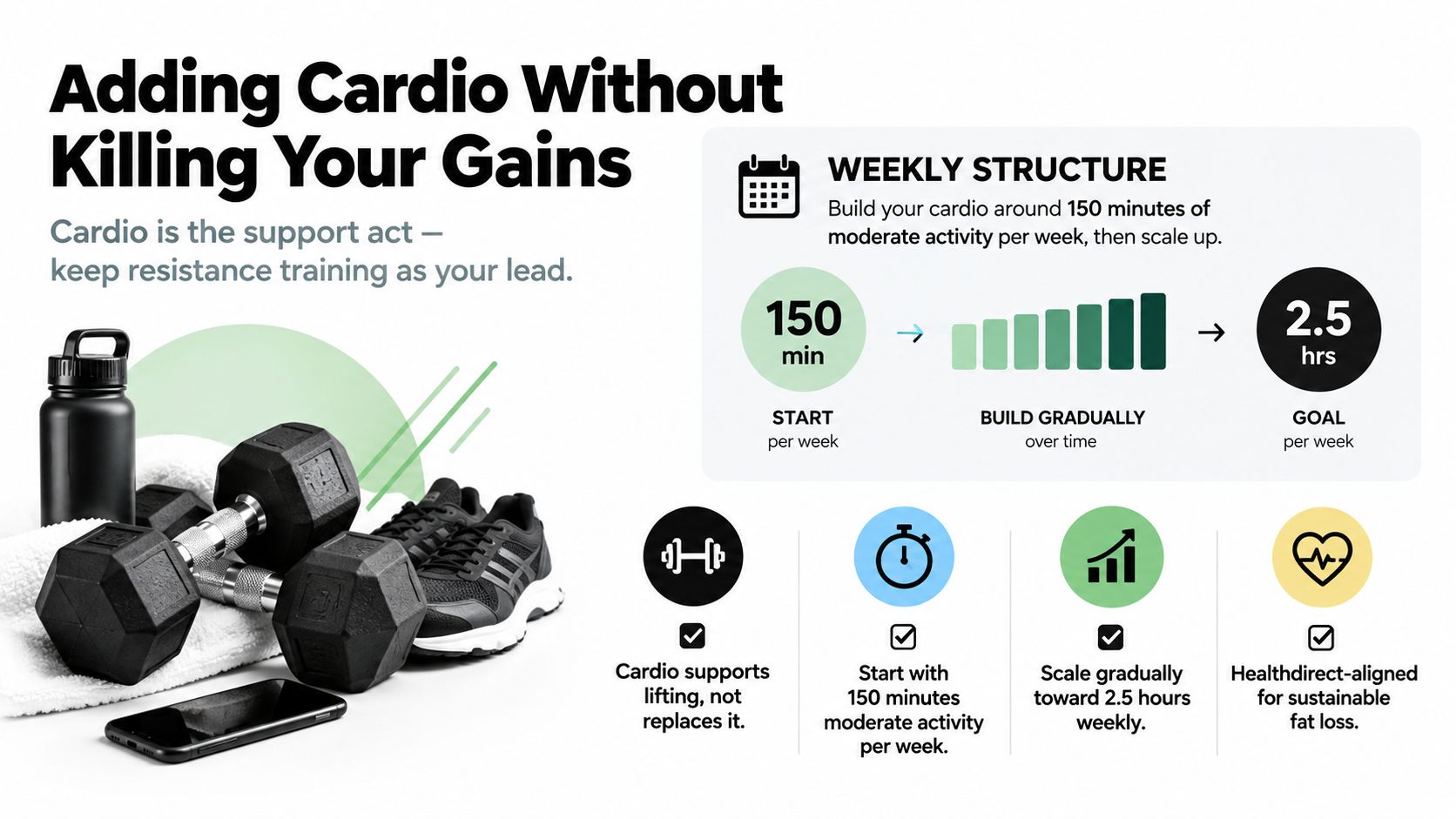
Cardio should support your lifting, not replace it. Healthdirect recommends about 2.5 hours of aerobic exercise weekly alongside resistance training, and also recommends resistance training three times per week to help prevent muscle loss during weight loss (Healthdirect muscle-mass guidance).
Start with moderate activity that you can recover from. Brisk walking, indoor cycling, swimming and incline treadmill walking are practical options. If joints are irritated, vary the mode rather than forcing more impact. Guidance on alternative cardio for osteoarthritis offers additional low-impact ideas.
Layer it around the weights
Most cardio should be low intensity, including steady treadmill, rower or cycling work that allows conversation. Short interval sessions can be useful, but place them after weights or on a separate day, and keep them limited if lower-body recovery is already marginal.
A practical progression looks like this:
- Begin with 150 minutes: Use Healthdirect-aligned moderate activity as the initial weekly structure.
- Choose joint-friendly modes: Walking, cycling, swimming and incline work are easier to repeat than punishing sessions.
- Track the extra demand: A smartwatch can show whether an added session materially changes your activity load.
- Protect performance: If grip strength, deadlift volume or session effort is clearly worse by the third week, reduce cardio before cutting more food.
Don't automatically eat back every calorie displayed by a watch. Those estimates can be imprecise. Use the device to identify changes in activity, then compare them with hunger, body-composition trends and gym performance.
A Venus Smart Basal Thermometer for Ovulation - Bluetooth BBT Tracker with App is designed for basal temperature and fertility tracking, not cardio-load monitoring, so it isn't a substitute for a training watch or exercise log.
Recovery and Sleep as Training Inputs
A calorie deficit reduces your margin for poor recovery. You may still complete the workout, but the quality of your sets, your willingness to push and your ability to repeat performance can gradually deteriorate.
Give sleep a defined place in the programme. Aim for 7 to 9 hours, maintain a consistent wind-down window and keep the bedroom cool enough to sleep comfortably. Late screen exposure is a common Australian routine problem, particularly when work and family responsibilities push training into the evening.
Build a repeatable evening
A useful routine might include:
- Caffeine timing: Set an early-afternoon cut-off if later intake disrupts sleep.
- Light control: Dim the room and reduce stimulating screen use before bed.
- Consistent timing: Keep wake time relatively stable, even when the training week changes.
- Trend monitoring: Use a wearable or sleep app to notice repeated deterioration rather than obsessing over one score.
Light mobility, walking and brief foam rolling can make active recovery feel easier between sessions. They don't replace sleep, food or rest. Sauna sessions and stretching may support relaxation, but neither can compensate for a programme that asks for more work than you can recover from.
Stress from work, finances or family can also reduce training quality and appetite control. Ask yourself once a week: “What is currently taking recovery capacity away from me?” If the answer is obvious, reduce optional training volume before you reduce sleep.
The plan should bend around recovery, not the other way around. When sleep slides, preserve the main lifts, remove lower-value work and avoid adding cardio to compensate for a difficult week.
Tracking Muscle Retention Week by Week
Treat the first week as a baseline, not a test you can pass or fail. Record a morning fasted weight, waist circumference, a consistent body-composition reading and performance benchmarks on movements such as the squat, bench press, deadlift or pull-up.
Use the same conditions for each reading. Similar timing, hydration and food status make trends easier to interpret, although no home body-composition device should be treated as a precise clinical measurement. The useful question is whether several signals point in the same direction.
The weekly dashboard
Log these measures:
- Seven-day weight average: This reduces the noise created by water and gut content.
- Reported muscle-mass trend: Look for a sustained direction, not a single fluctuation.
- Waist circumference: Measure at the same location and under similar conditions.
- Average daily steps: Pull the figure from a connected watch rather than guessing.
- Session RPE and volume: Record how hard the work felt and how much you completed in Strong, Hevy or a similar training app.
Two consecutive weeks of falling reported muscle mass or stalled lifts should trigger a review of calories, protein, sleep and training volume. Don't make five changes at once. First check whether the readings were consistent, then adjust the smallest useful variable.
The example below is a worked illustration, not a client case study. It shows the pattern you want to see, with fat mass falling by 1.5 kg across four weeks while reported muscle mass stays stable.
| Week | Fasted Weight (kg) | Muscle Mass (kg) | Waist (cm) | Avg Session RPE |
|---|---|---|---|---|
| 1 | 82.4 | 61.8 | 91.0 | 8 |
| 2 | 82.1 | 61.9 | 90.5 | 8 |
| 3 | 81.6 | 61.7 | 89.8 | 8 |
| 4 | 80.9 | 61.8 | 89.0 | 8 |
The scale trend is moving down, the waist is narrowing and the reported muscle figure is broadly stable. Session effort hasn't collapsed. That combination is more useful than celebrating a large single-day drop.
For a further measurement-focused perspective, see how to measure muscle gain. The same principle applies during fat loss: measurement is valuable only when it changes a sensible decision.
Your 12-Week Recomposition Game Plan
Use the programme as a controlled experiment. Keep the first phase deliberately simple, then add demand only when your measurements and performance show that recovery is holding.
Phase 1 weeks 1 to 4
Set calories at a 300 to 500 kcal deficit, protein at 1.6 to 2.0 g/kg, three full-body resistance sessions and two moderate cardio sessions. Record a body-composition reading once per week in the paired app, alongside waist and gym performance.
The main aim is consistency. Don't add HIIT, extra restriction or daily weigh-in panic before you know how your body responds to the basic structure.
Phase 2 weeks 5 to 8
If strength, sleep and appetite remain manageable, add a fourth lifting session. You can shift some cardio towards intervals, but only if lower-body performance and recovery remain steady. Increase daily steps gradually towards 10,000, rather than forcing a large jump in activity overnight.
Keep the deficit unchanged at first. More work doesn't automatically justify less food, especially if the extra activity improves fatigue rather than fat loss.
Phase 3 weeks 9 to 12
Use a controlled diet break or reverse-diet block to test whether lean mass and performance hold with more food. This phase isn't an excuse to abandon structure. Keep protein, lifting and measurement consistent while you assess whether the next cut is justified.
| Phase | Weeks | Deficit | Protein (g/kg) | Lift Sessions | Cardio Sessions | Daily Steps | Checkpoint Metric |
|---|---|---|---|---|---|---|---|
| Baseline | 1 to 4 | 300 to 500 kcal | 1.6 to 2.0 | 3 | 2 | Current baseline | Consistent readings and stable performance |
| Build | 5 to 8 | Same starting deficit | 1.6 to 2.0 | 4 | 2 to 3 | Progress towards 10,000 | Strength and recovery remain manageable |
| Confirm | 9 to 12 | Controlled break or reverse diet | Maintain target | 3 to 4 | Adjust to recovery | Maintain sustainable level | Lean mass and performance hold |
Use these checkpoints as decision aids, not guarantees: keep major-lift performance within 5%, look for a weekly fat-mass trend declining by 0.25 to 0.5 kg, keep sleep score above 75 if you use a consistent scoring system, and look for waist reduction of 1 to 2 cm across the relevant monitoring period. These targets are practical guardrails for the plan, not universal physiological rules.
If strength drops in two sessions in a row, add 100 calories from carbohydrates and reassess training quality. If fat mass stalls for three weeks, reduce intake by a further 100 calories only after checking tracking accuracy and activity. If the muscle-mass flag falls, increase protein and pull back cardio volume before making the deficit more aggressive.
For additional context on body-fat reduction, focus on the same principle: fat loss is only a successful outcome when your health, performance and lean tissue remain part of the result.
Venus Health Co. offers app-connected tools for tracking body weight, fat and muscle trends, with weekly summaries and nutrition-related insights that can support this week-by-week recomposition process. Visit Venus Health Co. to explore the home health tools and decide whether structured body-composition data would make your next cut easier to manage.