

What Is Body Recomposition and How It Works
Dr. Adeyinka AdegbosinYou've been training consistently, eating more thoughtfully, and feeling stronger, yet the number on the bathroom scale barely changes. Your jeans may fit differently, your waist may look smaller, and an exercise that once felt difficult may now feel manageable. Still, the unchanged scale can make you wonder whether anything is happening.
That frustration often comes from asking one measurement to answer two different questions. Weight tells you how much mass you have in total. It doesn't tell you whether that mass includes more muscle, less fat, or a combination of both. To understand what is body recomposition, you need to look at the compartments that make up your body, not just their combined total.
This guide explains how fat loss and muscle gain can overlap, which training and nutrition habits support the process, and how to track change more intelligently. You'll learn how to interpret stalled scale weight, choose practical actions, and build a repeatable system for checking whether your body composition is moving in the direction you want.
Introduction Why the Scale Does Not Tell the Whole Story
Consider two people who each weigh the same before and after several months of training. One has lost fat while maintaining muscle. The other has lost weight without protecting lean tissue. The scales might make the second person appear more successful, but the readings don't reveal which body has changed in the more useful way.
That's why body recomposition can feel invisible at first. Fat mass and lean mass can move in opposite directions, leaving total body weight relatively stable. A person might notice a smaller waist, improved muscle definition, or better performance before seeing a meaningful change on the scale.
The idea also matters beyond appearance. Australian cohort data from the AusDiab study found that fat-free mass and skeletal muscle mass began declining from about age 25, while men's fat-free mass peaked around age 38 before falling. From peak levels to age 75 and older, the relative loss reached 6 to 8% for fat-free mass and 11 to 15% for skeletal muscle mass in both men and women (Australian AusDiab analysis). Those patterns show why preserving muscle deserves separate attention as adults age.
A better question than “How much do I weigh?”
A scale can be useful, but it's only one signal. Body composition asks a more practical question: what proportion of your body is fat, muscle, bone, water, and other lean tissue?
You can read a broader explanation of these compartments in what body composition means, then apply the idea to your own training. By the end of this article, you'll know how to:
- Define recomposition clearly: Separate fat loss, muscle gain, and total weight.
- Coordinate the inputs: Match resistance training, food intake, and recovery.
- Track the right signals: Use measurements that can reveal progress when body weight stays flat.
- Set realistic expectations: Interpret early performance changes without demanding instant visual results.
What Body Recomposition Really Means
Body recomposition means reducing fat mass while maintaining or increasing lean mass. Think of renovating a house without changing its outside footprint. The total area may stay similar, but the rooms inside become more functional. In the same way, your scale weight may remain steady while the balance between fat and lean tissue improves.
Fat mass is the body tissue stored primarily as fat. Lean mass is broader than muscle alone. It includes skeletal muscle, water, bone, organs, and other non-fat tissue. This distinction matters because a body-composition device may report “lean mass”, while a scan or report may separately estimate muscle-related compartments.
The scale adds everything together
Imagine losing some stored fat while building muscle through resistance training. Those changes can partly offset each other on the scale. The result may be a stable total weight, even though your clothes fit better and your strength improves.
That doesn't mean the scale is useless. It means scale weight is an outcome of several compartments combined, so it can't identify which compartment changed. Recomposition is therefore less about chasing a lower number and more about improving the relationship between fat and lean tissue.
Why the Australian context matters
The Australian cohort findings provide a useful reason to think beyond body weight. Muscle preservation is a distinct health target, particularly with ageing, because a stable scale reading could hide a gradual change in the balance between fat-free tissue and fat.
Australian researchers also developed local lean-mass and fat-mass reference ranges using Hologic DXA scans in community-dwelling Australian adults. The study addressed the lack of normative data for that commonly used Hologic system in Australia and supported clinical and research interpretation of conditions involving soft tissue, including obesity, sarcopenia, and cachexia (Australian Hologic DXA reference study).
The mental model is simple: body weight tells you the size of the package, while body composition tells you what's inside it. Recomposition aims to improve what's inside, even when the package weighs much the same.
How Your Body Builds Muscle While Burning Fat
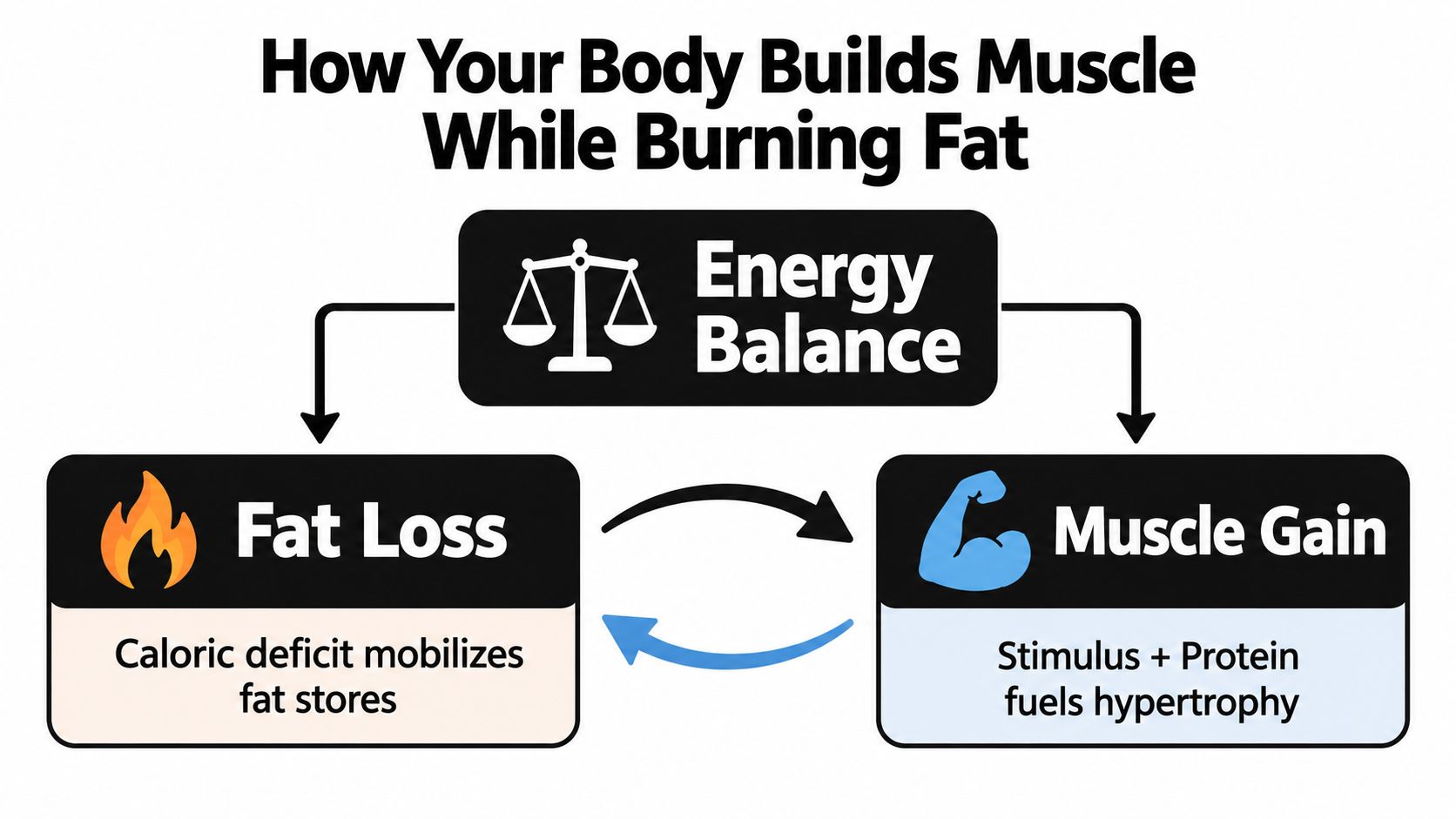
Fat loss and muscle gain involve different processes, but they can overlap. Fat loss generally requires your body to draw on stored energy. Muscle gain requires a training stimulus, building materials, and enough recovery to adapt to that stimulus.
A person can create the conditions for both by combining resistance training with appropriate food intake. The body doesn't need to choose one process permanently. Instead, the balance depends on training history, available energy, protein intake, recovery, and the size and duration of any energy deficit.
Fat loss starts with energy balance
When you consistently use more energy than you obtain from food, your body needs to access stored energy. That stored energy can include fat. Recomposition doesn't require an extreme approach. In fact, pushing food intake too low can make training quality and recovery harder to sustain.
The practical aim is to support gradual fat reduction while keeping enough energy available for productive training. That often means avoiding dramatic restriction and paying attention to performance, hunger, sleep, and consistency rather than treating a single daily intake figure as the whole plan.
Muscle gain needs a reason to happen
Resistance training gives your muscles a reason to adapt. Each session creates a challenge, and repeated exposure can encourage the body to become stronger and better able to handle that challenge. Progressive overload can involve adding load, completing more repetitions with the same load, improving technique, or gradually making an exercise more demanding.
Protein supplies amino acids used in muscle repair and adaptation. Recovery then gives the body time to respond. Beginners, people returning after a break, and people with more available stored energy may find the overlap between fat loss and muscle gain more responsive than highly trained, already lean athletes.
Core idea: Recomposition isn't magic. It's the overlap between a fat-loss signal and a muscle-building signal, managed well enough for both to continue.
Where health tracking fits
Some people also monitor other physiological patterns alongside training and nutrition. For example, the Venus Smart Basal Thermometer for Ovulation - Bluetooth BBT Tracker with App records basal body temperature and syncs readings to an app, which may be relevant for someone tracking fertility or broader health patterns. It doesn't replace body-composition measurements, but it illustrates a useful principle: repeated data becomes more informative when you collect it consistently.
Evidence Based Strategies for Nutrition Training and Recovery
A useful week can look uneventful on the scale: body weight stays similar, yet your waist becomes smaller and your lifts improve. Recomposition becomes easier to manage when you treat it as a measurement problem first. Nutrition, resistance training, and recovery are the tools, while separate signals help you see whether fat and lean tissue are changing in the intended direction.
Nutrition that supports the goal
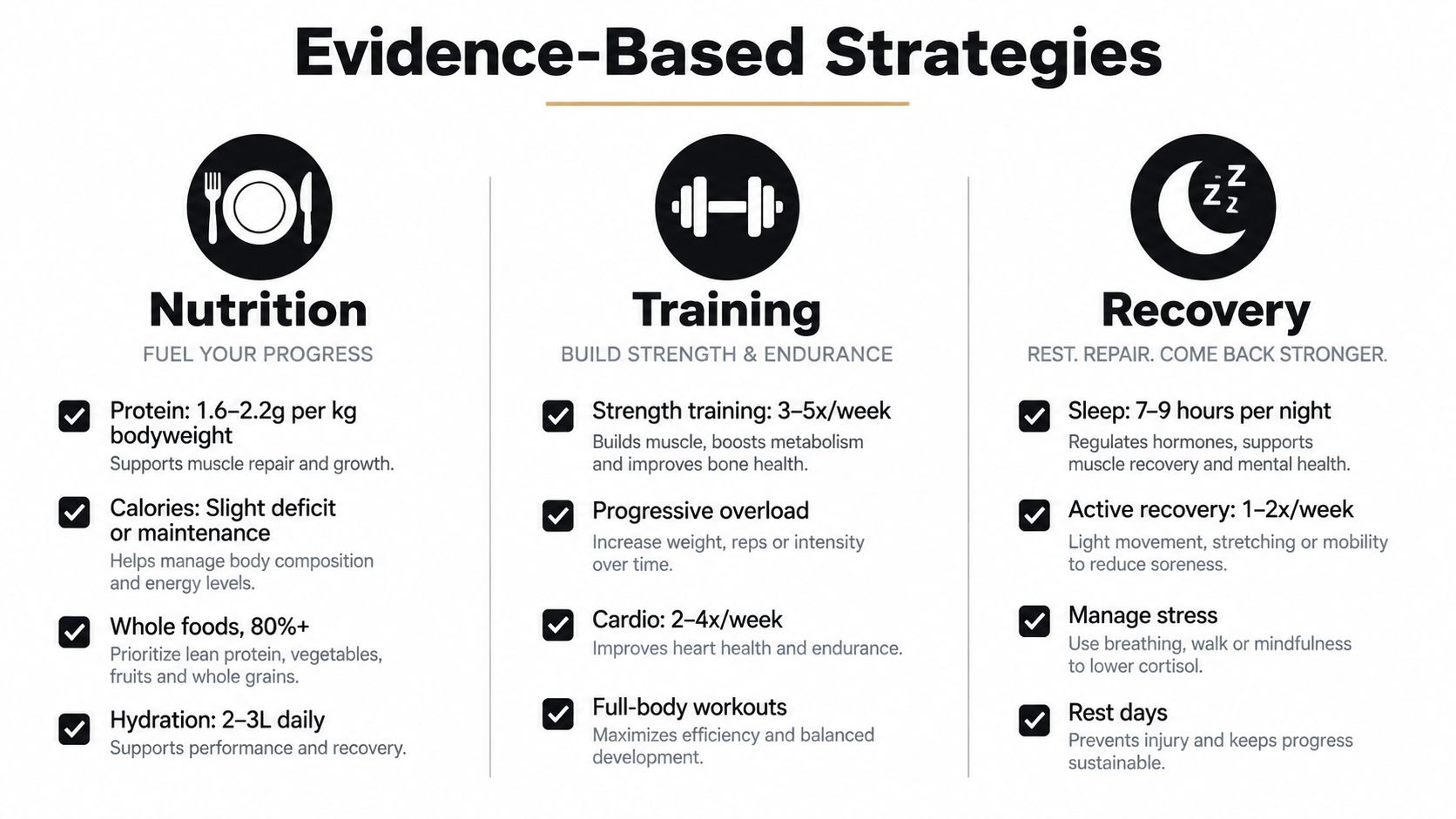
Protein supplies the amino acids muscle tissue uses for repair and growth. The verified Australian guidance in the evidence brief supports choosing a protein intake target that fits your body size and training context, rather than leaving protein to chance.
Energy intake needs a workable balance. Severe restriction can reduce training quality and make muscle retention harder. Eating around maintenance may suit someone prioritising gradual improvement in both fat and lean compartments. Starting body composition, training experience, appetite, and daily activity should guide that choice.
Build meals around a clear protein source, add carbohydrate for demanding sessions, and include vegetables, fruit, legumes, and other fibre-rich foods for volume and nutrition. Enjoyable foods can remain part of the plan. Repeatable eating usually serves recomposition better than a perfect approach that you cannot maintain. For a broader health-focused approach, see how to improve body composition.
Training that sends a clear signal
Australian exercise guidance recommends whole-body resistance training 2 to 3 times per week on non-consecutive days, commonly using 8 to 12 repetitions per set for general health or lean-mass gain. The same evidence found that resistance training reduced body-fat percentage by 1.46%, body-fat mass by 0.55 kg, and visceral fat with a standardised mean difference of 0.49, compared with a control group (resistance-training meta-analysis and Australian guidance).
Centre sessions on movements that train the major muscle groups. Record repetitions, load, and technique so gradual progress becomes visible, even when scale weight does not change. This training record adds a practical compartment signal: stronger performance can support the case that lean tissue and training capacity are being maintained or improved.
Cardio can support fitness and energy expenditure, but it should not displace resistance work. Walking, cycling, swimming, or another activity you enjoy can fit around strength sessions, provided the total workload still leaves room for recovery.
Recovery keeps the plan usable
Sleep, rest days, stress management, and adequate food intake affect whether you can train consistently. If soreness, fatigue, or declining performance keeps accumulating, reduce unnecessary volume before choosing a more aggressive diet.
For practical ideas after training, use this workout recovery guidance as a supplementary resource. Recovery is part of the measurement process too, because a tired week can temporarily affect performance, water balance, and how your body feels.
Matching your recomposition focus to your starting point
| Starting point | Primary lever | Training emphasis | Nutrition emphasis |
|---|---|---|---|
| New to resistance training | Build a repeatable routine | Whole-body sessions and technique | Consistent meals with adequate protein |
| Returning after a break | Rebuild capacity gradually | Progressive overload without rushing | Fuel sessions and avoid drastic restriction |
| Experienced and relatively lean | Protect performance and recovery | Planned progression and quality volume | Precise, sustainable intake |
| Managing a higher body-fat level | Improve adherence and strength | Resistance training as the anchor | A manageable energy deficit or maintenance approach |
How to Track Body Recomposition Progress Accurately
Tracking starts with accepting that no single method answers every question. The scale is convenient and inexpensive, but it combines fat, muscle, water, and other tissue into one reading. During recomposition, that can hide meaningful progress.
Tape measurements add context. A waist measurement can show a change in body size even when weight is stable, while hip, thigh, chest, and arm measurements may help you see where changes are occurring. Use the same position, tape tension, time of day, and measurement process each time.
Progress photographs work in a similar way. Consistent lighting, clothing, posture, and camera distance matter more than taking photos frequently. Strength records provide another useful signal, particularly when your lifts or repetitions improve while your measurements move in a favourable direction.
Why compartment data is more actionable
DXA can estimate separate fat and lean compartments, while home body-composition devices can provide directional trends. Australian reference research has established ranges for total and regional lean and fat compartments, including appendicular lean mass and android and gynoid fat distribution (Australian regional DXA reference data). That kind of local benchmark helps clinicians and researchers interpret composition rather than relying only on body size.
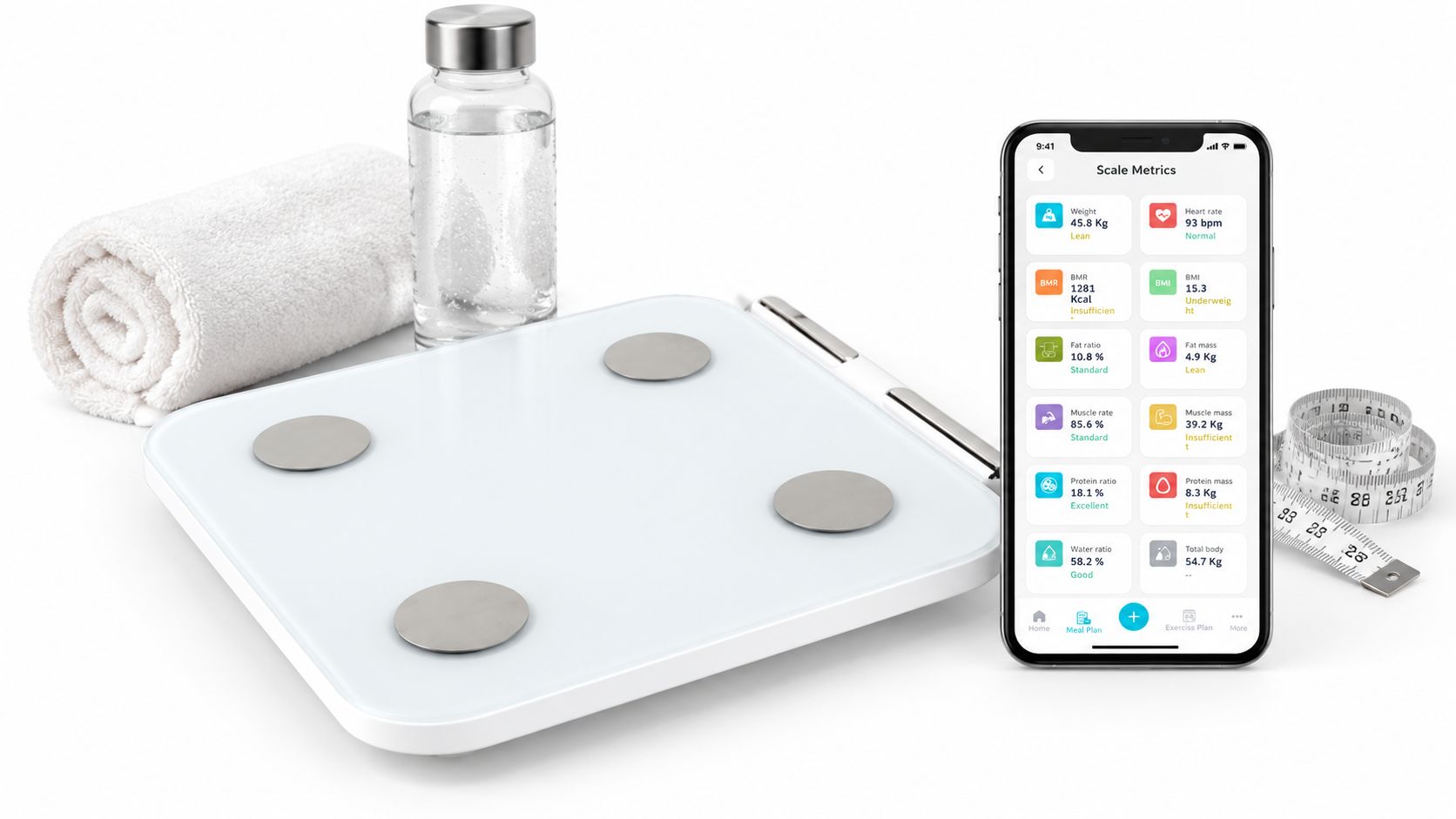
At home, the Venus AI Smart Scale is described as providing weekly body-fat, muscle-mass, visceral-fat, and other body-composition insights through the Venus Health App, along with trend reports and nutrition tracking. Treat readings as estimates and focus on the direction across repeated, standardised measurements rather than reacting to one result.
A simple tracking routine
Take a baseline using the methods available to you, then repeat them under similar conditions. A weekly weigh-in or composition check can reveal a trend, while tape measurements and photos can be spaced further apart to make visible change easier to recognise.
Look for a pattern rather than a perfect reading:
- Fat-related signals: Waist or other measurements trend down, and estimated fat measures move lower over time.
- Lean-related signals: Strength, repetitions, training quality, or estimated lean mass hold steady or improve.
- Context signals: Energy, recovery, and exercise tolerance remain manageable.
For more detail on using training performance and measurements together, see how to measure muscle gain. If measurements disagree, don't panic. Hydration, food, recent training, and measurement conditions can all affect short-term readings.
Realistic Timelines and What to Expect
Recomposition doesn't move at one universal speed. Someone new to resistance training may respond quickly because the stimulus is unfamiliar. Someone returning after time away may also regain capacity efficiently. A highly trained, lean athlete usually has less room for rapid change and needs more precise programming.
The first signs may appear in performance rather than appearance. You might complete an extra repetition, use a slightly heavier load with good technique, or recover more comfortably between sessions. Those changes don't prove that fat loss has already occurred, but they show that your training system is becoming more capable.
A useful way to read the calendar
Around weeks 4 to 8, many people can begin looking for early performance and measurement signals, although individual responses vary. Between weeks 8 and 16, clothing fit, circumference measurements, and photos may make changes easier to notice. These timeframes are guides, not promises, and inconsistent training or nutrition can extend them.
A beginner might see strength improve while body weight changes very little. A trained person may need longer before a small shift becomes visible. Sleep, stress, age, sex, training history, food intake, and measurement quality all influence what you notice first.
Patience protects the actual goal
Daily scale changes can reflect water, food volume, and other short-term factors. A flat reading across several days doesn't tell you whether the underlying compartments are changing.
A stable scale can be compatible with progress, but it isn't proof of progress. Pair it with measurements, performance, and repeated composition data.
The Australian age-related findings also give recomposition a longer-term purpose. Preserving lean tissue as adults age is a meaningful health target even when the goal isn't a dramatic change in appearance.
Putting It All Together for Lasting Results
Body recomposition becomes easier to manage when you stop treating it as a scale challenge and start treating it as a feedback system. Training creates the demand for adaptation, nutrition supplies the materials and energy, and tracking tells you whether the balance is moving in the intended direction.
Use the next month to establish consistency rather than chase a dramatic result:
- Schedule whole-body resistance sessions: Follow the Australian guidance of training 2 to 3 times weekly on non-consecutive days.
- Create a dependable protein habit: Include a clear protein source in regular meals instead of trying to compensate later in the day.
- Protect recovery: Keep sleep, rest, and manageable training volume in the plan.
- Choose a measurement routine: Record scale weight and one or more composition signals under similar conditions.
- Change one lever at a time: If progress stalls, adjust training consistency, food intake, recovery, or measurement quality before changing everything at once.
You don't need to win every day. You need enough repeatable days for the trend to become visible. When fat mass gradually falls while lean mass holds or rises, the result can show up in performance, clothing fit, measurements, and health even if the scale moves slowly.
Venus Health Co. offers app-connected tools for tracking body composition, nutrition, and related health measurements at home, including the Venus AI Smart Scale and Venus Health App. Visit Venus Health Co. to explore the available tools and choose a measurement system that helps you turn week-to-week data into practical next steps.