

How to Improve Body Composition: A Science-Backed Guide
Dr. Adeyinka AdegbosinMost advice on body change starts with “eat less and watch the scale”. That approach can reduce body weight, but it doesn't tell you whether you've lost fat, water, muscle, or a combination of all three. How to improve body composition is a more useful question: how can you reduce fat mass while preserving, or ideally building, lean mass?
That distinction matters in Australia, where excess weight affects the population rather than a small niche. The Australian Institute of Health and Welfare reports that 2 in 3 Australian adults were overweight or obese in 2022, while more recent reporting places the figure at 67.1% in 2022–24, including 32.8% living with obesity (Australian Government health information). A sensible plan therefore needs to address fat loss without treating muscle as expendable.
Why Scale Weight Is the Wrong Target
The scale can show progress while hiding a problem. It measures total mass, not whether that change came from fat mass, skeletal muscle, body water, bone mass, and visceral fat.
Two people may weigh the same yet differ in strength, waist measurement, fitness, clothing fit, and the amount of lean tissue they carry. A lower reading is therefore not automatically a better outcome. Losing muscle alongside fat can reduce training capacity and make maintenance harder.
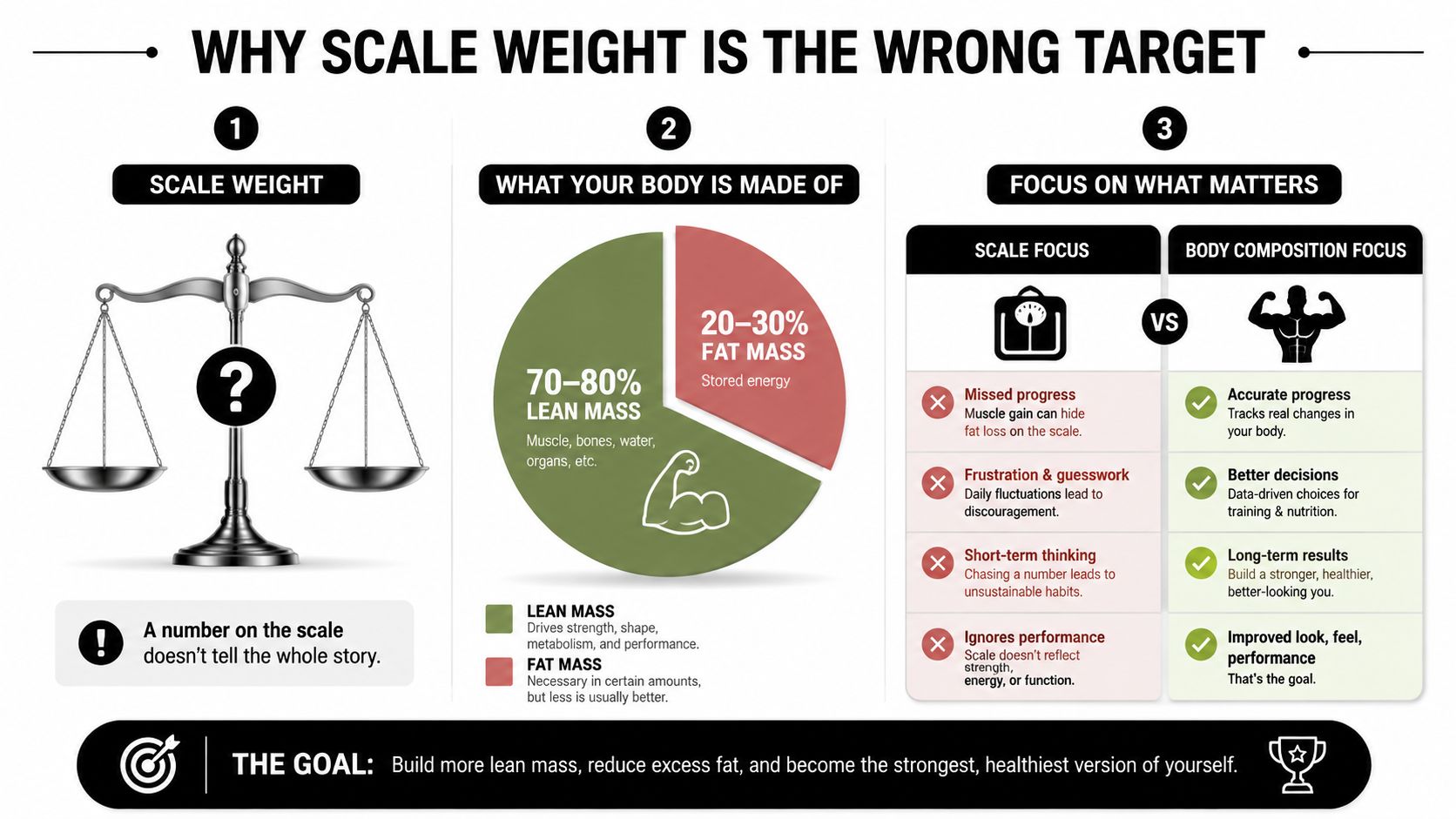
Fat loss and weight loss aren't identical
Weight loss records a change in total mass. Recomposition describes a change in the balance between fat and lean tissue. Fat mass may decrease while muscle stays stable, or fat may decrease while muscle gradually increases through structured resistance training.
Muscle preservation needs to guide the plan from the start. An aggressive diet combined with no lifting and inadequate protein can produce a quick scale drop, but strength, recovery, and lean tissue may fall with it. That approach builds restriction into the process instead of supporting a body that can perform and recover.
The Australian context makes this practical, not merely cosmetic. Adult overweight and obesity rose from 57% in 1995 to 63% in 2014–15, and obesity was identified as the main driver of that increase in AIHW trend information. A repeatable fat-loss process should protect the muscle that supports movement and strength, rather than pursue the fastest possible scale change.
For a clear explanation of the measurements involved, read this guide to what body composition means. Review these questions each week:
- Is fat mass trending down?
- Is strength holding steady or improving?
- Are measurements and clothing fit changing?
- Can I sustain the nutrition and training plan?
Practical rule: A successful cut lowers fat while keeping performance and lean mass moving in the right direction. The fastest scale drop is not the goal.
Establishing Your Body Composition Baseline
You can't manage what you haven't measured consistently. A baseline doesn't need to be perfect, but it does need to be repeatable so that later readings have some context.

Start with consistent conditions
Take your first reading under conditions you can repeat. A useful routine is to measure at the same time of day, before training, and with similar hydration and food conditions. A single reading is a starting point, not a diagnosis, and home bioelectrical impedance measurements can shift with hydration and recent activity.
Track the trend rather than reacting to one result. Record your body weight, body fat estimate, muscle mass, waist measurement, training performance, and relevant notes such as menstrual-cycle timing or an unusually hard session.
Read the report as a pattern
Common metrics have different uses:
- Body fat percentage: An estimate of the proportion of total mass that is fat.
- Muscle mass: A trend indicator that can help you assess whether training and protein intake are supporting lean tissue.
- Visceral fat level: A device-specific estimate that may help flag a trend, but it shouldn't replace clinical assessment.
- Body water: A hydration-related measure that can explain some short-term variation.
- Bone mass: A scale estimate, not a substitute for a clinically indicated bone-density scan.
- Segmental balance: A comparison of estimated muscle distribution between limbs, useful for spotting asymmetry worth discussing with a qualified practitioner.
If you want the practical details behind different measurement methods, use this resource on how to measure body fat. For nutrition planning, you can find your recomposition macros, then adjust the result around training demands, hunger, recovery, and medical context.
The Venus AI Smart Scale: Body Composition & Body Fat Scale is one example of an app-connected scale that provides body-composition metrics, trend charts, a wellness report, nutrition tracking, and personalised action prompts. Treat those outputs as decision-support data. They can help you notice direction over time, but they don't make body-composition estimates clinically definitive.
Nutrition Strategies for Body Recomposition
Nutrition determines whether your body has enough energy to train, recover, and retain muscle while fat mass decreases. The most reliable approach is a moderate energy deficit, not the largest deficit you can tolerate. Push the deficit too hard and training quality, sleep, mood, and adherence often suffer.
Protein is the anchor. Sports-nutrition guidance used by Australian practitioners commonly places exercising individuals around 1.4–2.0 g of protein per kilogram of body weight per day, with roughly 20–25 g of high-quality protein every 3–4 hours and a leucine-rich serving of approximately 700–3000 mg (International Society of Sports Nutrition guidance). These are benchmarks, not automatic prescriptions. Kidney disease, pregnancy, medical treatment, and individual dietary needs require professional advice.
Spread protein across the day
A large protein-heavy dinner doesn't fully compensate for meals that contain very little protein. Distribute servings across breakfast, lunch, dinner, and a snack so each eating occasion supports the day's target.
| Meal | Protein target | Example foods |
|---|---|---|
| Breakfast | 20–25 g | Greek yoghurt, eggs, tofu, or a protein-fortified breakfast |
| Lunch | 20–25 g | Chicken, tuna, lean beef, tempeh, tofu, or legumes |
| Afternoon snack | 20–25 g | Cottage cheese, yoghurt, milk, or a protein smoothie |
| Dinner | 20–25 g | Fish, lean meat, tofu, tempeh, or a legume-based meal |
Choose carbohydrates according to training load rather than removing them automatically. Carbohydrate can support hard resistance sessions and sport performance, while replacing every carbohydrate serving with protein can leave an active person under-fuelled. In Australian football and soccer research, trained athletes failed to meet either energy or protein recommendations, illustrating that training hard doesn't guarantee adequate fuelling (Australian Institute of Sport research).
For simple ways to add protein without rebuilding your entire menu, these practical protein-boosting strategies can help. Start with food structure before supplements: include a clear protein source at each meal, prepare portable options, and log intake long enough to identify your usual gap.
Women trying to conceive need an added layer of care. A calorie deficit shouldn't become extreme, and fertility goals may change the priority from aggressive fat loss to adequate energy and nutrient intake. The Venus Smart Basal Thermometer for Ovulation - Bluetooth BBT Tracker with App tracks basal body temperature and syncs readings to an app, which may help organise cycle observations alongside nutrition and training. It isn't a substitute for fertility or medical care.
Resistance Training and Cardio Programming
Resistance training is the part of body recomposition that generic weight-loss plans often underplay. Australian evidence-based guidance recommends training the entire body 2–3 times per week on non-consecutive days, using loads that allow no more than 8–12 repetitions before fatigue, with 1–2 minutes of rest between sets for general health (AUSactive resistance exercise prescriptions).
That recommendation is especially relevant because resistance training remains uncommon. A regional Australian study reported that 79.6% of adults did no resistance training, while only 5.2% met sufficient resistance-exercise guidelines (Australian adult obesity trends). You don't need an elaborate bodybuilding split to make progress. You need regular exposure to challenging movements and a way to progress them.
Build the week around lifting
A practical full-body session can include:
- Knee-dominant work: Squat, leg press, or a supported sit-to-stand variation.
- Hip-dominant work: Romanian deadlift, hip thrust, or a controlled hinge.
- Push and pull: Pressing and rowing patterns adapted to your equipment.
- Trunk and carry work: Bracing, loaded carries, or anti-rotation exercises.
Start with manageable loads and record repetitions, sets, and technique notes. Progress by adding repetitions within the chosen range, increasing load when form is stable, or improving control and range of motion. The target is progressive overload, not exhaustion for its own sake.
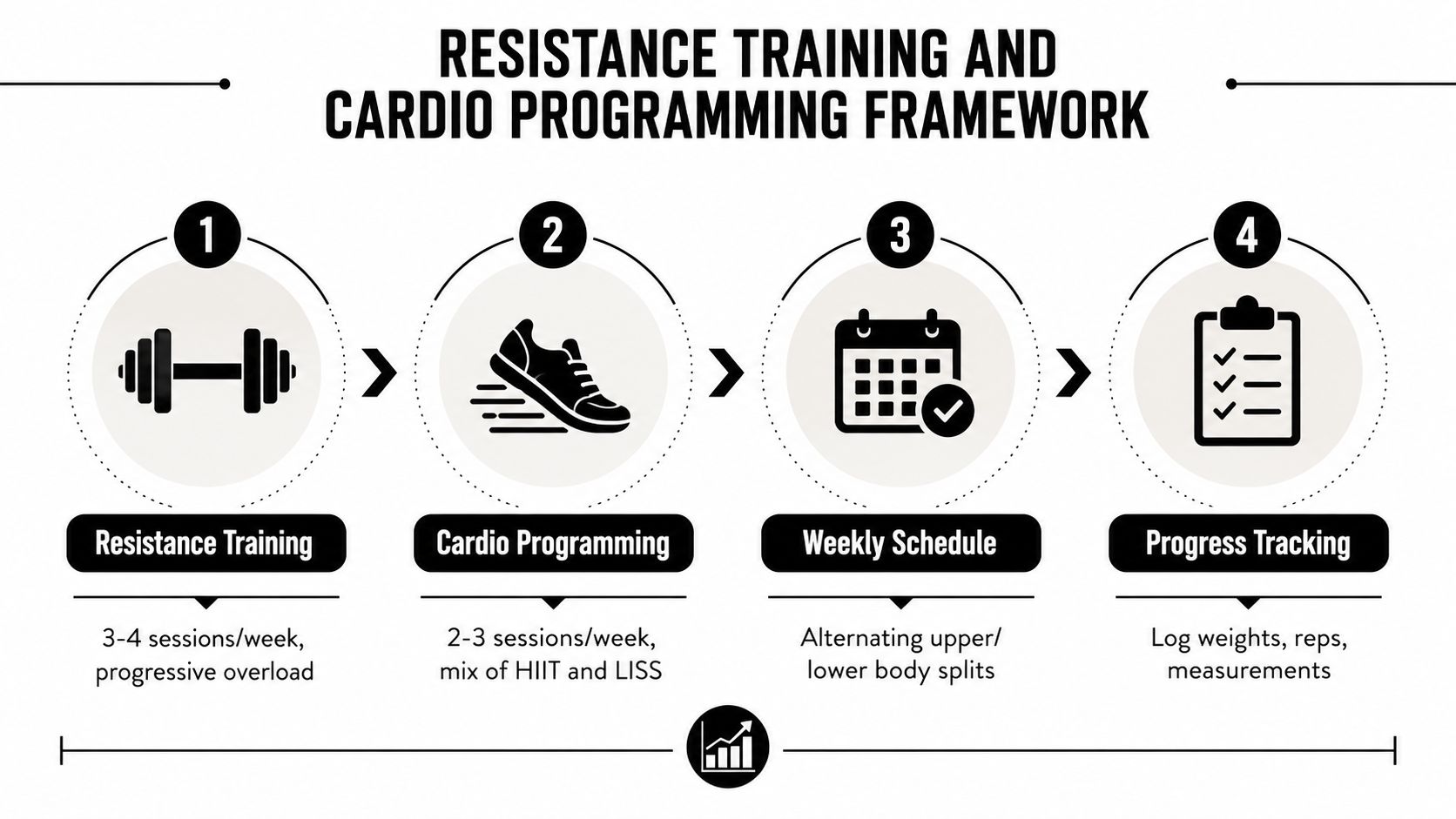
Cardio should support the plan rather than compete with it. Use walking, cycling, swimming, or other low-impact work to increase activity without making recovery impossible. Higher-intensity intervals can suit some people, but they aren't mandatory, particularly when strength, joint comfort, or fatigue is already limiting.
A simple week might place full-body resistance sessions on Monday, Wednesday, and Friday, with easy cardio or walking on separate days. Older adults, beginners, and people managing pain should scale exercise with a qualified professional. Women may also need to adjust perceived effort around sleep disruption, menstrual symptoms, pregnancy, postpartum recovery, or perimenopausal changes.
This practical guide on losing fat while gaining muscle expands on the same muscle-first principle.
Recovery, Sleep, and Hormonal Considerations
A training plan only works if you can recover from it. Poor sleep, persistent stress, and insufficient food can turn a sensible calorie deficit into a cycle of poor sessions, cravings, irritability, and missed workouts.
Start with the basics that survive busy weeks. Keep a consistent wake time where possible, make the bedroom dark and comfortable, reduce stimulating screen use before bed, and avoid treating every tired day as a motivation problem. If sleep disruption is persistent, severe, or associated with symptoms such as snoring or daytime impairment, seek clinical assessment.

Women need context, not rigid rules
Hormonal shifts can affect appetite, fluid retention, body temperature, perceived effort, and training readiness across the menstrual cycle. That doesn't mean women need a completely different body-composition programme. It means a single weekly weigh-in may be harder to interpret if you ignore cycle timing.
Track symptoms, bleeding, sleep, training performance, and basal body temperature together. A temperature pattern can provide useful cycle context, but it doesn't directly measure body fat, muscle gain, or calorie needs. People trying to conceive should prioritise medical and fertility guidance over an aggressive recomposition target.
Recovery check: If performance is falling, sleep is worsening, and hunger is escalating, reduce the training or dietary pressure before adding more discipline.
For men and women, recovery also includes managing the gap between planned and actual workload. A parent carrying children, a shift worker standing all day, and an athlete completing field sessions may need different amounts of food and rest even if they share the same gym programme. The right plan responds to those demands rather than rewarding punishment.
Sample 8 to 12 Week Plans for Real Life
The same body-composition principles look different in different households. The following examples are templates, not medical prescriptions, and they should be scaled to training history, injuries, medications, and fertility or pregnancy status.
The performance-focused athlete
Use three to five resistance sessions across the week, with sport-specific conditioning placed where it doesn't undermine heavy lifting. Keep protein distributed across meals, retain enough carbohydrate to support training, and review strength, body-composition trends, and recovery notes weekly. The early phase should establish technique and food consistency. Later weeks can add load or volume only when performance and recovery remain stable.
The busy parent
Choose three short full-body sessions built around squats or sit-to-stands, hinges, presses, and rows. Keep each session simple enough to complete at home or in a small gym, and use walking as flexible activity rather than promising an elaborate cardio schedule. Batch-cook protein foods, keep yoghurt or milk available, and use a weekly measurement routine so missed daily tracking doesn't erase the bigger picture.
The older adult preserving muscle
Prioritise controlled resistance work, balance, walking, and joint-friendly exercise selection. A chair, resistance band, machines, or light dumbbells can provide a starting point. Track confidence with everyday movements, strength progression, waist measurement, and body-composition trends rather than chasing rapid scale changes. Medical review is appropriate when new pain, dizziness, unexplained weakness, or significant health changes appear.
The woman trying to conceive
Use a conservative approach. Centre meals around adequate protein and overall nourishment, maintain resistance training at a recoverable level, and record cycle observations, sleep, symptoms, and basal temperature. Avoid aggressive dieting or sudden training increases without guidance from a GP, fertility specialist, or accredited practising dietitian. The milestone is a stable routine that supports health and fertility priorities, not a forced deadline for body change.
Review each plan at the end of the first few weeks. If adherence is poor, simplify the plan before changing the calorie target or adding exercise.
Troubleshooting Plateaus and Tracking Progress
A plateau is not one unchanged scale reading. Body water, food volume, bowel movements, menstrual-cycle timing, and recent training can all obscure short-term changes. Look for a sustained pattern across body-composition readings, waist measurement, training performance, and nutrition adherence.
| What you see | More likely explanation | First adjustment |
|---|---|---|
| Weight is stable, strength is improving, waist is changing | Possible recomposition | Keep the plan steady |
| Weight changes but body-fat readings swing sharply | Measurement conditions vary | Standardise timing and hydration |
| Fat trend is flat and logging is inconsistent | Intake may be higher than expected | Audit portions and meal structure |
| Strength is falling with fatigue and hunger | The deficit or workload may be too aggressive | Review fuelling, sleep, and training volume |
| Muscle trend is falling while lifting is inconsistent | Lean-mass stimulus is missing | Rebuild regular resistance sessions |
Don't respond to every plateau by cutting more food. First check whether the plan has been followed, whether readings were taken consistently, and whether training performance has changed. If the trend remains stalled, make one measured adjustment and observe the response rather than changing calories, cardio, and exercises simultaneously.
For another practical perspective on overcoming a weight loss plateau, focus on the difference between a noisy measurement and a real trend. Weekly app summaries can make that comparison easier by placing body weight, fat estimates, muscle estimates, nutrition records, and action prompts in one view.
Venus Health Co. offers app-connected tools for tracking body weight, fat and muscle estimates, weekly trends, nutrition, and basal body temperature. Visit Venus Health Co. to explore a practical way to monitor body-composition progress while keeping muscle preservation, recovery, and hormonal context in the same routine.