

Reasons for Low Progesterone: A Practical Guide
Dr. Adeyinka AdegbosinHave you been told that your progesterone is “low” without being asked whether you ovulated, or when the blood was taken? That question exposes the most common misunderstanding about progesterone. A low result can point to disrupted ovulation, but it can also reflect a blood test taken at the wrong stage of the cycle. In other words, the number may describe a timing problem or an underlying cycle issue, not a standalone hormone deficiency.
What Low Progesterone Actually Means
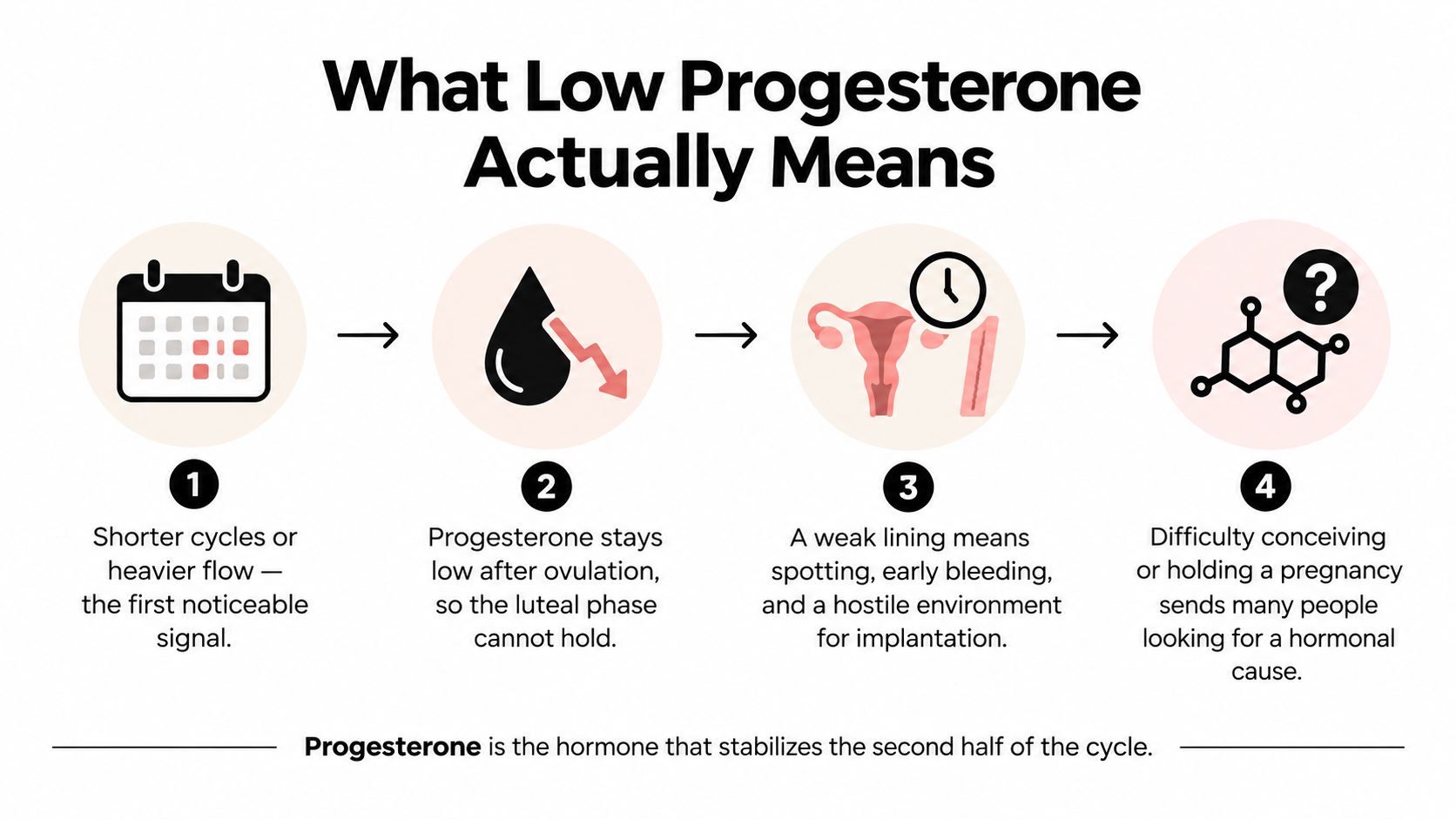
What does a low progesterone result tell you? It may help explain shorter cycles, spotting before a period, heavier bleeding, or difficulty conceiving, but the result only makes sense within the cycle that produced it. Progesterone normally rises after ovulation, so the first question is whether an egg was released and whether the test captured the expected rise.
Oestrogen prepares the uterine lining earlier in the cycle. After ovulation, the corpus luteum forms in the ovary and begins producing progesterone. Progesterone then stabilises the endometrium, the lining of the uterus, so it can support possible implantation and early pregnancy. In this sequence, progesterone is less like a constant supply and more like a post-ovulation signal that appears after a specific event.
If ovulation does not occur, the usual corpus luteum response does not develop. Progesterone may stay low because its main source for that stage of the cycle has not formed. Australian guidance notes that a low mid-luteal result may indicate anovulation or inappropriate timing of the blood test, rather than proving a hormone deficiency (Australian progesterone testing guidance).
The key distinction
Two different situations can produce the same label:
- Low progesterone because ovulation did not occur: the body did not create the normal post-ovulation structure that produces progesterone.
- Low progesterone despite ovulation: an egg was released, but progesterone production or the endometrium's response may have been inadequate during that cycle.
The difference changes what clinicians investigate. With PCOS, thyroid dysfunction, high prolactin, or hypothalamic amenorrhoea, the priority may be identifying and treating the condition affecting ovulation. A persistent concern about the luteal phase may call for a different assessment.
A single result cannot answer every question. Clinicians consider the cycle phase, bleeding pattern, evidence of ovulation, other hormone results, pregnancy status, and medical history together. The practical goal is to find out why progesterone is low and whether the finding has clinical significance, rather than only trying to raise the number.
This article examines the main reasons for low progesterone, symptoms that deserve attention, the role of test timing, and possible implications for fertility. It provides education, not a diagnosis. Persistent changes in bleeding or cycles should be assessed by a qualified health professional.
Common Medical and Lifestyle Causes
Could low progesterone be the main problem, or is it showing that ovulation did not happen? The answer depends on what occurred earlier in the cycle. Progesterone is produced mainly after ovulation, when the corpus luteum forms. If that event is delayed, inconsistent, or absent, the progesterone reading may be low because the hormonal sequence never reached its usual second stage.
A useful analogy is a relay race. The brain and ovaries begin the process, an egg is released, and the corpus luteum carries the race by producing progesterone. A problem with any earlier handoff can leave little progesterone at the finish line. Australian clinical information lists PCOS, perimenopause, premature ovarian insufficiency, hypothalamic amenorrhoea, thyroid dysfunction, and high prolactin among conditions associated with anovulation (Australian clinical information on progesterone).
Ovulatory and luteal causes
Anovulation is a common reason for a low result. When no egg is released, the usual corpus luteum response does not develop, so progesterone stays low during that cycle. This may occur with PCOS, during perimenopause, with premature ovarian insufficiency, or when reduced energy availability or illness disrupts signalling between the brain and ovaries.
PCOS can make egg release irregular. Some people have long or unpredictable cycles, while others experience bleeding without consistent ovulation. Bleeding therefore does not always confirm that a complete ovulatory cycle took place. The explanation of PCOS and irregular periods describes this relationship in plain language.
A different possibility is luteal phase deficiency. Ovulation may have occurred, yet the corpus luteum may produce too little progesterone, produce it for too short a time, or fail to provide an adequate hormonal signal to the endometrium. The Australian TGA assessment of Utrogestan discusses these broad mechanisms and reports that about 35% of women with recurrent pregnancy losses are attributed to luteal phase deficiency. That finding does not make progesterone the only possible explanation for every loss (TGA assessment of Utrogestan).
Endocrine, energy, and life-stage factors
The thyroid and pituitary systems coordinate reproductive signals. Thyroid dysfunction and high prolactin can interfere with ovulation, causing progesterone to fall as a downstream effect. Clinicians may consider these conditions when periods become irregular, stop, or change with other symptoms.
Hypothalamic amenorrhoea can develop when the body receives too little energy for its needs. Severe undernutrition, rapid weight loss, very low body fat, extreme exercise, and chronic stress may suppress ovulation in some people. Stress does not just “use up” progesterone. It can disrupt the signals needed for ovulation, leaving progesterone low because ovulation did not occur.
Perimenopause brings another source of variation. As ovarian function changes, one cycle may include ovulation and another may not, so progesterone can differ substantially between cycles. A low result may therefore reflect that particular cycle rather than a permanent deficiency.
Medication effects
Some hormonal contraceptives suppress ovulation by design. A low endogenous progesterone result while using one may reflect the medication's effect, not a previously hidden ovarian disorder. Tell the clinician about contraception, fertility medication, and other hormone-active treatments before interpreting the result.
The practical question is therefore, “What is preventing a normal ovulatory pattern, or was the test taken and interpreted at the right time?” General discussion of balancing hormones with plastic surgery may provide broader context about women's hormone concerns, but an individual low result still needs clinical assessment.
Symptoms Worth Paying Attention To
Symptoms can suggest that something in the cycle needs investigating, but they can't diagnose low progesterone by themselves. The strongest clues usually relate to timing after ovulation, not symptoms that remain unchanged throughout the month.
A short interval between ovulation and the next period can raise concern about luteal phase function. So can spotting that begins before proper menstrual bleeding. In these situations, the uterine lining may not be receiving stable hormonal support for the full post-ovulation phase. The pattern matters more than a single isolated episode.
Irregular or absent cycles are another important clue because they may indicate that ovulation isn't happening consistently. A person can have bleeding without having a predictable ovulatory cycle, particularly with PCOS or other endocrine disruptions. Recurrent early pregnancy loss also warrants medical investigation, where luteal function may be considered alongside other possible causes.
Look for a cycle pattern
Keep a simple record of:
- Bleeding dates: note the first day of proper flow separately from light spotting.
- Possible ovulation signs: record LH tests, cervical mucus, or a sustained basal temperature shift.
- Post-ovulation timing: note how long the period begins after your suspected ovulation.
- Recurring symptoms: track breast tenderness, mood changes, sleep disturbance, or premenstrual symptoms.
Mood changes, breast tenderness, and sleep disruption may appear when progesterone and oestrogen patterns shift, but they're nonspecific. They can also occur with stress, thyroid problems, poor sleep, medication changes, or other reproductive hormone changes.
Weight gain, acne, and general fatigue are often attributed to low progesterone online, yet they don't point specifically to it. They may reflect other hormonal, metabolic, dermatological, lifestyle, or medical factors. A symptom that appears only in the post-ovulation window is more informative than fatigue that has been present every day for months.
Practical rule: Use symptoms to decide what to discuss and track, not to assign yourself a hormone diagnosis.
A useful next step is to compare your symptom timing with objective cycle information. If spotting repeatedly appears before the period after a suspected ovulation, tell your clinician. If the cycle is irregular and ovulation can't be identified, that may be the more important problem to investigate first. This guide to signs and symptoms of low progesterone can help you organise questions, but it shouldn't replace an assessment.
How Progesterone Is Tested and When
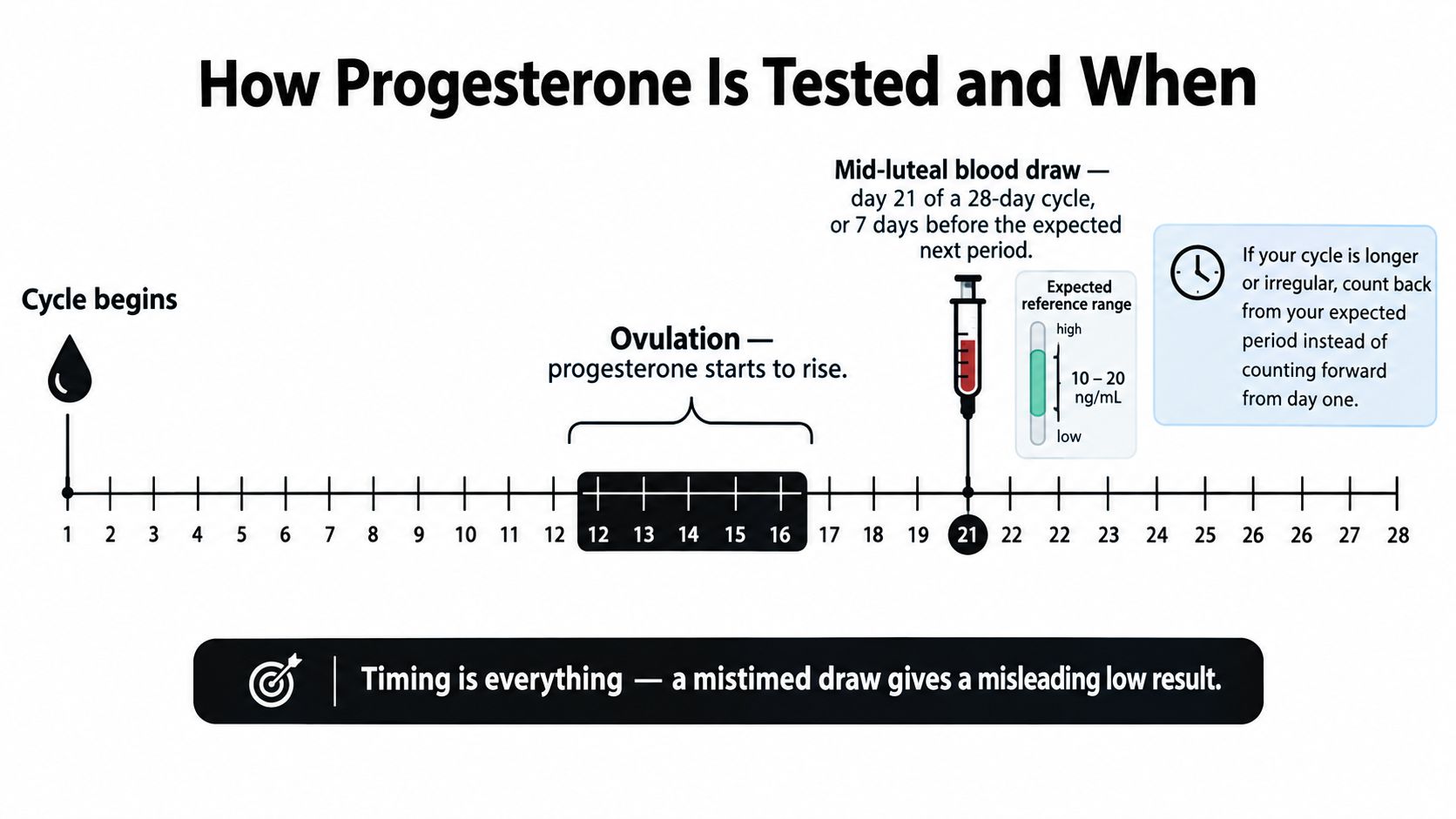
Progesterone testing only makes sense when the timing matches the biological question. In the first part of the cycle, a low progesterone level may be expected. The more useful question is whether progesterone rose after ovulation and reached an appropriate level for that phase.
Start by identifying ovulation
For a regular cycle, a clinician may request a mid-luteal blood test. People often call this a “day 21 test”, but the more meaningful principle is testing after ovulation, not blindly choosing a calendar date. If your cycles are longer, shorter, or unpredictable, counting from the expected next period or using ovulation evidence may be more useful than counting forward from the first day of bleeding.
You can help identify the likely window with:
- LH surge tests, which detect the hormonal signal that precedes ovulation.
- Basal body temperature, which may show a sustained shift after ovulation.
- Cervical mucus observations, which can add context to other signs.
- Ultrasound monitoring, when a fertility specialist needs direct cycle assessment.
A blood test measures serum progesterone at a particular moment. A urine test may measure a progesterone metabolite and can be used in some at-home ovulation tracking systems. These methods answer related but not identical questions, so your clinician should interpret the result according to the test used and the purpose of testing.
Why one result may mislead
Progesterone is released in pulses, so the concentration can change over a relatively short period. A single blood draw may therefore not represent the whole luteal phase. If the result doesn't match your cycle history, a provider may repeat the test, retime it, or use other evidence of ovulation.
Australian guidance notes that progesterone above 20 to 25 nmol/L can confirm ovulation in that cycle, while a lower result may reflect anovulation or mistiming. The same guidance cautions that blood progesterone values can mislead when taken at the wrong point in the cycle (Australian medicine information for progesterone).
Laboratory reference ranges also vary by unit, method, and cycle phase. Don't compare your number with an online range from a different laboratory without professional help. A progesterone lab test can provide useful background on the biomarker, but your result still needs to be read alongside your cycle details and broader hormonal picture.
If you're tracking basal temperature at home, the Venus Smart Basal Thermometer for Ovulation, Bluetooth BBT Tracker with App is one example of a device designed to record morning basal temperature and sync readings with an app. Tracking can help establish a pattern, but it doesn't diagnose the cause of low progesterone.
What It Means for Fertility and Your Cycle
Could a low progesterone result be a problem in itself, or evidence that ovulation did not happen? That distinction matters. Progesterone rises after ovulation, when the corpus luteum forms and supports the uterine lining. If ovulation is absent, progesterone may stay low because its usual source never developed. In that situation, low progesterone is often a sign of disrupted ovulation rather than the root cause.
The cycle works like a sequence of linked steps: ovulation comes first, progesterone production follows, and the endometrium then prepares for possible implantation. If ovulation is absent or unpredictable, the fertile window can be difficult to identify and conception may be less likely in that cycle. If ovulation occurs but luteal function is inadequate, a clinician may assess whether the lining is receiving enough hormonal support.
Progesterone also helps explain bleeding changes. Disrupted exposure after ovulation may accompany spotting before a period, an earlier bleed, or irregular cycles. These signs can offer useful clues, but they cannot identify the cause on their own.
The relationship between luteal phase deficiency and early pregnancy loss is clinically relevant and complex. A TGA assessment of Utrogestan discusses inadequate progesterone production as one proposed mechanism and evaluates a context-specific progesterone threshold for assessing luteal function. That threshold depends on the testing method and clinical situation. It is not a universal self-diagnosis tool, and a single result cannot establish that progesterone is the root problem.
| Context | Typical effect | Evidence strength |
|---|---|---|
| Anovulatory cycle | Progesterone may remain low because the corpus luteum does not form normally. | Strong explanation for a low post-ovulation result |
| Ovulation with suspected luteal dysfunction | Progesterone production or the endometrial response may be inadequate. | Clinically recognised, but diagnosis can be difficult |
| Irregular bleeding | Spotting or early bleeding may occur alongside disrupted ovulation. | Useful clue, not a diagnosis |
| Recurrent early pregnancy loss | Luteal function may be considered among several possible factors. | Relevant, but causation is not always clear |
| Regular cycles with one low result | Timing or normal hormonal fluctuation may explain the result. | Requires contextual assessment |
Testing and treatment are separate decisions. Australian evidence-based material states that no conclusive minimum mid-luteal progesterone threshold has been established as necessary for pregnancy, and that exogenous progesterone has not been shown to improve live birth rates for women with regular cycles in the general situation described (Australian progesterone prescribing review).
Progesterone has specific uses, including assisted reproductive technology luteal support and prevention of preterm birth. Broader preconception topics, such as microbiome balance for pregnancy, may also arise in discussion with a clinician, but they should not replace investigation of ovulation and established medical causes. For a focused explanation of the post-ovulation window, read about the luteal phase and fertility.
Next Steps and When to Seek Care
A sensible evaluation starts with the cause, not with a supplement bottle. Your clinician may review pregnancy status, medications, cycle history, ovulation evidence, thyroid function, prolactin, and conditions such as PCOS or hypothalamic amenorrhoea. If the first result was taken at the wrong time, repeating or retiming it may provide more useful information than treating the number immediately.
A practical care pathway
- Review the test context. Bring the cycle day, suspected ovulation date, laboratory range, medication list, and any pregnancy possibility.
- Check for disrupted ovulation. Irregular or absent ovulation may be linked with PCOS, thyroid dysfunction, high prolactin, perimenopause, premature ovarian insufficiency, inadequate energy intake, or excessive exercise.
- Address the underlying factor. Treatment may involve managing an endocrine condition, reviewing ovulation-suppressing medication, improving energy availability, or using a clinician-directed fertility plan.
- Discuss progesterone support only when indicated. Supplementation may be considered in assisted reproduction, after ovulation induction, or in particular pregnancy-loss and luteal-support contexts. The dose, route, and timing should come from the prescribing clinician.
- Avoid self-prescribing creams. Over-the-counter progesterone products and “bioidentical” claims aren't a substitute for an individual assessment or a standardised prescription.
If body composition changes are part of your broader health assessment, the Venus AI Smart Scale records body composition measurements and provides app-based reports and health summaries. It shouldn't be used to diagnose reproductive hormone disorders, and weight data must be interpreted sensitively, particularly when under-fuelling or excessive exercise may be affecting ovulation.
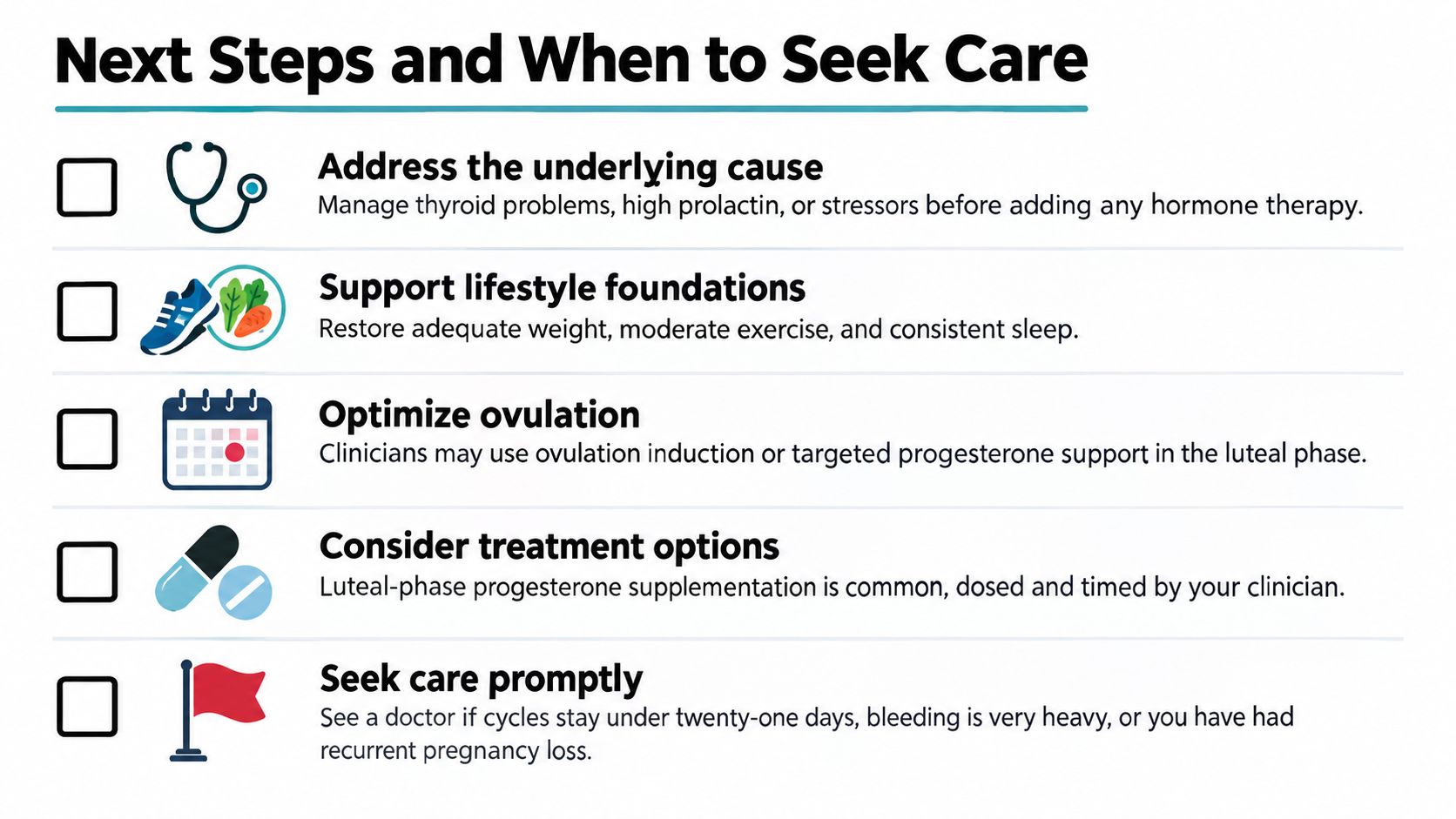
Seek medical care for absent periods, persistently very short cycles, recurrent pregnancy loss, or significant difficulty conceiving. Australian guidance also recommends excluding causes of secondary amenorrhoea such as pregnancy, prolactinoma, thyroid disease, pituitary disease, hypothalamic disorders, and outflow obstruction before focusing narrowly on progesterone.
Write down your bleeding and ovulation patterns before the appointment. A clear record can help your clinician distinguish an isolated mistimed test from a recurring cycle pattern that needs further investigation.
Key Takeaways and Moving Forward
The most important conclusion is simple: low progesterone is often a symptom of disrupted ovulation, not the original problem. If ovulation didn't occur, progesterone may be low because the corpus luteum wasn't established. If ovulation did occur, persistent low results may lead clinicians to assess luteal function, the endometrium, endocrine conditions, and the timing of testing.
The main reasons for low progesterone include anovulation, PCOS, luteal phase concerns, thyroid dysfunction, high prolactin, hypothalamic suppression, premature ovarian insufficiency, perimenopause, and medication effects. Severe undernutrition, rapid weight loss, extreme exercise, and chronic stress can also disrupt the signals that support ovulation.
Pay closest attention to repeated spotting before menstruation, a consistently short post-ovulation phase, irregular cycles, or absent ovulation. Fatigue, acne, weight changes, and mood symptoms may be real, but they're not specific enough to identify low progesterone on their own.
The testing decision should follow the biology. First, establish whether ovulation probably occurred. Then, if appropriate, measure progesterone in the mid-luteal phase, with the timing adjusted to your actual cycle rather than relying on a calendar day that doesn't fit. A result taken at the wrong time may need to be repeated or interpreted as a timing issue.
If a cycle changes once, tracking may be enough to see whether the pattern settles. If the same symptoms recur, ask for a structured assessment rather than starting progesterone independently. Seek professional care promptly for absent periods, recurrent pregnancy loss, concerning bleeding, or ongoing fertility difficulties.
Venus Health Co. offers app-connected tools for tracking basal body temperature, ovulation signals, body composition, and health trends at home. If you want clearer cycle data to take to a clinician, explore Venus Health Co. and choose the tracking approach that fits your needs.