

Luteal Phase Fertility: What It Means and How to Track It
Dr. Adeyinka AdegbosinYou've checked an ovulation test late at night, seen a result that might mean your LH is rising, and then wondered what happens next. The second half of the cycle can feel less visible than ovulation itself, but it matters because it's the period between ovulation and your next period, when progesterone changes the uterus and gives clinicians useful information about ovulation.
Luteal phase fertility is easier to understand when you separate established clinical practice from unsettled research. Australian guidance provides practical ways to confirm ovulation and assess progesterone, while research still debates how much a short luteal phase, on its own, predicts natural fertility or miscarriage. That distinction helps you know when to observe, when to record a pattern, and when to ask for medical advice.
What the Luteal Phase Is and Where It Fits in Your Cycle
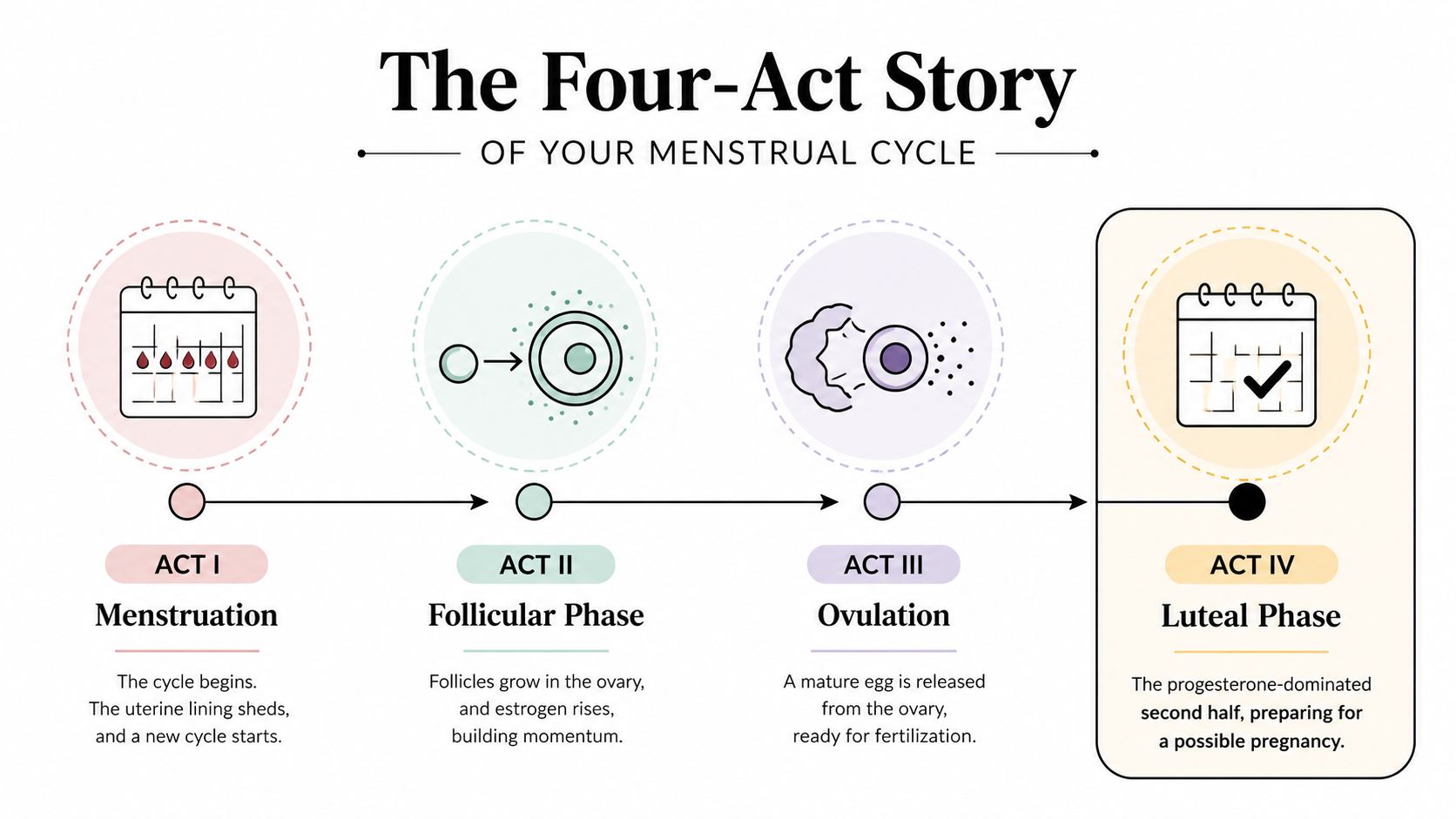
Think of the menstrual cycle as a four-act story. Act I is menstruation, when the uterine lining sheds. Act II is the follicular phase, when a follicle develops and the lining begins rebuilding. Act III is ovulation, when an egg is released. Act IV is the luteal phase, the post-ovulatory stretch before the next period.
In a typical 28-day cycle, ovulation may occur around the middle, with the luteal phase occupying the final part of the cycle. But the key point is that the luteal phase is anchored to the day ovulation happens, not automatically to a fixed calendar day. If ovulation occurs later or earlier, the start of the luteal phase moves with it.
The corpus luteum takes over
During ovulation, the mature follicle releases an egg. The follicle doesn't disappear afterwards. Its remaining cells reorganise into the corpus luteum, a temporary hormone-producing structure.
The corpus luteum produces progesterone, which prepares and stabilises the endometrium, the lining inside the uterus. You can think of the follicle as the team that prepared the venue for ovulation, and the corpus luteum as the temporary manager responsible for keeping that venue ready afterwards.
If pregnancy doesn't occur, the corpus luteum loses function, progesterone falls, and the uterine lining sheds as menstruation. If pregnancy occurs, hormonal signals help maintain progesterone production while the early pregnancy develops.
Practical rule: Count the luteal phase from confirmed ovulation to the day before the next period, rather than assuming it always starts on the same cycle day.
This explains why cycle-day shortcuts can confuse people with variable cycles. Australian clinical guidance recommends a mid-luteal progesterone blood test about 7 days before the expected next period, rather than insisting on one fixed date. In the examples provided by Australian Prescriber's fertility testing guidance, that corresponds to day 21 in a 28-day cycle, day 23 in a 30-day cycle, and day 25 in a 32-day cycle.
The luteal phase is therefore both a biological stage and a useful clinical reference point. What happened before it, especially whether ovulation occurred and when it occurred, determines how accurately you can interpret what happens after it.
How Progesterone Runs the Luteal Phase
Progesterone is the luteal phase's project manager. After ovulation, the corpus luteum produces it and progesterone coordinates the conditions needed for a possible pregnancy.
Its main task is to change the endometrium from a rebuilding surface into a stable, receptive environment. The lining needs to be developed enough to support implantation, but it also needs hormonal organisation so that its readiness matches the embryo's development.
The work begins after ovulation
Immediately after ovulation, progesterone rises from its lower pre-ovulatory level. The endometrium responds by becoming more glandular and secretory, which means it releases substances that can support the implantation process if an embryo reaches the uterus.
Progesterone also reduces the likelihood of another ovulation in the same cycle. It changes cervical mucus, making it thicker after the fertile window, and contributes to the familiar post-ovulation shift in basal body temperature.
These changes are useful clues, but they aren't proof of a healthy or adequate luteal phase by themselves. Symptoms such as breast tenderness, bloating, fatigue, or premenstrual spotting can occur for many reasons and don't diagnose low progesterone. For a plain-language discussion of possible symptoms, see signs and symptoms of low progesterone.
Why timing matters for implantation
The endometrium must be prepared during the window when an embryo might try to implant. Progesterone helps coordinate this timing, rather than just making the lining thicker in a straightforward, linear fashion.
If progesterone exposure is inadequate, or if ovulation occurred later than assumed, a test or symptom diary can be misread. A low blood result might reflect anovulation, insufficient progesterone production, or a sample taken at the wrong point in the cycle.
Progesterone doesn't work in isolation. Its meaning depends on whether ovulation has occurred, when it occurred, and how the uterine lining responds.
For people trying to conceive, that makes the hormone important without making it a single-answer explanation for every fertility concern. A progesterone result is most useful when interpreted alongside cycle timing, ovulation evidence, bleeding patterns, and medical history.
How Long the Luteal Phase Should Last
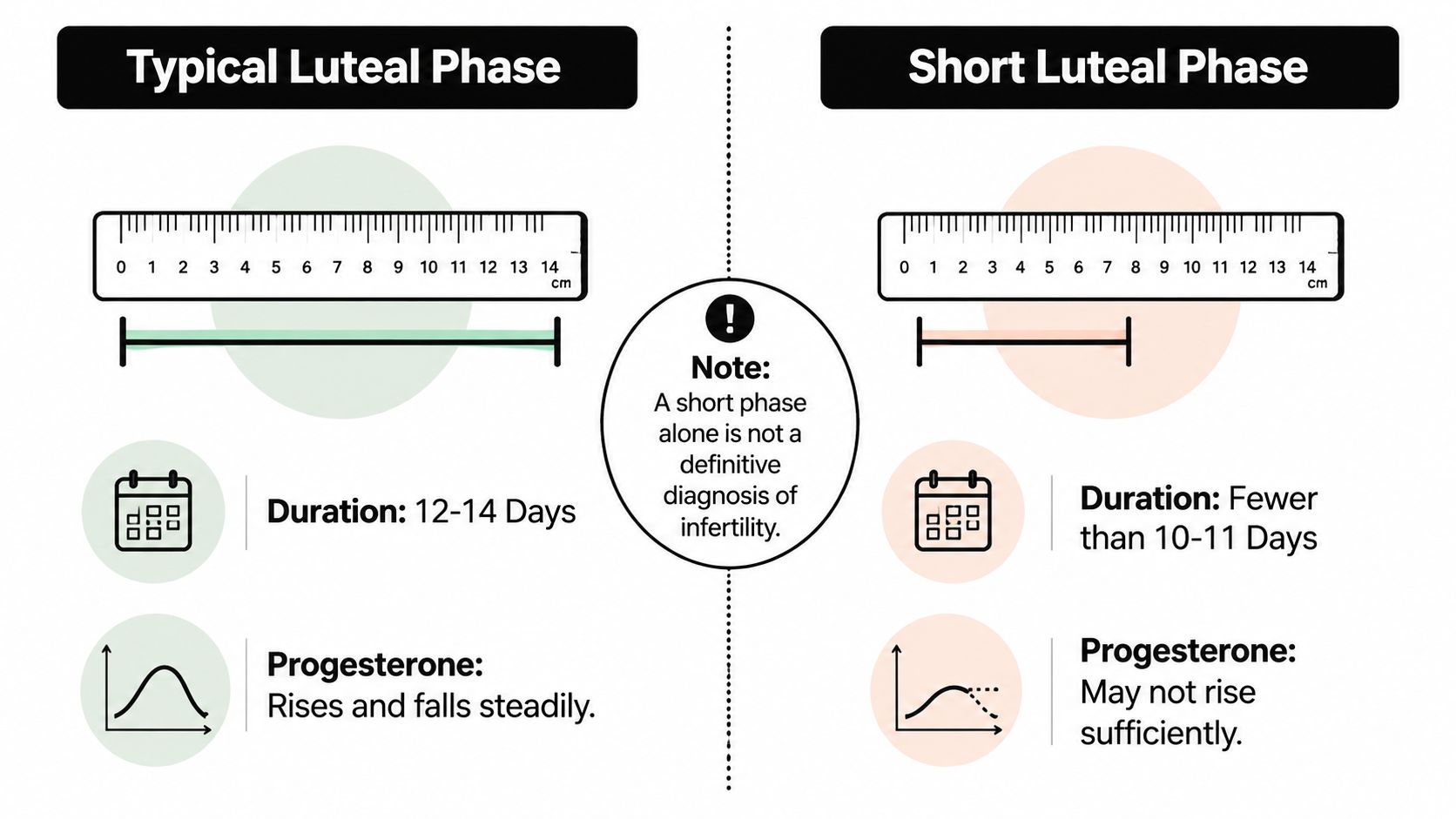
A period that arrives sooner than expected can make you wonder whether your luteal phase is too short. One early bleed does not answer that question. The luteal phase is a flexible interval, commonly described in Australian fertility education as 11 to 17 days, with 12 to 14 days occurring often in healthy cycles. These ranges reflect guidance from Australian fertility resources, including Jean Hailes information and material associated with the Fertility Society of Australia and New Zealand.
Cycle length often changes because the follicular phase takes more or less time to mature a follicle and lead to ovulation. After ovulation, the luteal phase is usually steadier, although it can still vary. A single shorter or longer cycle does not establish a disorder.
The corpus luteum, the temporary structure left after ovulation, has a limited working life. If hormonal signals from an embryo and early pregnancy do not extend its activity, progesterone falls and menstruation starts. This biological timer helps explain why the luteal phase usually has a narrower range than the follicular phase.
| Range | Luteal Phase Length | What It Usually Means |
|---|---|---|
| Common range | 11 to 17 days | Often consistent with ordinary cycle variation |
| Frequently seen | 12 to 14 days | A common pattern in healthy cycles |
| Review pattern | Consistently under 10 days | Worth discussing, especially when repeated |
| Variable pattern | More than two days' variation between cycles | May justify closer tracking and clinical review |
| Whole-cycle concern | Cycles under 21 days overall | Appropriate to raise with a GP |
Use the table as a prompt for observation, not as a diagnosis. An early period may follow later-than-expected ovulation, illness, stress, or ordinary variation. Repeated patterns matter more than one isolated result.
Australian clinical guidance also separates a useful test from a poorly timed one. Serum progesterone is generally sampled about 7 days before the expected next period, rather than on one fixed calendar day. Australian Prescriber and RACGP guidance describe a result above 20 to 25 nmol/L as confirming ovulation in that cycle. A lower result may reflect anovulation or testing at the wrong time. The Australian Prescriber's fertility testing guidance explains this timing principle. The research discussion around what a “short” luteal phase means is less settled, so a repeated pattern deserves context from cycle timing, bleeding history, and a clinician rather than an automatic conclusion.
Tracking the Luteal Phase with BBT, LH, and Apps
A positive LH test can make it feel as though ovulation has been confirmed. It has not. LH, basal body temperature, and an app each show a different part of the cycle, so using them together gives a clearer sequence.
An LH test is an early warning signal. A positive result suggests that ovulation may happen soon, but it predicts a possible event rather than proving that an egg was released. The luteal phase starts after ovulation, not on the day of the positive test.
BBT records the change that follows ovulation. Progesterone raises resting temperature, producing a sustained shift from the earlier baseline. One high reading is easy to misread, so look for a consistent rise instead. A shift around 0.2 to 0.5°C is commonly used in fertility tracking, although illness, broken sleep, alcohol, travel, and different measuring times can affect the pattern.
A simple tracking sequence
- Test for LH before expected ovulation. Record the date and time of any positive result.
- Take BBT each morning. Measure before getting up and keep the routine as consistent as possible.
- Check for a sustained temperature shift. A rise after the LH result helps estimate when ovulation probably occurred.
- Count to the next period. This provides an estimated luteal phase length for that cycle.
- Compare several cycles. Repeated patterns are more informative than one unclear chart.
Apps can organise period dates, LH results, BBT, cervical mucus, and symptoms. They can estimate fertile days and count the days after ovulation, but an app prediction cannot confirm ovulation. It may be projecting from earlier cycle patterns instead of measuring the hormone changes occurring this month.
| Signal | What It Tells You | When to Use It |
|---|---|---|
| LH test | Ovulation may be approaching | Before the expected ovulation window |
| BBT | Ovulation likely occurred | Every morning, especially after an LH rise |
| App | Organises observations and estimates timing | Throughout the cycle, with physical markers added |
For background on combining observations to find your fertile window, review the signs that appear before ovulation. Manual recording can also be simplified with the Venus Smart Basal Thermometer for Ovulation, Bluetooth BBT Tracker with App, which records basal temperature and syncs readings to an app through Bluetooth. A related BBT thermometer guide explains how this type of tracking fits into cycle observation.
These tools make collection easier, while clinical interpretation gives the record context. Tracking helps you identify timing and repeated patterns, then discuss them clearly with a healthcare professional.
Short Luteal Phase and What the Evidence Actually Says
A short luteal phase can raise a sensible question, but it shouldn't automatically become a diagnosis of infertility. In Australian fertility practice, a luteal phase of less than 10 days is commonly used as a threshold for specialist review when the pattern repeats, particularly alongside difficulty conceiving or recurrent early loss. The concern is that the endometrium may have less time under progesterone's influence before menstruation begins.
The term luteal phase defect is often used when the post-ovulation phase appears too short or progesterone exposure appears inadequate. However, the research literature has not established one universally reliable test that identifies defective luteal function in every person. A major review notes that diagnostic tools for adequate luteal function remain limited, and symptoms such as spotting or irregular cycles are indirect clues rather than definitive proof. The review of luteal phase deficiency is useful for understanding this uncertainty.
What a short pattern may mean
A repeated short phase could reflect an ovulation or progesterone issue, but it could also result from incorrectly identifying ovulation. If the LH surge is mistaken for the ovulation date, the calculated luteal phase may look shorter than it actually is.
The evidence is also more nuanced than the phrase “short luteal phase causes infertility” suggests. Prospective findings have been mixed. One cohort reported lower short-term pregnancy odds after a short luteal phase, but found no significant difference in cumulative pregnancy probability by 12 months. That means a short phase may be relevant to investigate without being treated as a permanent barrier to natural conception.
A short luteal phase is a pattern to investigate, not a verdict about your fertility.
If you're researching treatment options, resources discussing luteal phase defect remedies can help you prepare questions. Don't start progesterone or other treatment based only on an app estimate or one early period. Record the likely ovulation date, the next period, any premenstrual spotting, and the method used to identify ovulation, then take that information to a clinician.
When to Seek Care for a Luteal Phase Concern
A cycle that seems unusual once is difficult to interpret. If the same pattern appears repeatedly, or comes with other symptoms, a GP or fertility specialist can help check whether the concern reflects ovulation timing, progesterone, or another factor.
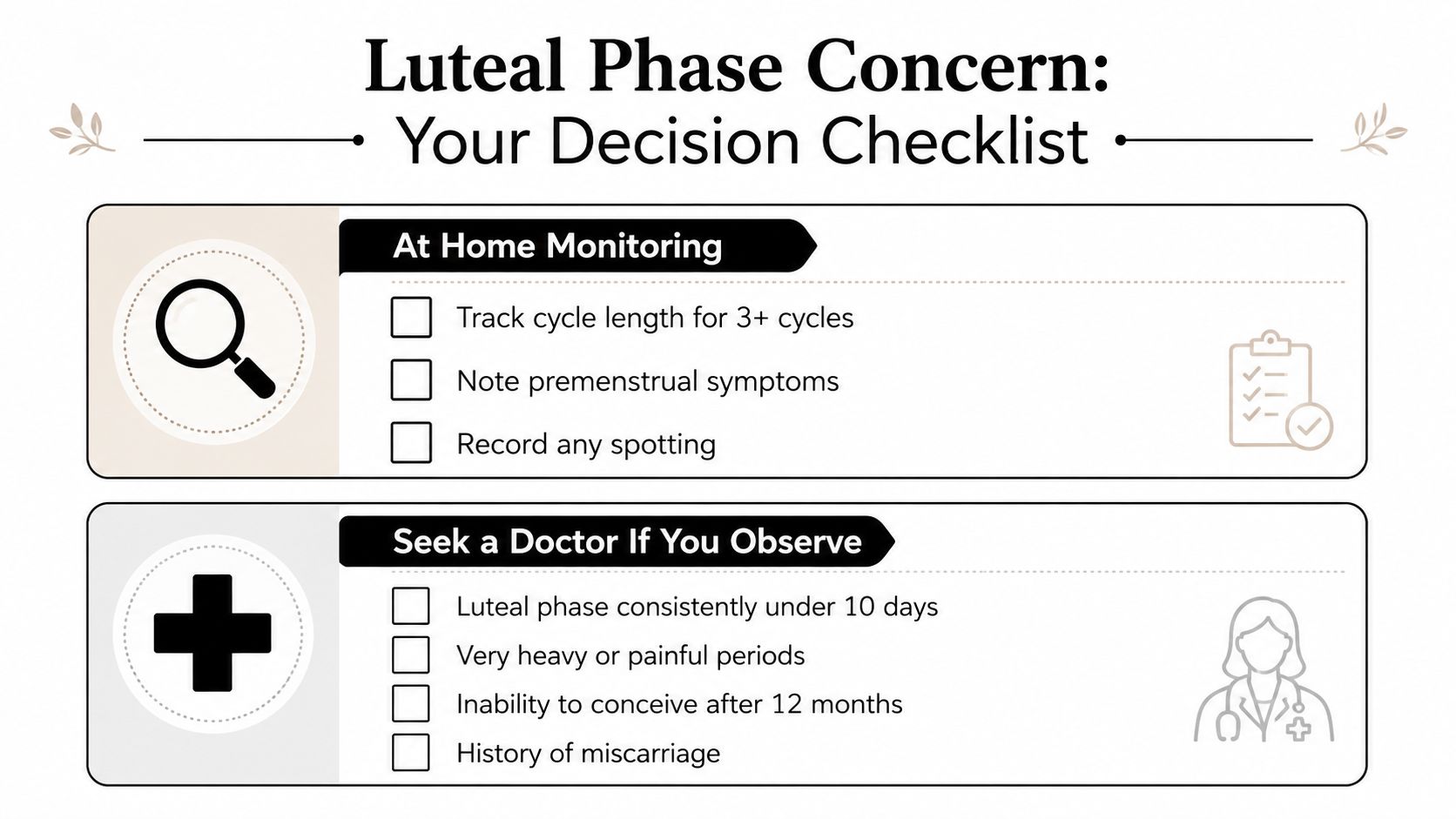
Consider booking a GP appointment if you notice:
- Repeated short phases: A luteal phase consistently under 10 days for three or more cycles deserves review, particularly if you're trying to conceive.
- Premenstrual spotting: Spotting for two or more days before the period is useful to record and discuss. It does not, by itself, prove a luteal phase defect.
- Unclear ovulation: If LH tests and BBT do not form a consistent pattern, ask whether further assessment would help.
- A low progesterone result: A result below 10 nmol/L from a properly timed day-seven-before-period blood draw needs clinical interpretation rather than a conclusion based on the number alone.
Timing is the main qualification. Australian guidance recommends sampling about 7 days before the expected next period. A result below the expected ovulatory range can reflect a mistimed test, not necessarily a confirmed hormone disorder. As noted earlier in Australian Prescriber's guidance, a fixed calendar day is not interchangeable with a mid-luteal sample.
What each appointment can do
A GP can review your cycle history, bleeding, medications, medical conditions, and pregnancy history. Depending on that history, they may arrange blood tests or assess other hormonal factors, including thyroid or prolactin concerns.
A fertility specialist may suggest more targeted assessment, such as repeated mid-luteal progesterone testing or ultrasound. Treatment should match the cause being investigated, rather than follow from the label alone.
Bring a simple record: cycle dates, positive LH dates, BBT shifts, spotting, medication, and the date of any blood test. You could say, “I've tracked ovulation and the next period over several cycles, and the interval appears repeatedly short. Can we check whether the timing is accurate and whether progesterone or another cause needs investigation?”
Putting It All Together for Your Fertility Journey
The luteal phase is one signal within a connected cycle. Menstruation, follicle development, ovulation, corpus luteum activity, progesterone, the uterine lining, and the next period all belong to the same sequence. A short interval may matter, but it can't explain every fertility outcome by itself.
For a practical fertility-awareness framework, fertility awareness methods can help you think about multiple observations rather than relying on period predictions alone. The most useful record combines an LH result that signals approaching ovulation with a BBT pattern that supports the conclusion that ovulation occurred.
A calm checklist for your next cycles
- Confirm ovulation with two signals. Pair an LH result with a later BBT shift where possible.
- Record the interval for three cycles. Count from likely ovulation to the day before the next period.
- Note associated changes. Include spotting, unusually early bleeding, and anything that repeatedly affects your cycle.
- Use the right clinical timing. If you have progesterone testing, ask when the sample should be taken relative to your expected period.
- Arrange a review for persistent patterns. A repeated phase under 10 days, unclear ovulation, or other concerns is worth discussing with a GP.
Tracking isn't a diagnosis, and it shouldn't turn every variation into an emergency. It gives you a shared language for your own body and a more accurate starting point for a medical conversation. If you also monitor broader health data, the Venus AI Smart Scale, Body Composition & Body Fat Scale is described by the manufacturer as providing body composition measurements, wellness reports, AI coaching, nutrition tracking, and app-based trend information, but those features don't replace fertility assessment.
Keep observing without judging each cycle as a pass or fail. Bring your records to an appointment, ask whether ovulation timing has been confirmed, and focus on the pattern rather than one unexpected month.
Venus Health Co. offers app-connected tools for tracking basal body temperature and organising fertility observations, including LH results, symptoms, and cycle data. Visit Venus Health Co. to explore the available options and choose a tracking approach that helps you turn daily observations into a clearer conversation with your healthcare professional.