

Natural Family Planning App: How to Choose in 2026
Dr. Adeyinka AdegbosinYou might be standing in the bathroom with an ovulation test in your hand, glancing at the result, and realising the bigger question isn't what that strip means. It's what you're supposed to do with the information next. A natural family planning app exists for that in-between moment, when you want help making sense of your cycle without handing the job over to guesswork.
What a Natural Family Planning App Actually Does
A natural family planning app is a digital notebook and interpreter for your fertility signals. It helps you record things like period dates, basal body temperature, cervical mucus, and ovulation test results, then organises those clues into a picture you can use for conception planning or pregnancy avoidance.
Conception planning and contraception use the same body, not the same rulebook
The biology is the same, but the goal changes how you read the signs. If you're trying to conceive, the app is helping you identify the fertile window so you can time intercourse around it. If you're trying to avoid pregnancy, the same fertile window becomes the time you need to treat as risky and use another method.
That's why the app is not a magic answer machine. It can only work with the information you give it, and it can only interpret that information as well as the method behind it allows. A calendar alone doesn't tell you ovulation has happened, it only guesses based on timing.
For many people, that slower, more attentive approach is a relief. It turns body changes into something you can actually follow, instead of something you vaguely hope is happening on schedule. If you're also getting your body ready for pregnancy, a useful companion read is nutrients to focus on before pregnancy, because cycle awareness works best when it sits inside a broader health plan.
Practical rule: treat the app like a translator, not a decision-maker. Your observations still matter more than a colourful chart.
The other thing to keep clear is that an app can support learning, but it can't replace good instruction. That's especially true in early use, when your own cycle patterns are still becoming familiar. If you want a deeper look at how the method works in practice, this overview of fertility awareness methods is a helpful companion.
The Body Data an App Can Track
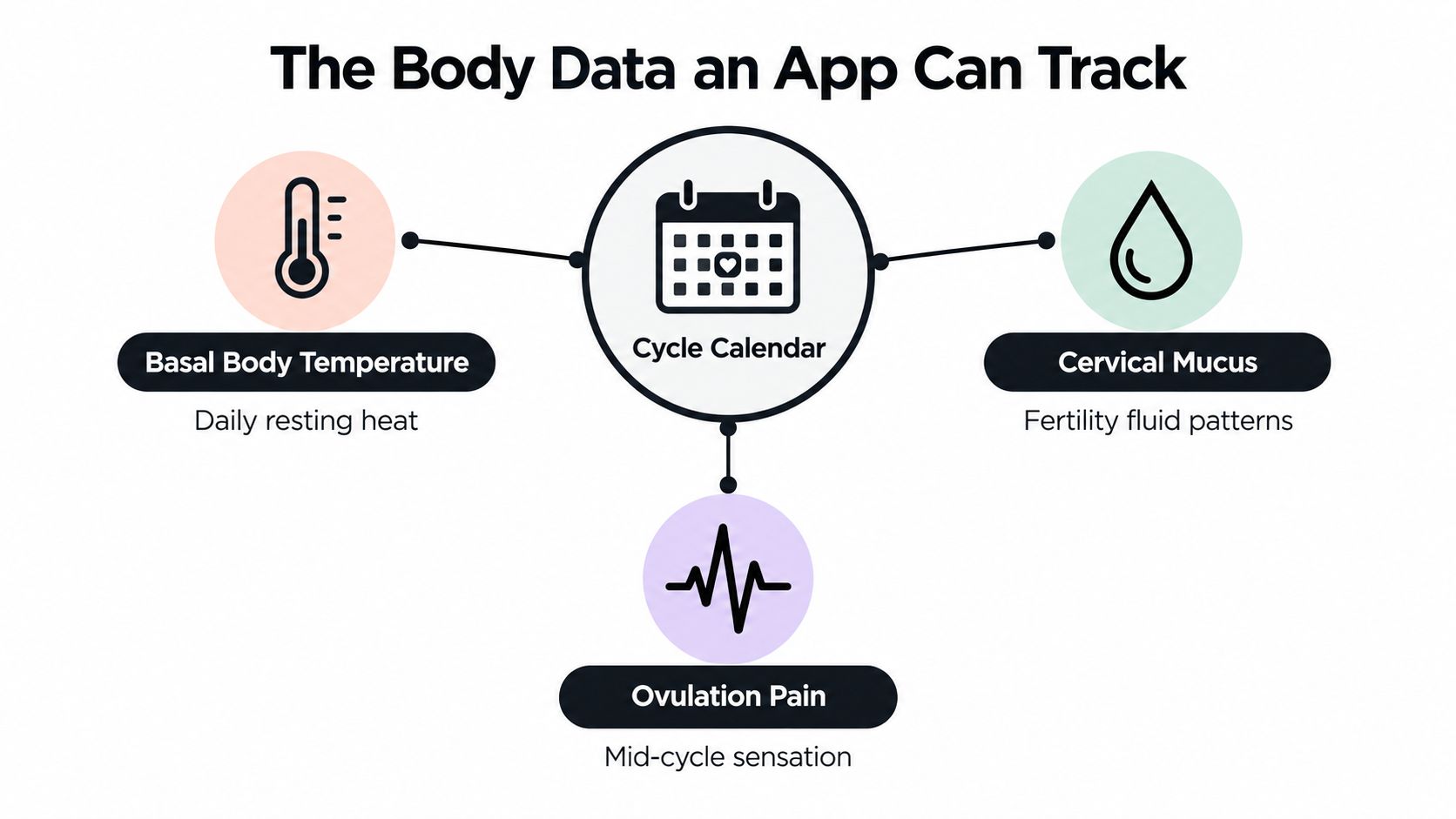
Fertility tracking is easiest to understand as reading a weather report. One signal tells you almost nothing, but several together start to reveal a pattern. An app can hold those signals in one place, which is why the daily habit matters more than any single fancy feature.
Start with the calendar, then add the body clues
The cycle calendar is the simplest layer. It shows when bleeding starts, how long cycles tend to be, and whether your pattern is changing over time. On its own, it's useful for recording, but it's only a rough map of timing.
Basal body temperature adds a different kind of information. It's the small rise in resting temperature that appears after ovulation, so it's a confirmation signal rather than a forecast. That's why many people pair a dedicated thermometer with an app, including devices like the Venus Smart Basal Thermometer for Ovulation - Bluetooth BBT Tracker with App, which is built to capture those tiny morning shifts and sync them automatically.
Cervical mucus works sooner. Fertile mucus often changes before ovulation, so it can help you see when the fertile window is opening. LH test results are another forward-looking clue, because they point to the hormone surge before ovulation rather than the event after it.
Secondary cues, like sleep, mood, pelvic sensations, and ovulation pain, give context, not certainty. They can help explain a messy cycle, but they can't overrule the core fertility signs. That's especially important for readers who feel sure they “know their body” while still missing the fertile window, because the gap between confidence and understanding can be wide in real life, as seen in Australian general-practice survey data where 63.9% felt aware of the fertile period but only 2.1% achieved a high fertility-awareness score (RACGP study).
A useful habit is to log the same way every day, even when the result feels boring. Boring days build the pattern that makes the interesting ones readable.
The app's job is to gather these pieces without making you reassemble them from memory. If you're using a thermometer-based workflow, this guide on BBT thermometers gives a plain-English view of why temperature precision matters.
What the fertile window looks like in practice
At the start of a cycle, the calendar is the open notebook. As ovulation approaches, mucus and LH start giving clues. After ovulation, temperature usually helps confirm what has already happened. That sequence is the backbone of cycle tracking, and a good app should present it clearly rather than burying it under decorative graphs.
Key Features That Matter in an NFP App
The strongest apps aren't just diaries with prettier screens. They're built to accept the right data, interpret it cautiously, and let you control what happens to your information. If you're comparing options, the feature set should tell you whether the app is a serious fertility-awareness tool or just a period tracker with a fertility label.
Features that distinguish a serious fertility-awareness app
| Feature area | What to look for | Why it matters |
|---|---|---|
| Data inputs | Period dates, temperature, mucus, LH, symptoms | The app needs more than a cycle start date to make useful predictions |
| Interpretation logic | Clear explanation of how predictions are made | You should understand whether the app is using calendar math, biomarkers, or both |
| Device integration | Bluetooth thermometers, ovulation tests, easy manual logging | Fewer missed entries usually means cleaner patterns |
| Privacy controls | Delete, export, opt-in sharing, separate analytics settings | Fertility data is sensitive, and you should control who sees it |
A serious app should also help you understand uncertainty instead of hiding it. That means letting you annotate unusual days, note when you were ill or travelling, and recognise when a single reading doesn't settle the question. A simple diary records facts, but a proper fertility app should learn from your pattern over time.
The Venus Ovulation Predictor Test Kit is one example of how an at-home kit can fit into that workflow. It provides LH test strips for manual result tracking, which can then be paired with an app if you want to keep everything in one place.
Another thing to check is whether the app keeps the methodology visible. If it just shows a green or red day without explaining why, you're expected to trust a hidden decision. If it explains how it weighs temperature, cycle length, and test results, you can judge whether that logic suits your own goals.
A quick way to test any app's usefulness
Ask yourself three questions before you commit:
- Can it handle the signs I'm willing to track? If not, it'll become a half-used app quickly.
- Does it explain predictions in plain language? If not, you won't know what to do when the pattern changes.
- Can I see, export, and delete my data easily? If not, the app owns more of your information than it should.
The best apps don't just store data, they turn it into a pattern you can learn from. That matters because fertility awareness depends on understanding change, not just accumulating entries.
How Apps Turn Signals into Predictions
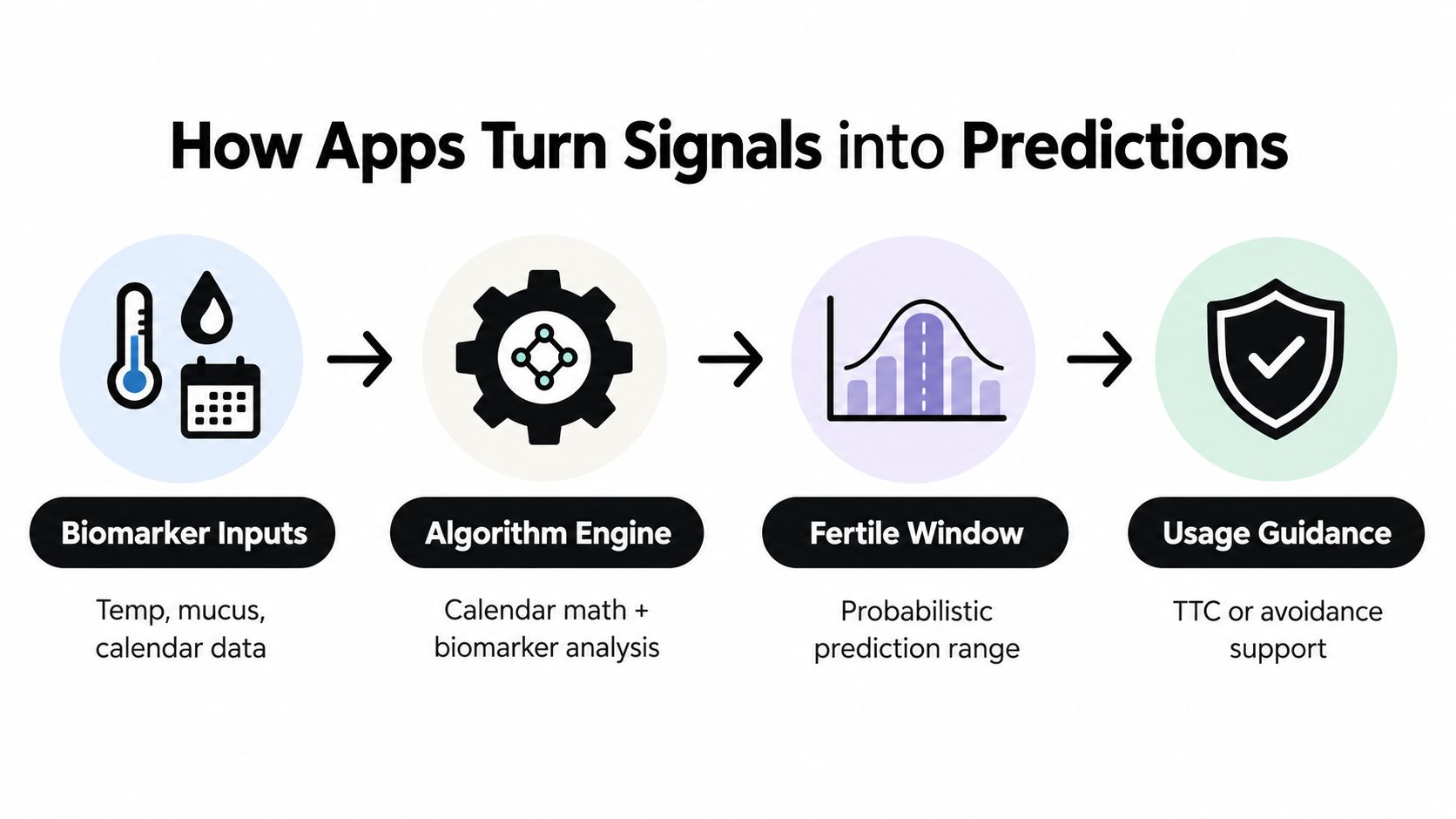
Most apps work by combining calendar math with one or more body signals, then turning that mix into a fertile-window estimate. The important word is estimate. A prediction is helpful, but it's still a probability, not a promise.
The algorithm should earn your trust, not hide behind it
A transparent app tells you what it uses and how it weighs each input. It should be clear about whether it relies mostly on cycle history, temperature shifts, mucus observations, or LH results. If the app lets you override a prediction when you know a day is unusual, that's a good sign that the designers expect real life to be messy.
Australian reporting on natural methods of contraception noted that effectiveness under typical use can sit around 75% to 80%, depending on the method and consistency of use (ABC News). That matters because the same app can feel reassuring to one user and unreliable to another if the data entry is inconsistent or the body signals are hard to read.
Bottom line: perfect charts don't matter if the readings behind them are sloppy or incomplete.
Some apps also refine their predictions from your own history instead of treating every user the same. That can be useful, but it only works well when you keep logging consistently. If the app is learning from noise, it will produce a polished version of confusion.
Typical use and perfect use are not the same thing
This is the part many people miss. Perfect use means the method is used exactly as intended every time. Typical use reflects what happens in ordinary life, with forgotten readings, odd sleep, travel, and uncertain days included.
The gap between those two matters more than the branding around the app. If your routine is stable and you're disciplined about logging, the app has a better chance of matching your body's pattern. If your routine is chaotic, the prediction engine has less to work with and the fertile window becomes harder to trust.
That's why the right question isn't “Is this app smart?” It's “Does this app help me make good decisions from imperfect data?” If the answer is yes, you've got a useful tool. If the answer is no, you've got a colourful calendar.
When App Predictions Can Be Misleading
Fertility apps struggle most when biology becomes less predictable. That sounds obvious, but many apps still present fertility timing as if every cycle is neat, regular, and neatly comparable to the last one. Real cycles don't always cooperate.
When the pattern gets noisy
Irregular periods can make calendar-based predictions shaky. So can PCOS, postpartum cycles, breastfeeding, perimenopause, shift work, travel across time zones, poor sleep, fever, illness, and recent hormonal contraception use. In those situations, the app may still collect useful information, but its timing assumptions can stop matching what your body is doing.
The tricky part is conflicting signals. You might see a temperature rise without the mucus pattern you expected, or mucus changes without a clear LH result. That doesn't mean the app is broken, it usually means the body didn't follow a neat textbook sequence.
A sensible rule is to trust the pattern, not a single reading. If one day looks odd, keep logging and watch what the next few days do. If the pattern keeps breaking, pause app-based contraception and use condoms or another method until you've got clearer information.
What to do when the signs don't line up
A few practical responses help more than panic:
- Keep logging daily. One messy day rarely tells the full story.
- Use backup protection when certainty drops. If you're avoiding pregnancy and the signals are unclear, don't stretch the method beyond what it can support.
- Watch for repeating disruption. Stress, sickness, travel, and sleep loss can all change the picture.
- Get clinician support if cycles stay unpredictable. Repeated uncertainty is a reason to ask for help, not a reason to work harder at guessing.
The useful contrarian point is that more data doesn't automatically fix uncertainty. More sensors can still give you a misleading sense of precision if the biology is erratic or the signals are being interpreted without context. A higher number of measurements is not the same thing as a better understanding.
If your cycle keeps changing, the app should act like a notebook that flags uncertainty, not a machine that pretends uncertainty doesn't exist. That's the difference between support and false confidence.
Privacy and Data Security in NFP Apps
Fertility tracking isn't just about biology, it's also about data handling. A cycle app can store period dates, sex-related notes, contraception use, pregnancy intentions, miscarriage history, symptom logs, and sometimes location or device-linked information. That makes privacy a core feature, not a legal afterthought.
What Australian users should ask before they sign up
Australian privacy reporting has shown that healthcare websites often rely on tracking technology, and regulators have treated fertility-related tracking as potentially involving sensitive health information that needs consent (CHOICE on healthcare tracking and privacy). That means you should ask whether the app uses third-party advertising tools, analytics SDKs, or tracking pixels before you enter your first cycle.
The simplest privacy checklist looks like this:
- Encryption: Is data protected in transit and at rest?
- Consent control: Can you opt out of research, advertising, or sharing?
- Deletion and export: Can you leave with your data, and does deletion actually remove it?
- Retention limits: How long does the company keep your records after account closure?
- Overseas processing: Do you know where the data is stored or processed?
If an app can't answer those questions clearly, it's asking for trust it hasn't earned.
For a useful general reference on the kind of safeguards health data should have, HIPAA and GDPR safeguards explained gives a plain overview of the standards many users expect, even when their local laws differ. For Venus Health Co. users, the matching internal overview is data security and privacy, which fits naturally with the broader question of where cycle data lives and who can access it.
What secure design looks like in practice
Secure apps don't just promise privacy, they structure it. They separate identity from reproductive records where possible, minimise the fields they collect, and make deletion workflows real rather than cosmetic. They also explain whether data is kept only on your device, in the cloud, or shared with any external services.
That matters because even apparently harmless data can become identifying when it's mixed with timestamps, device information, or usage patterns. A fertility app should make that risk visible, not pretend it doesn't exist.
Choosing an App and Using It Safely
Start with your goal. If you're trying to conceive, pick an app that makes it easy to log ovulation signals and review patterns over time. If you're avoiding pregnancy, prioritise clear fertility-status guidance, backup-method reminders, and a transparent explanation of when predictions are less reliable. If you mainly want cycle awareness, choose the simplest app that helps you learn without overwhelming you.
A calm way to compare your options
Use this shortlist before you download:
- Match the app to the goal. Conception, avoidance, and learning all need slightly different rules.
- Check the signal list. Make sure it tracks the body data you can realistically collect.
- Read the privacy settings. Look for opt-in sharing, deletion, export, and clear retention info.
- Test the explanation. If the app can't explain its predictions in plain language, skip it.
The first three cycles are the learning phase. Log consistently, review the pattern once a week, and don't overreact to one odd day. If you're seeing irregularity, illness, poor sleep, or travel, write it down so the chart has context. A good app gets more useful when you treat it like a teacher rather than an oracle.
One connected option is the Venus Smart Basal Thermometer paired with the Venus App, which uses Bluetooth to move morning temperature readings into the app without manual entry. That kind of setup can reduce typing mistakes, but it still depends on clear interpretation and regular logging.
You can see this kind of workflow in the video below, then compare it against the privacy and feature questions above before choosing anything.
The safest habit is simple. Learn the signs behind the predictions, review your data weekly, and ask for clinical support when your cycles stay unpredictable. That way, the app stays in its proper role, a guide that helps you read your body more clearly.
Venus Health Co. offers app-connected tools for cycle tracking, including a Bluetooth basal thermometer and LH test kit that can work alongside fertility-awareness routines. If you want a practical starting point for body-based tracking, visit Venus Health Co. and compare the available options with your own goal, whether that's trying to conceive, learning your cycle, or using fertility awareness with more structure.