

Lack of Iron and Weight Gain: What the Evidence Shows
Dr. Adeyinka AdegbosinIron deficiency, anaemia and weight gain are related questions, not interchangeable answers. Low iron is not an established direct cause of increased body fat, though symptoms may make weight management harder, and the conditions can occur together.
Iron deficiency means the body's available iron or stores are low; anaemia develops when low iron affects haemoglobin. Weight change alone cannot distinguish either condition. Even a ferritin result that appears normal may not settle the question, particularly when excess body weight and inflammation affect how iron is stored and measured. Supplements do not explain the cause of weight change.
Does Low Iron Cause Weight Gain
Low iron isn't an established direct cause of increased body fat. The possible connection is indirect: symptoms can change how much you move, while diet, bleeding and inflammation can affect iron status independently of weight.
Iron helps your body produce haemoglobin, the protein in red blood cells that carries oxygen. Iron deficiency means your available iron or stores are inadequate. Iron-deficiency anaemia develops when that shortage compromises haemoglobin production, reducing the blood's oxygen-carrying capacity.
You can have depleted iron stores without anaemia. You can also gain weight without either condition.
Five links between low iron and weight change
| Link | What happens | Does it cause fat gain? |
|---|---|---|
| Direct fat storage | Low iron doesn't directly trigger fat storage | No established direct link |
| Lower activity | Fatigue, and reduced oxygen transport when anaemia develops, can cut training and daily movement | Possibly, gradually, but an independent causal effect isn't established |
| Inflammation from excess body fat | Raised hepcidin can restrict iron absorption and keep iron in storage cells | Not a direct cause of gain; it complicates iron availability and testing |
| Low intake or restrictive dieting | Cutting food can reduce iron intake and alter energy intake | Can contribute to low iron and weight change, not necessarily fat gain |
| Heavy menstrual bleeding | Blood loss depletes iron, whether weight changes or not | No direct fat-gain mechanism |
Why overlap doesn't prove cause
The Australian Institute of Health and Welfare reported that 66% of Australian adults were overweight or obese in 2022. That common background makes coincidence possible: having both higher body weight and low iron doesn't establish which, if either, influenced the other.
Think of a low-fuel warning light. It doesn't make a car heavier, but a fuel shortage can limit how far you drive. Likewise, feeling exhausted may reduce activity, but that doesn't mean an iron shortage produces fat gain.
Other explanations deserve attention. Weight Method's guide to medical causes of stalled weight loss offers context for a broader clinical conversation, rather than assuming iron explains everything. If changes follow your menstrual cycle, understanding weight gain before your period can also help you describe the pattern.
Practical rule: If weight changes accompany unexplained fatigue, breathlessness or declining training tolerance, arrange a medical assessment instead of responding only by eating less.
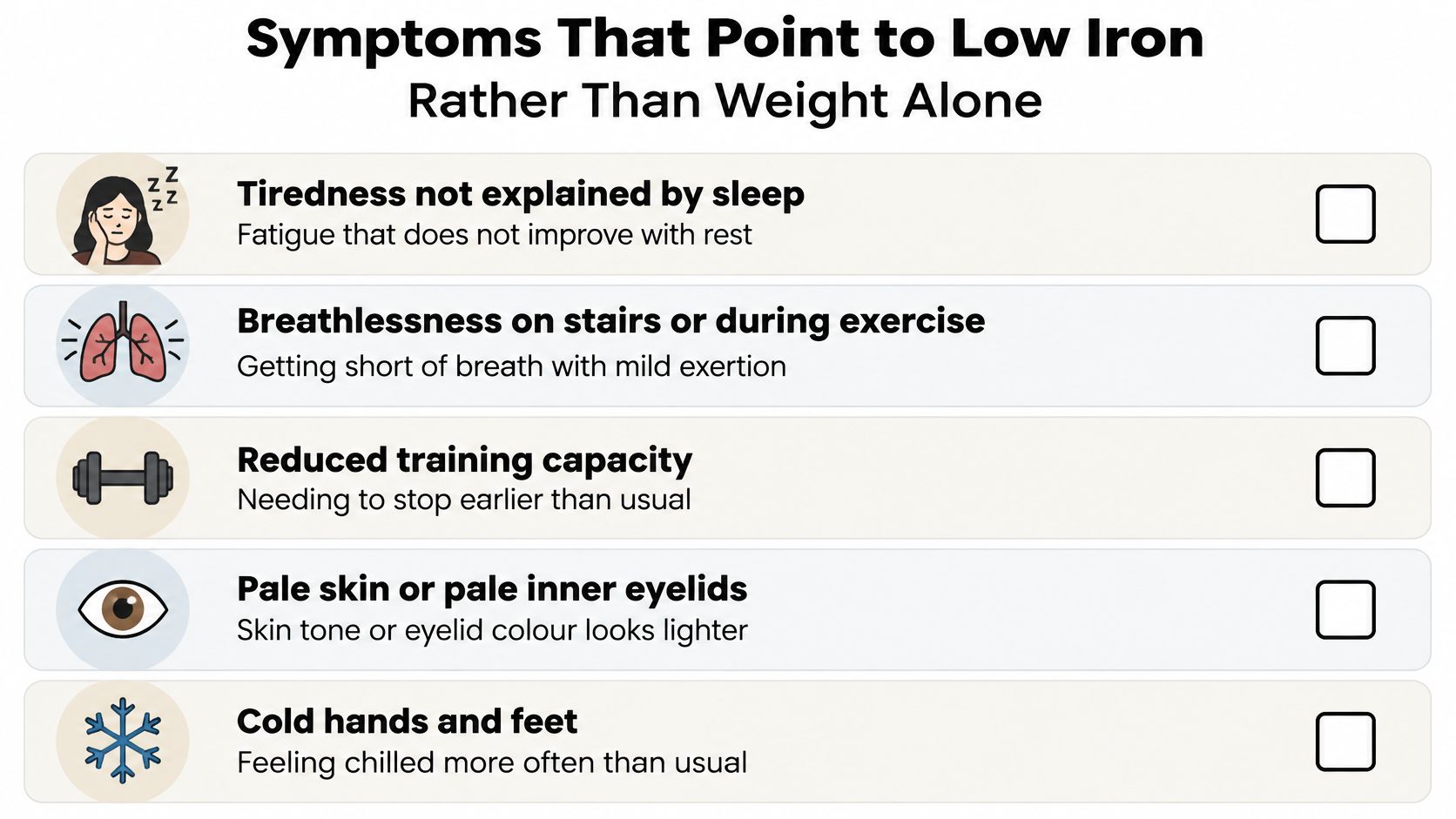
Symptoms That Point to Low Iron Rather Than Weight Alone
A cluster of symptoms tells your GP more than a scale reading. Persistent changes in energy and exercise tolerance are particularly useful to report, but none of the signs below can diagnose low iron on its own.
Use this checklist to describe what's changed, not to decide whether you need supplements.
Symptoms need context
- Tiredness not explained by sleep: Low iron is one possibility. Depression, sleep apnoea, pregnancy and inadequate food intake can also cause fatigue.
- Breathlessness on stairs or during exercise: Anaemia can contribute, but heart or lung problems and reduced fitness are other explanations.
- Reduced training capacity: Report needing to stop earlier than usual. Under-fuelling, illness and poor recovery can produce a similar change.
- Pale skin or pale inner eyelids: These may accompany anaemia, but appearance and lighting aren't reliable tests.
- Cold hands and feet: These aren't specific to iron deficiency. Thyroid problems and circulation-related conditions can also contribute.
- Hair shedding or brittle nails: Nutritional problems are possible, alongside thyroid disease, stress and local hair or nail conditions.
- Restless legs or unusual cravings: Mention uncomfortable legs at night or cravings for ice or starch. These warrant assessment, but don't establish the cause.
Fatigue during hormonal changes deserves the same care. Our explanation of menopause and fatigue can help you recognise overlapping patterns without attributing every symptom to hormones.
Describe the pattern, not just the weight
Say a woman with heavy periods notices that her usual run feels harder and her weight is gradually rising. Her doctor would consider menstrual loss, food intake, recovery, sleep, pregnancy where relevant, and other medical causes before deciding which tests are appropriate.
Weight change without those accompanying symptoms provides less reason to suspect iron as the explanation. Thyroid disease and fatty-liver disease may also warrant review when fatigue and weight change occur together.
Bring answers to these questions:
- Duration: When did symptoms begin, and are they worsening?
- Menstrual changes: Has bleeding become heavier, longer or less predictable?
- Routine changes: What has changed in your diet, training, sleep or medicines?
Who Is Most at Risk in Australia
Menstrual blood loss is an important risk factor, particularly when dietary iron does not replace what is lost. Risk can also rise when iron intake is low, absorption is reduced, or another source of ongoing blood loss is present.
An Australian study indexed in PubMed found that heavy menstrual bleeding lasting more than two days was associated with higher odds of low ferritin, with an adjusted odds ratio of 1.73. This is an association, not proof that heavy periods always cause iron deficiency.
The figures below describe two different things: measured iron stores and dietary iron intake. Low intake does not by itself confirm depleted stores or anaemia.
Iron status figures for Australian women and men
| Group or measure | Figure | Source or year |
|---|---|---|
| Women aged 18–39 with ferritin below 30 µg/L | 34.8% | Eastern states survey, 2016–2017 |
| Women with ferritin below 30 µg/L, New South Wales | 41.4% | Eastern states survey, 2016–2017 |
| Women with ferritin below 30 µg/L, Victoria | 31.5% | Eastern states survey, 2016–2017 |
| Women with ferritin below 30 µg/L, Queensland | 32.6% | Eastern states survey, 2016–2017 |
| Women with depleted iron stores compared with men | 22.3% vs 3.5% | Australian clinical guidance |
| Females with inadequate iron intake compared with males | 26.8% vs 8.2% | ABS, 2023 |
| Heavy menstrual bleeding lasting more than two days | Adjusted odds ratio of 1.73 for low ferritin | Eastern states survey, 2016–2017 |
The eastern states survey figures apply to women in the ages and locations studied, not to every Australian woman. The national estimates for depleted iron stores come from Australian clinical guidance. The Australian Bureau of Statistics reports inadequate iron intake in 26.8% of females and 8.2% of males in 2023. These intake figures should not be confused with estimates of low iron stores.
Who should raise testing with their GP
- People with heavy periods: Describe the amount and duration of bleeding, even if it seems normal for you.
- People following restrictive or plant-based diets: Plant-based eating can include iron, but a limited range of foods or insufficient intake may increase risk.
- Endurance athletes: Discuss training demands, recovery and fuelling together.
- People with gut symptoms or blood loss: Gastrointestinal bleeding and conditions such as coeliac disease may need investigation, not dietary advice alone.
The survey also found an association between obesity and lower odds of low ferritin. That does not establish protection from deficiency. In people with excess body weight, inflammation can raise ferritin, so a result within the usual range may not tell the whole story about iron status.
Risk factors guide who may benefit from assessment; they are not diagnoses. Deficiency can occur without anaemia, and weight change alone cannot show whether iron stores are low.
How to Get Tested for Iron Deficiency
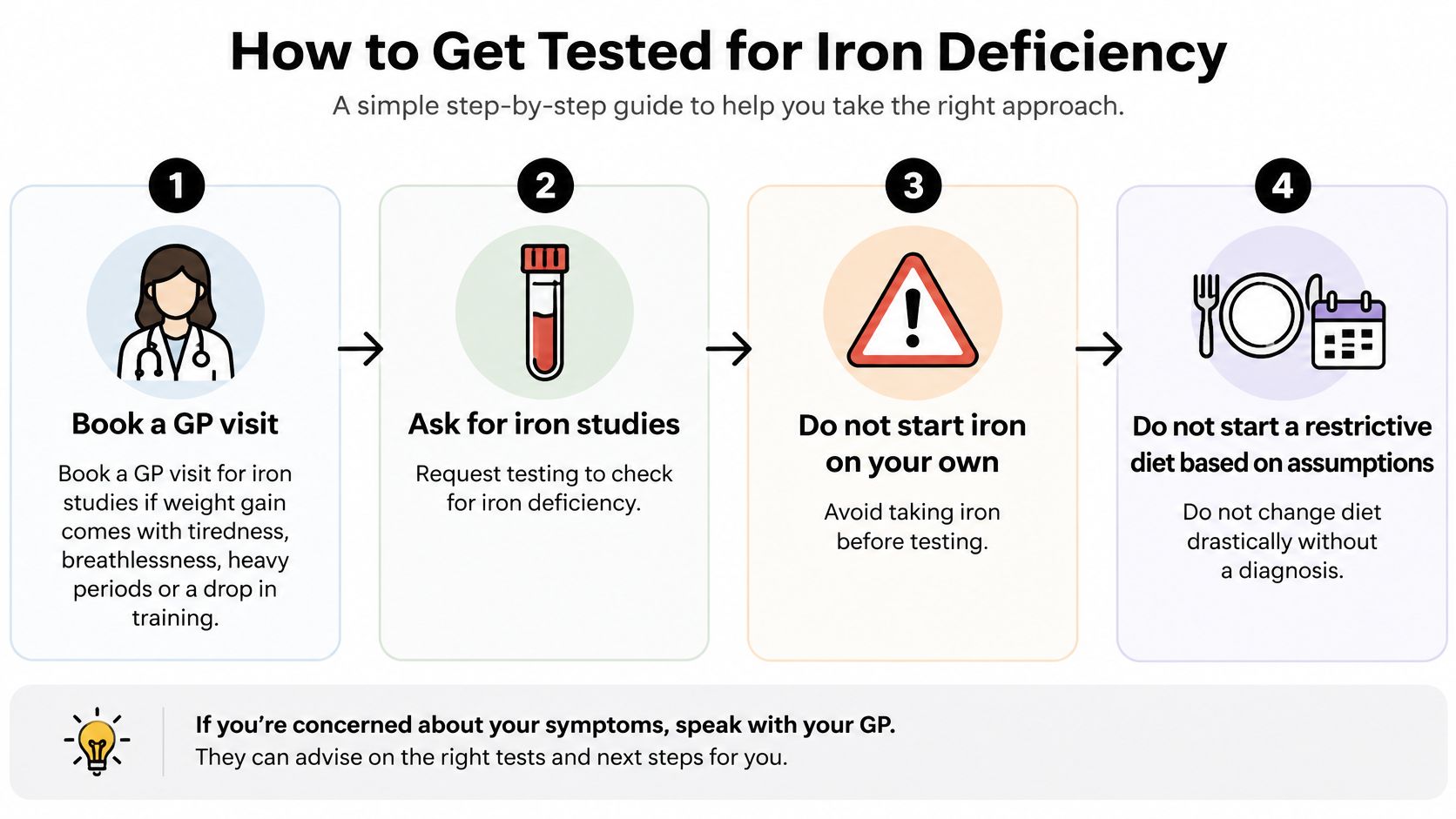
Book a GP appointment if weight change accompanies persistent tiredness, breathlessness, heavy periods or an unexplained drop in training capacity. Don't start iron or a restrictive diet based on the scale alone.
This testing pathway keeps the focus on confirming a problem and finding its cause.
Prepare for a useful appointment
- Record symptoms while you wait. Note when tiredness or breathlessness started, which bleeding days are heavy, and changes in food intake or training. Don't delay an appointment to complete a diary.
- Discuss a suitable blood-test panel. Ask whether a full blood examination, ferritin, transferrin saturation and C-reactive protein are appropriate. Your GP should select tests based on your symptoms and medical history.
- Raise possible causes at the same visit. Discuss menstrual loss, dietary restriction, gastrointestinal symptoms and absorption problems. Coeliac testing or a bowel assessment may be appropriate, but not everyone needs the same investigations.
- Avoid self-prescribing iron. Confirming deficiency matters because unnecessary supplementation can be inappropriate or harmful.
- Agree on follow-up. Ask when results will be reviewed, whether treatment is needed and how the underlying cause will be investigated.
The Medical Journal of Australia guidance on diagnosis and management states that adult ferritin below 30 µg/L is generally diagnostic of iron deficiency, while inflammation, obesity and fatty-liver disease can conceal deficiency by raising ferritin. It also reports depleted stores in 22.3% of Australian women compared with 3.5% of men.
Keep home measurements in their proper role
If you already track weight, bring the trend rather than isolated readings. Our Venus AI Smart Scale: Body Composition & Body Fat Scale provides weekly AI-driven fat and muscle summaries and nutritional recommendations, but it can't diagnose iron deficiency. It's not suitable for pregnant women or anyone with a pacemaker or similar electronic implanted device.
A video is available alongside this appointment checklist:
Take these questions to your appointment: What is my iron status? What could be causing it? What should I monitor while we investigate? Seek urgent care for severe breathlessness, chest pain or fainting rather than waiting for routine testing.
Reading Blood Markers Together, Not Ferritin Alone
A woman with excess body weight might have ferritin inside her laboratory's reference range, raised inflammatory markers and low transferrin saturation. Her clinician wouldn't necessarily call her iron-replete, because those results can indicate that stored iron isn't readily available for use.
Normal ferritin doesn't always mean normal iron availability. The useful question is whether the whole blood-test pattern fits the symptoms and medical history.
What the markers contribute
Blood markers clinicians read together
| Marker | Usual reference point | What it tells you |
|---|---|---|
| Ferritin | A low result supports depleted stores; interpret against clinical guidance | Iron stores, but it also rises with inflammation |
| Transferrin saturation | A low result against the laboratory's range supports restricted iron availability | How much iron is available in circulation |
| Haemoglobin | Below the appropriate laboratory reference range indicates anaemia | Whether anaemia is present, not its cause by itself |
| Mean corpuscular volume (MCV) | Below the laboratory reference range indicates smaller red blood cells | A pattern that can support iron deficiency, but isn't specific to it |
| C-reactive protein (CRP) | Above the laboratory reference range supports an inflammatory context | Whether ferritin may be falsely reassuring |
Use the reference ranges printed on your report. Your clinician also considers your circumstances, including pregnancy where relevant, rather than applying a single internet cut-off to every person.
OneTwenty's explanation of what ferritin reveals about iron stores provides background on the storage marker. It doesn't replace interpretation of the accompanying results.
Why higher body weight can complicate interpretation
Adipose tissue can contribute to low-grade inflammation. That can increase hepcidin, a liver-produced hormone that reduces intestinal iron absorption and limits release of iron from storage cells.
The result can be functional iron deficiency: iron may be present in storage, yet insufficiently available where the body needs it. In an Australian adult cross-sectional study published in BMJ Open, iron deficiency prevalence in obesity class I was 12 percentage points lower than in the healthy-weight group, but higher obesity classes didn't show the same reduction.
That uneven pattern doesn't support a simple rule that heavier people have better or worse iron status.
A laboratory result inside its reference range is information, not a stand-alone explanation for persistent symptoms.
Apply three principles: look for a pattern, consider whether infection or inflammation affected the sample, and don't use a normal blood count alone to exclude depleted stores. Equally, anaemia or small red blood cells can have causes other than iron deficiency.
Ask your clinician whether ferritin is reliable given your inflammatory markers, whether transferrin saturation helps clarify the picture, and what happens if results remain borderline.
What Iron Treatment Can and Cannot Do for Weight
Treating confirmed deficiency matters for health, but it doesn't reliably produce weight loss. Nor does improving an iron-storage marker guarantee a uniform improvement in athletic performance.
In a 2025 study of 30 elite Australian Rules footballers, iron deficiency affected roughly 47–54% of players across the season; increasing ferritin from 30 to 49 µg/L produced small-to-moderate gains in some external-load measures, without consistent improvement across all performance outcomes. Those findings concern athlete performance, not proof that supplementation reduces body fat.
Set the right treatment goal
If iron deficiency explains your symptoms, treatment may improve energy, exercise tolerance and breathlessness. Some people may also notice improvement in iron-related restless legs, but individual responses differ.
Treatment isn't an automatic metabolism booster. If sleep, under-fuelling, thyroid disease or another condition also contributes to fatigue, correcting iron alone may not resolve everything.
A home body-composition record can accompany that assessment, but it remains separate from medical testing.

Why self-dosing can cause problems
- Digestive effects: Oral iron can cause constipation, nausea or stomach discomfort.
- Unnecessary iron exposure: Taking iron when you don't need it can be harmful, particularly if you have a condition that causes iron accumulation.
- Medicine interactions: Iron can interfere with some medicines, so a pharmacist should review timing and compatibility.
Your clinician should direct the formulation, dose, duration and monitoring. Don't increase your dose because your weight hasn't changed, and don't stop prescribed treatment solely because you feel better.
If oral iron is prescribed, discuss absorption and timing with your pharmacist. NexiHerb LLC's tips for better iron absorption can help you prepare questions, but commercial supplement guidance shouldn't determine your treatment.
Measure recovery by function: Notice whether ordinary stairs feel easier, familiar training becomes manageable and your clinician is satisfied with repeat blood tests.
A stable scale reading doesn't mean treatment has failed. Conversely, weight loss doesn't confirm that iron stores have recovered. The most useful progress record combines symptoms, training tolerance, treatment side effects and the tests your clinician requests.
Dietary and Lifestyle Steps to Support Iron Intake
A scale can show weight change, but it cannot reveal whether iron intake is adequate. Iron deficiency can occur without anaemia, and a normal ferritin result may not always tell the whole story for people with excess body weight. Food choices can support iron intake, while weight change alone cannot identify the cause of low iron.
The AIHW nutrition-across-the-lifestages report reports that about 38% of Australian women aged 19–30 and 31–50 don't consume enough iron. Build meals around iron-containing foods and maintain enough energy to support daily activity and training.
Build meals that support intake
- Choose an iron-containing foundation. Include red meat, poultry, fish, legumes, tofu or iron-fortified cereals to suit your preferences. Plant-based meals can provide iron when planned deliberately.
- Pair plant sources with vitamin C. Try lentils with tomato, tofu with capsicum, or fortified cereal with citrus fruit to support iron absorption.
- Have tea and coffee between meals. This keeps them separate from iron-rich meals rather than making them the main drink alongside those foods.
If you're planning pregnancy, this guide to iron-rich foods for pregnancy offers meal ideas to discuss with your maternity clinician or dietitian.
Protect fuelling and address losses
- Avoid crash dieting: Skipping meals or removing whole food groups can make it harder to maintain iron, protein and energy intake.
- Adjust training to recovery: If familiar sessions feel unusually difficult, reduce training demands and seek assessment rather than pushing through unexplained symptoms.
- Discuss heavy bleeding medically: Food choices cannot investigate substantial menstrual blood loss.
- Tell your clinician about changes: Share supplements, dietary restrictions and new eating patterns before adding iron.
A lentil-and-capsicum lunch is one practical way to include plant-based iron and vitamin C. Ongoing bleeding, possible malabsorption and the reason for weight change still need separate assessment.
Build a sustainable eating pattern that supports iron intake. A dietitian can help align food preferences, training needs and meal choices without unnecessary restriction.
Venus Health Co. sells an AI Body Composition Smart Scale that provides weekly AI-driven fat and muscle summaries and nutritional recommendations. Its wellness report includes 30-day trend charts for weight, fat percentage and muscle. These readings can help organise weight and body-composition trends alongside symptoms and clinician-directed iron testing, but they do not diagnose iron deficiency.