

Do You Gain Weight Before Your Period? a Clear Guide
Dr. Adeyinka AdegbosinYou step onto the bathroom scale five to ten days before your period and see a number that's one, two, or even three kilograms higher than it was last week. Your jeans feel tighter, your abdomen looks puffy, and the change seems too sudden to match what you've eaten or how you've trained.
If you're asking, “Do you gain weight before your period?”, the short answer is yes, many people do. The more important answer is that the increase is usually a temporary change in fluid balance, digestion, and appetite, not a sudden increase in body fat. Understanding that difference can stop one luteal-phase reading from undermining your confidence.
That Number on the Scale the Week Before Your Period
The scale is giving you a real measurement, but it isn't necessarily measuring the change you fear. A higher number before bleeding can reflect water stored in your tissues, slower movement through your digestive system, and the effects of ordinary changes in food, sleep, activity, and sodium intake.
Australian consumer health information commonly describes a premenstrual increase of about 1.5 to 3 kilograms, with fluid retention and bloating as the main explanations rather than fat gain. One Australian health source describes about 1.5 to 2.5 kilograms of water weight before menstruation, usually stabilising after bleeding begins, as outlined by Kin Fertility's explanation of period weight changes.
That can feel dramatic when you're tracking closely. A person weighing themselves at the same time each morning might see a mid-cycle baseline rise, then notice a fuller stomach, breast tenderness, or rings and clothing feeling snug. Those sensations are valid. They don't prove that body fat has increased.
Why the timing matters
The days before a period belong to the luteal phase, when cycle-related symptoms often become more noticeable. If the number rises during the same part of each cycle and settles after menstruation starts, the pattern points more strongly towards a recurring fluctuation than a lasting change.
It also helps to remember that weight moves in ordinary life, even outside menstrual cycles. In an Australian longitudinal study of more than 300 adults aged 18 to 65 in Adelaide, body weight typically fluctuated by about 250 grams from week to week, while the average participant gained about 220 grams across a full year. The sharpest short-term increase occurred around Christmas and New Year, when weight rose by about 500 grams over that holiday period, according to this Australian summary of seasonal weight change.
The useful question isn't “What did I weigh today?” It's “Where does this reading sit in my cycle, and does it return to my usual baseline?”
For many people, the extra fluid begins to clear within a few days of flow starting. That doesn't mean you should ignore a persistent rise, but it does mean a single premenstrual reading deserves context before it deserves a reaction.
Why Hormones Make the Number Jump
Think of the luteal phase as a temporary change in your body's instructions for fluid handling and digestion. The hormone shifts don't create fat overnight, but they can make the scale and your clothes feel different.
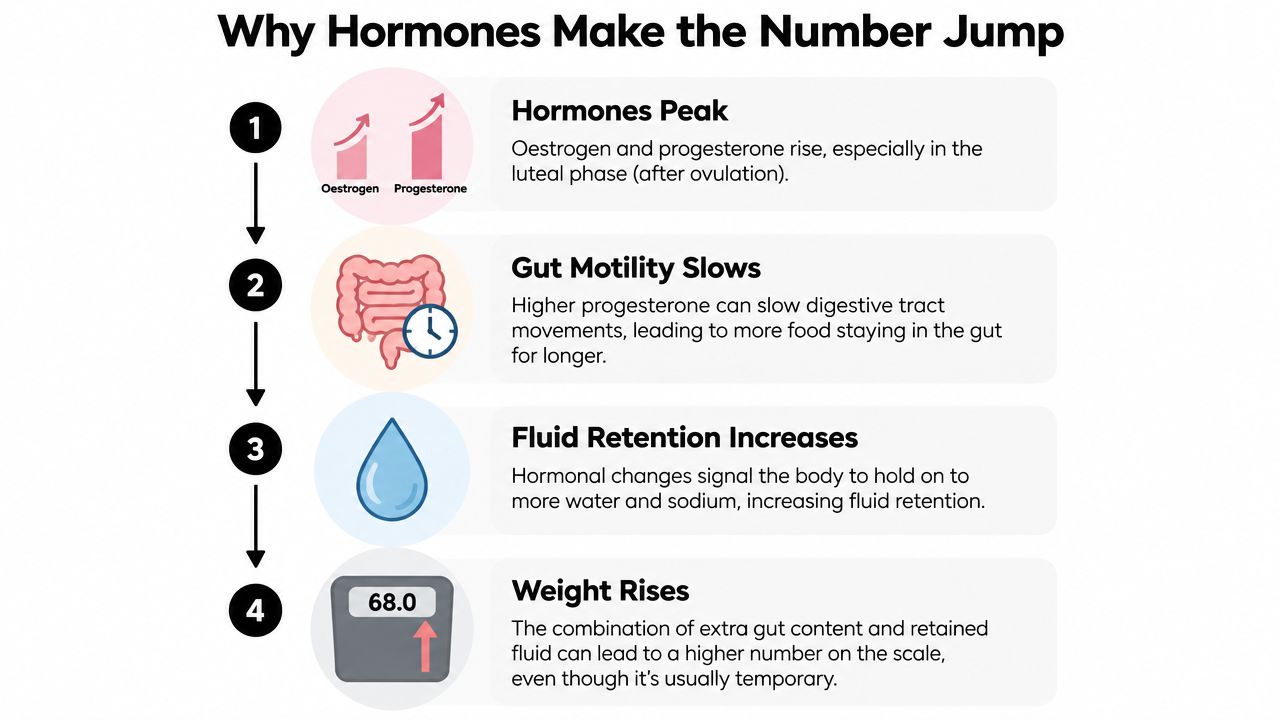
Four changes to understand
- Oestrogen and progesterone change after ovulation. These hormones influence several body systems, including the gut. As gut movement slows, food and gas may remain in the digestive tract longer, creating constipation, pressure, or bloating. That can contribute to a heavier feeling without representing a comparable amount of fat tissue.
- The kidneys receive stronger fluid-retention signals. Rising progesterone is linked with changes in aldosterone activity. Aldosterone helps regulate sodium, and water follows sodium. Picture it as your body briefly turning down the release valve, so more fluid remains in the spaces between tissues. This can show up as puffiness around the abdomen, breasts, hands, or legs.
- Appetite and cravings can become more noticeable. Hormonal changes, tiredness, stress, and disrupted sleep may make salty or energy-dense foods more appealing. Extra sodium can make the fluid shift more visible, while additional food in the digestive tract can add to a short-term scale reading.
- The instructions change again when bleeding begins. Oestrogen and progesterone fall, fluid-retention signalling eases, and the kidneys can release the water they were holding. That's why the scale often moves back towards its usual range after menstruation starts.
For a simple visual overview of how cycle hormones can change across the month, see this menstrual-cycle hormone graph. Food choices and regular sleep can also support general wellbeing during hormonal changes, and this resource on hormone balancing foods SleepHabits offers ideas to discuss with your healthcare professional.
The key distinction is mass versus composition. Your body can hold more water and digestive contents without creating an equivalent amount of new fat. The scale detects both, so it needs to be read alongside timing, symptoms, and the pattern that follows.
How Much Weight Is Normal and When It Happens
You step on the scale a few days before your period and see a higher number than expected. That reading can feel alarming, especially when your eating and activity have not changed. A menstrual weight pattern is not identical for everyone. Some people notice little change, while others see a clear rise or mainly feel bloated without a large shift on the scale.
Australian health sources commonly place temporary premenstrual changes around 1.5 to 3 kilograms. Fluid retention and bloating account for much of this short-term movement. Timing matters more than a single number: a rise that appears before bleeding and eases after menstruation begins fits a cycle-related pattern. Compare it with your longer baseline rather than treating one reading as a verdict.
A practical cycle map
| Cycle phase | What you may notice | How to read it |
|---|---|---|
| Earlier cycle, after bleeding | More stable reference readings may appear here | Use consistent morning readings to establish your personal baseline |
| Luteal phase | Bloating, appetite changes, and a temporary rise may appear | Compare with the same phase in earlier cycles |
| Days before bleeding | Fluid-related symptoms may feel most obvious | Treat a short-term rise as provisional, not a verdict |
| After bleeding begins | Retained fluid may begin to clear | Check whether your weight trends back towards baseline |
Use the table as a tracking aid, not a diagnostic rule. Cycles do not always follow a neat calendar, particularly when periods are irregular, hormonal contraception is involved, or symptoms vary between months.
What deserves a closer look
A rise that does not resolve after menstruation, increases from one cycle to the next, or comes with progressively more disruptive symptoms deserves attention rather than automatic dismissal as PMS. The pattern may also reflect behaviour and environment. Weekends, winter, and Christmas or New Year were recurring periods of weight gain in a 2023 Australian cohort study on seasonal weight change, showing why cycle timing should be considered alongside routines, food, activity, and other context.
If you track ovulation as well as weight, the Venus Ovulation Predictor Test Kit is described as an at-home LH test designed to identify the fertile window and provide results in under ten minutes. Ovulation timing can help label cycle phases more accurately, but it cannot explain every change on the scale. persistent changes still need to be judged against your personal baseline and overall symptoms.
Reading Your Smart Scale Through the Luteal Phase
A smart scale can provide more context than body weight alone, but its extra readings still need careful interpretation. Bioelectrical impedance estimates body composition through electrical signals, and changes in hydration can affect those estimates. A single reading isn't a laboratory verdict on fat or muscle.
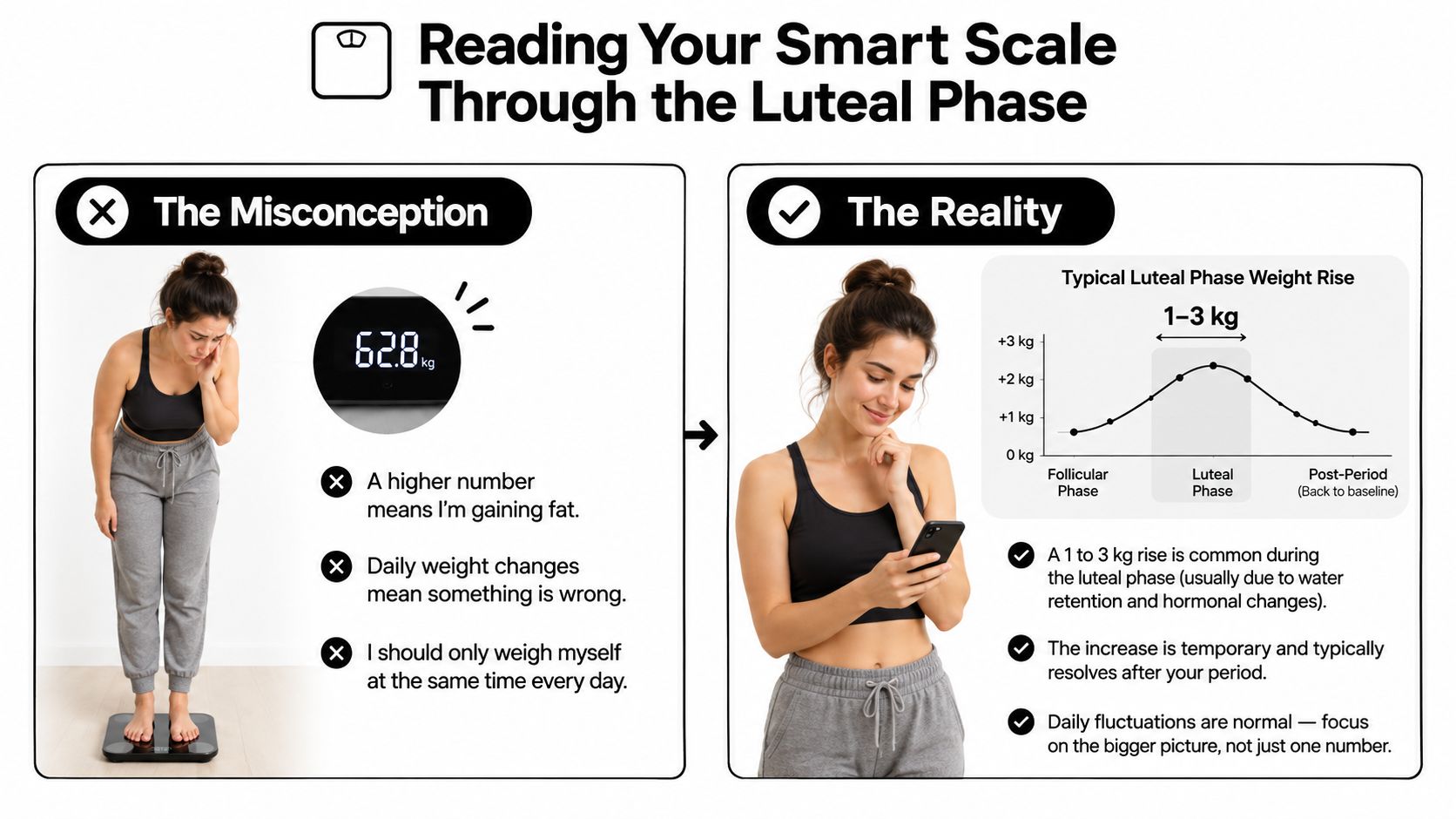
Build a cycle-aware baseline
Choose a consistent weighing routine. Many people find the readings after bleeding has finished more useful as a reference because premenstrual fluid is less likely to dominate the number.
Use this process:
- Weigh under similar conditions. Morning readings, after using the bathroom and before food, make comparisons cleaner.
- Record the cycle day. Add the first day of bleeding and note symptoms such as bloating, constipation, poor sleep, or unusual sodium intake.
- Compare like with like. A luteal-phase reading should be compared with luteal-phase readings from earlier cycles, not only with your lowest mid-cycle number.
- Look at the longer trend. Body composition becomes more meaningful across several months than across a few days.
Separate water signals from fat signals
A rise in total weight with a stable or lower estimated body fat percentage can fit a fluid-retention pattern. A sustained rise in both weight and estimated fat percentage may suggest a broader change, but home body-composition readings can be noisy, so don't interpret one reading in isolation.
The Venus AI Smart Scale: Body Composition & Body Fat Scale is one example of a home device that records multiple body-composition measures, syncs with an app, and provides trend reports and recommendations. Whatever device you use, consistent conditions matter more than chasing a perfect daily number.
A smart scale is most useful when it helps you recognise a repeating pattern, not when it encourages you to explain every fluctuation immediately.
A salty meal, a hard training session, poor sleep, dehydration, and digestive changes can all disturb a reading. Tag those circumstances instead of treating them as evidence that your body has suddenly changed.
When the Bump Is More Than Just Hormones
Premenstrual water retention is common, but “temporary” shouldn't become a reason to dismiss every persistent increase. A cyclical rise should begin moving back towards your usual range after bleeding starts. If it remains high, keeps building, or appears without a consistent cycle pattern, look at the wider picture.
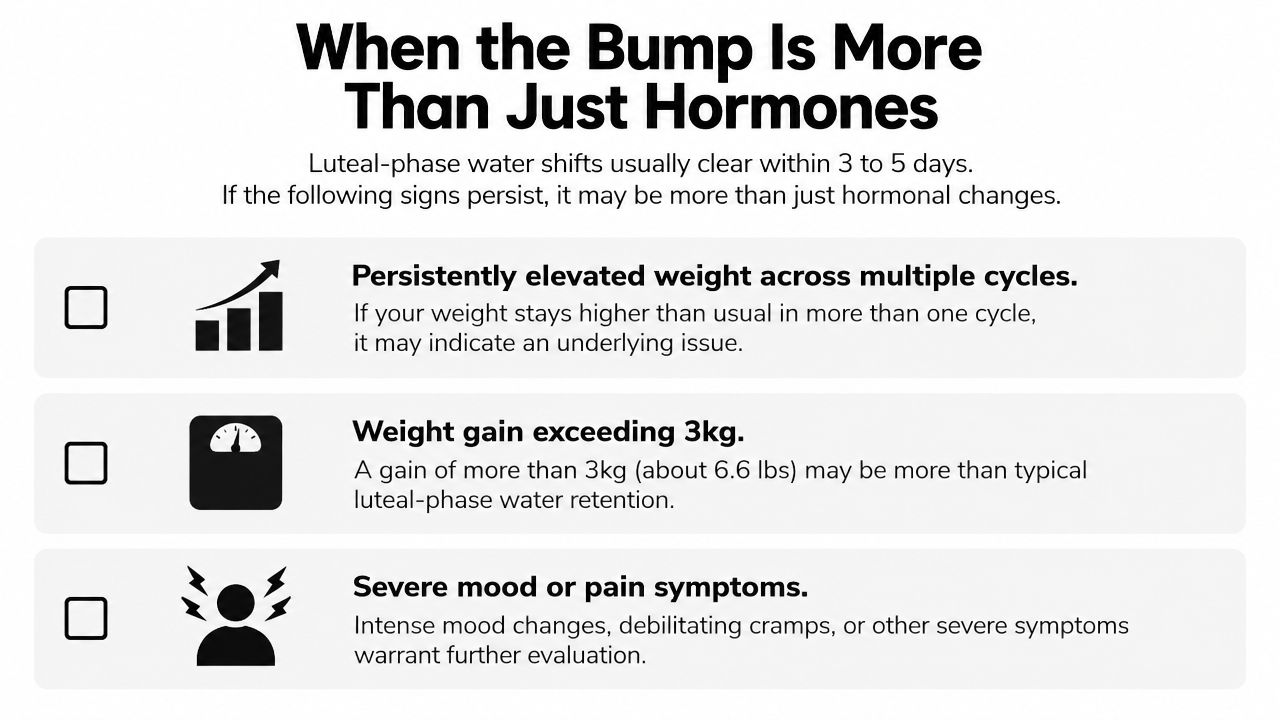
Ask whether the pattern resets
Compare your baseline from one cycle with the equivalent baseline in the next. If the post-period readings keep moving upwards rather than returning towards their earlier range, food intake, activity, sleep, medication, stress, and health conditions may all deserve consideration.
A cycle-related explanation becomes less convincing when the increase:
- Stays after menstruation: The number doesn't move back towards its usual range once bleeding has begun.
- Grows across cycles: Each cycle's baseline is higher than the one before.
- Arrives without the usual symptoms: There's no familiar timing, bloating, or other premenstrual pattern.
- Changes your daily life: Pain, mood symptoms, fatigue, or swelling interfere with work, training, relationships, or sleep.
Waist measurements, clothing fit, energy, and estimated body-composition trends can add context, although none should be used alone to diagnose a cause. A clinician can help assess the pattern, especially if periods become absent or irregular, weight rises rapidly without an obvious explanation, or symptoms feel severe.
People with irregular cycles may find it harder to identify a reliable luteal window. The guide to PCOS and irregular periods explains why cycle timing can vary and why persistent symptoms deserve individual assessment.
Don't use PMS as a blanket explanation for a trend that never resets.
You also don't need to wait for a particular number before seeking help. A smaller change can still matter if it comes with significant swelling, escalating pain, missing periods, or mood changes that disrupt your ability to function.
Practical Ways to Feel Lighter Before Your Period
You can't always prevent a hormonal fluid shift, but you can reduce the extra noise around it and make the days more comfortable. The aim isn't to force the scale down. It's to support regular eating, movement, hydration, sleep, and observation.
Start with ordinary routines
Keep meals steady rather than restricting heavily and then responding to intense hunger later. Include a protein source and fibre-rich foods at meals, choose potassium-containing foods such as vegetables, legumes, fruit, and yoghurt if they suit you, and moderate very salty packaged foods when they make bloating worse.
Drink regularly according to your thirst and usual health needs. Avoid using extreme fluid restriction or unapproved diuretics to chase a lower scale reading.
Movement can be gentle and still useful. Walking, mobility work, yoga, swimming, or a reduced-intensity strength session may help you stay connected to your routine when fatigue or cramps make hard training unappealing. Rest is also appropriate when your body needs it.
Make tracking less reactive
A simple log can include:
- Cycle timing: First day of bleeding and the days when symptoms begin.
- Body signals: Bloating, bowel changes, sleep, cravings, mood, and pain.
- Context: Training load, restaurant meals, unusually salty food, travel, and stress.
- Scale trend: Readings taken under similar conditions, interpreted across phases rather than as isolated highs.
If daily weighing makes you anxious, reduce the frequency. A consistent weekly or phase-based routine can show the pattern without turning every morning into a judgement.
The following video can provide a practical movement option for days when you want a gentler approach:
Sleep also belongs in the plan. Poor sleep can make cravings, fatigue, and bloating feel harder to manage, so create a repeatable evening routine and avoid using a temporary scale increase as a reason to under-eat or overtrain.
A Calmer Way to Think About Your Cycle and the Scale
Use the scale as one signal, not a verdict. A useful reading includes the number, the cycle day, your sleep, appetite, energy, mood, bowel habits, training, and whether your clothes feel different.
Start this week by choosing a consistent reference period after bleeding has started. Record your readings under similar conditions, label the days when premenstrual symptoms appear, and avoid making decisions from a single luteal-phase spike. Review the full pattern after several cycles, rather than trying to solve it on the day the number rises.
The Australian data on ordinary weekly variation provides helpful perspective: short-term changes of a few hundred grams happen in real life, and seasonal routines can influence weight independently of menstruation, as described in the Australian weight-fluctuation overview. That doesn't make your experience imaginary. It gives you a better comparison point.
Small habits often create clearer information than dramatic responses. Keep meals reasonably consistent, continue comfortable movement, prioritise sleep, and weigh at a similar time when you do weigh. For ideas that shift attention away from the scale, these Strive Workout Log NSV examples show how progress can also appear in strength, stamina, comfort, and daily function.
Your body isn't failing because it changes across a cycle. Once you understand the difference between a temporary fluid signal and a sustained trend, the scale becomes a tool for feedback rather than a scorecard for self-worth.
Venus Health Co. offers app-connected tools for tracking body weight, body composition, fertility signals, and cycle-related patterns at home. If you want to compare your readings with longer trends instead of reacting to one premenstrual number, visit Venus Health Co. to explore its health tracking options.