

How Much Protein to Build Muscle Daily
Dr. Adeyinka AdegbosinRegularly training Australians need about 1.2 to 1.6 grams of protein per kilogram of body mass each day, which works out at roughly 96 to 128 grams for an 80 kg athlete, while the 1.6 to 2.4 g/kg band belongs to dieting for fat loss while protecting muscle rather than to a default muscle-building push.
So why does the answer change every time you open a new tab? Because most advice hands you the middle of a range and calls it a rule. A 62 kg netballer training twice a week and a 95 kg lifter eight weeks into a cut get served the same sentence, and neither of them can do much with it.
The number isn't wrong. It's a range doing three jobs at once, and the job changes as your training load and your calorie intake change. What's usually missing is the structure around it: a training band for normal weeks, a higher band for fat-loss phases, and a per-meal split that turns either one into food.
Get that structure and you'll read every protein article differently. You'll know which row you're in, what a single serve is meant to deliver, and which results tell you to hold steady or shift. Protein supplies raw material. Your lifting decides whether any of it becomes muscle, and more of the first never fixes a shortage of the second.
Daily Protein Grams for Muscle
How much protein gives a training week a useful target? For Australians who train regularly, the Australian Institute of Sport's guidance puts daily needs at approximately 1.2–1.6 grams per kilogram of body mass. For an 80 kg athlete, that is 96–128 grams a day.
Muscle repair continues after training, so protein intake matters across the day, not only straight after a session. A daily range is a bit like a training zone: it gives you room to choose a target that fits your current goal.
| Situation | Grams per kg | Worked example |
|---|---|---|
| Regular training, weight stable | 1.2–1.6 | 80 kg: 96–128 g |
| Hard lifting to build muscle at maintenance or a small surplus | about 1.6 | 75 kg: about 120 g |
| Dieting to lose fat and keep muscle | 1.6–2.4 | 75 kg: 120–180 g |
| Each meal or snack, 3–5 times a day | 0.3–0.4 | 80 kg: 24–32 g |
For muscle gain, about 1.6 g/kg is a practical target when weight is stable or rising slowly. The higher 1.6–2.4 g/kg range serves a different purpose: it applies during fat loss, when the aim is to preserve muscle while calories are reduced. More protein alone does not make muscle grow if your weight is climbing.
Split the daily total across 3–5 eating occasions, aiming for 0.3–0.4 g/kg per meal or snack. At 80 kg, that works out to 24–32 grams per occasion. Distributing protein gives you several opportunities to support muscle repair instead of leaving most of the day's intake for dinner.
If you use pounds, divide the grams-per-kilogram figure by 2.2. The regular-training range is roughly 0.55–0.73 grams per pound.
Practical rule: Choose one daily range and the per-meal range. Use those as your targets for the week.
The Australian Institute of Sport recommends getting protein from food first. A shake can help when a meal falls short, but it need not be the foundation of your plan.
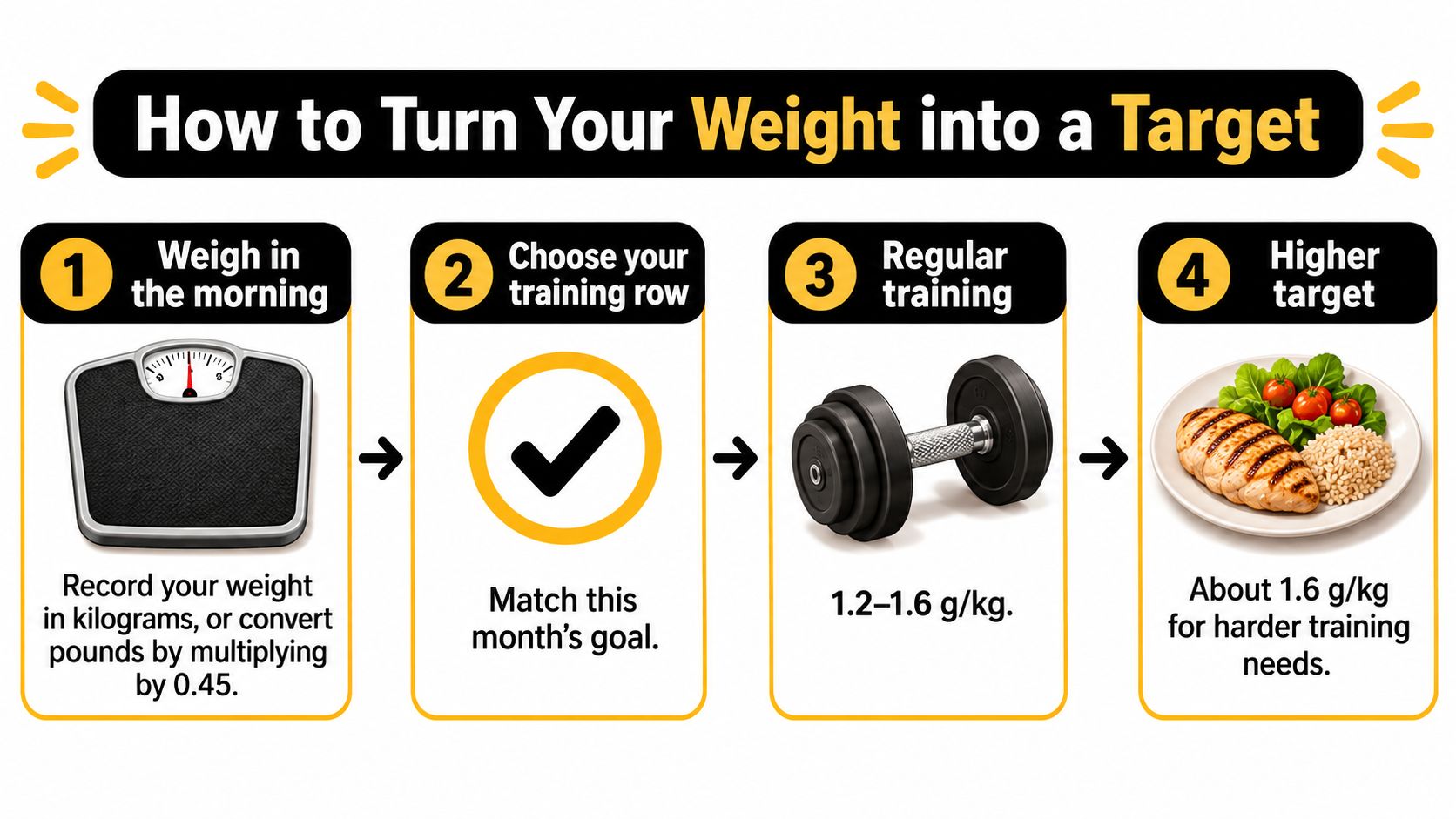
How to Turn Your Weight into a Target
Six steps, in order, and the maths is finished by the end of step four.
- Weigh yourself in the morning, in kilograms. Same routine each time: after the bathroom, before breakfast, minimal clothing. If your scale reads pounds, multiply by 0.45 to get kilograms.
- Choose the row that matches this month. Use 1.2–1.6 g/kg for regular training, about 1.6 g/kg if muscle is the goal and your weight is steady or slightly rising, and 1.6–2.4 g/kg only when calories are deliberately down and you're still lifting.
- Write a band, not a single number. Multiply your weight by the low end and again by the high end. A range survives real life. A single figure invites you to feel like you failed over 6 grams.
- Divide it across 3–5 eating times at 0.3–0.4 g/kg, so breakfast and lunch carry real protein and dinner isn't doing all the work.
- Fill the slots with food first. Keep a shake in reserve for the day a meal collapses, not as the default.
- Log one ordinary day. Not your best day, an ordinary one. If the total misses the band, nudge a portion up tomorrow rather than rebuilding your diet.
The 68 kg example, worked through
Say you weigh 68 kg and lift four days a week, wanting muscle while your weight holds steady. The top of the training band, 1.6 g/kg, gives about 109 grams a day. Split across four occasions, that's roughly 27 grams each: eggs at breakfast, chicken or tofu at lunch, yoghurt as an afternoon snack, fish or legumes at dinner.
Four plates. No arithmetic at the table, no panic about a shake you forgot.
Two things won't follow from the maths. A calorie deficit with no lifting won't convert a higher protein number into muscle, because the training stimulus is the signal and protein is only the material. And a surplus has to come from enough total food, not from protein alone; pushing protein up while energy stays flat just reshuffles the same day.
A band is a shopping list, not a scorecard. Landing 104 grams on a 96–128 gram day is a good day, and chasing the exact gram costs more attention than it returns.
Food Quality Before Protein Powder
Once you know the per-meal dose, the main question is which serve delivers it without becoming an enormous plate.
Here's the standard I'd use: a serve earns its place if it lands near 25–30 grams of protein in a portion you'd happily eat. That's the target range the per-meal guidance points at for a moderately heavy adult, and the foods that hit it easily are the ones worth building meals around.
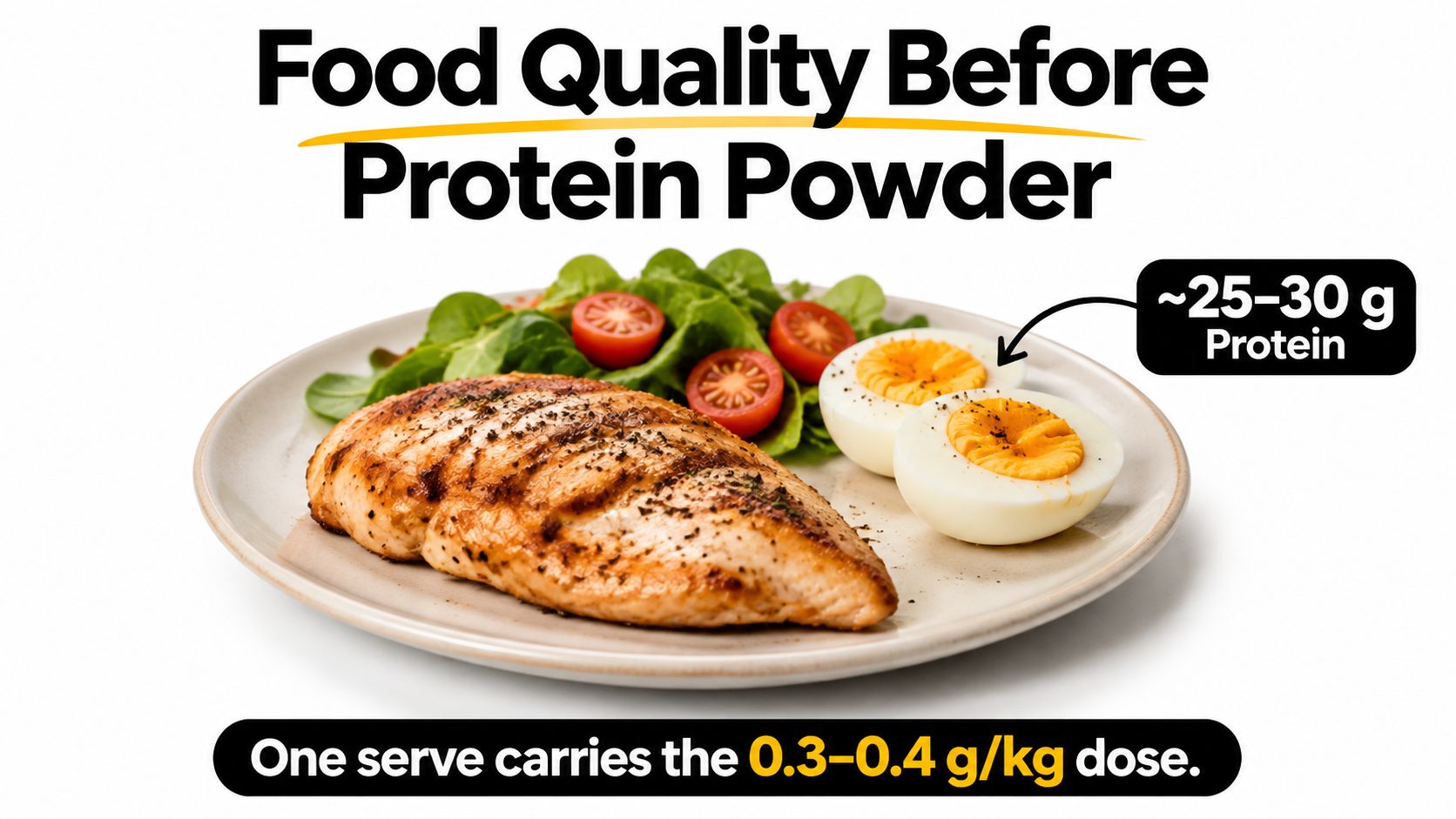
Lean meat and poultry do it with about 100 grams cooked. Fish and tinned tuna sit slightly lower per tin but need zero preparation. Dairy and eggs stack well together: 200 grams of high-protein yoghurt plus two eggs clears 30 grams without cooking. Firm tofu with soy milk reaches the same place, and whey gets there in a shaker when you're on a train.
| Serve | Amount | Protein (g) |
|---|---|---|
| Cooked chicken or lean beef | 100 g cooked | about 25–30 |
| Tuna, drained tin | one standard tin | about 20–25 |
| High-protein yoghurt with eggs | 200 g yoghurt plus two eggs | about 30 |
| Firm tofu with soy milk | 200 g firm tofu plus a cup of soy milk | about 30 |
| Lentils or beans | one small bowl | about 10–15 |
| Whey protein scoop | one standard scoop | about 20–25 |
Legumes are the honest problem. A small bowl gives you about 10–15 grams, so lentils and beans work better as a supporting act than as the whole 30 gram anchor, unless the serve is very large. Animal foods and soy also deliver a stronger leucine dose per bite, which matters when you're trying to fit the dose into a normal appetite.
Whey digests quickly, so it suits the trip home from the gym. Yoghurt or milk later in the evening is fine. That's convenience, not biology: there's no penalty for missing a narrow post-workout window if the day's total is sound. Our general nutrition recommendations cover the wider plate if you want to build these serves into a full eating pattern.
Two decisions finish this section. Pick two anchor foods you already eat and know roughly what portion hits the dose. Then pick one backup shake for the day a meal falls short. You don't need a supplement stack, and the powder doesn't excuse the rest of the plate.
A Sample Day That Hits the Target
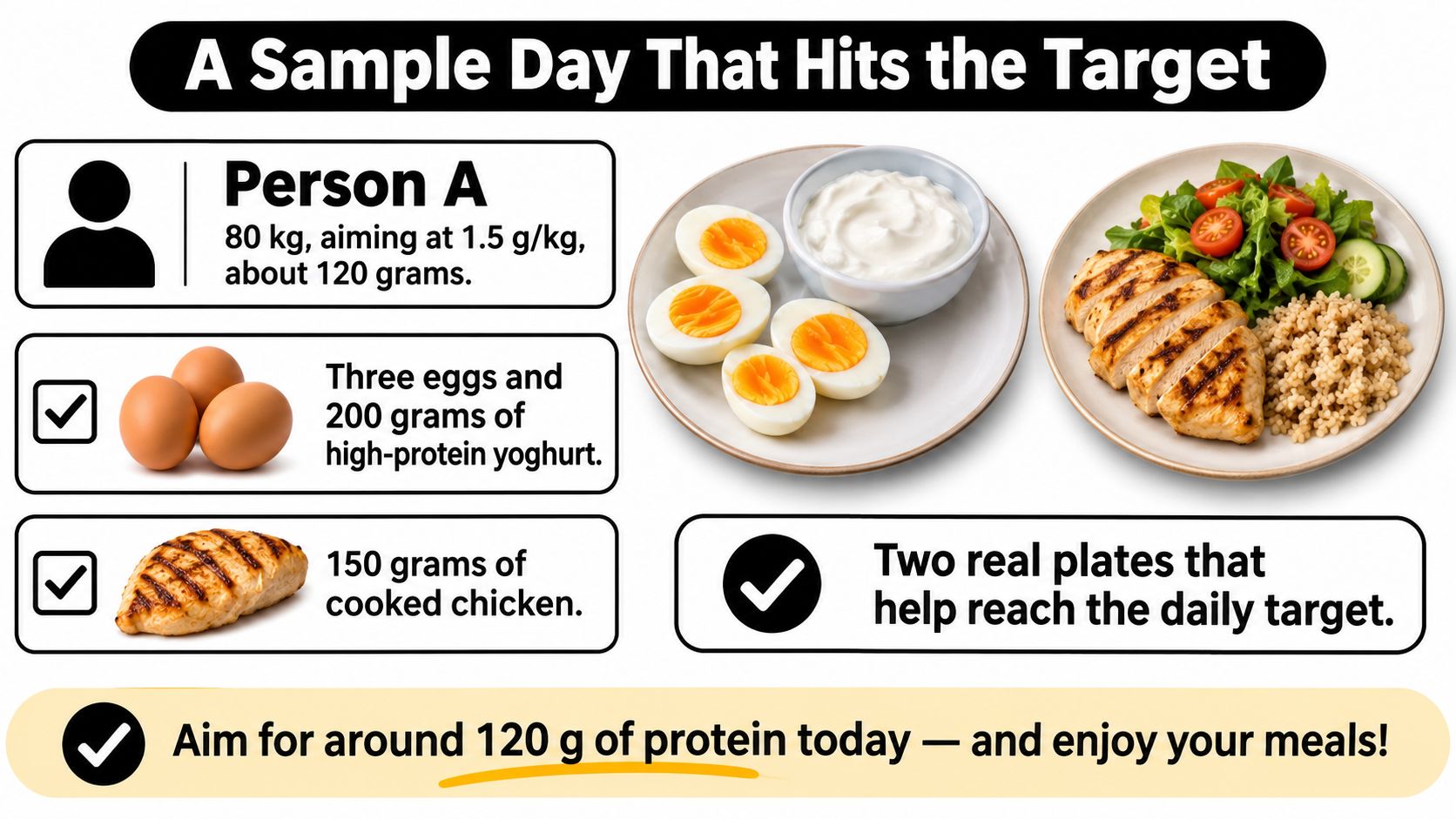
Numbers on paper are easy. Plates are harder, so here's a full day belonging to a real kind of person: 80 kg, lifting four times a week, aiming at 1.5 g/kg, which is about 120 grams.
| Eating time | Example plate | Protein (g) |
|---|---|---|
| Breakfast | Three eggs and 200 g high-protein yoghurt | about 30 |
| Lunch | 150 g cooked chicken with rice and salad | about 40 |
| Afternoon | Glass of milk or small tin of tuna on grainy bread | 15–20 |
| Dinner | 180 g fish with noodles and vegetables | about 40 |
| Day total | Four occasions, about 1.5 g/kg at 80 kg | about 120 |
Nothing on that table is exotic. The day works because breakfast contains substantial protein instead of toast and coffee, and the afternoon slot is included. Many who believe they consume enough protein often miss one occasion, usually the one between lunch and dinner.
Scaling down to 60 kg
A 60 kg reader at 1.4 g/kg needs about 84 grams. The temptation is to delete a meal. Don't. Keep all four occasions and shrink each one: two eggs instead of three, 100 grams of chicken instead of 150, a smaller fillet at dinner. Four smaller slots protect appetite and keep the feeding pattern that the per-meal guidance is built around.
Vegetarian version, same skeleton
Tofu at lunch with rice, Greek yoghurt with fruit at breakfast, soy milk in the afternoon, and a lentil and egg dinner keep the meal count intact. The check is simple: lunch and dinner should each still clear roughly 20 grams. If a meal is mostly vegetables and rice, it probably doesn't.
One practical trap. Cooked weight and raw weight are not the same thing, and a 150 gram chicken breast on a supermarket label usually refers to raw weight, which shrinks to roughly 110–120 grams cooked. Weigh cooked food when you're checking against the table.
Swap rule: trade any food for another of similar protein and the day still works. The structure is doing the heavy lifting, not the specific menu.
Fat Loss and Older Adults
A single muscle-building number does the most damage here, because the training band assumes something that isn't true during a diet: that you're eating enough.
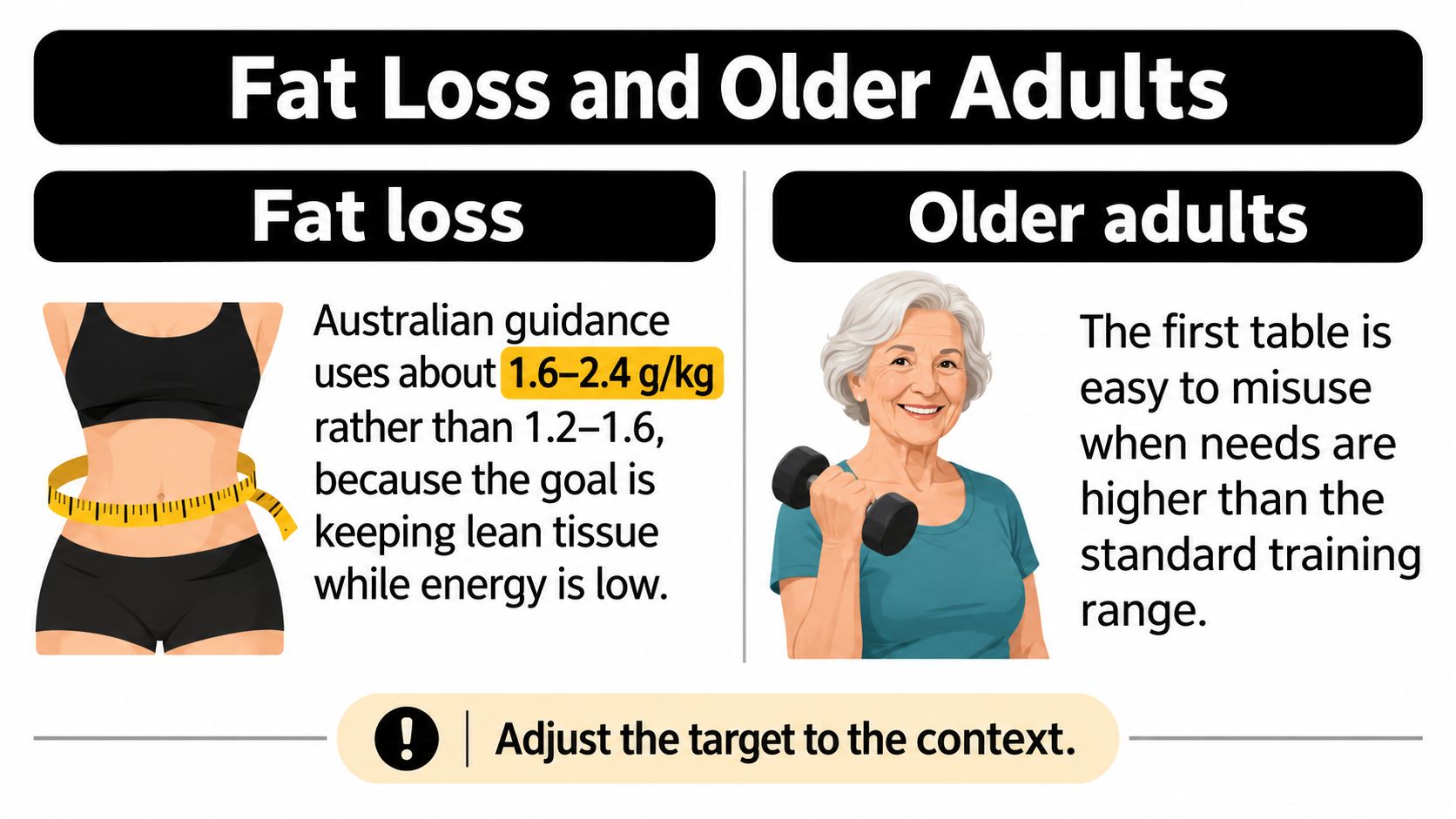
When calories drop, the job changes from adding tissue to defending it. The Australian Institute of Sport's guidance on protein supplements separates the two situations: roughly 1.2–1.6 g/kg/day for athletes in heavy training, and 1.6–2.4 g/kg/day for athletes pursuing weight loss where preserving lean mass is the priority. For a 75 kg person that's 120–180 grams a day during a fat-loss phase.
The higher range isn't automatically superior, and treating it as a permanent upgrade is a common mistake. It's framed specifically for weight-loss contexts, and total energy intake, continued resistance training, food quality and medical considerations still decide what's sensible. A target so high that you can't finish your meals and your training suffers isn't a win.
Decision rule: if calories are down and you're still lifting, use the higher band. If calories are up or steady, use the training band. The band follows the diet, not the ambition.
Scale weight alone can't tell you which tissue you're losing, so the protein change needs to sit next to waist measurement, strength progression and how your clothes fit, not the scale by itself. If you want the longer picture on how lean tissue shifts with age, our guide to muscle mass loss with age covers what changes and when.
Older adults and smaller appetites
For someone over 70, the training band still applies if they're lifting, but the limiting factor is rarely the recommendation. It's how much can be eaten and used.
Small appetite, early fullness and a preference for lighter meals all push against a 30 gram dose in one sitting. The workable version is fewer grams per meal but the same number of meals, built around soft, protein-dense foods: yoghurt, eggs, milk, fish, tofu. Two or three resistance sessions a week decide whether any of it is retained.
Check Muscle Change Then Adjust
Give the target a week to see whether it fits your meals and training, then review your progress over two to four weeks. A single weigh-in can fluctuate, so compare measurements taken under similar conditions and look for patterns.
If strength is rising while weight stays steady, keep your current protein band and meal split. If you're dieting and your lifts or muscle measures are slipping, move towards the higher band from the previous section and review again after two weeks. If weight is rising but strength and measurements are flat, check your overall food intake before adding more protein.
Track your intake on three ordinary days, rather than trying to log every meal indefinitely. Put waist and strength trends beside weight: each helps show a different part of the picture.
Where protein stops helping
Protein supports muscle repair and growth, but it cannot replace the training stimulus. The Better Health Channel's guidance on protein explains that people exercising vigorously or aiming to gain muscle do not necessarily need extra protein. Resistance exercise gives the body the signal to build muscle; protein supplies building material.
For older adults, a practical target also has to fit appetite and meal size. Smaller portions of protein-rich foods such as yoghurt, eggs, milk, fish or tofu can make meals easier to manage. Regular resistance exercise remains part of the plan.
That distinction matters when progress stalls: adding protein alone may not address a lack of progressive resistance training. Check whether your usual exercises are becoming more challenging, and whether everyday movements such as standing from a chair feel manageable.
Venus Health Co.’s AI Body Composition Smart Scale provides weekly AI-driven fat and muscle summaries and nutritional recommendations. The wellness report includes 30-day trend charts for weight, fat percentage and muscle, which can help you compare changes over time. Personalised protein targets are calculated from your body weight.
Use the trends alongside your training and food routine, not as a verdict from one reading. For practical ways to assess progress, see this guide to measuring muscle gain. Then keep your current target or adjust it according to the pattern you see.