

Home Health Devices Explained: A Practical Guide
Dr. Adeyinka AdegbosinYou probably know the feeling. The scale is in the bathroom, your phone is already in your hand, and there's a thermometer in the drawer that only comes out when you're trying to make sense of a cycle, a training block, or a worrying symptom. The tricky part isn't the gadget itself. It's deciding which measurement is worth trusting, and whether it changes anything you do that day.
Australia has already moved a lot of health care out of the clinic and into the home. Between 2020 and 2024, Australian health practitioners issued 219 million electronic prescriptions, while the country recorded 132 million telehealth consultations (Australian Trade and Investment Commission report). That shift matters because a lot of health decisions now start with a reading on a bench, a screen, or an app.
Your Bathroom Is Becoming a Mini Clinic
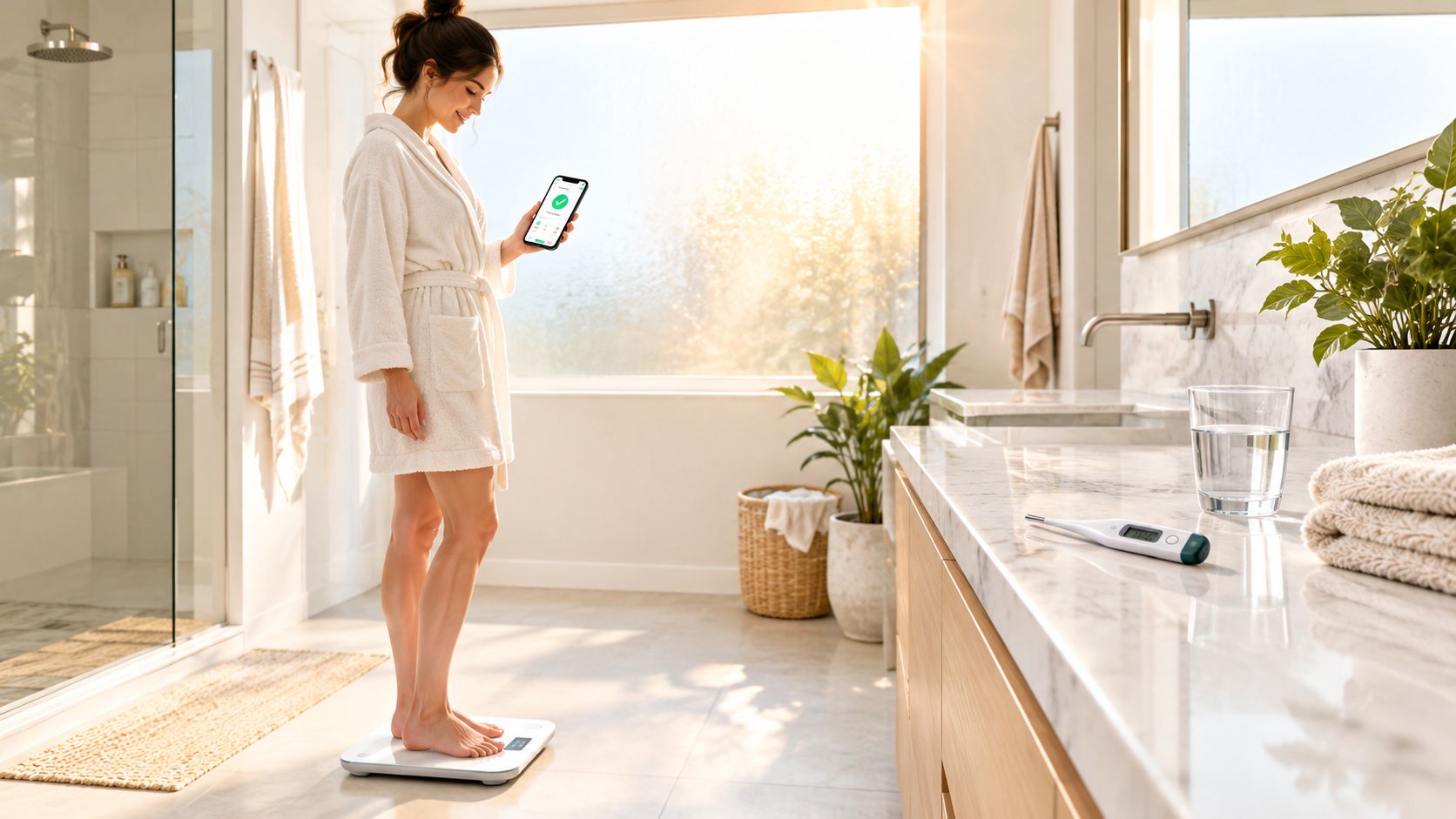
The modern bathroom routine can look a lot like a tiny handover between devices. You step on a smart scale, glance at a phone app, maybe take a basal temperature reading, then check whether the number means anything in the context of last week, last month, or your cycle. That's where home health devices stop being accessories and start becoming part of a measurement routine.
For some people, the goal is fertility tracking. For others, it's keeping an eye on body composition, blood pressure, sleep, or recovery. For seniors and carers, the question can be simpler, whether the device helps spot a change early enough to matter.
Practical rule: a reading only matters if it changes a decision, even a small one.
That's why this guide doesn't treat home health devices like a gadget shelf. It treats them as tools for answering specific questions, such as, “Is my trend changing?”, “Is this measurement reliable?”, and “Can I share it with someone who can help?”
The home setting also raises questions buying guides often skip. What if syncing fails? What if someone can't use an app every day? What if a device looks smart but doesn't produce a trustworthy signal? Those are the problems that decide whether a device earns a permanent place in your home.
If you're comparing smart scales, this practical best smart bathroom scale guide can help you think about what to look for before you buy.
What Counts as a Home Health Device
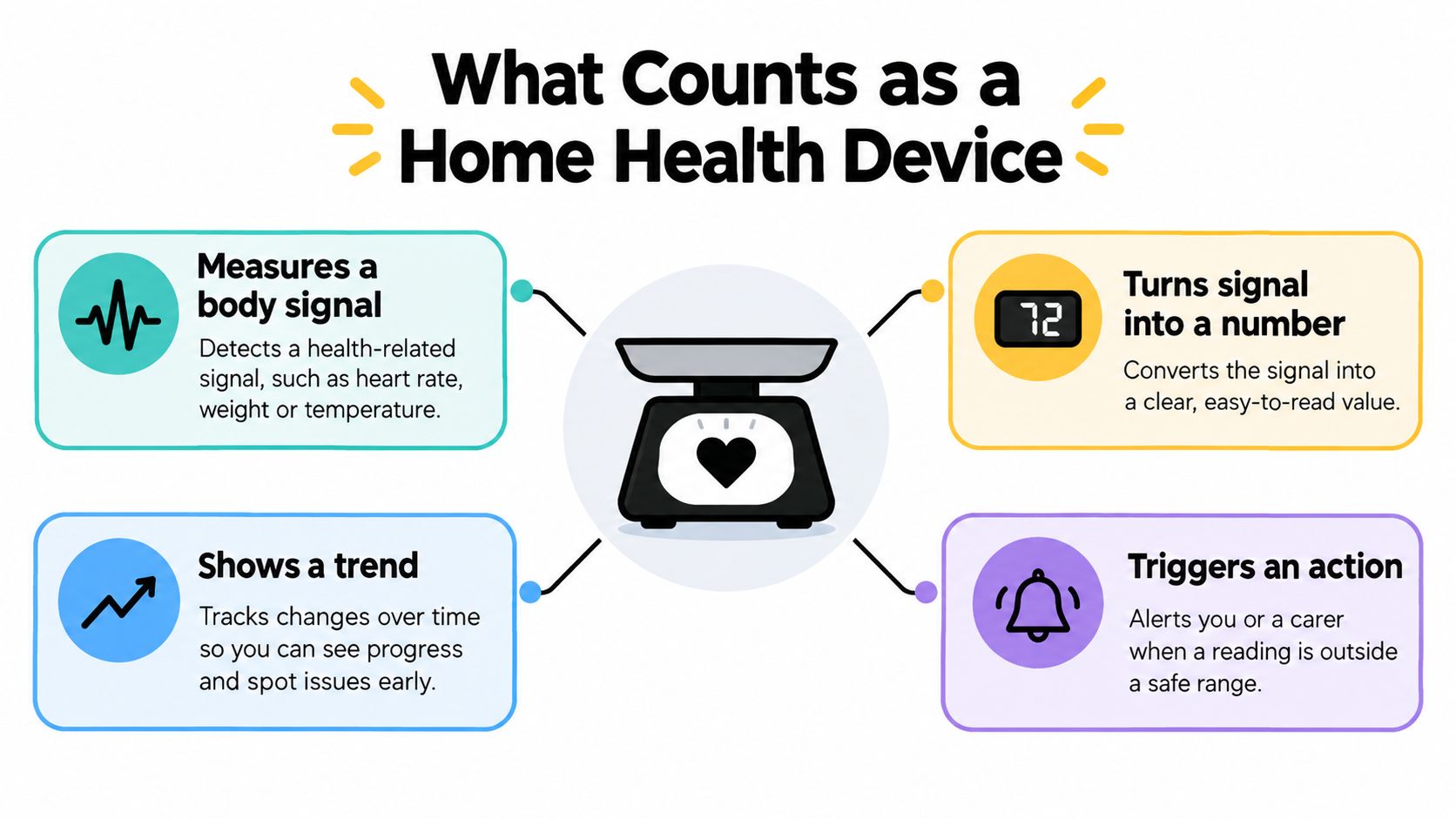
A home health device is anything that measures a body signal at home and turns it into a number, a trend, or an action. That could be a scale, a thermometer, a blood pressure cuff, a fertility test strip, or a wearable. The hardware matters, but the measurement system around it matters just as much.
The kitchen-scale test
Think about a kitchen scale. If it's poorly made, one bowl of flour might look heavier one day and lighter the next. If it's well made, it gives repeatable numbers. But if you don't know what the scale is measuring, how it was calibrated, or whether the result means anything outside that moment, the number still doesn't tell you much.
That's the difference between precision, accuracy, and validation. Precision means the device gives similar readings under similar conditions. Accuracy means the reading is close to the actual value. Validation means the device has been checked against recognised standards, so you're not just trusting a nice-looking screen.
A number on its own is not a health conclusion. A number compared with your own history starts to become useful.
That's why a trend is often more valuable than a single reading. Your own baseline tells you whether today is normal for you. A smart scale, for example, is rarely useful because of one weigh-in. It's useful because it records a pattern. A thermometer matters when it can detect a small but real change. A blood pressure cuff matters when it can do that reliably enough to support a decision.
The clearest way to think about home health devices is this, they're measurement plus interpretation systems. The device captures the signal. The app or display turns it into a number. The trend makes it readable. The clinical value depends on whether the underlying measurement is trustworthy enough to act on.
The Main Categories of Home Health Devices
Different devices answer different questions. That sounds obvious, but people often buy the wrong tool because they start with the feature list instead of the body signal. A smart scale, a thermometer, and a blood pressure monitor can all live in the same house, but they're doing completely different jobs.
Weight, temperature, pressure, and signals
A smart body composition scale measures weight and estimates things like body fat or muscle so you can watch change over time. It's best when you want trend tracking, not a one-off verdict. A basal thermometer is different. It's looking for a small temperature shift, and fertility-awareness guidance notes that basal body temperature typically rises by approximately 0.2 to 0.5°C after ovulation and stays higher until the next period (RACGP fertility-awareness guidance). That's a tiny signal, which is why daily consistency matters more than occasional checking.
An ovulation test strip isn't measuring temperature at all. It's looking for a fertility-related hormonal signal, which is why it can be useful alongside temperature rather than instead of it. An upper-arm blood pressure monitor measures a cardiovascular signal that needs correct cuff placement and, ideally, validation. A wearable tracker usually watches several everyday signals at once, such as heart rate, steps, sleep, or oxygen saturation, which makes it helpful for general pattern spotting rather than diagnosis.
Here's the important part. The device is only as useful as the question it answers.
- For fertility timing: a basal thermometer and ovulation tests help you understand timing across a cycle.
- For weight and body composition: a smart scale helps you watch trends, not obsess over one number.
- For cardiovascular monitoring: a validated upper-arm cuff is the safer choice.
- For everyday wellness: wearables can show broad patterns, but they shouldn't be treated as final clinical answers.
Some products combine these jobs in one app. For households that want that kind of integration, the Venus AI Smart Scale: Body Composition & Body Fat Scale is one example of a connected scale that pairs body-composition tracking with app-based summaries. For chronic-condition monitoring at home, a guide to at-home chronic care can also help families think beyond the device itself and into daily support.
How Devices Connect to Apps and Why It Matters
A standalone device gives you a reading. A connected device tries to turn that reading into something more useful. That usually happens in four layers. First, the sensor captures the signal. Next, Bluetooth or Wi-Fi sends it somewhere. Then the phone app stores and visualises it. After that, cloud services or AI tools may sort the data into trends, summaries, or alerts.
That chain matters because data sitting on the device is easy to ignore. Data that appears in an app, lines up against previous readings, and shows you a change is much more likely to become action.
Why automatic syncing beats manual effort
The clearest evidence for this comes from a CSIRO-led telehealth trial. Over 12 months, the trial enrolled 287 patients across six sites and used video communication, messaging, questionnaires, and connected sensors. Measurements were transferred in near real time for remote review, and the reported outcomes included a 24% reduction in healthcare-system costs, a 53% decrease in hospital admissions, and a 76% reduction in length of stay among admitted patients (CSIRO home monitoring trial). That's a clinical program, not a consumer scale comparison, but the design lesson is clear. Fast transfer into a workflow is what makes the data useful.
For home users, that means automatic syncing usually beats manual logging. If the app can capture the reading without extra effort, the trend is more complete and less fragile. If a weekly summary translates the numbers into plain language, the device becomes easier to live with. If the system only gives you raw readings, you're still doing the interpretation yourself.
Good connected design removes friction. Bad connected design just moves the typing from paper to phone.
That's why AI summaries can be helpful when they're grounded in your own history. They're not magic, and they're not a diagnosis. They're a way of turning a pile of readings into something you can use. Manual spreadsheets can work too, but they demand discipline that most households don't keep forever.
The same logic applies to fertility tools. A connected thermometer can sync basal body temperature automatically, while ovulation tests can be logged manually if needed. That's a useful mix because it gives you both structure and flexibility. If you're comparing app ecosystems, the Venus Health App syncing guide is a practical example of how readings can move into a broader health app without being trapped on the device.
Matching Devices to Real Australian Audiences
Different households need different signals. Athletes don't need the same measurements as people trying to conceive, and seniors don't need the same interface as busy parents juggling three schedules. A good purchase starts with the question, “What am I trying to learn from this body signal?”
What fits each goal
| Reader goal | Best-fit device | Primary signal to track |
|---|---|---|
| Athletes and fitness enthusiasts | Smart body composition scale | Weight and body-composition trend |
| Trying to conceive | Basal thermometer plus ovulation test kit | Temperature shift and fertile-window signal |
| Seniors and older adults | Validated upper-arm blood pressure monitor, plus a simple scale | Blood pressure and weight trend |
| Busy parents and general wellness users | Integrated app-connected ecosystem | Weight, temperature, and cycle data in one place |
Athletes usually care less about a single weigh-in than about whether weight, muscle, and recovery are moving in the right direction. That's where a body-composition scale earns its place. People trying to conceive usually need two kinds of information, the hormonal signal from ovulation testing and the temperature pattern that appears after ovulation. Seniors often need the simplest possible reading path, especially if the goal is to keep tabs on pressure or weight without juggling complicated screens. Busy parents tend to do best when the app holds everything together in one place, because fragmentation is where the tracking habit dies.
A household can also mix goals. One person may care about fertility tracking, another about body composition, and another about blood pressure. In that case, the device ecosystem matters more than any one gadget. The question isn't just “Which device is accurate?” It's also “Can the whole family use it?”
The Quiet Problem of Digital Exclusion
Connected health sounds convenient until the app becomes the barrier. Australian evidence shows that 20.6% of Australians were either digitally excluded or highly digitally excluded, with particularly sharp disadvantages for Aboriginal and Torres Strait Islander peoples, people in rural and remote areas, and people with disability (Australian Digital Inclusion Index reference). That doesn't mean connected devices are a bad idea. It means connectivity is not the same thing as usability.
A device can look modern and still fail in a real home. If it needs a recent smartphone, steady internet, Bluetooth pairing, English-language graph literacy, or confidence with account settings, it can become harder to use than a plain tool with a clear display. Cost, maintenance, repairs, internet access, bandwidth, and digital literacy are all practical barriers, not edge cases.
Questions worth asking before you buy
- Does it still work without the app? A device should still give a usable reading when the phone isn't nearby.
- Can readings be entered manually? That matters when syncing fails or when a carer is helping.
- Is the display readable? Large text, clear contrast, and simple menus help more than extra features.
- Can someone assist without taking over the account? Shared care should be possible without confusion.
- Is there a fallback for offline use? A non-digital path is often the difference between a tool that gets used and one that sits in a drawer.
Here is where “connected” and “usable” diverge. A device that does less but works for more people is often the better choice. That's especially true in households where different generations need the same data in different ways.
Who Owns Your Home Health Data
The path from device to app to user to clinician sounds straightforward, but each step raises a different question. The device collects the reading. The app stores it. The cloud may process it. The user decides what to keep. A clinician may later need only part of it, not the whole stream.
That data path matters because a consumer reading is not the same as a clinical result. The clearest example is blood pressure. A survey of 972 blood-pressure-monitor models available online in Australia found that only about 6 to 7% had been validated against recognised accuracy protocols, and none of the wrist-based models had been validated (UTAS blood pressure monitor survey). If the hardware isn't validated, the trend may still look neat while the underlying signal is unreliable.
Three things to know before sharing data
The first is consent. Know what the app collects, who can see it, and what happens if you delete the account. The second is minimum necessary sharing. If a clinician only needs the last two weeks of readings, don't send the whole history unless they ask for it. The third is scope. A trend on your phone isn't automatically medical advice.
Australian reforms in 2025 allow consumers and providers to attach Healthcare Identifiers to health-related information and let compliant technology providers use those identifiers for mobile apps, wearables, and in-home monitoring equipment. Those reforms don't erase privacy obligations, which still sit under the Privacy Act and My Health Records Act. In plain language, that means connectivity can help data move safely, but it doesn't make every reading public or every recommendation clinical.
If you want a straightforward family-facing explanation of account access, deletion, and sharing, the Venus privacy and data security guide is a useful companion read. The key question is simple. Can you explain, in one sentence, how your data moves from the device to the person who needs it?
If a home trend keeps repeating or looks clearly different from your usual pattern, bring it to a professional conversation rather than trying to self-diagnose from the graph alone.
A Simple Checklist for Choosing Your First Home Health Device
Start with the question, not the catalogue. If your main concern is fertility timing, get the tool that captures the relevant signal. If it's body composition, get the scale that produces repeatable trends. If it's blood pressure, choose the validated cuff first and the app second.
Use four filters
- Measurement quality. Ask what the device measures, how often, and whether that signal is strong enough to matter.
- App usability. Check whether the app helps you see trends, export data, and understand what changed.
- Validation and relevance. Prefer devices with independent validation when the reading affects a health decision.
- Support and trust. Warranty, return terms, shipping, and subscription rules matter more than most buyers think.
If you're helping a household member, a practical resource like the Caregiver schedule app guide can be helpful because device use often sits inside a bigger routine of reminders, care tasks, and shared responsibility. That's especially true when one person tracks data and another person acts on it.
For people who want a single ecosystem rather than separate tools, Venus Health Co. offers a body-composition scale, a basal body thermometer, and an ovulation test kit that all work with the same app. The useful part isn't the brand story, it's the way the data stays together instead of scattering across three places. Venus also supports no-subscription app access, a 30-day money-back guarantee, a 3-year warranty, and shipping options for different households that want a lower-friction setup.
The right device won't make you healthier on its own. It will make your next decision clearer. If you're ready to choose a tool that matches your actual goal, visit Venus Health Co. and start with the measurement you'll realistically use.