

Fertility Awareness Method Australia Explained
Dr. Adeyinka AdegbosinYou wake before your alarm, reach for your phone, and wonder whether today is a fertile day. The app predicts one answer, your body seems to suggest another, and a late night makes you question whether yesterday's temperature means anything at all. That uncertainty is common, especially when cycle tracking has been reduced to period dates and calendar estimates.
The fertility awareness method in Australia is better understood as a cycle-literacy skill. It can support people who are trying to conceive, help some people avoid pregnancy when they follow a recognised method carefully, and teach anyone with menstrual cycles to notice patterns in cervical mucus, basal body temperature, ovulation tests and symptoms. It isn't a magic calendar, and an app prediction alone doesn't confirm ovulation.
Introduction to Fertility Awareness in Australia
Fertility awareness begins with reading cycle signs and using that information for a chosen purpose. If avoiding pregnancy, a person may change sexual behaviour during days when pregnancy is possible. Australian health guidance covers symptothermal tracking, cervical mucus observation, ovulation testing, periodic abstinence and rhythm methods, while noting that predictions become less dependable when cycle patterns vary (healthdirect's Australian overview).
The same observations can support different decisions. Someone trying to conceive may use fertile signs to time intercourse. Someone avoiding pregnancy may avoid unprotected sex during potentially fertile days or choose another contraceptive option. Someone else may record patterns to understand their body. The signs overlap, but misreading them has different consequences depending on the goal.
Australia also has a long history of organised fertility-awareness education. Teaching began in marriage guidance clinics in Melbourne, Brisbane and Sydney in the late 1950s. By 1970, each Australian archdiocese had an organised natural family planning body, and an Australian Council of Natural Family Planning formed in July 1975 to coordinate 75 Australian centres (historical Australian fertility-awareness documentation).
The useful mindset: treat your cycle as information to interpret, not a date to guess.
Understanding remains uneven. An Australian discussion reported that 4.3% of respondents used fertility awareness as contraception, 37.1% were actively trying to improve their knowledge, and only 2.1% of the overall sample correctly identified the fertile period (Royal Australian College of General Practitioners summary). Those findings support learning the biology behind BBT, LH tests and app predictions rather than treating a calendar estimate as a decision.
For people preparing for pregnancy, cycle observations can sit alongside wider health preparation, including preconception nutrition from Feed Mom & Me. The sections ahead connect cycle literacy with practical tracking and Australian healthcare choices.
How Your Cycle and Fertile Window Really Work
You open your cycle-tracking app and see a predicted fertile day. Treat that date as a prompt, not a verdict. Your body provides changing signs that help you understand when fertility may be approaching, when ovulation may occur, and when it has probably passed. The route can vary from cycle to cycle.
The menstrual phase begins with bleeding. During the follicular phase, an ovarian follicle develops and oestrogen rises. Hormonal signals then include a surge in luteinising hormone, or LH, which triggers the release of an egg at ovulation. During the luteal phase, progesterone rises after ovulation and usually causes a measurable increase in basal body temperature.
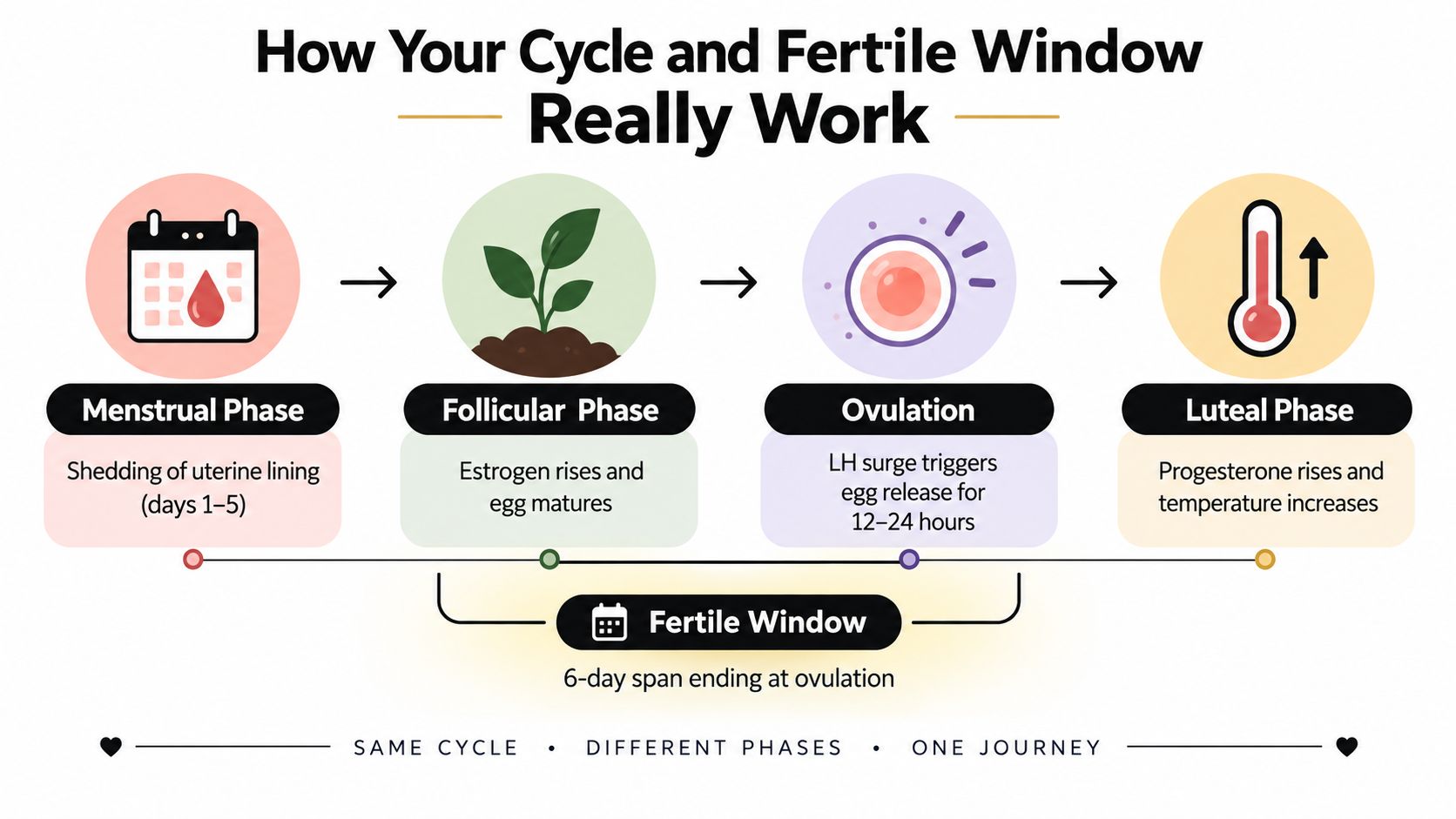
Why the fertile window moves
A calendar counts from the first day of bleeding, but it cannot observe the hormonal changes inside your body. Ovulation does not always happen on the same cycle day, so an app prediction works best as a reminder to check your signs. It cannot prove that fertility has begun or ended.
The fertile window spans several days because sperm can remain capable of fertilisation for several days in favourable conditions, while the egg remains available for a much shorter time after ovulation. Fertile cervical mucus can therefore appear before ovulation, rather than only on the day the egg is released.
Cervical mucus acts as an early signpost. As oestrogen rises, it may become wetter, clearer, slipperier or more stretchy. Many people notice a more lubricated sensation. Appearance varies between people and across cycles, so record your own pattern instead of trying to match an online image.
What each signal can and can't tell you
An LH test detects the surge that usually comes before ovulation. It offers a useful near-term signal, especially when trying to conceive, but a positive result does not prove that ovulation occurred.
BBT records a later part of the story. Australian guidance recommends taking your temperature immediately after waking, before activity, and at the same time each day where possible. The progesterone-related rise generally occurs after ovulation, so a sustained shift can help confirm that ovulation has already passed (HealthyWA guidance on fertility awareness).
Remember: mucus may show that fertility is approaching, LH may suggest ovulation is near, and BBT can help confirm the pattern afterwards.
Using these signs together gives a clearer picture than relying on a calendar prediction alone. It works like checking the sky, wind and temperature before deciding whether beach conditions are changing. One clue can mislead. Several consistent clues are easier to interpret, and they turn app-connected tracking into cycle literacy rather than date guessing.
Accuracy Effectiveness and What Affects Results
A fertility app may highlight a fertile day while your body is following a different timetable. That gap explains why fertility awareness effectiveness depends on more than the method's name. It also depends on the signs you observe, the rules you follow and the decisions you make when the chart is unclear. Australian patient information describes a broad range, from about 75% to 99% effective, depending on the method and whether it is used correctly (Australian patient information summarised by the RACGP).
Western Australian guidance also reports a wide range, from 76% to 99.5%, and cautions that fertility awareness methods may be less effective than many other contraceptive options, including with correct use (HealthyWA effectiveness guidance). These figures describe different methods, levels of instruction and everyday behaviour. Someone recording several signs and applying clear rules is working with more information than someone relying on a predicted fertile day or guessing when fertility has ended.
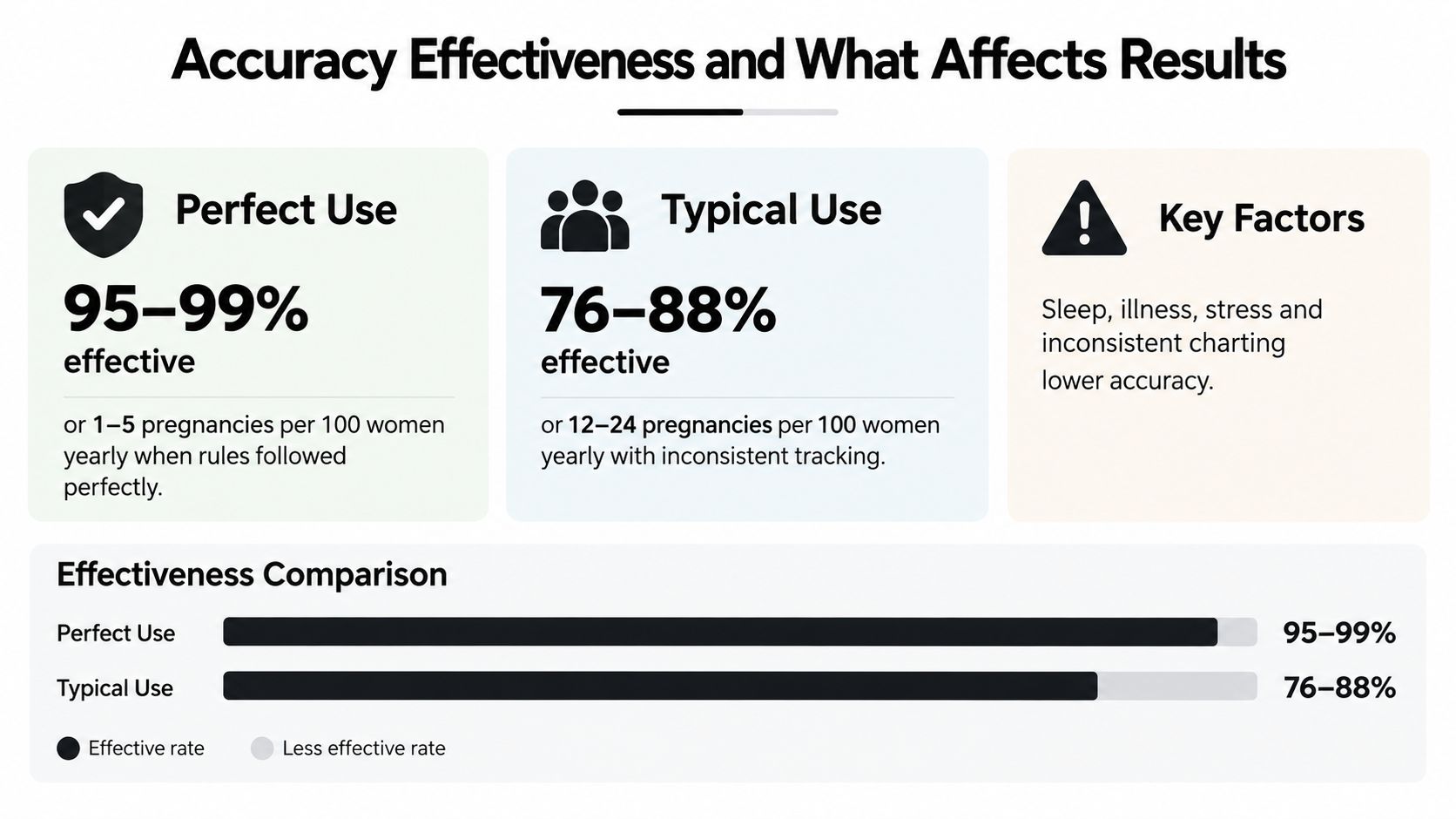
The difference between knowledge and execution
Training matters. You need to recognise your own mucus pattern, record possible disturbances and understand the rules of the approach you use. An app forecast can organise entries, but accepting its prediction is not the same as understanding the biology behind it.
Consistency matters too. A missed temperature leaves a gap. Illness, broken sleep, stress, travel and alcohol can make a reading harder to interpret. Mark the disturbance rather than treating that result as decisive. The rest of the chart may still provide useful context.
Cycle variation changes the practical challenge. A calendar or temperature-based approach becomes harder to interpret when ovulation timing shifts. Australian guidance notes that temperature and cycle-timing methods are not suitable for irregular cycles because changing patterns reduce prediction reliability (healthdirect's Australian guidance).
For contraception, consider how much uncertainty you can safely manage. If avoiding pregnancy is a high priority and you cannot reliably avoid unprotected sex on uncertain days, another contraceptive strategy may suit you better. For conception or cycle education, the same observations can still help you understand your body, even when they cannot provide a precise answer every day.
LH testing adds another data point, not a final verdict. Learn how test timing and interpretation fit into a wider tracking plan with this Australian guide to using ovulation tests. Used well, connected tools turn daily records into cycle literacy. They help organise evidence, while your understanding determines how cautiously you interpret it.
Comparing the Main Fertility Awareness Approaches
Each fertility-awareness approach watches a different clue. The choice isn't about which method sounds most natural. It's about whether the signal fits your cycle, your schedule and your reason for tracking.
| Method | Signals tracked | Best for | Limitation to know |
|---|---|---|---|
| Symptothermal | Cervical mucus, BBT and other cycle signs | People who want several cross-checks | Requires regular observation, recording and method-specific rules |
| Cervical mucus | Sensation and appearance of mucus | People comfortable noticing daily changes | Interpretation is personal and can be affected by vaginal products, infection or confusing discharge |
| Basal body temperature | Resting temperature after waking | Confirming that ovulation has likely passed | It's retrospective, and sleep disruption or illness can affect readings |
| Rhythm or calendar | Previous cycle dates and calculated patterns | People with very predictable cycles who understand its limits | Less reliable when cycle length or ovulation varies |
Symptothermal tracking
Symptothermal tracking combines observations, usually cervical mucus and BBT, rather than asking one sign to answer every question. Mucus may show that the body is moving towards ovulation, while a sustained temperature rise can support confirmation afterwards. This combination takes more attention, but it also reduces dependence on a single uncertain clue.
Mucus-only observation
A mucus approach can be practical for someone who notices body sensations easily and doesn't want a morning temperature routine. It still requires learning, because “wet” can mean different things to different people and discharge can have causes unrelated to ovulation. A new odour, itching, pain or unusual discharge deserves clinical attention rather than being treated as a fertility sign.
BBT-focused tracking
BBT is appealing because it turns a subtle hormonal effect into a graph. The limitation is timing. A temperature rise usually confirms that ovulation has already happened, so it won't give you an advance warning on its own. It works more effectively as part of a pattern, especially when paired with mucus or LH results.
If you use other home measurements, keep their purpose separate. A body-composition device such as the Venus AI Smart Scale is designed for weekly body tracking and reports measurements through its app, but it isn't a fertility monitor and shouldn't be used to identify ovulation.
Rhythm methods
Calendar rhythm is the simplest to describe and the easiest to overtrust. It assumes future cycles will resemble previous ones, but biology doesn't promise that. Australian guidance explicitly warns that cycle variability weakens prediction, which is why a calendar alone is a poor fit for irregular cycles.
Decision rule: choose the approach you can perform consistently, then check whether it matches your cycle pattern and pregnancy goal.
Step by Step Tracking With BBT LH Tests and Apps
A useful routine starts before you open an app. It starts with collecting signals in a consistent order, then recording what happened without asking the software to make a decision for you.
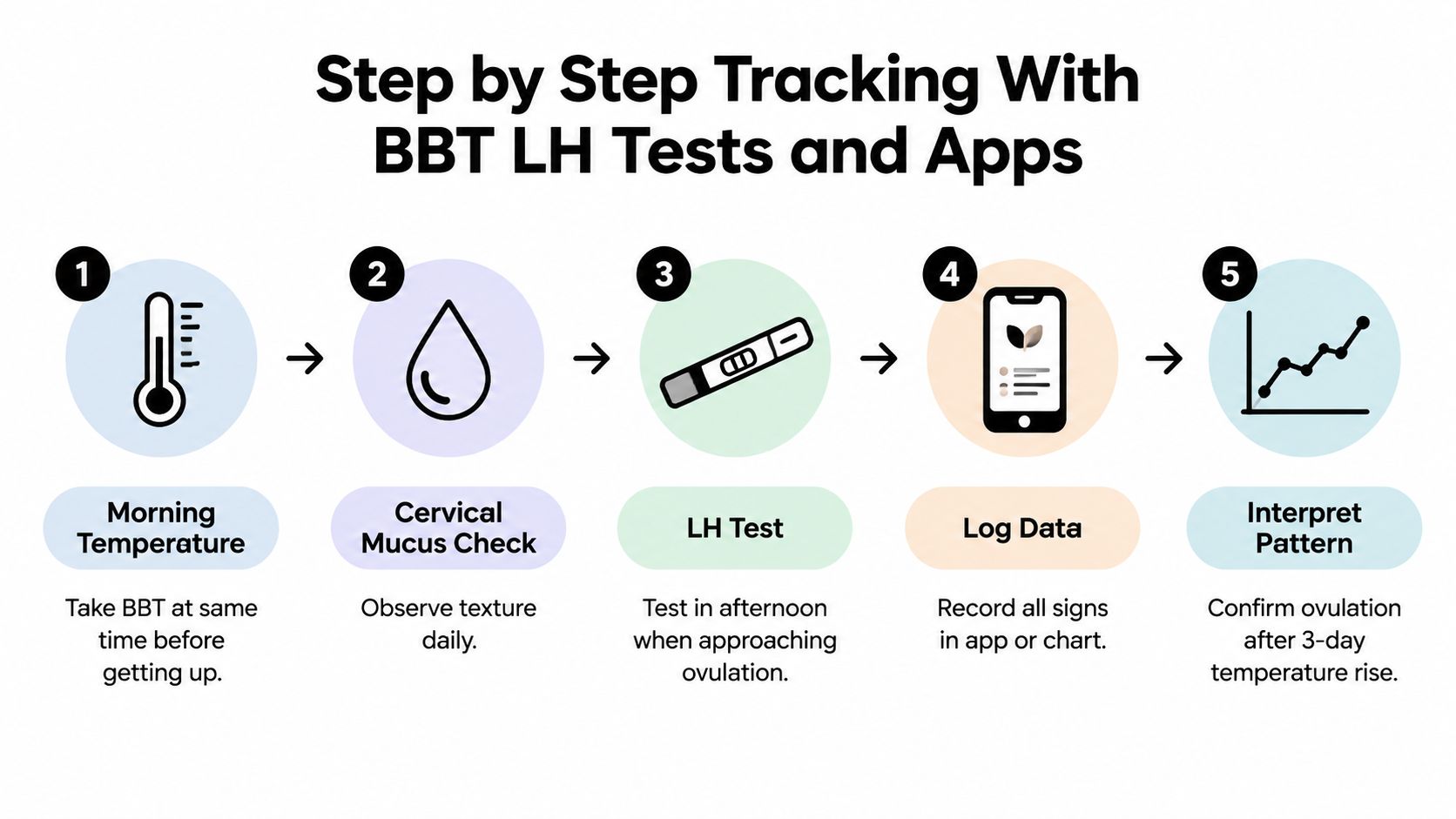
Build the morning habit
- Take BBT before getting up. Keep the thermometer within reach and measure immediately after waking, before walking, drinking, talking or checking messages. Aim for the same time each morning, and record unusual sleep, illness or a later-than-usual measurement.
- Check cervical mucus during the day. Notice sensation first, then appearance. Record the most fertile-quality observation you see according to the method you're learning, rather than trying to analyse every bathroom visit.
- Use LH tests as ovulation approaches. Start according to your usual cycle pattern and the instructions for your test. Testing too early can use supplies without adding much information, while starting too late can miss a brief surge. A positive result is a signal to interpret alongside mucus and later BBT, not a guarantee that ovulation has occurred.
- Log the data immediately. Add temperature, mucus, LH result, bleeding, sleep and relevant symptoms to one chart or app. Manual entry can work, but Bluetooth syncing can reduce forgotten readings and transcription errors. The Venus Smart Basal Thermometer for Ovulation, Bluetooth BBT Tracker with App is one available device that records basal temperature and syncs it to a phone app; use any tool only if its routine suits you.
- Interpret the pattern after several observations. Look for the relationship between the pre-ovulatory signs and the later temperature shift. Don't label a single high reading as confirmation, especially after restless sleep, fever, travel or another disturbance.
A simple day might look like this: temperature on waking, mucus observation during the day, LH testing when your expected fertile signs begin, and a short evening note in your chart. After enough cycles, you'll have a personal record that is more informative than a generic calendar estimate.
Travel and broken sleep don't make tracking impossible, but they do require honesty in the chart. Mark the disturbance, avoid overinterpreting that temperature, and rely more heavily on the other available signs until the pattern becomes clearer.
For people who prefer app-connected routines, app-based fertility tracking guidance can help you think through how digital tools fit into your habits rather than replacing them.
The app should display the pattern clearly, but you still need to understand the meaning of each input. A prediction is not the same as a measurement, and a measurement is not always proof. That distinction protects you from false confidence.
Fertility Awareness in the Australian Healthcare Context
A cycle chart can become useful in an Australian clinic when it shows more than a predicted fertile window. It records signs you can discuss with a GP or fertility educator, connecting everyday tracking habits with questions about ovulation, contraception and reproductive health.
Fertility awareness has a longer Australian history than app-based tracking. Organised teaching developed through marriage guidance clinics in Melbourne, Brisbane and Sydney in the late 1950s, followed by national coordination through the Australian Council of Natural Family Planning in 1975. Australian clinical discussions describe the approach as identifying fertile days through signs such as cervical mucus and body temperature, so the skill is cycle literacy rather than calendar guessing.
That context supports a practical view of FAM. It is a structured way to observe biological signs, not a universal replacement for contraception. Its usefulness depends on the method you choose, the quality of your observations and your wider health situation. Apps can organise those observations, while Australian healthcare professionals can help explain patterns that remain unclear.
When clinical input helps
Speak with a GP or qualified fertility educator if your cycles are irregular, you have symptoms associated with PCOS, you are postpartum, you are approaching perimenopause, or your charts repeatedly lack a clear pattern. Tracking can still provide useful information in these situations, but interpretation may need more context than an app can supply.
A consultation also makes sense if you are trying to conceive and have concerns about your cycle, ovulation or fertility. Australian clinical discussion has highlighted that difficulty conceiving affects many couples and that assisted reproductive technology forms part of some families' paths to pregnancy. Careful observations can therefore support, rather than replace, medical care.
Take your chart, LH results, bleeding notes and contraception questions to the appointment. A clinician can help distinguish a recording issue from a possible cycle-health concern and discuss options that fit your priorities. Before the visit, you can review this Australian-focused guide to natural family planning in Australia.
Putting It All Together for Confident Cycle Tracking
FAM works best when you treat it as a learnable skill. You're not trying to predict your body perfectly from a calendar. You're building a record of signals, learning what changes before ovulation, recognising what confirms the event afterwards, and adjusting your confidence when sleep, illness or irregular cycles complicate the picture.
A sensible starting checklist is short:
- Choose your goal: Decide whether you're tracking to conceive, avoid pregnancy or understand your cycle.
- Choose a method: Symptothermal tracking offers more than one biological signal, while a calendar-only approach depends heavily on predictable cycles.
- Create a routine: Measure BBT before activity, observe mucus and record LH results consistently.
- Mark disturbances: Note illness, poor sleep, travel and other factors that may affect interpretation.
- Set a safety boundary: If pregnancy prevention is important and your fertile status is uncertain, don't treat an app forecast as confirmation.
- Ask for help: A GP or trained educator can support you when patterns are confusing or your cycle changes.
An app or Bluetooth thermometer can reduce the friction of recording, but the technology shouldn't become the method. Your observations remain the foundation. Over time, better records can give you a clearer understanding of your own cycle and better questions to take to an Australian healthcare professional.
Start with one complete cycle, record and stay patient with the learning curve. If you're ready for app-connected BBT and fertility tracking tools, visit Venus Health Co. to explore options that combine basal-temperature tracking with digital cycle records. Use the technology to make consistent observation easier, while keeping clinical advice at the centre of decisions about contraception and fertility.