

Natural Family Planning Australia: A Complete Guide
Dr. Adeyinka AdegbosinYou're in your late twenties, sitting on the edge of the bed in a Brisbane, Perth or Melbourne flat, scrolling through contraception options after another month of unpleasant hormonal side effects. You want to understand your cycle, avoid pregnancy for now, and keep the option of trying to conceive later, but the online advice seems to swing between overly confident app predictions and vague references to “natural” methods.
Natural family planning in Australia can offer a non-hormonal way to observe fertility signs and make decisions about avoiding pregnancy or trying to conceive. It isn't guesswork when it's taught and applied carefully, but it does demand daily attention, accurate interpretation and cooperation between partners. Australian reporting found that natural contraception use had become more visible, with about 15% of sexually active Australians using natural methods in 2017, compared with 7% in earlier studies. The same Australian report on natural contraception use also highlighted the trade-off: natural methods were quoted at roughly 75–80% effectiveness, compared with about 99% for IUDs and implants.
This guide separates perfect-use claims from typical-use realities. It explains the calendar, Billings, basal body temperature and symptothermal approaches, then looks at apps, connected devices, daily tracking and situations where a GP or fertility clinician can help. If you're comparing cycle science with hormone-free contraception, this visual guide to menstrual cycle hormones can help you see how changing hormones relate to the signs you're recording.
Understanding Natural Family Planning in Australia
Natural family planning, or NFP, is a broad term for using observations of the menstrual cycle to identify when pregnancy is more or less likely. Fertility awareness-based methods, often shortened to FAM, may use cervical mucus, basal body temperature, cervical changes and cycle history. People can then choose whether to have unprotected sex, use condoms or avoid vaginal sex during the fertile window, depending on whether they're trying to conceive or avoid pregnancy.
The key difference between modern fertility awareness and the old rhythm method is the information used. The rhythm method relies mainly on previous cycle lengths and assumes future cycles will follow a similar pattern. Modern methods use current bodily signs as well, which matters because ovulation can shift with stress, illness, disrupted sleep, breastfeeding and changes around menopause.
The practical distinction: NFP doesn't predict fertility from a calendar alone. It observes signs that change as your body moves towards and away from ovulation.
Australian clinical guidance describes fertility awareness methods as generally ranging from about 75% to 99% effective when used correctly and consistently, depending on the method and the person's ability to follow its rules. The Australian fertility awareness guidance also describes calendar-based calculations using at least three recorded cycles, with the fertile window estimated by subtracting 21 days from the shortest cycle and 10 days from the longest cycle.
Why the Australian setting matters
NFP sits within a much larger shift in reproductive planning. The oral contraceptive pill arrived in Australia in 1961, and wider contraceptive access helped women plan and adjust when they had children. Australia's total fertility rate later fell to 1.58 in 2020 and 1.481 births per woman in 2024, both below the replacement level of about 2.1, according to the NHMRC fertility case study.
Those figures don't prove that NFP causes or reflects any single fertility trend. They show that cycle planning now takes place alongside contraception, fertility treatment, delayed childbearing and a growing interest in non-hormonal choices. For one person, fertility awareness may be a way to avoid pregnancy. For another, it may be a way to recognise fertile days while trying to conceive.
The method is best approached as a learned health practice, not a quick app download. You'll need to understand what each sign means, record it consistently and agree with your partner about what you'll do during potentially fertile days. If avoiding pregnancy is especially important, discuss alternatives with an Australian GP, sexual health nurse or trained fertility awareness educator before relying on NFP as your only contraceptive method.
How Each Fertility Awareness Method Works
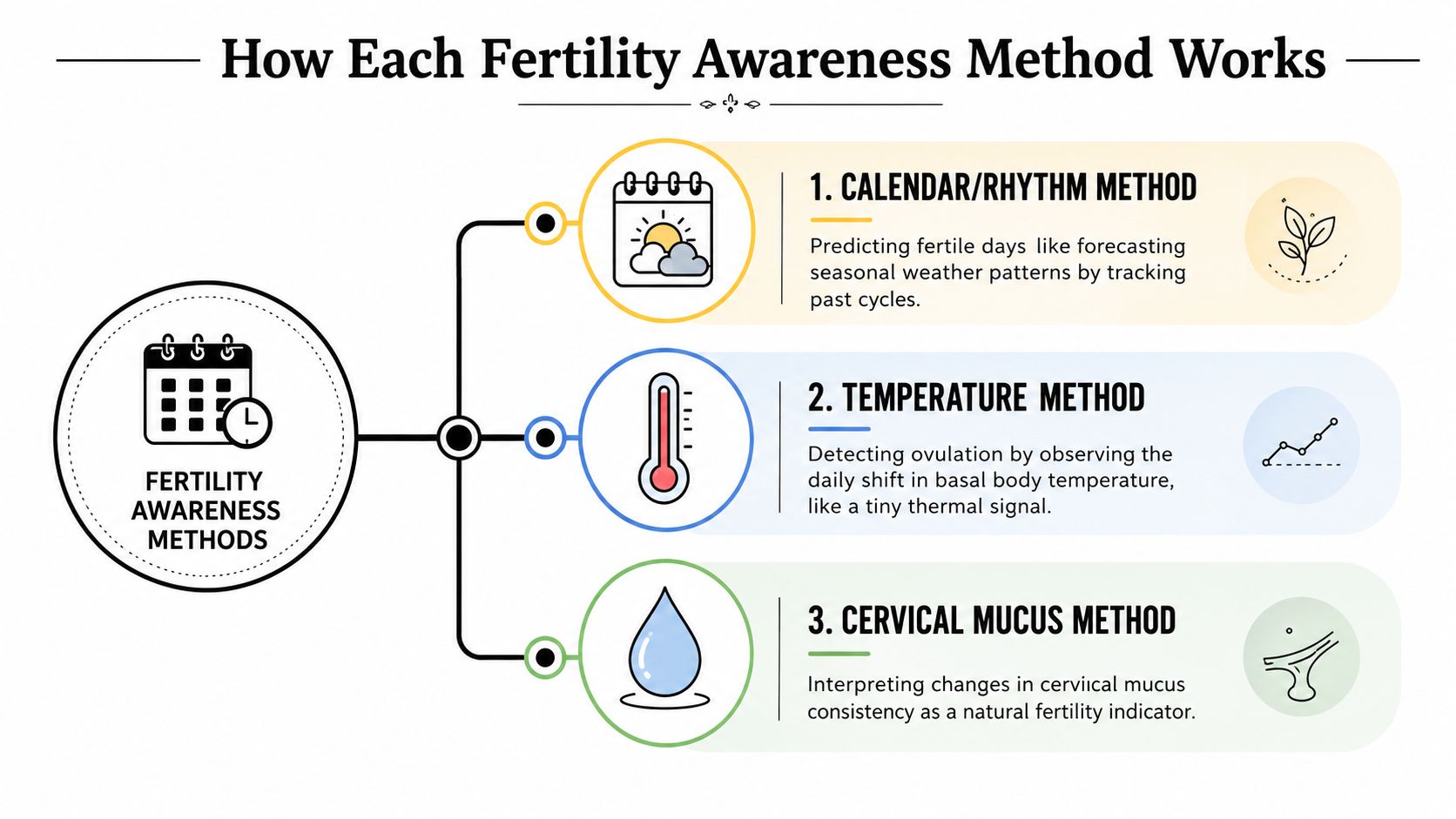
Each fertility awareness method reads a different part of the cycle. The calendar looks backwards at patterns, basal body temperature confirms a hormonal shift after ovulation, and cervical mucus can provide information before ovulation occurs. Combining signs gives you more context than relying on one measurement.
Calendar or rhythm tracking
The calendar method is like checking historical weather data before planning a camping trip. If past cycles have followed a pattern, the record may help estimate when ovulation could occur. But a weather forecast based only on last summer's temperatures can't account for today's conditions, and a calendar can't see a late ovulation caused by illness, stress or a changing routine.
Australian guidance recommends recording at least three cycles before applying the calendar rhythm calculation. You identify the shortest and longest recorded cycles, then estimate the beginning and end of the potentially fertile window using the calculation described in Australian clinical information on fertility awareness methods. This approach is easy to start, but it's vulnerable to irregular cycles and should not be treated as a precise ovulation detector.
Basal body temperature
Basal body temperature, or BBT, is your resting temperature measured immediately after waking. After ovulation, progesterone usually produces a small temperature rise. Think of a thermostat clicking upwards after a heater starts. The temperature shift tells you that ovulation has probably already happened, rather than giving a guaranteed advance warning.
For useful readings, take your temperature before getting out of bed, at a consistent time and using the same body site. The Australian BBT practice guide says the measurement should be taken immediately on waking, before movement, and under consistent conditions.
Illness, poor sleep, alcohol, travel and night work can make a reading harder to interpret. Under a symptothermal approach, the fertile period is considered to end only after three consecutive higher-temperature readings, so one isolated high temperature doesn't confirm the shift.
A Bluetooth device such as the Venus Smart Basal Thermometer for Ovulation, Bluetooth BBT Tracker with App can record morning BBT and sync readings to an app. It may reduce manual entry, but it doesn't remove the need to measure under suitable conditions or understand disrupted readings.
Cervical mucus and the Billings approach
Cervical mucus changes as oestrogen rises before ovulation. Many people notice a progression from little or no noticeable mucus, to thicker or creamier secretions, then to mucus that feels wetter, clearer, more slippery or stretchy. That fertile-quality mucus helps create an environment where sperm can move more easily.
The Billings Ovulation Method focuses on the sensation and appearance of mucus throughout the day. You might notice the difference when walking, wiping after using the toilet or changing underwear. Record what you observe rather than trying to force a label that doesn't fit.
Arousal fluid, semen, vaginal infections and some lubricants can look or feel similar to fertile mucus. Training helps you separate these observations. If discharge has an unusual odour, causes itching or comes with pain, seek medical advice rather than treating it as a fertility sign.
The symptothermal method
The symptothermal method combines BBT with cervical mucus and sometimes other observations, such as cervical position or cycle history. It works like a navigator using two compasses. If the mucus pattern suggests that fertility is approaching and the temperature later confirms a post-ovulation shift, the combined picture is more informative than either sign alone.
This approach still depends on consistent recording and correct rules. It doesn't turn an unpredictable cycle into a predictable one, and it can be difficult during rotating shifts, illness or major time-zone changes.
Lactational amenorrhoea after birth
Lactational amenorrhoea, or LAM, is a specific postpartum method based on breastfeeding's temporary effect on ovulation. It requires all three conditions described by healthdirect's LAM guidance: the baby is under six months old, periods haven't returned, and breastfeeding is full or almost full. If any condition changes, speak with a GP, midwife or maternal child health nurse about another option.
Accuracy and Limitations You Should Know
A couple charts the cycle carefully, follows the rules and avoids unprotected sex during fertile days. Another misses several temperatures, misreads discharge or relies on an app's prediction. Both may be using the same method, yet their real-world results can differ sharply. That difference is the gap between perfect use and typical use.
Perfect use assumes accurate observations, correct interpretation and consistent behaviour each cycle. Typical use includes illness, disrupted sleep, uncertain mucus patterns, unexpected ovulation, relationship pressures and ordinary human inconsistency. The method provides information, not control over every biological change.
Australian consumer guidance reports a broad effectiveness range. Healthdirect's fertility awareness information explains that some methods may be over 99% effective, while others are about 76% effective, depending on the method and how consistently it is followed. NFP also provides no protection against sexually transmitted infections.
Comparing methods honestly
The comparison below shows why one headline percentage cannot represent every fertility awareness method. A symptothermal chart combines several signs, while calendar tracking mainly projects from earlier cycles. Billings relies on interpreting cervical mucus, and BBT confirms a temperature rise only after ovulation has occurred.
| Method | Perfect-use failure rate | Typical-use failure rate | Key limitation |
|---|---|---|---|
| Symptothermal | About 1% when used correctly, within the guidance range of 75–99% effectiveness | Varies widely, with Australian guidance describing methods from about 76% to over 99% effectiveness | Requires multiple observations, accurate rules and consistent behaviour |
| Billings or cervical mucus | Can be over 99% effective with correct use | Can fall towards the lower end of the Australian range when observations or rules are inconsistent | Discharge can be difficult to interpret |
| BBT tracking | Falls within the correct-use range of about 75–99% | Less reliable when readings are missed or disrupted | Confirms ovulation after the temperature shift |
| Calendar or rhythm | Less precise than methods using current biomarkers | Often less reliable when cycle length changes | Relies heavily on previous cycle patterns |
These figures support a discussion with a trained educator or clinician. They do not guarantee that a particular person will achieve the same result. The Australian contraception report previously cited in this article described natural methods at roughly 75–80% effectiveness in practice, compared with about 99% for IUDs and implants. The difference matters if an unintended pregnancy would carry serious health, financial or emotional consequences.
Situations that make charting harder
A calendar prediction can place the fertile window on the wrong dates when cycles vary. Stress, illness and changing cycle length may also make an app forecast less dependable. People approaching menopause can see changing patterns, while those recently off hormonal contraception may need time to recognise their usual baseline.
Sleep disruption creates a particular problem for BBT. A nurse after a night shift, a resources worker changing rosters or anyone sleeping at inconsistent times may not obtain readings under comparable conditions. Travel across Australia can affect timing as well, especially after short or broken sleep.
A reliable rule: If you're unsure whether a sign is fertile, treat the situation cautiously and use a backup method until you've received personalised advice.
Partner cooperation affects the result too. The couple may need to use condoms, avoid penis-in-vagina sex or follow specific charting rules during fertile days. If a partner will not accept those arrangements, NFP may not provide the pregnancy prevention required. Condoms remain important when STI exposure is possible because fertility awareness does not reduce infection risk.
Fertility education remains uneven. An Organon survey reported that 4 in 5 Australians wanted more fertility education, but having a tracking app does not automatically build cycle knowledge. The Australian fertility education report also reported that only 16% of women who were currently or previously experiencing difficulty conceiving had accessed fertility treatment. Clear education should show both what NFP can reveal and where its uncertainty begins.
For people trying to conceive, this guide to ovulation tests explains the difference between detecting an LH surge and confirming ovulation after the temperature shift.
Smart Tools and Apps for Cycle Tracking
A cycle-tracking app can organise observations, but it cannot turn an uncertain biological pattern into a certain one. It may store temperatures, flag missing entries and display trends. The quality of the result still depends on the readings, cervical mucus observations or test results entered.
Before using an app for contraception, Australians should ask: Is this a tracking diary, or a regulated contraceptive product? A calendar app that predicts a period has not automatically been validated for preventing pregnancy. Check its intended use, relevant Australian regulatory status and whether a GP or fertility educator considers it suitable for your circumstances.
What each tool can and can't do
| Tool type | Primary function | Key benefit | Limitation |
|---|---|---|---|
| Smart BBT thermometer | Measures and records waking temperature | Reduces transcription errors and displays temperature trends | Still depends on consistent timing and suitable sleep |
| Wearable temperature sensor | Collects temperature data during wear | May reduce the need to take a manual reading at waking | Skin temperature may not equal oral or other basal readings |
| Digital ovulation test reader | Interprets hormone test results | Gives a clearer visual result than manually judging a strip | An LH surge doesn't guarantee that ovulation occurred |
| Cycle-tracking app | Stores dates, symptoms and biomarkers | Brings information into one place | Some apps only estimate fertile days from dates |
| Cervical mucus log | Records daily observations | Preserves a key pre-ovulation fertility sign | Interpretation remains personal and requires education |
Bluetooth-enabled BBT devices can send a temperature directly to an app. This reduces the chance of misremembering the reading or entering it later. Some systems also combine temperature, LH tests, symptoms and cervical mucus, creating a fuller chart than period dates alone.
Each tool answers a different question. A digital LH reader or strip detects a hormone surge that often occurs before ovulation, which may help with timing sex when trying to conceive. It does not confirm that ovulation happened, so it cannot replace cervical mucus observations or the temperature shift used in symptothermal charting. Medication, delayed surges and conditions such as PCOS can also make LH results more difficult to interpret.
The Venus Ovulation Predictor Test Kit is described in its product information as an at-home LH strip for detecting the fertile window 24–36 hours before ovulation, with results available in under 10 minutes. The product information states that results can be recorded manually or used with fertility apps, and that the kit is manufactured in a TGA-compliant facility. These are product claims, not a promise that every individual cycle will be predicted accurately.
Comparing methods objectively
Apps are most useful when they support a defined method rather than replace it. In a symptothermal approach, software can organise BBT, cervical mucus and other observations, but the user still applies the method's rules. A Billings-based chart depends mainly on careful mucus observation and its changing sensation. A calendar system uses previous cycle dates, so it can be easier to follow but less responsive to delayed ovulation or irregular cycles.
App-assisted tracking may reduce recording errors, yet it does not remove typical-use challenges such as missed observations, disrupted sleep or misinterpreted signs. Perfect-use performance assumes consistent training and correct application. Real-life results depend on whether the couple can follow the required fertile-window rules every cycle.
Regulatory language needs careful reading
Terms such as “fertility score”, “fertile window” and “cycle prediction” describe features, not automatic contraceptive approval. If avoiding pregnancy is the goal, check the product's intended use and Australian regulatory status, then ask a GP or sexual health professional whether it fits your chosen method.
Smart scales, symptom logs and connected mucus features can support health awareness, but they should not replace the primary signs taught by that method. This guide to customising app-based fertility tracking can help with choosing which observations to record. An app remains an aid to observation, not a substitute for fertility education.
Practical Tips for Daily Tracking and When to See a Clinician
Good charting starts with a routine you can repeat on an ordinary day, not just on a quiet weekend. Keep the thermometer within reach, decide where you'll record observations and learn how your chosen method defines the start and end of the fertile window.
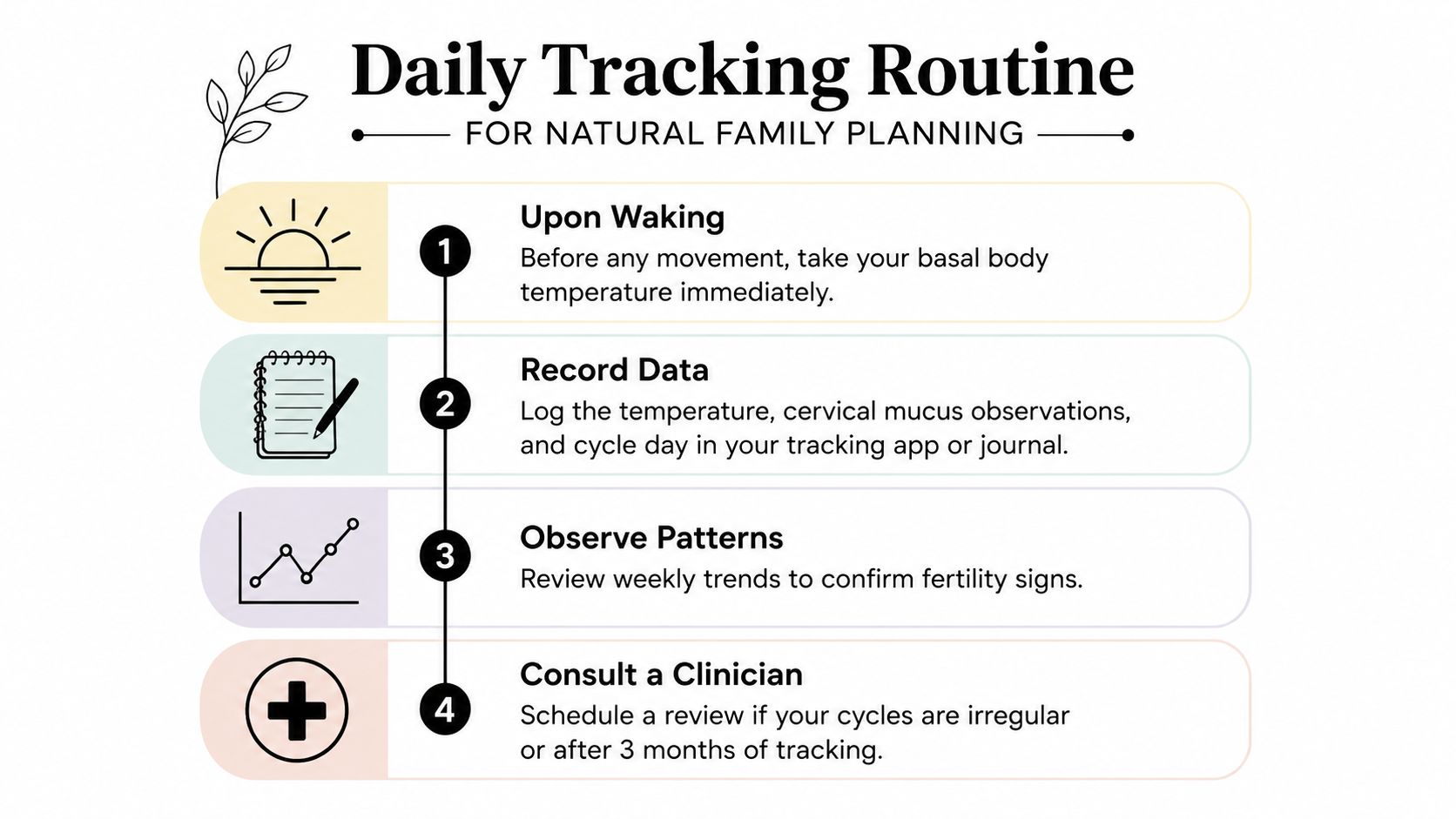
A workable daily sequence
- Measure before movement. Take BBT immediately upon waking, before sitting up, walking, drinking water or checking your phone. Use the same device, body site and approximate timing whenever possible.
- Record the context. Log the temperature, cycle day and cervical mucus observation. Mark anything that could affect interpretation, such as illness, broken sleep, alcohol, unusual stress or a late night.
- Observe throughout the day. Notice sensation and appearance rather than checking only once. Cervical mucus can change between morning and evening, so a brief note after using the toilet may be more useful than trying to remember everything at bedtime.
- Review trends, not isolated readings. One high temperature isn't enough to confirm a shift. Under the symptothermal rules described in Australian practice guidance, look for the required pattern of three consecutive higher readings.
The routine becomes harder during rotating shifts and travel. If you sleep during the day, take the reading after your main sleep period and record the altered conditions. Do not treat a disrupted reading as normal data without comment. Mark it so you, your educator or your clinician can interpret the chart with context.
Recording principle: A messy chart can still be useful when the reasons for unusual readings are visible.
This video offers another way to think about the daily observation process:
Common interpretation mistakes
A temperature rise may reflect illness or poor sleep rather than ovulation. Semen, arousal fluid, lubricant and infection-related discharge can also be confused with fertile cervical mucus. If you're unsure, record the uncertainty and follow the more cautious rule until a trained educator reviews the chart.
Speak with a GP if your cycles are persistently very short or long, your periods stop for an extended period, your charts repeatedly show no clear ovulation pattern, or you experience severe mid-cycle pain or unusual bleeding. A clinician can assess possible hormonal, thyroid, ovarian, uterine or other health factors and decide whether blood tests, imaging or referral is appropriate.
Australian health guidance recommends a pre-pregnancy appointment three to six months before trying to conceive, as outlined by healthdirect's pregnancy planning guidance. If you're trying to conceive and aren't pregnant after 12 months at age 35 or younger, or after six months at age 36 or older, speak with your doctor about fertility assessment and referral. Medicare coverage and out-of-pocket costs vary by service and test, so ask the practice what applies to your circumstances.
Is Natural Family Planning Right for You
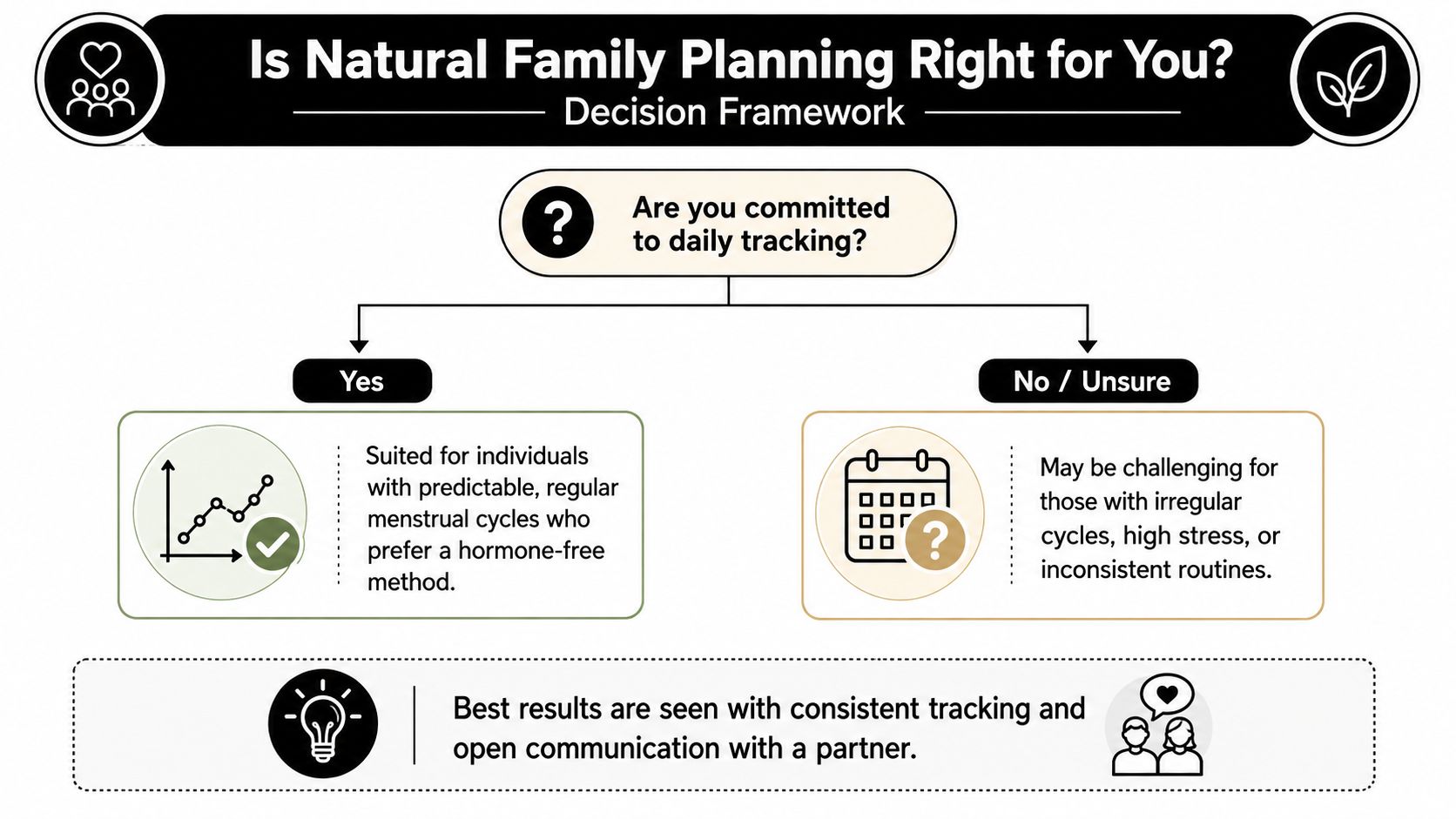
You finish a late shift, sleep poorly, and wake unsure whether today's temperature is reliable. If you need contraception, that uncertainty matters. Natural family planning (NFP) can suit people who want a hormone-free approach and are ready to treat fertility awareness as a daily practice, not a calendar shortcut.
It may work well for couples who want cycle information for both contraception and conception. A suitable fit usually includes:
- Predictable routines: You can measure, observe and record consistently.
- Regular communication: Both partners agree on what to do during potentially fertile days.
- A willingness to learn: You will follow an educator's method rules rather than an app's default prediction.
- A compatible reproductive goal: You are comfortable avoiding sex or using a backup method when the chart is uncertain.
The method becomes harder to apply when cycles are irregular, sleep changes often, or contraception cannot depend on daily behaviour. If an unintended pregnancy would be medically unsafe or personally unacceptable, discuss highly effective alternatives with a qualified Australian clinician. More tracking cannot remove every source of uncertainty.
Fertility awareness sits on a spectrum. Recording periods and symptoms can help you understand general health. Adding cervical mucus observations and basal body temperature (BBT) gives more information about changing fertility. A full symptothermal method combines signs with defined rules, formal education, partner agreement and a plan for uncertain days. Billings focuses mainly on cervical mucus, calendar methods estimate fertile days from previous cycles, and apps may automate records and predictions. Their perfect-use claims do not describe every couple's typical-use experience, especially when observations are missed or rules are misunderstood.
Australia's fertility education gap makes trained support valuable. Monash IVF's 2025 Fertility Insights Index reported an Australian score of 61.35 out of 100, while only 47% of Australians aged 25–34 knew what fertility health assessments involve, according to the Australian fertility insights reporting. Having cycle data is different from knowing how to interpret it.
Choose NFP because its requirements fit your life, not because it appears effortless. Learn from an appropriately trained educator, use the signs your chosen method requires, and reassess if your health, relationship, cycle or pregnancy intentions change.
Venus Health Co. offers app-connected fertility tools, including a Bluetooth basal thermometer for morning temperature recording and an LH ovulation test kit for tracking hormone surges at home. Visit Venus Health Co. to explore these options alongside appropriate clinical guidance.