

Fertile Cervical Mucus: A Complete Guide to Tracking
Dr. Adeyinka AdegbosinYou're in a public toilet, halfway through your usual routine, when something looks different on the toilet paper. It's clear, slippery and stretches between your fingers instead of breaking straight away. You pause, wondering whether it's just discharge, a sign of arousal, or a clue that ovulation is approaching.
That small observation can be useful. Fertile cervical mucus is a real-time body sign linked with the fertile part of the cycle, and learning to recognise it doesn't require complicated equipment or medical knowledge. You can observe the sensation, notice the texture and record the change in a few seconds.
A Quick Look at What You're Noticing
Cervical fluid changes as reproductive hormones change, so the same person may see dry, sticky, creamy, watery and slippery patterns at different points in the cycle. These changes are part of a sequence, rather than separate problems appearing at random.
The pattern most closely associated with approaching ovulation is clear, slippery and stretchy mucus. Australian fertility-awareness guidance describes the fertile phase as a shift towards mucus that becomes clear, watery and elastic, often compared with raw egg white. Healthdirect Australia explains the recognised cervical mucus pattern and how it can be used in fertility awareness.
Sensation can be as informative as appearance. A wetter feeling while walking, toilet paper that glides more easily, or mucus forming a strand instead of a thick smear may all mark a change. Some cycles produce a noticeable amount of fluid, while others show the shift mainly through sensation. Cervical mucus works a little like a changing road surface: the texture and wetness provide clues about what is happening ahead, while one observation gives only part of the picture.
Start with observation, not interpretation. Record what can be seen and felt first. Consider what it may mean after the pattern has appeared across several days.
A consistent record can also reduce manual guesswork. An app-based workflow lets observations be entered at the time they occur, keeps mucus descriptions together with LH tests and basal body temperature, and makes it easier to review the sequence without relying on memory. This supports a clearer view of the cycle while preserving the lived experience of noticing small changes.
Australian evidence has also examined how the quality of observed mucus relates to conception outcomes. The wider aim is therefore practical: recognise the movement from less fertile secretions towards wet, slippery and stretchy mucus, then note when that quality ends. One wipe cannot identify the exact day of ovulation, but repeated observations can turn an ordinary bathroom check into useful cycle information.
What Fertile Cervical Mucus Is
Cervical mucus is fluid made by glands around the cervix. Before ovulation, rising oestrogen usually changes it from a thicker secretion into fluid that is clearer, wetter and more elastic. Its structure can form channels that support sperm movement. Less fertile mucus is more likely to feel dry and appear thick, cloudy or absent.
The pattern often develops in stages:
- After menstruation, you may notice little mucus, a dry sensation, or fluid that feels dense, flaky or sticky.
- As oestrogen rises, mucus can become creamy, cloudy or similar to lotion. This is a transition, so it does not necessarily represent the most fertile quality.
- Near peak fertility, it may look clear or watery and feel slippery, lubricative and stretchy, with an egg-white-like appearance.
Colour helps, but sensation and elasticity add important detail. Egg-white cervical mucus may stretch about 5 cm without breaking, giving you a practical feature to observe rather than relying on colour alone. Healthdirect Australia outlines the changes in cervical mucus and the practical signs used to identify the fertile phase.
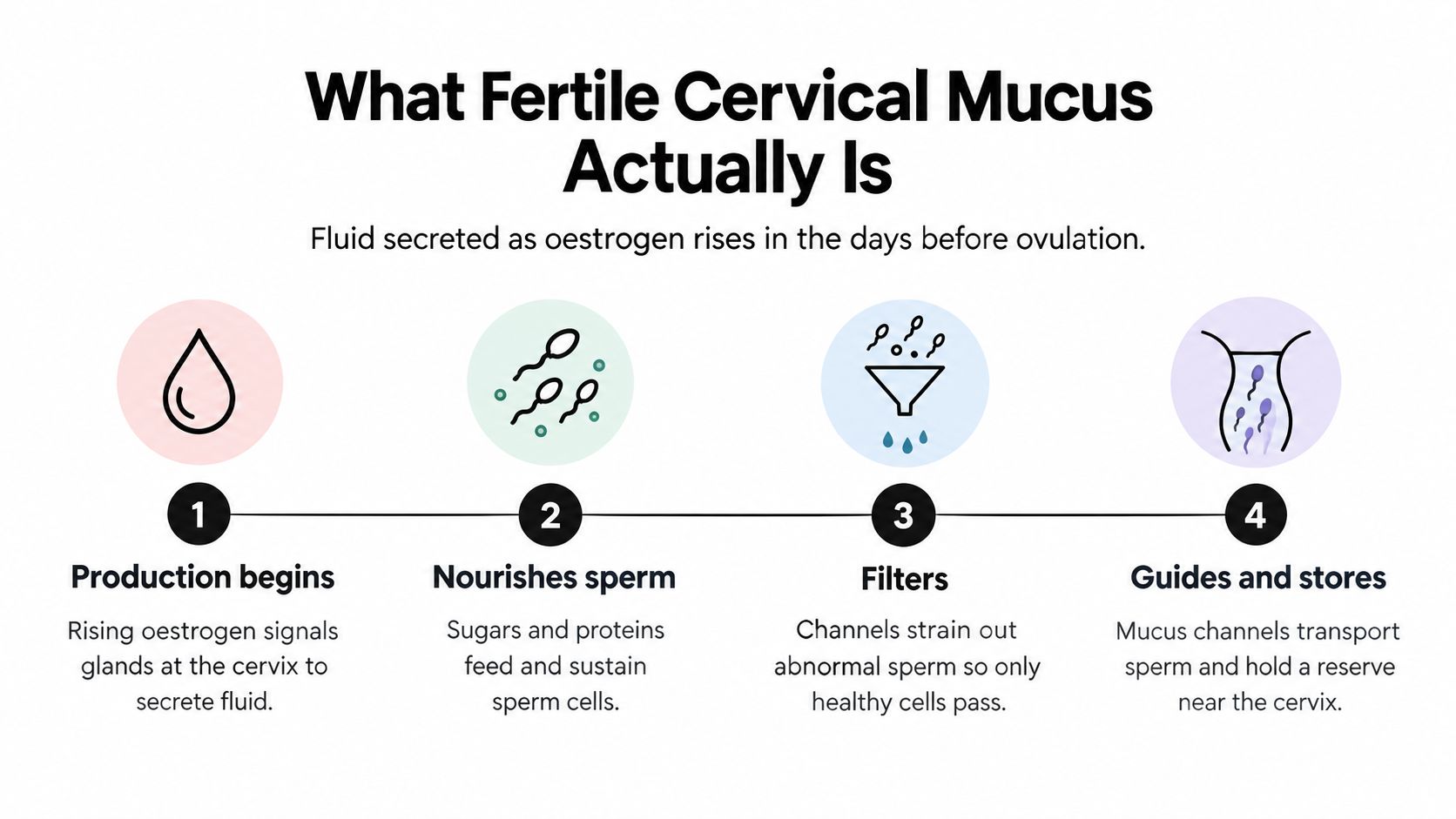
After ovulation, progesterone commonly changes the mucus again. It may become cloudy, thicker and sticky, or the vulva may return to a dry feeling. The final day with the most slippery, lubricative sensation is often called the peak day. It describes the highest-fertility mucus quality, but it does not confirm that ovulation occurred at that exact time.
Australian evidence has examined how observed mucus quality relates to conception outcomes, which gives these everyday observations practical meaning. A basal temperature rise can help confirm the shift later, while mucus shows the pattern as it develops. An app can store mucus notes alongside LH tests and temperature readings, reducing reliance on memory. For temperature tracking, the Venus Smart Basal Thermometer for Ovulation records basal body temperature and syncs readings to a phone through Bluetooth.
How to Check and Record What You See
You can check cervical mucus during your normal bathroom routine. Internal checking isn't required, and many people get enough information from the sensation at the vulva and what appears on toilet paper.
Use the look, feel and stretch method
Look first. Before wiping, notice whether the fluid is absent, dry-looking, cloudy, creamy, watery or clear. Look for sheen on the paper and whether the discharge sits as a thick smear or forms a glossy strand.
Feel next. With clean hands, you can assess a small amount between your thumb and forefinger if that feels comfortable. Ask whether it feels rough, tacky, damp, wet, smooth or slippery. The feeling of lubrication is often more informative than a small difference in colour.
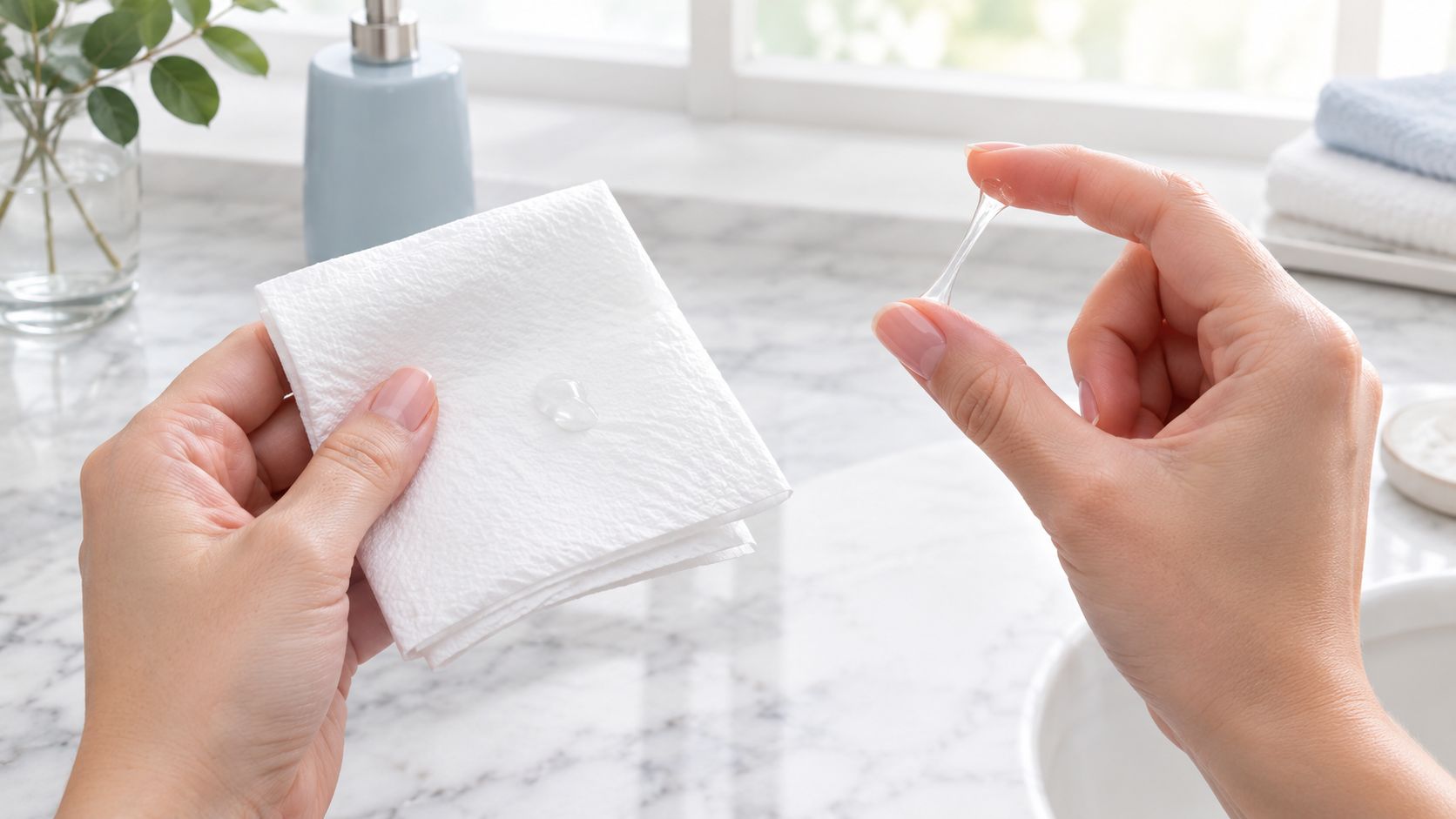
Stretch last. Gently move your fingers apart. Fertile-quality mucus may form a clear or slightly cloudy strand and stretch before breaking. Don't pull hard or keep testing if the sample is too small to judge.
Check before wiping after urination, then notice the sensation during the day. You might choose a consistent mid-morning check and another after lunch, particularly when you're learning your pattern. Avoid interpreting fluid immediately after intercourse, when semen or lubricant may be present, and don't confuse arousal fluid with cervical mucus.
Keep the record simple
A basic chart can use four labels:
- Dry: No visible mucus and a dry or rough sensation.
- Sticky: Tacky, dense or paste-like fluid.
- Creamy: Smooth, cloudy or lotion-like mucus.
- Watery or egg-white: Wet, slippery, clear and possibly stretchy.
Record the strongest sign you noticed that day, rather than trying to calculate an average. A short note such as “wet, slippery, stretches” is more useful than leaving the day blank because the observation wasn't perfect. If you're also tracking temperature, this guide to basal body temperature thermometers can help you understand how that separate sign fits into your routine.
Where Fertile Mucus Fits in the Fertile Window
Fertile cervical mucus is most useful because it changes while the body is moving towards ovulation. A calendar predicts from previous cycles, but mucus gives you a direct observation of what's happening in the current cycle.
The important progression is not a fixed timetable. You may first notice a dry feeling, then a damp or sticky change, followed by creamy fluid and finally a wetter, slippery, stretchy pattern. The fertile-quality phase can be brief for some people and more noticeable for others. Illness, stress, medication, breastfeeding, hormonal contraception and other factors can also affect what you see.
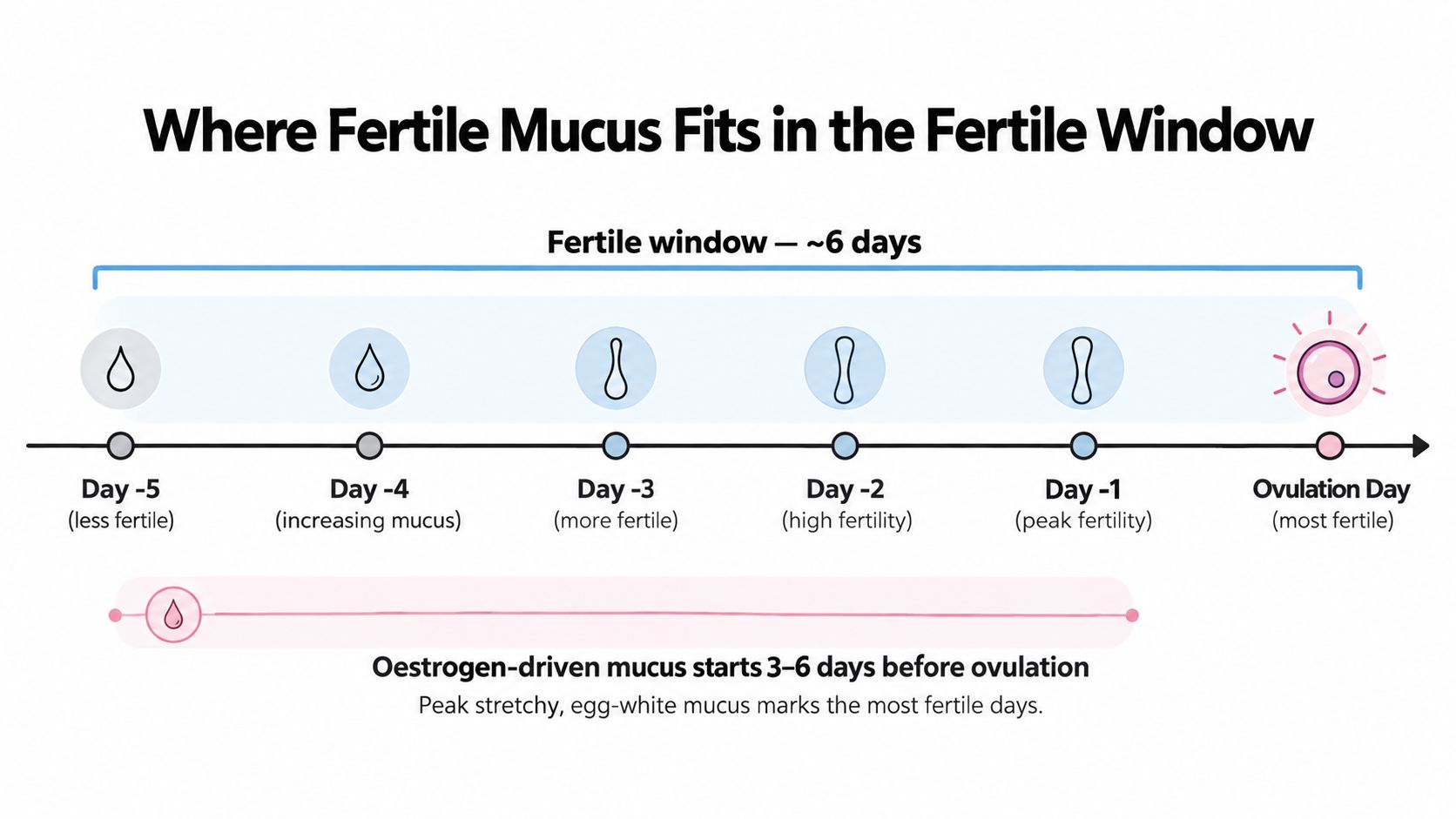
A useful way to interpret the signs is to give each tool a different job:
- Cervical mucus: Shows the body's changing environment as fertility rises and falls.
- LH testing: Detects the hormonal surge that commonly occurs before ovulation. A positive result can help narrow the timing, but it doesn't explain every mucus observation.
- Basal body temperature: Shows a temperature pattern after ovulation has occurred, so it's mainly confirmatory rather than predictive.
Australian data adds an important reason to take mucus quality seriously. In a cohort of 384 women attending 17 Billings Ovulation Method clinics, the group classified as having a favourable fertile-mucus pattern had a 72.3% pregnancy rate, compared with 44.4% in the low-pregnancy-potential group. The same study reported a shorter time to conception, 4.2 months compared with 6.4 months, with p=0.003. The Australian cohort study details the association between cervical mucus patterns, pregnancy rates and time to conception.
Those results don't mean mucus alone guarantees pregnancy, and they don't turn one observation into a diagnosis. They do suggest that the quality and pattern of fertile mucus can carry meaningful information when people use it consistently.
If you want to add an LH test to your routine, the Venus Ovulation Predictor Test Kit is designed for at-home testing and can be logged manually in a fertility app.
Fertile Mucus Versus Other Discharge
A single sample can be confusing because several different fluids look wet or clear. Use the whole context, including sensation, timing, smell and associated symptoms, rather than relying on colour alone.
| Type | Appearance & Sensation | When It Appears | Key Distinguishing Sign |
|---|---|---|---|
| Fertile cervical mucus | Clear or slightly cloudy, wet, slippery and elastic | As fertility rises before ovulation | It can stretch and often creates a lubricative sensation |
| Arousal fluid | Thin, wet and slippery, sometimes frothy | During or soon after sexual stimulation | It follows stimulation and tends to dry relatively quickly |
| Infection-related discharge | May be green, yellow, grey or cottage-cheese-like | Can occur at any cycle stage | It may come with itch, odour, burning, irritation or pain |
| Less fertile cycle-phase discharge | Sticky, pasty, creamy or dense | Common outside the fertile pattern | It usually feels dry, damp or tacky rather than distinctly lubricative |
Fertile mucus doesn't need to be perfectly transparent. Slight cloudiness can still occur, especially during a transition. The stronger combination is wetness plus slipperiness plus stretch, particularly when those features follow drier or thicker secretions.
Arousal fluid is easiest to recognise by the situation in which it appears. If the change happens after stimulation and disappears soon afterwards, it's less likely to represent the cycle's cervical mucus pattern. Semen, lubricant and vaginal moisturisers can also alter the texture, so mark that day as difficult to interpret rather than forcing it into a category.
Seek advice from a GP or sexual health clinician if discharge has an unusual colour, strong odour, persistent itch, irritation, pain or a cottage-cheese-like texture. A swab or examination may be more appropriate than fertility charting when symptoms suggest infection.
When symptoms are uncomfortable, stop treating the discharge as a tracking puzzle. Health concerns deserve clinical assessment.
Common Misunderstandings That Trip People Up
Many tracking errors come from expecting fertile cervical mucus to behave like a predictable calendar event. The body sign is useful, but it still needs careful observation.
A calendar date isn't a body sign
A period app can estimate when ovulation might occur from previous entries. It can't see whether this cycle has produced the same hormonal pattern. Travel, stress, illness and other changes can shift the timing, so mucus observations can add current-cycle information that a date prediction misses.
Dry days are part of the pattern
People often record only the exciting change, such as the first slippery sample. That leaves out the baseline. A dry or sticky observation helps show how the cycle moved towards wetter mucus and later changed back again. If you skip those days, you lose part of the sequence.
A regular cycle can still vary
A cycle that usually follows a familiar rhythm doesn't guarantee identical ovulation timing every month. Tracking remains useful because it shows what happened this time, rather than asking the calendar to repeat the previous pattern.
Not every cycle will look textbook
You may see a short fertile-quality phase, several patches of wetter mucus, or no obvious egg-white pattern. Log what happens instead of dismissing the cycle as a failure. A pattern that repeatedly lacks a clear progression can be worth discussing with a clinician, particularly if you're trying to conceive.
Products and sex can interfere with interpretation
Douching, lubricants, semen residue and arousal fluid can mask or imitate cervical mucus. Keep the observation simple, note anything that may have affected the sample, and return to your normal routine at the next check. A questionable observation is still useful when it's labelled as questionable.
Australian medical education research highlights why clear instruction matters. In one Australian sample, only 2.1% of participants correctly identified the fertile period of the cycle, as reported by the Royal Australian College of General Practitioners. Misunderstanding is common, so needing practice doesn't mean you're doing it badly.
Tracking Mucus With LH, BBT, and an App
Each fertility sign answers a different question. Mucus helps you notice changing fertility, LH testing identifies a surge, and basal body temperature helps confirm a post-ovulation pattern. An app can place those observations in one timeline, reducing the chance that a handwritten note or forgotten test disappears from view.
Build one repeatable daily entry
Take the temperature reading before sitting up or moving around, then record the result. Observe mucus during your bathroom routine and choose the category that best describes the day. If you're using LH strips, test at a consistent time and record the result according to the test instructions.
A sample entry might look like this:
- Morning temperature: Record the BBT before getting out of bed.
- Mucus observation: Note “wet and slippery” or “clear, stretches” rather than just writing “fertile”.
- LH result: Record whether the test was negative, rising or positive according to the product's reading instructions.
- Context: Add intercourse, illness, poor sleep, medication or lubricant if it could affect interpretation.
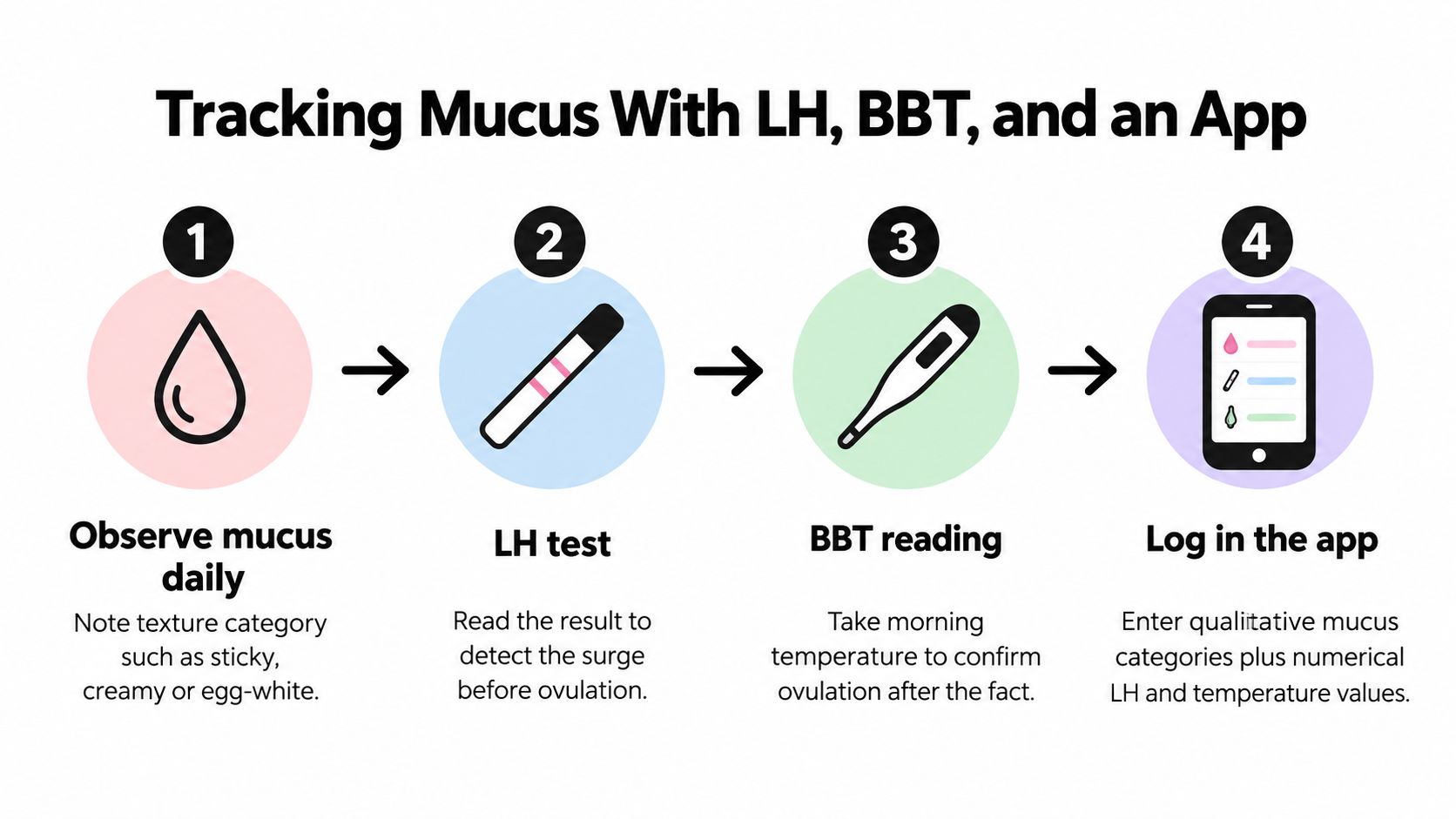
A BBT rise is generally useful after the event, because temperature patterns confirm that the body has moved beyond ovulation rather than warning you in advance. Mucus and LH can therefore guide attention in real time, while BBT provides a retrospective check. Combining them is more informative than treating any one sign as infallible.
For detailed testing instructions, use this guide to LH test strips and follow the instructions supplied with your chosen test. An app can accept qualitative entries such as dry, sticky, creamy and egg-white alongside numerical temperature readings, but it shouldn't replace medical interpretation.
Consider a GP or fertility specialist review if you repeatedly see no fertile-quality mucus across three cycles, persistent creamy discharge without a clear dry-to-wet progression, or mucus that returns with bleeding outside the expected phase. Before an appointment, export or screenshot your charts so the clinician can assess the trend rather than relying on memory.
Bringing It All Together
The most useful fertile cervical mucus observation combines three qualities: wetness, slipperiness and stretch. Oestrogen drives the change towards this pattern, and progesterone commonly brings the mucus back towards thicker, cloudier or drier secretions after ovulation.
You don't need to become an expert overnight. Choose one consistent bathroom check this week, record the result in your app, and keep going for two complete cycles. Look for whether your own pattern moves from dry or sticky, through wetter secretions, towards slippery mucus, then back again.
The Australian evidence gives this everyday skill a stronger foundation. The cohort findings link favourable mucus patterns with different conception outcomes, while Australian clinical education research shows that many people have never been taught how to identify the fertile period accurately. Fertility-awareness methods can provide further context for combining body signs with structured cycle tracking.
Use LH testing when you want another sign connected with the pre-ovulatory hormonal shift. Use BBT when you want a retrospective temperature pattern. Use an app when you want the observations together, with fewer gaps and less manual sorting.
An imperfect note still adds information. With repetition, you'll learn which sensations are normal for you, which changes are meaningful and which samples were affected by sex, products or illness. Small daily observations can become a clearer picture of your cycle and a more practical plan for conception timing.
Venus Health Co. offers app-connected fertility tools, including LH testing and a Bluetooth basal body thermometer that records temperature data alongside cervical mucus observations. Visit Venus Health Co. to explore the available options and start building a more organised record of your cycle.