

Body Fat Monitor Guide: Accuracy and How to Use It
Dr. Adeyinka AdegbosinYou step onto the bathroom scale after a week of training and eating more thoughtfully. Your weight barely changes, but the app says your body fat has gone up. Before you cut back on food or add another workout, pause: that number might reflect the conditions of the measurement, not a change in your body fat.
A body fat monitor can help you understand progress, provided you give it the right job. Use it to follow patterns alongside your waist measurement, strength and wellbeing, rather than asking a single reading to decide whether your plan is working.
Body Fat Monitors at a Glance
A body fat monitor estimates the share of your weight that's fat. It doesn't separate fat from the rest of your body and weigh it directly. The percentage comes from a model, which means the method, equipment and assumptions all matter.
The options range from bathroom smart scales to clinic-based scans. A tape measure belongs in the comparison too, although it measures your waist rather than your body fat percentage.
Body fat measurement methods compared
| Method | What it measures | Gap to DXA | Typical cost | Best for |
|---|---|---|---|---|
| Smart scale (BIA, foot electrodes) | Whole-body fat estimate from an electrical pathway through the feet | Model-specific, not a fixed correction | Low to moderate | Weekly trend tracking at home |
| Handheld BIA unit (hand electrodes) | Body fat estimate from an electrical pathway through the hands | Requires model-specific validation | Low | Quick checks and travel |
| Skinfold calipers | Thickness of fat folds at set sites | Tester skill and equation affect agreement | Low equipment cost | Tracking one person over months |
| DEXA scan | Fat, lean tissue and bone mineral using low-dose X-rays | Clinical reference method, not error-free | High; requires a clinic | Clinical or research baseline |
| Waist tape measure | Waist circumference | Not a body fat percentage | Very low | A simple check alongside another method |
These cost bands describe relative expense, not quoted Australian prices. Buying calipers is inexpensive, for example, but paying a trained person to take measurements adds a service cost.
Choose the question before the tool
If you want to follow changes at home without appointments, a smart scale is practical. If you work with a trained exercise professional, skinfold measurements can provide a consistent record. If you need a more detailed assessment of tissue distribution, a clinic-based DXA scan, also written DEXA, may be appropriate.
A waist tape answers a narrower but useful question: is your waist getting larger, smaller or staying similar? It can help you interpret a scale result without pretending to produce a competing body fat percentage.
Practical rule: Choose the method you can use consistently, not the one that displays the most decimal places.
Don't combine results from different methods into a single trend line. A caliper estimate and a smart-scale estimate can disagree without either measurement session having been performed carelessly.
How Each Method Estimates Body Fat
Each method starts with a different signal, which is why a smart scale, calipers and a clinic scanner can disagree about the same body. Knowing the signal tells you what the percentage represents.
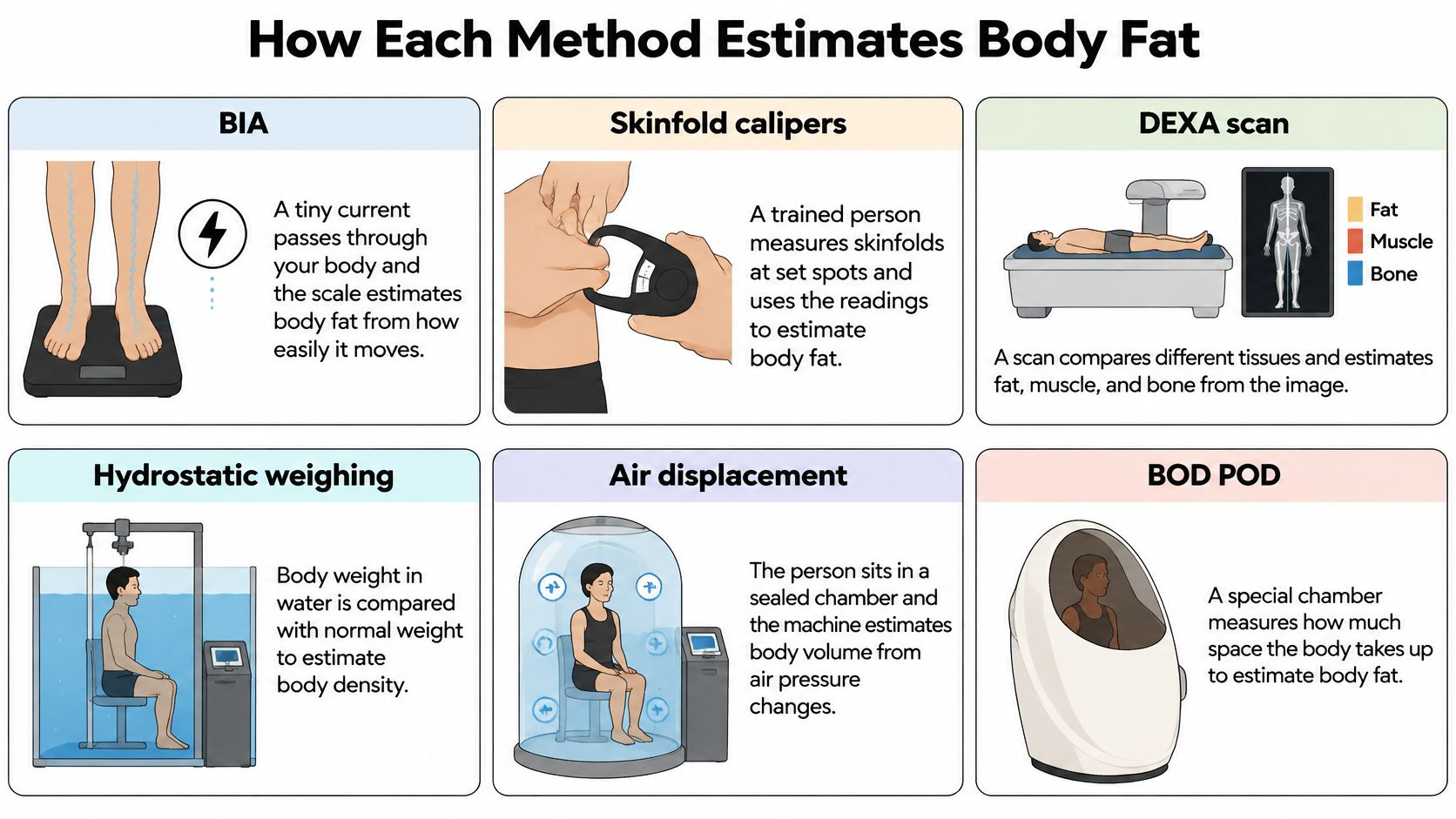
BIA measures electrical impedance
Bioelectrical impedance analysis, or BIA, passes a tiny electrical current through the body and measures opposition to its movement. Water-containing lean tissue conducts electricity more readily than fat tissue.
A wet sponge conducts electricity more easily than a dry one, and for the same reason: water carries the current. The device never detects fat. It measures how easily electricity moves, then works backwards.
The monitor feeds its impedance result into an equation, usually alongside height, weight, age and sex. A foot-electrode scale samples a different pathway from a handheld device, so both rely on the equation to estimate tissue the current never reached.
Those equations matter. The Australian AusDiab body-composition study examined age- and sex-related differences using BIA, a reminder that an equation fitted to one reference population may describe a different individual less well. A repeatable reading and an accurate reading are not the same thing.
Calipers measure folds, while DXA compares tissues
Skinfold calipers measure the thickness of pinched skin and underlying fat at standard sites, typically the triceps, below the shoulder blade, the abdomen and the front of the thigh. The tester feeds those readings into an equation that estimates body density and then fat percentage.
Only a few folds are sampled, so technique carries the result. A slightly different pinch, or a site a centimetre away, changes the number even though your body has not. Same tester, same sites, same pinch keeps the trend trustworthy.
DXA sends two low-dose X-ray beams through the body. Bone, lean tissue and fat absorb each beam differently, so the software sorts every scanned point into three compartments: fat mass, lean soft-tissue mass and bone mineral content, reported for the whole body and for regions such as the arms, legs and trunk.
The video below follows a scan from setup to finished report, showing what that regional breakdown looks like.
Hydrostatic weighing and air-displacement methods take another route: they estimate body density from body mass and volume. A BOD POD is a particular air-displacement system, not a separate biological principle.
Every method involves interpretation. Even a careful assessment produces an estimate built from a signal plus a set of assumptions; none takes a direct inventory of fat cells. That gap is why consistent conditions matter so much: the trend can stay dependable even when the single number is off.
Pros and Cons of Each Measuring Method
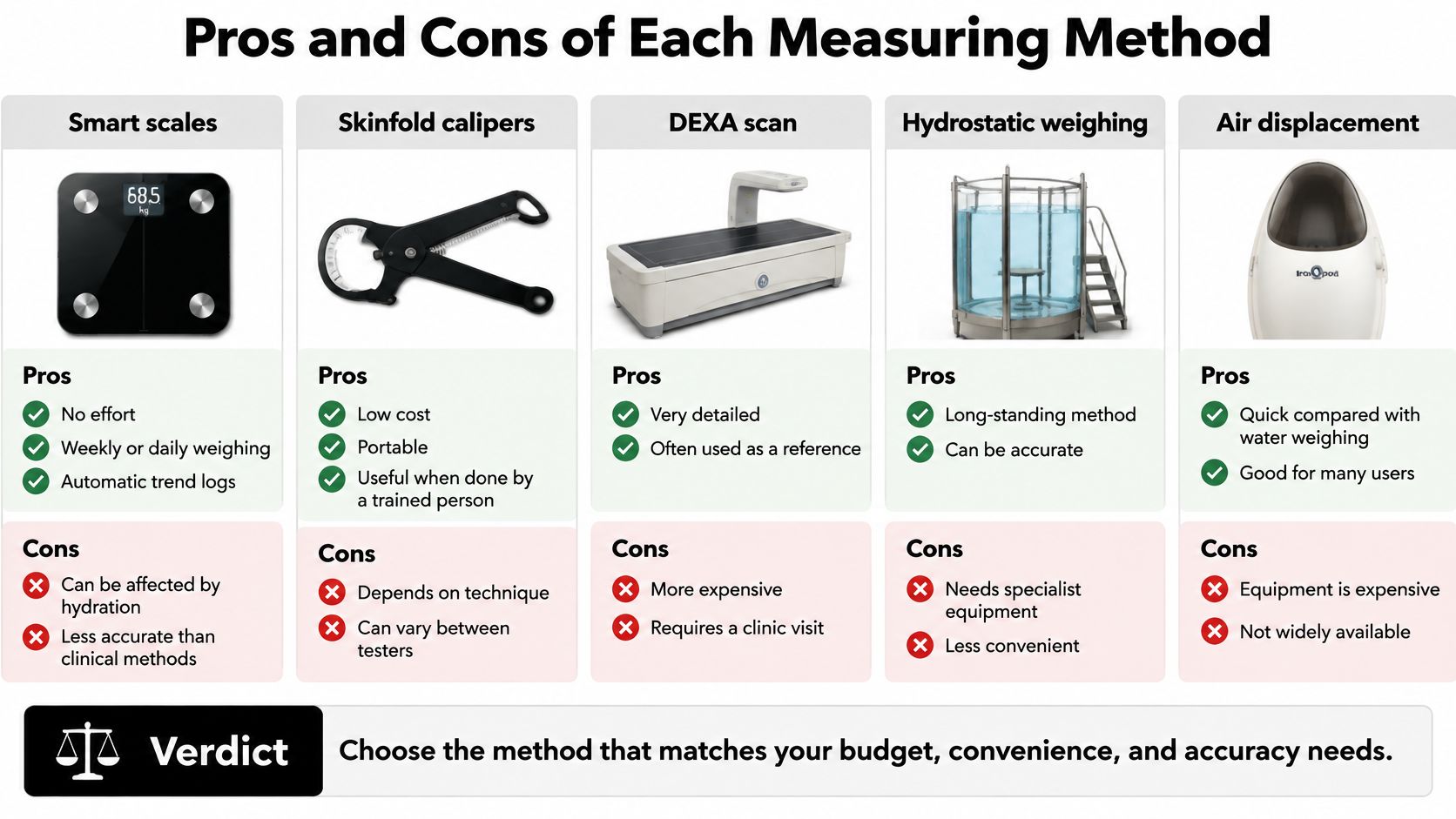
A more elaborate device isn't automatically the better choice. Convenience, operator skill and the usefulness of the result all affect whether a method earns a place in your routine.
Match the benefits to the limitations
Smart scales
- Pros: Little effort, convenient home measurements and automatic logs when the app supports them.
- Cons: Hydration, timing, skin temperature and foot contact can affect the estimate. Changing brands can create an apparent change that isn't biological.
Handheld BIA
- Pros: Portable and quick to use without setting up a bathroom scale.
- Cons: Grip, arm position and electrode contact need care. Portability doesn't establish accuracy.
Skinfold calipers
- Pros: Portable equipment and useful tracking when the same skilled tester measures standard sites.
- Cons: Site selection and pinching technique affect results. Very small or difficult-to-grasp folds can make consistent measurement harder.
DXA
- Pros: A commonly used reference method that provides regional tissue information and bone mineral measurements.
- Cons: Requires an appointment, clinic access and greater expense. It isn't a convenient weekly check.
Waist tape
- Pros: Simple, inexpensive and useful for following abdominal size.
- Cons: Doesn't estimate total body fat, and changing tape placement or tension can obscure progress.
The comparison below also includes specialist options that aren't usually practical for home monitoring.
What validation means for your purchase
In a study of 196 Anglo-Celtic Australian adults aged 26–86, the Australian skinfold and BIA validation study reported good agreement between skinfold estimates and DXA, with slightly weaker agreement for single-frequency BIA. That finding supports sensible use, not treating every home monitor as equivalent to clinical assessment.
Before buying, look for published validation against a named reference method and clear measurement instructions. Multi-frequency capability is worth noting, but the label alone doesn't prove an individual device is more accurate.
Choose an app that makes trends easy to review and allows you to retain or export your records. The Venus AI Smart Scale: Body Composition & Body Fat Scale is one app-connected option; app features shouldn't be mistaken for independent validation of the fat estimate.
For a closer explanation of the clinic-based alternative, see this guide to DEXA scans and body fat.
The verdict: choose a method you can repeat well, and judge it by the decisions it helps you make rather than the precision of its display.
Routine and Factors That Shift a Reading
Everyday factors that change a body fat reading
| Factor | Effect on the reading | How to control it |
|---|---|---|
| Hydration, including drinks, sweat and alcohol | Changes body water and the electrical signal | Keep usual fluid habits consistent; use steps 2 and 5 |
| Training in the hours before | Sweat, temperature and fluid shifts can move the estimate either way | Measure before training; use step 5 |
| Food and carbohydrate intake | Gut contents, glycogen and associated water change measurement conditions | Use the meal-timing rule in step 2 |
| Time of day | Fluid distribution and recent activities change throughout the day | Apply the fixed-time rule in step 2 |
| Skin temperature and damp feet | Alter electrode contact and impedance | Use clean, dry feet at a comfortable temperature in step 3 |
| Swelling or oedema | Extra fluid makes the estimate difficult to interpret | Pause interpretation and arrange clinical review, as in step 7 |
| Older age, very low bone density, athletic build or pregnancy | Standard equations may not represent the person well | Use the suitability check in step 7 before acting |
Hydration is especially important because BIA interprets an electrical signal influenced by body water. An Australian review of bioimpedance and hydration assessment reports a typical total-body-water estimation error of 1.5–2.5 kg for conventional BIA and cautions against using bioimpedance alone to monitor hydration.
That isn't a body-fat error margin, and it can't be converted into a universal correction for your scale. It explains why a post-training reading deserves caution rather than celebration or alarm.
A repeatable routine you can start this week
- Keep the same method. Use one device throughout your tracking period. Check your profile details, and don't switch between standard and athlete modes in response to results you dislike.
- Choose a consistent morning appointment. Measure after waking and using the toilet, before breakfast or drinks, if that fits your life. Don't delay needed fluids or medication to obtain a reading; choose another repeatable time if necessary.
- Prepare the contact points. Put the scale on a firm, level floor and use clean, dry, bare feet. Let unusually cold feet return to a comfortable temperature, and position them over the electrodes as instructed.
- Stay still until the measurement finishes. Let the device complete its full sequence rather than stepping off as soon as weight appears. For a handheld monitor, reproduce the instructed grip and arm position.
- Plan around training and unusual intake. Measure before exercise rather than immediately afterwards. Choose a morning following your usual routine, and postpone interpretation after unusually hard training, alcohol, a large late meal or deliberate carbohydrate loading.
- Standardise caliper technique. Have the same trained tester mark and measure the same anatomical sites. Keep the equation and recording method unchanged so a technique change doesn't masquerade as progress.
- Record context as well as results. Log bodyweight, waist measurement and anything unusual, such as illness, swelling or a demanding training session. If your health circumstances make BIA unsuitable, ask a clinician how to monitor progress instead.
When an athlete's reading is least trustworthy
After a sweaty session, you've changed more than your energy expenditure. You've changed body water, skin temperature and possibly the distribution of fluid between tissues.
Carbohydrate loading creates a different interpretation problem. Stored carbohydrate, or glycogen, is associated with water, so a fuller or heavier body after fuelling isn't proof of fat gain.
Don't use a post-workout body fat reading to decide how much you're allowed to eat or drink.
For a broader routine that supports consistent measurement conditions, Lola's guide to everyday wellbeing brings hydration, nutrition, exercise and sleep together. Keep those habits sustainable rather than manipulating them to improve a scale result.
If your weight reading itself seems inconsistent, check the basics in this guide to digital scale measurements.
At your monthly review, look for a direction across comparable measurements. You can control device choice, timing and technique; persistent swelling, unexplained weight change or deteriorating wellbeing needs professional interpretation, not a more elaborate spreadsheet.
Reading Trends for Training and Nutrition Decisions
An athlete finishes a demanding training block and sees a sharp fall in estimated body fat. They're pleased, but also tired, hungry and performing worse. The useful question isn't whether the number looks good, but whether their measurements and recovery tell a coherent story.
Use a four-week review window as a practical organising tool, not a scientifically guaranteed threshold. The patterns below are prompts for investigation, not diagnoses.
Reading patterns and what they usually mean
| Pattern over four weeks | Likely meaning | Action |
|---|---|---|
| Body fat falling, weight stable, strength steady | Possible fat loss or recomposition, especially if waist also falls | Keep nutrition and training steady while monitoring recovery |
| Body fat up one day, flat across the week | Measurement conditions are a plausible explanation | Don't react to the isolated reading |
| Body fat sharply down after a hard training week | Fluid or glycogen change may explain the result | Restore normal recovery conditions and reassess |
| Body fat rising repeatedly, waist up, performance down | Possible fat gain alongside a training or recovery problem | Review intake, training load, sleep and measurement conditions |
| Body fat, waist and strength all falling | Possible under-fuelling, accumulated fatigue or lean-tissue loss | Review fuelling promptly and seek professional advice |
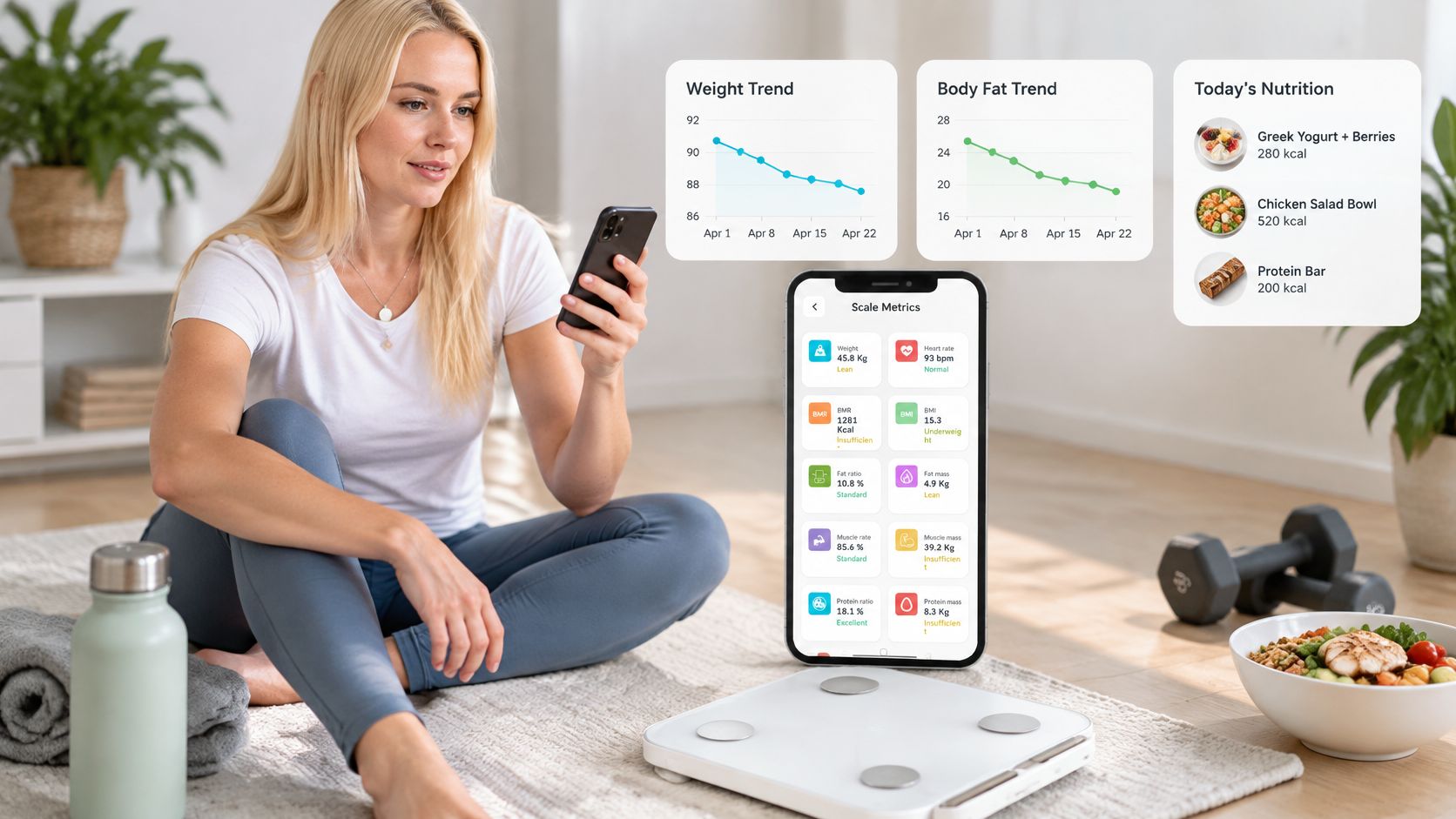
A connected scale can organise measurements, but you still need to interpret the surrounding circumstances.
Look for agreement between independent signals
Waist measurements and training records add information that isn't just another output from the same scale equation. Several app metrics changing together don't necessarily provide independent confirmation, because the device may calculate them from overlapping inputs.
If your waist gradually decreases while strength and recovery remain good, maintaining your plan may be more sensible than chasing faster weight loss. Stable bodyweight doesn't rule out useful change, as this explanation of losing body fat without losing weight discusses.
By contrast, a rising fat estimate with an unchanged waist and worsening performance doesn't automatically call for less food. Check whether you've increased training, reduced sleep or measured under different conditions.
Make nutrition changes for a reason
Don't set an energy deficit from the body fat percentage alone. Review your eating pattern, hunger, training quality and recovery, and use a sports dietitian when performance or substantial dietary changes are involved.
A falling waist isn't automatically a warning sign. It becomes more concerning when it accompanies declining strength, persistent fatigue, poor recovery or other symptoms suggesting you're not meeting your needs.
Protein planning and resistance training deserve the same measured approach. Keep a structured programme, record what you do, and avoid recalculating food targets after every fluctuation in estimated muscle mass.
Change the plan because several meaningful indicators support a change, not because one app tile changed colour.
Review several weeks of comparable records before making routine adjustments. Don't wait for a trend review if you feel unwell, have unexplained weight loss or develop concerning symptoms.
Decide Whether a Monitor Is Enough for You
When a body fat monitor is enough
| Situation | Monitor for trends? | Next step |
|---|---|---|
| Healthy adult tracking trends | Yes, as a supporting tool | Keep one device and a consistent routine |
| Athlete or highly trained body | Cautiously, away from immediate post-training conditions | Consider a professionally interpreted DXA baseline |
| Older or frail adult | Only with appropriate context | Arrange clinical review before major changes |
| Kidney disease, dialysis or swelling | Don't use absolute values to guide decisions | Ask your treating doctor first |
| Pregnancy or childhood | Not for self-directed body-fat decisions | Follow obstetric or paediatric advice |
| Very low bone density | Limited usefulness | Discuss DXA or another clinical assessment |
| Medical or major nutrition decision | Screening information only | Obtain professional assessment |
Omron's Australian weight-management guidance identifies groups whose estimates may differ substantially from average values, including adults over 81, highly trained people, people with very low bone density, dialysis patients, people with swelling, pregnant women and children. These aren't situations where a precise-looking display should override clinical judgement.
Repeatable isn't the same as individually accurate
A monitor can give similar results under similar conditions while consistently estimating above or below a clinical reference. Repeatability describes consistency; accuracy describes closeness to the value being assessed.
That distinction separates screening from diagnosis. A home estimate can help you notice a pattern worth discussing, but it can't diagnose malnutrition, establish that you've lost muscle or determine whether a medical treatment is working.
Nor should a universal app category become your personal target. Age, health, training history and the purpose of the assessment all influence what a useful goal looks like.
- For everyday fitness: Use measurements to support manageable habits and informed conversations.
- For performance goals: Bring your training log, recovery notes and eating pattern to a qualified professional.
- For health concerns: Prioritise symptoms and clinical assessment over the monitor's score.
This week, choose your method, set a repeatable measurement time and start a simple record that includes waist and wellbeing. Review it after a month if you're otherwise well, and seek advice sooner if something concerns you. A body fat monitor should support professional advice, not replace it.
Venus Health Co. offers an app-connected body composition scale with weekly AI-driven fat and muscle summaries, nutritional recommendations and wellness reports containing 30-day trend charts. Visit Venus Health Co. to explore tools for keeping your measurements organised, and use those records alongside your training, recovery and professional advice.