

Body Composition Monitor: How It Actually Works
Dr. Adeyinka AdegbosinA body composition monitor is a home scale that uses bioelectrical impedance to estimate metrics such as body fat, muscle and visceral fat, and it's best used for weekly trends rather than absolute values. Even a reading of 25% body fat may realistically represent roughly 21–29%, so one measurement shouldn't drive a training or nutrition decision.
You step on after a normal week, expecting a familiar result. Instead, your weight has barely moved while the app reports a different body-fat percentage and muscle estimate. The instinctive reaction is to ask whether the scale is broken. Usually, the better question is whether the measurement conditions changed.
A body composition monitor can help you see direction over time, but it can't provide a perfect snapshot of your tissues from a single bathroom reading. Australian guidance is especially useful here because it treats body composition as a structured monitoring process, with attention to timing, measurement error, consent and individual context. The principles apply whether you're managing weight, returning to activity after illness or training for sport.
What a Body Composition Monitor Actually Is
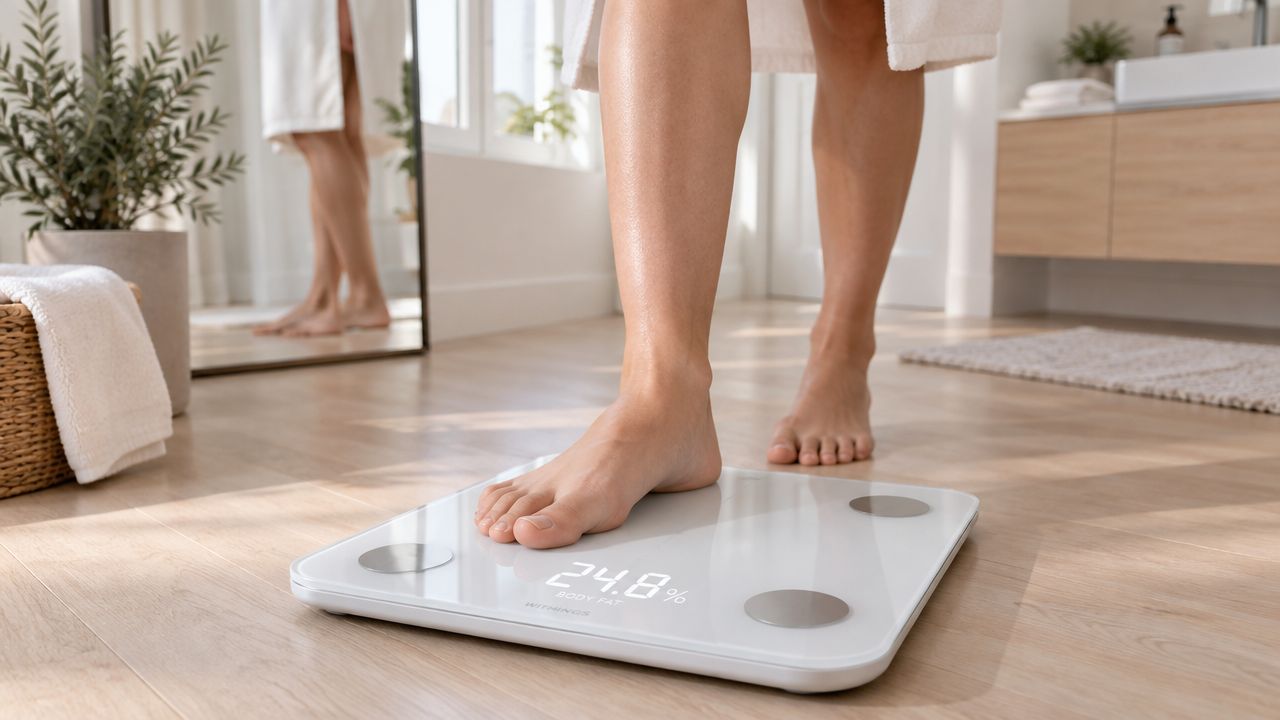
You step on a bathroom scale expecting one familiar number. Instead, the app reports body weight alongside estimates for body fat, muscle mass, visceral fat, hydration, bone mass and resting metabolic rate. A regular scale measures weight only. A body composition monitor combines that measurement with bioelectrical impedance analysis, commonly called BIA, to estimate what makes up your weight.
Body composition describes the proportions of fat, lean tissue, water and other components in the body. A plain-language guide to what body composition means can help clarify why weight alone does not describe physical change.
That distinction can matter across several weeks. Your body weight may stay similar while estimated fat mass and lean mass move in different directions. An athlete might monitor whether muscle is being maintained during a demanding training block. Someone managing weight may want context beyond the scale number.
From casual weighing to useful tracking
The monitor works best as a trend tool, not a verdict delivered by one reading. Hydration, recent exercise, food, alcohol, medication and time of day can all affect a result. Repeating measurements under similar conditions makes it easier to recognise a developing pattern.
Weekly checks can therefore be more useful than reacting to daily movement. Australian guidance on body-composition assessment emphasises standardised procedures and careful interpretation. The same principle supports home monitoring: keep the routine consistent and treat the result as an estimate.
For equipment comparisons, scales for fitness assessment can help distinguish ordinary weighing scales from devices that estimate additional metrics.
Use the monitor to follow directionality, then interpret changes alongside training, nutrition, health and how you feel. A number gains meaning through repeated, consistent observations.
How BIA Scales Measure Fat, Muscle, and Visceral Metrics
BIA works a little like testing how easily water moves through different materials. Lean tissue generally contains more water and conducts an electrical signal more readily, while fat tissue offers greater resistance. The monitor sends a safe, very low electrical signal through the body, measures impedance, and combines that result with information such as height, weight, age and sex to generate estimates.
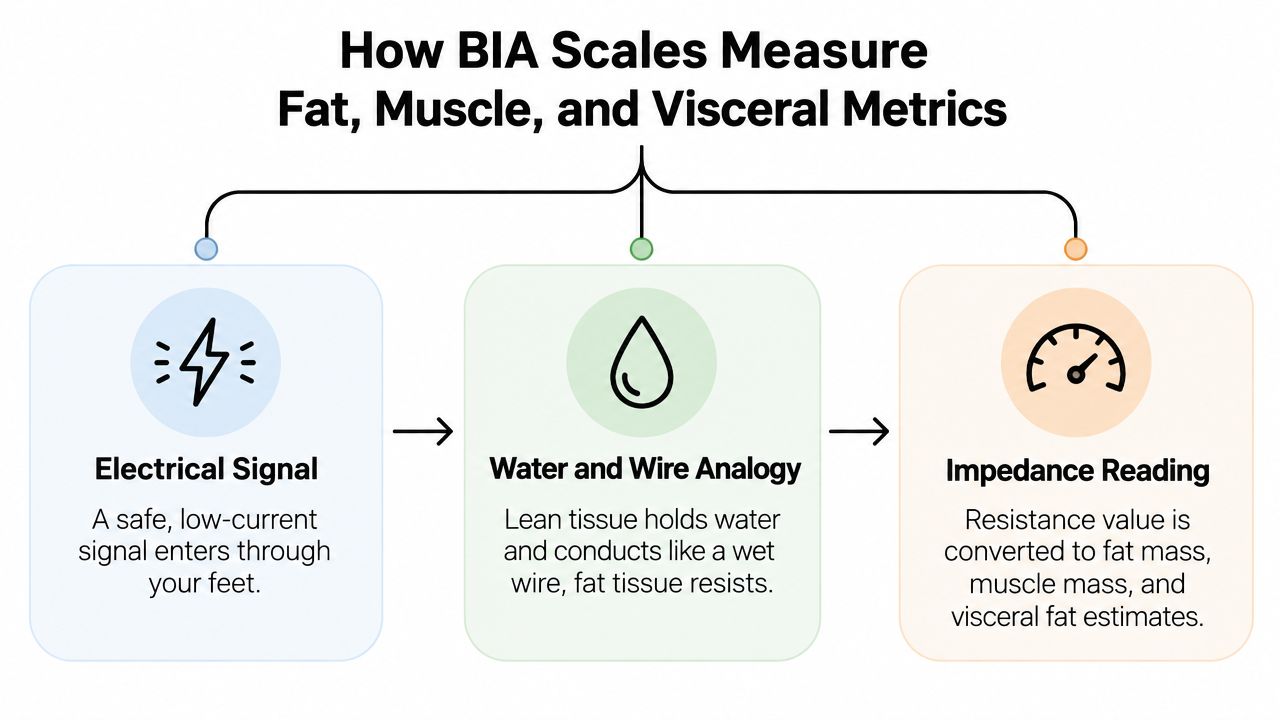
The important word is estimate. The monitor doesn't directly see fat cells, muscle fibres or the fat around your organs. It applies a prediction equation to an impedance reading. That means two devices can produce different results from the same person, even when both are functioning correctly.
What the main readings mean
- Body fat percentage estimates the proportion of total body weight attributed to fat mass. It can be useful for following a broad trend, but a single result shouldn't be treated as a precise diagnosis.
- Muscle mass usually refers to an estimated amount of muscle or lean tissue, depending on the manufacturer's definition. Some monitors also provide segmental values, such as estimates for each arm and leg.
- Visceral fat is an indirect device score or estimate associated with fat stored around internal organs. It isn't a direct image of abdominal tissue, so interpret it alongside clinical advice and other health measures.
- Body water reflects estimated water content. Because BIA responds to water status, this value can help explain why other readings changed.
- Bone mass is generally an estimate derived from the device's equation. It shouldn't be confused with a clinical bone-density assessment.
- Resting metabolic rate is a calculated estimate of energy use at rest. Treat it as a planning reference, not a laboratory measurement of exactly how much energy you burn.
For a more detailed explanation of how a smart scale arrives at a muscle estimate, see how smart scales measure muscle mass. A product such as the Venus AI Smart Scale: Body Composition & Body Fat Scale illustrates the connected-scale format, combining multiple estimated metrics with app-based reporting.
A useful guide to tracking weight loss with BIA scales can also help you focus on repeated readings rather than interpreting one percentage in isolation.
Think of the result as a modelled picture, not a scan. The model can still be useful when you use the same device, follow a repeatable routine and compare your results with how you feel, perform and function.
Accuracy, Limitations, and Why Consistent Conditions Matter
You measure on Monday morning and see a higher body-fat percentage than last week. The change may reflect hydration, food, exercise, or sleep rather than a sudden shift in tissue. Australian consumer testing found that even the best-tested body-fat scales differed from reference methods by about 3–4 percentage points. A displayed result of 25% body fat may correspond roughly to 21–29%, within the limitation described in CHOICE's body-fat scale guidance.
That level of uncertainty does not make a monitor useless. It defines the question it can answer. For a clinically assessed snapshot, a service such as DEXA body composition testing in Manchester belongs to a different category of assessment. A home BIA monitor is more appropriate for repeated tracking under similar conditions. For a practical explanation of how accurate smart scales are in practice, focus on their role as trend tools rather than one-off truth machines.
Why the equation matters
BIA devices use prediction equations, and those equations are not identical. In an adult Australian population, equations for appendicular skeletal muscle mass correlated strongly with DXA, with reported correlations of 0.96–0.97. However, error varied by equation and sex. The best-performing equation had a mean error of −1.09 kg and an RMSE of 2.09 kg, while the Kyle equation in men had a mean error of −0.32 kg and an RMSE of 1.54 kg in the cited Nutrition study.
A useful reading on one device is not automatically comparable with a result from another brand. The device, equation, electrode arrangement and app calculations all shape the estimate.
Build a repeatable measurement routine
Hydration creates substantial noise. Tanita Australia's FAQ recommends testing at the same time of day and waiting at least three hours after rising, exercising, eating, drinking alcohol or taking medication.
Use that guidance to establish a repeatable routine:
- Choose one weekly measurement window.
- Use the same monitor on the same hard, level surface.
- Keep clothing and hydration conditions similar.
- Treat readings after hard exercise, a meal, alcohol or disrupted sleep with caution.
- Review several results before changing your programme.
Practical rule: Repeatability often matters more than apparent precision. A consistent estimate can show direction without identifying your exact body-fat percentage.
Active recomposition adds another complication. Australian research indexed by PubMed notes that BIA can perform poorly while diet and exercise are actively changing body composition. During this phase, combine monitor trends with waist measurements, training performance, strength, clothing fit and professional guidance where appropriate.
How Athletes, Older Adults, and Weight-Management Users Should Interpret Readings
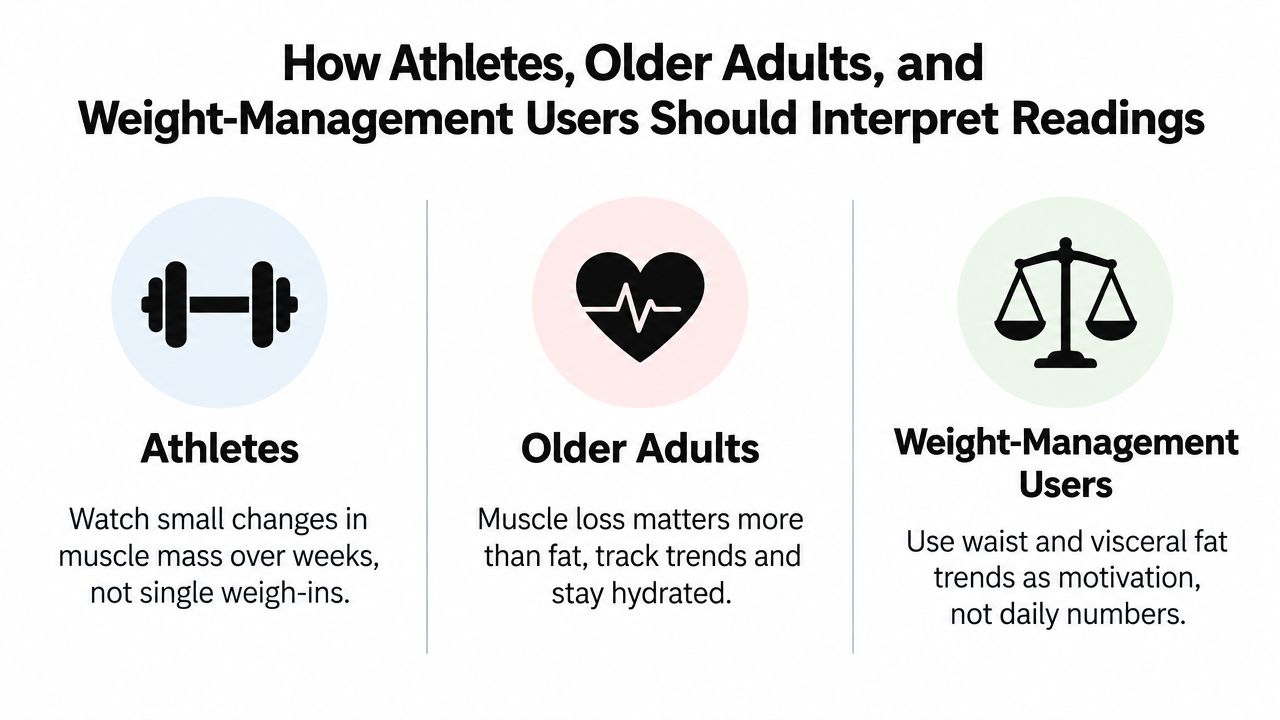
A reading can matter for different reasons. An athlete may ask whether lean mass appears stable during a demanding training block. An older adult may focus on preserving muscle and everyday function. Someone managing weight may want to know whether gradual changes in habits are producing a helpful direction.
Australian sports medicine guidance places body composition monitoring within a protocol-driven process. The practical lesson for home users is to measure under consistent conditions, connect readings to a defined goal, and review trends rather than treating one result as a final answer. Follow-up measurements should not normally exceed 4–6 times per year when following formal assessment protocols. Reports should include precision-error information and earlier individual results where available, while athlete reports should avoid normative or reference values.
Athletes
For an athlete, the useful question is whether the broader pattern supports a performance goal. A small change in an estimated muscle metric may deserve attention over several weeks, but it should be considered alongside strength, speed, recovery, training quality and medical advice.
Use the monitor to support a planned intervention, such as a nutrition adjustment or carefully managed training phase. Avoid comparing a home result with a teammate's result. Different devices, equations, measurement conditions and starting points can make that comparison misleading.
Older adults
For older adults, muscle preservation can provide a useful focus. Stable body weight may conceal changes in fat and lean tissue, while a monitor cannot assess muscle health by itself.
Pair the trend with practical markers such as walking ability, balance, strength, appetite and recovery. A sharp change, new symptom or wider health concern deserves discussion with a GP or accredited health professional. The app can show a change, but it cannot establish its cause.
Weight-management users
For weight management, direction matters more than perfect precision. Australian preventive guidance recognises regular weight and waist measurement, along with methods such as skinfold testing and DXA, when monitoring overweight and obesity. The RACGP guidance reports that in 2017–18, 67% of Australian adults aged 18 years and older were living with overweight or obesity, including 31% with obesity. It also reports overweight or obesity in 1 in 4 Australian children and adolescents aged 2–17 years, with 8.2% having obesity.
These figures support a role for body measurement in health care, but they do not make a home monitor diagnostic. Review sustained patterns across weight, waist, habits, energy and function. Treat an isolated shift as a prompt to examine conditions and context, not proof that a plan has failed.
Best Practices for Consistent Weekly Tracking and App Insights
A good tracking routine should be boring. Boring conditions reduce the number of reasons a reading might change, which makes the remaining pattern easier to interpret.
Start with one weekly appointment with yourself. Use the same device, at roughly the same time, before a predictable part of your routine. Record the result even when it surprises you, then review the trend rather than making a decision in response to one unusual measurement.
A simple weekly checklist
- Keep the window stable: Measure at a similar time and under similar conditions.
- Keep the device constant: Don't switch between monitors and assume their estimates are directly comparable.
- Write down context: Note unusually hard exercise, illness, alcohol, disrupted routines or other factors that could affect hydration.
- Review direction: Look at whether the pattern is broadly moving towards your goal.
- Use other signals: Include waist, strength, energy, performance, mobility and how your clothes fit.
Apps can reduce the effort of this process. Instead of leaving isolated numbers on a display, a connected monitor may organise readings into charts, summaries and prompts. That doesn't make the underlying estimate exact, but it can make the pattern easier to notice and discuss.
For example, the Venus AI Smart Scale is described as generating a 6-page wellness report after a reading, with body composition analysis, 30-day trend charts, segmental muscle mapping, risk flags and a personalised action plan. Its connected platform also includes weekly email briefs, AI health coaching, nutrition logging and multi-user profiles. Those features are best understood as interpretation tools, not proof that the scale has replaced a clinical assessment.
Dynamic recomposition deserves particular caution. During active diet and exercise, BIA can be less reliable against reference methods, so an app should help you see directionality rather than encourage you to obsess over exact percentage changes. A connected system can also be useful when you want one place to record related information, although nutrition suggestions and health prompts still need sensible judgement.
A fertility-focused product such as the Venus Ovulation Predictor Test Kit serves a different measurement purpose, detecting an ovulation-related hormone signal rather than estimating body composition. Keeping those roles separate prevents users from treating every health metric as if it carries the same meaning.
Turning Measurements Into Meaningful Weekly Trends
A body composition monitor works best as a coaching and trend tool, not a diagnostic truth machine. Hydration, recent exercise, food, alcohol, medication and timing can shift an estimate even when your actual tissues haven't changed.
Choose one consistent weekly measurement window, use the same device and review several readings together. Then compare the pattern with practical outcomes such as waist, strength, energy, mobility, training performance and sustainable habits.
The useful signal is usually smaller and steadier than the dramatic number that catches your eye on the app. If a reading changes unexpectedly, record the context, continue your routine and seek professional advice when the result relates to a medical concern.
Venus Health Co. offers app-connected tools for tracking body composition, including a smart scale that combines estimated weight, fat and muscle metrics with weekly summaries, nutrition features and AI-supported explanations. Visit Venus Health Co. to explore a way to turn your home readings into more organised weekly trends.