

Best Smart Scale for Body Fat: An Honest 2026 Guide
Dr. Adeyinka AdegbosinThe popular advice is to buy the scale with the most body-composition metrics. That's backwards. The best smart scale for body fat isn't the one that displays the most impressive percentage. It's the one you can use under repeatable conditions, with an app that helps you interpret trends instead of encouraging daily panic.
Home scales estimate body fat indirectly, usually through bioelectrical impedance analysis, or BIA. Australian evidence shows they can be useful for tracking change, but readings become unreliable during active weight loss or exercise phases, precisely when many buyers care about them most. University of Sydney research recommends treating these figures mainly as trend data, not as one-off diagnostic measurements.
| Use case | What matters most | What matters least |
|---|---|---|
| Fat-loss monitoring | Consistent weigh-ins, clear trend charts, reliable weight measurement | A single body-fat reading |
| Athletic programming | Repeatability, segmental data, useful integrations | Decorative health scores |
| Family wellness | Multi-user profiles, simple app, readable display | Complex clinical-sounding metrics |
| Fertility and morning tracking | Same-time weigh-ins, easy logging, cycle-aware records | Frequent body-fat comparisons |
This guide takes a practical position. Buy for your actual routine, use the scale in a disciplined way, and treat marketing claims about “clinical-grade” body composition with caution unless the device has credible validation behind it.
The Smart Scale Promise Most Reviews Skip Past
A smart scale can measure your weight directly. It can't directly see how much of that weight is fat, muscle, water, or bone. Those composition figures come from an estimate built from electrical impedance, your physical measurements, and the manufacturer's algorithm.
That distinction matters because many reviews treat every displayed metric as equally trustworthy. They aren't. A scale may report body fat, visceral fat, metabolic age, bone mass, muscle mass, and water with impressive precision on the screen, while the underlying estimates remain sensitive to hydration and other changing conditions.
The University of Sydney's TEMPO Diet Trial research makes the limitation unusually clear. Bioelectrical impedance scales can be reasonably accurate and precise when body composition is stable, but they give poor estimates during active weight-loss or exercise phases. The Sydney project is comparing publicly available scales with reference methods including a four-compartment model, DXA, air displacement plethysmography, deuterium dilution, and MRI or spectroscopy. That comparison tells you how to interpret a home scale: use it to follow a direction, not to certify a diagnosis.
The number on the screen isn't the whole product
A scale that shows a different body-fat percentage after a salty meal, hard training session, or poor night's sleep hasn't necessarily malfunctioned. It may be responding to a changed fluid distribution. The mistake is expecting a home BIA device to separate every short-term water shift from actual tissue change.
Your buying decision should therefore start with the question, “What decision will this data help me make?”
- For fat loss, you need a repeatable weekly signal alongside body weight, waist measurements, photos, and training performance.
- For athletic training, you may value segmental readings and integrations more than a headline fat percentage.
- For general wellness, an easy app and a stable weight reading matter more than a long list of inferred metrics.
- For a shared household, profile handling, privacy controls, and a readable platform can outweigh advanced BIA features.
Practical rule: If you won't weigh under similar conditions and review a trend rather than a single result, paying more for extra body-fat metrics won't solve the real problem.
Most comparison articles rank scales by features and star ratings. A better shortlist asks whether the device supports the habit you'll keep. The winner is the scale that produces comparable readings, stores them clearly, and doesn't make you mistake estimation for medical measurement.
How Body Fat Scales Actually Measure You
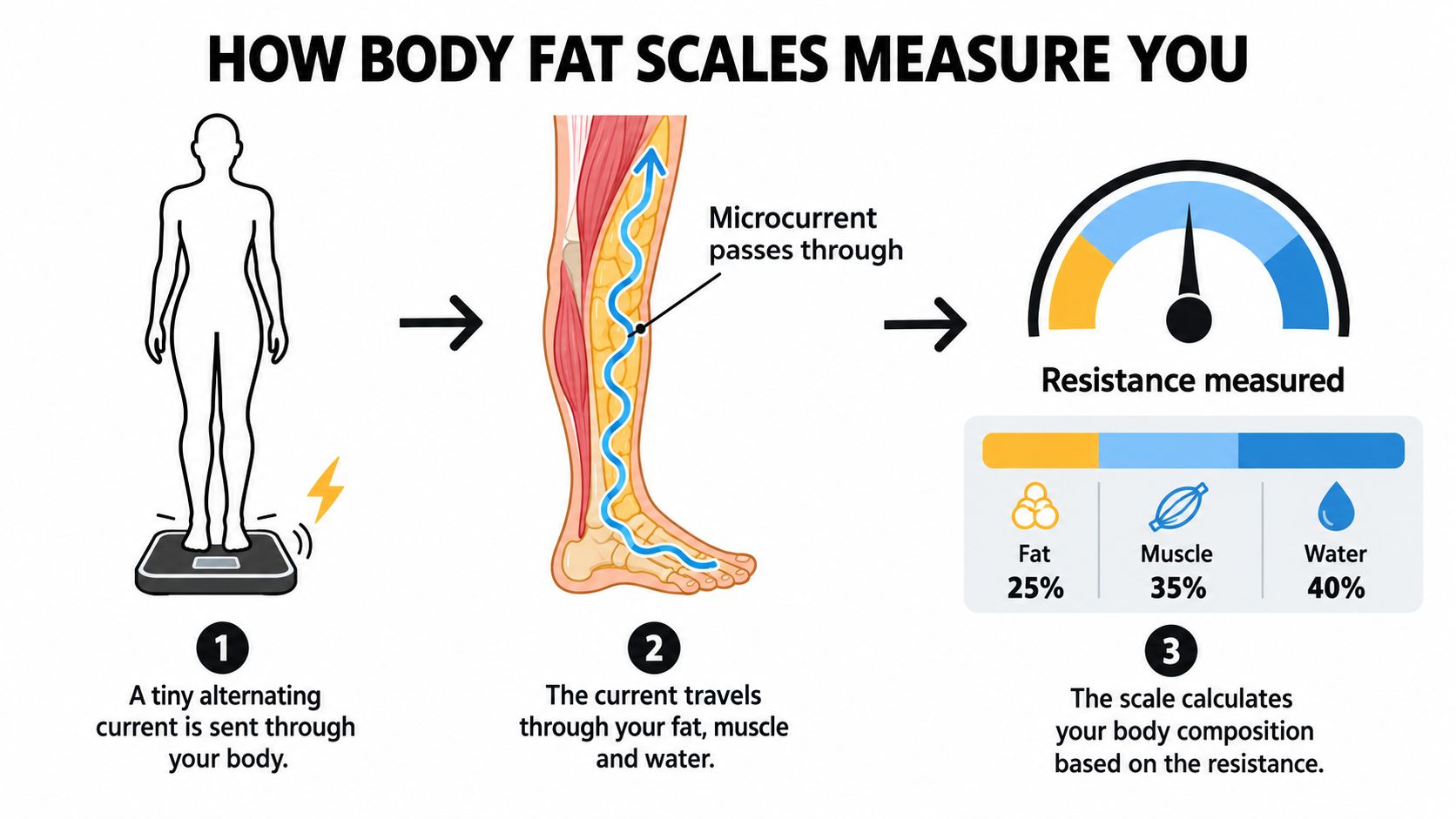
Most smart body-fat scales use bioelectrical impedance analysis, or BIA. You stand barefoot on metal electrodes, and the scale sends a tiny alternating electrical current through your body. It measures how much the signal is resisted, then combines that impedance result with inputs such as height, weight, age, and sex to estimate body composition.
Lean tissue contains more water than fat tissue, so it generally conducts electricity more easily. Fat creates greater resistance. The scale doesn't identify a fat cell directly. It measures electrical behaviour and applies an algorithm.
Why the result moves
BIA is influenced by the route electricity takes and by the amount and distribution of conductive fluid in your body. Readings can shift after exercise, changes in hydration, meals, alcohol, altered glycogen storage, or contact with wet or moisturised feet. A foot-only scale has less information about your upper body than a model with hand electrodes, and simpler contact arrangements can produce noisier composition estimates.
The electrode layout is therefore more important than the number of metrics listed in the app. Two scales may both claim to measure muscle and body fat, yet use different electrode paths and algorithms. Their results shouldn't be treated as interchangeable.
For a useful weekly comparison, create a fixed routine:
- Weigh at the same time, preferably in the morning.
- Use the bathroom first, before food or drink.
- Keep hydration conditions similar, rather than comparing a post-training reading with a rested one.
- Stand barefoot on dry electrodes, with your feet positioned consistently.
- Record the trend, not the most flattering result.
“Stable body composition” doesn't mean your body has stopped changing. It means the measurement conditions are stable enough that short-term fluid fluctuations don't dominate the result. During aggressive dieting or a heavy training block, your composition and fluid balance may both be changing, so a single reading becomes especially weak evidence.
For higher-confidence assessment, reference methods include DXA, air displacement plethysmography, deuterium dilution, MRI and spectroscopy. These methods serve different purposes and aren't practical replacements for a quick home weigh-in. A smart scale earns its place by making repeated tracking convenient.
If you want a plain-language explanation of the related muscle estimate, how a smart scale measures muscle mass covers the same measurement logic in more detail. The Venus AI Smart Scale: Body Composition & Body Fat Scale is one example of a device built around weekly reports, body-composition metrics, trend charts, and app-based interpretation. Those features can improve adherence, but they don't turn BIA estimates into direct measurements.
What the Evidence Says About Accuracy
The strongest buying lesson from validation research is straightforward: weight measurement and body-fat estimation are different products inside the same device. A scale can weigh you well while estimating body composition poorly.
A retail buying guide from Australia reports that reputable smart scales are generally accurate to about ±100 g for weight, while body-fat readings commonly differ from DEXA by around ±3 to ±5 percentage points. The guide, Australian smart-scale review guidance, also warns that hydration can shift a BIA estimate more than actual tissue change. Treat those figures as buying guidance, not clinical validation.
A peer-reviewed clinical study reached a harsher conclusion. The tested smart scales measured total weight accurately, but underestimated body-fat mass across all devices. Median absolute errors for fat mass were -2.2 kg, -4.4 kg, and -3.7 kg, depending on the scale. The authors said smart scales should not replace DEXA for body-composition assessment in patient care. The peer-reviewed validation study is why I would not recommend any consumer scale as a diagnostic instrument.
| Measurement | Home BIA scale error | Reference method | Practical meaning |
|---|---|---|---|
| Total weight | About ±100 g in reputable Australian retail reviews, with clinical testing also finding weight accurate | Calibrated reference weighing | Useful for routine weight tracking |
| Body-fat percentage | Commonly differs from DEXA by ±3 to ±5 percentage points in the retail guidance | DEXA | Use the result as an estimate and trend |
| Body-fat mass | Median absolute errors of -2.2 kg, -4.4 kg, and -3.7 kg across tested devices | DEXA | Systematic underestimation can occur |
For a plain-language explanation, read how accurate smart scales really are. The practical conclusion is clear: a small app change may be measurement noise, while a persistent direction across comparable readings can still show whether a plan is broadly working. During active dieting or heavy training, interpret single readings with even more caution because fluid balance and tissue may change together.
What Australian research adds
An Australian-affiliated study found that 2D smartphone image predictions performed better than the tested BIA scales for estimating body fat. The image method achieved concordance correlation coefficients of 0.90 for both males and females, while the BIA estimates achieved 0.66 and 0.79. Its RMSE values were 2.9 and 2.8 for the image method, compared with 5.6 and 4.6 for BIA. The PubMed study also reported clinical equivalence for the image predictions at the stated thresholds, while the BIA estimates were not equivalent at either threshold.
Smartphone images are not a universal replacement for a scale. The findings do challenge the marketing assumption that a consumer BIA number is automatically the most reliable at-home body-fat estimate.
If you track fertility alongside weight, the Venus Smart Basal Thermometer for Ovulation measures morning basal temperature, not body composition. Keep those data types separate.
The Features That Actually Matter When You Compare Scales
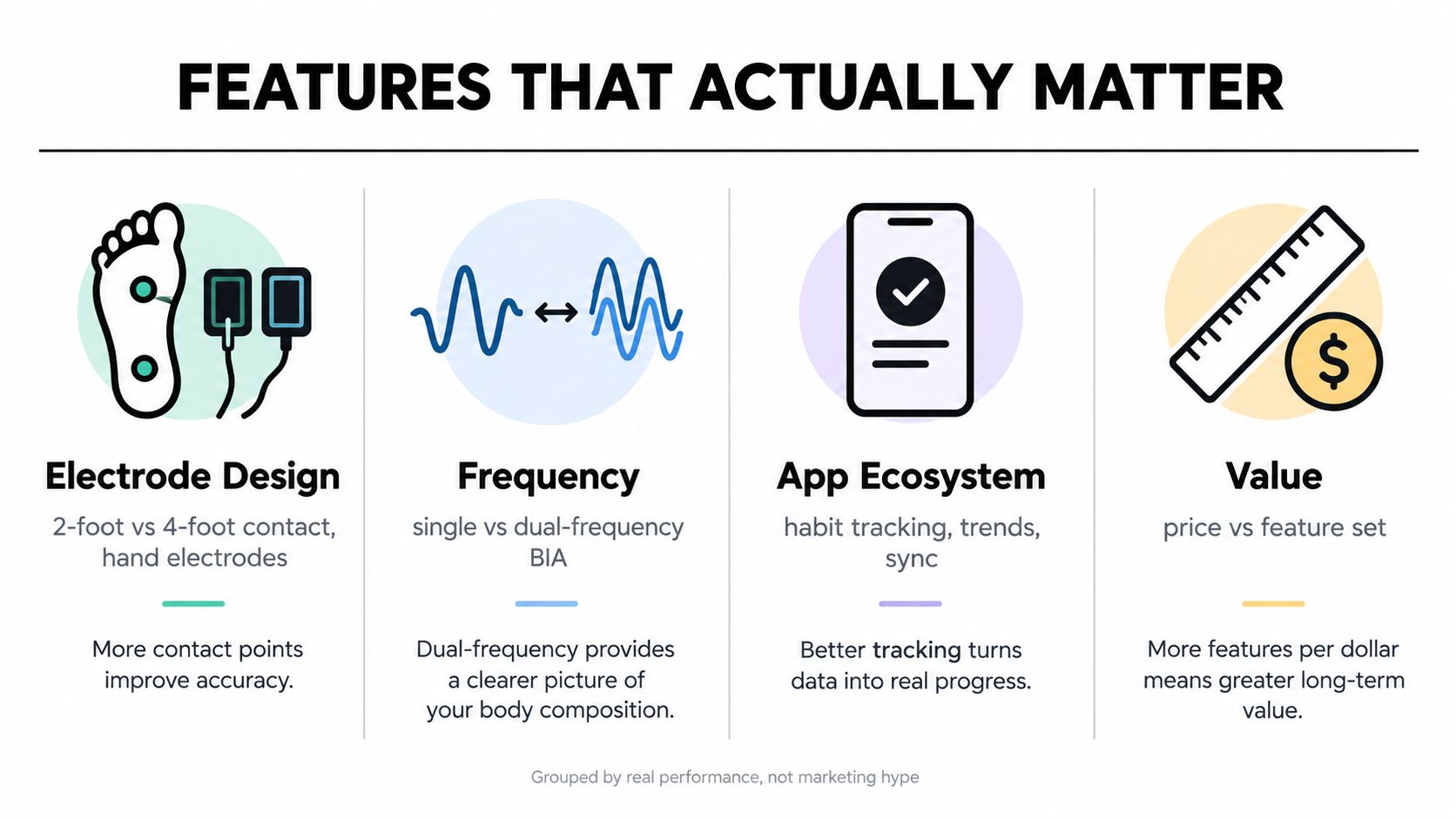
The best comparison starts with the measurement path, not the app screenshots. A polished interface can make poor data easier to read, but it can't compensate for limited electrode contact or weak validation.
Electrode design comes first
Basic foot-only models send current through the lower body and infer more from that limited route. Four-electrode foot-to-foot designs can offer more consistent contact than simpler two-point arrangements. Scales with hand electrodes add another measurement pathway and can provide more stable body-composition outputs, according to Australian review guidance.
Dual-frequency BIA is another meaningful differentiator in premium products. It may give the algorithm more information about fluid distribution than a basic single-frequency approach. That still doesn't remove the need for consistent conditions, and it doesn't justify accepting every number as true.
Metrics should change your behaviour
A metric has value only if it affects a decision. Lean mass may help you monitor whether a dieting phase is damaging training progress. Segmental readings can help an athlete review left-right or upper-lower patterns. Visceral-fat scores may offer a broad trend, but they shouldn't be read as a precise clinical measurement.
Bone-mineral estimates are frequently presented with more authority than they deserve on consumer hardware. Pulse wave velocity has the same problem. These features sound clinical, but a bathroom scale shouldn't replace appropriate medical testing.
The app layer matters because it determines whether you'll use the information. Look for:
- Trend views: You should be able to see changes over time without hunting through daily records.
- Data portability: Apple Health, Google Health Connect, or export options reduce lock-in.
- Household profiles: Automatic recognition is convenient, but check that users can correct misassigned weigh-ins.
- Privacy controls: Find out whether you can limit cloud sharing and whether the app explains its data practices.
- Long-term support: Firmware updates, warranty coverage, and continued app compatibility matter more than decorative dashboards.
For users who need a wider platform or easier access, a heavy-duty bathroom scale for seniors may be more appropriate than a compact smart model. The priority is safe, readable weighing, not body-fat analysis.
The best smart bathroom scale comparison should therefore include electrode configuration, app usability, data ownership, user handling, and warranty. Don't let a large metric count distract you from the two questions that determine usefulness: will the scale produce comparable readings, and will you still use the app after the novelty fades?
Matching a Scale to Your Real Goal
A scale for an athlete shouldn't be judged by the same standard as one for a grandparent. The measurement is the same kind of estimate, but the decision attached to it changes.
The athlete
A lifter or endurance athlete needs repeatability and context. Segmental readings may help identify a developing imbalance, while app integrations can place weight and composition trends beside training records. A stable routine matters more than a dramatic daily change, especially during hard blocks when hydration and glycogen fluctuate.
The winning feature is a useful training ecosystem. The irrelevant marketing feature is a bone-mineral estimate displayed with excessive confidence. If a scale can't export or integrate data cleanly, a large metric list won't help you adjust training.
The senior
For an older user, a large, readable display and a secure standing platform beat a complicated dashboard. The scale should be easy to step onto, easy to clean, and simple enough that a family member can help set it up without turning every weigh-in into technical support.
The winning feature is accessibility and stable weight tracking. The irrelevant feature is a dense body-composition report that encourages concern over small estimated movements.
The parent
A family scale has to keep different people's records separate. Auto-recognition can be helpful, but it shouldn't be the only safeguard, particularly when a teenager's weight is changing and several household members have similar measurements.
The winning feature is correctable multi-user management. Parents should also check whether the app offers appropriate modes and whether body-composition features can be avoided when they aren't suitable. A glossy score or gamified badge is irrelevant if the app assigns readings to the wrong profile.
The fertility-tracking user
Fertility tracking demands a consistent morning routine, not frequent body-fat interpretation. Weight can be logged alongside cycle information, but the key is keeping measurement timing consistent and understanding that hormonal, fluid, and cycle-related changes can affect the scale's composition estimates.
The winning feature is a low-friction app that supports regular records. The irrelevant feature is an elaborate visceral-fat score that has no direct role in identifying ovulation. Use the scale as a supplementary wellness record, not as a fertility diagnostic.
Price, Value, and the Subscription Trap
Price bands are useful only when they describe what changes in practice. A cheaper scale can be perfectly adequate if your goal is reliable weight tracking and a rough body-fat trend. A premium device is justified when its electrode design, segmental detail, or reporting system supports a routine you'll maintain.
Treat these ranges as buying categories, not guarantees of accuracy:
| Price tier | Typical hardware | App model | Best for |
|---|---|---|---|
| Under $60 | Basic smart scale with weight and estimated composition | Usually simple app tracking | Weight and broad trend monitoring |
| $60 to $150 | More metrics, stronger app experience, sometimes richer contact design | Trend charts and health-platform connections vary | Users who want more context without premium hardware |
| $150 and above | More advanced BIA configurations and segmental features may appear | Often deeper reporting, sometimes paid extras | Athletes and committed data users |
The subscription trap is straightforward. If an app locks historical trends, exports, reports, or household features behind a recurring fee, the sticker price is only the entry cost. The hardware may measure the data, but the company can still charge you to access or interpret it.
That model can work if the coaching or reporting changes your behaviour. It's poor value if you're paying to access information the scale already collected. Compare the full ownership experience before buying, including whether your data can move to Apple Health or Google Health Connect.
Value test: If the app charges for features the hardware already measures, treat the hardware price as the floor, not the total cost.
Premium also isn't automatically better for a casual user. If you'll weigh occasionally, need only body weight, and don't review trends, a basic scale is the sensible purchase. Pay more when the extra measurement pathways, integrations, or reporting will remove friction from a specific goal.
Your Shortlist and Buying Checklist
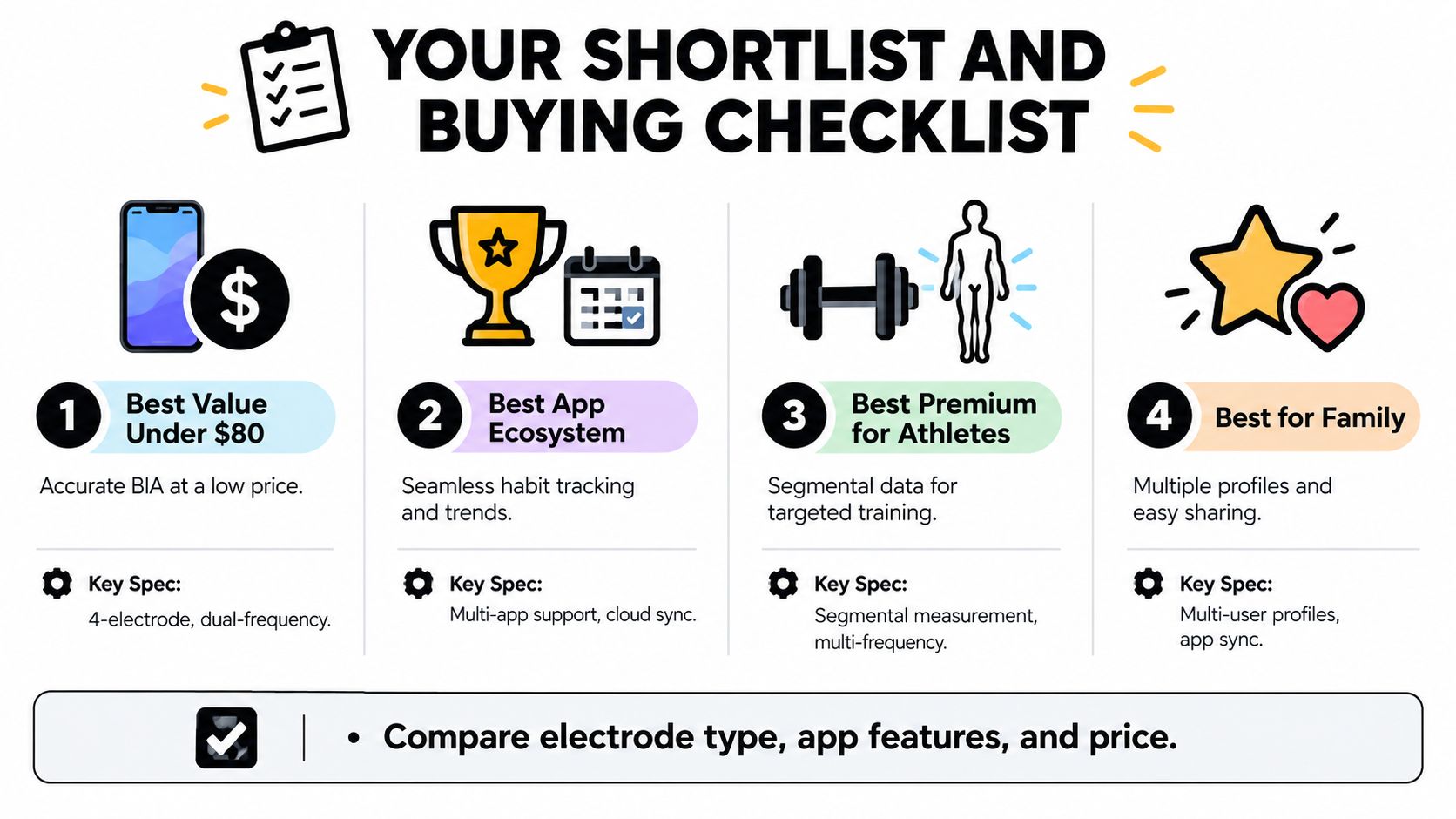
I'd narrow the market to four buying positions rather than name a universal winner.
- Best value under $80: Choose a simple BIA scale from a reputable brand with clear trend charts and reliable weight measurement. Don't pay extra for a long list of inferred metrics you won't use.
- Best app ecosystem for habit tracking: Choose the model that makes weekly review effortless, supports your phone's health platform, and keeps historical data accessible. The app should help you notice patterns, not bury them.
- Best premium option for athletes: Choose a model with additional electrode pathways, dual-frequency BIA where available, and segmental reporting. The priority is repeatable context for training, not a supposedly exact fat percentage.
- Best non-subscription option for privacy-focused households: Choose a scale with multi-user profiles, straightforward syncing, export or platform support, and clear control over account data. Avoid an ecosystem that makes your history unusable unless you keep paying.
Before you buy, run through this checklist:
- Confirm the electrode layout: Check whether the scale uses foot-only contact or includes hand electrodes, and make sure the platform suits the intended user.
- Verify data access: Look for Apple Health, Google Health Connect, or another export route you'll use.
- Inspect user handling: Test how easily the app separates profiles and corrects mistaken weigh-ins.
- Read the support terms: Check warranty length, firmware policy, app support, and what happens if the service changes.
- Decide on subscriptions first: If you don't want recurring costs, exclude locked ecosystems before comparing hardware.
- Set your measurement routine: Same morning conditions, dry feet, and trend review are part of the product's value.
For most buyers, my default is a well-supported mid-range scale used once weekly under consistent conditions. Athletes should spend more only when segmental data and integrations support real programming decisions. Everyone else should prioritise repeatability, privacy, and an app they'll continue opening.
Venus Health Co. offers an AI body-composition smart scale with weekly wellness reports, trend charts, nutrition tracking, app-based coaching, and no subscription according to its product information. If you want a connected way to review body-fat trends alongside broader wellness data, visit Venus Health Co. and compare its tools with the checklist above.