

Why Is My Period So Light This Month? Causes Explained
Dr. Adeyinka AdegbosinOne light period is usually a temporary shift in ovulation or the uterine lining rather than a disease, but rule out early pregnancy first if it's possible. Then compare the change with your previous three to six cycles rather than judging your health by this month alone.
You've reached for your usual period products, but barely needed them. Perhaps the bleeding stopped before you expected, or you're wondering whether spotting even counts as a period.
The useful question isn't just “Why is my period so light this month?” It's whether pregnancy is possible, what's changed recently, and whether this is an isolated difference or a developing pattern.
Is One Light Period a Reason to Worry
A single lighter period often isn't urgent. Your usual pattern matters more than someone else's flow, especially when your timing is otherwise familiar and you feel well.
The usual menstrual cycle is approximately 28 days, but a normal cycle can range from 21 to 35 days, and flow varies between individuals, as described in Healthdirect's female reproductive system information. A lighter bleed can reflect a temporary change in ovulation or how much uterine lining developed, rather than an underlying disease.
Match the situation to the next step
Use the table to decide whether to monitor, test or seek care. These are starting points, not diagnoses, and pain or faintness changes the urgency even when there's very little blood.
What a light period most likely means and what to do next
| Your situation | Most likely meaning | Next step |
|---|---|---|
| First light period, otherwise regular cycle | Normal month-to-month variation may explain it | Keep logging if pregnancy is excluded and you have no concerning symptoms |
| Light period after starting, switching or stopping contraception | A hormonal change may have altered the lining | Record the change and ask your prescriber about persistent or troublesome bleeding |
| Light period and pregnancy is possible | Early pregnancy hasn't been ruled out | Take a home pregnancy test at the appropriate time |
| Light bleeding between periods or after sex | The cause needs assessment | Book a GP visit |
| Light bleeding with one-sided pain, shoulder-tip pain or fainting | Possible ectopic pregnancy or significant blood loss | Seek emergency care now |
| Light periods across repeated cycles | A hormonal or medical pattern may be developing | Bring your cycle history to a GP rather than continuing to wait |
A lighter flow without other changes is different from bleeding that's become lighter, less predictable and painful. Similarly, spotting after sex shouldn't be counted as an ordinary period just because it happened near your expected date.
Practical rule: One month is a data point. A repeated change, or a concerning symptom, is a reason to act.
Tracking is useful when you're otherwise well. It isn't a requirement you must complete before asking for medical help.
Ruling Out Early Pregnancy First
Light bleeding doesn't exclude pregnancy. Early-pregnancy bleeding can occur with a normally developing pregnancy, miscarriage or ectopic pregnancy, so appearance alone can't establish what's happening.
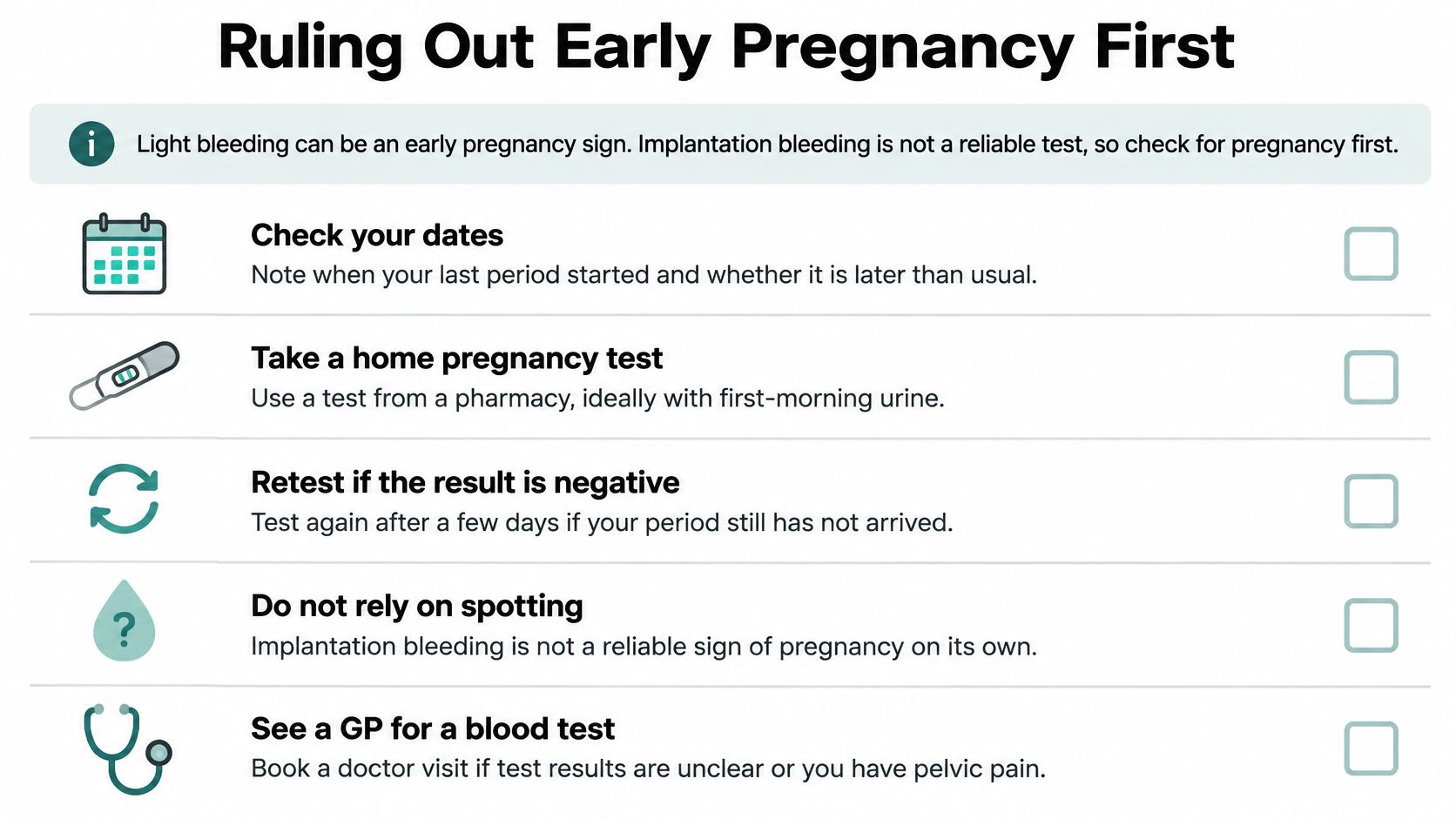
What people call implantation bleeding isn't a reliable diagnostic sign. Don't use spotting, its colour or its short duration as a substitute for a pregnancy test.
Follow the testing sequence
- Check when conception could have been possible. Note your last period and sexual intercourse without reliable contraception. Include any missed contraception or uncertainty about whether you used it correctly.
- Test at the appropriate time. Use a home urine pregnancy test from your expected period date or at least 14 days after possible ovulation, following the kit instructions.
- Repeat a negative test when needed. If pregnancy remains possible or your bleeding doesn't become typical, repeat the test after 48–72 hours. A negative result taken too early shouldn't be treated as a final answer.
- Arrange care after a positive result. Book a GP appointment to discuss the result, the bleeding and your next steps. Tell the practice about any pain or dizziness when arranging the appointment.
The testing intervals and warning signs above follow the pregnancy guidance summarised alongside Healthdirect's information on hormonal contraceptives and periods. If the display is confusing, this guide to reading pregnancy test results can help you work through the instructions.
This checklist offers a visual reminder, but the kit instructions and your symptoms should guide what you do.
Once pregnancy has been appropriately excluded, contraception changes, training, stress and other hormonal causes become more useful explanations to investigate. If results remain unclear, contact your GP rather than repeatedly trying to interpret the bleeding.
Seek emergency care now if light bleeding comes with one-sided or severe abdominal pain, shoulder-tip pain, fainting, marked dizziness or heavy bleeding. These can indicate ectopic pregnancy or significant blood loss. Don't wait for a pregnancy test result before seeking help.
How Ovulation, Lifestyle and Hormones Lighten Flow
A runner increases her training, keeps eating as before, and then notices that her periods have become unusually light. The change can make more sense when you follow the signals from the brain to the ovaries and then to the uterine lining.
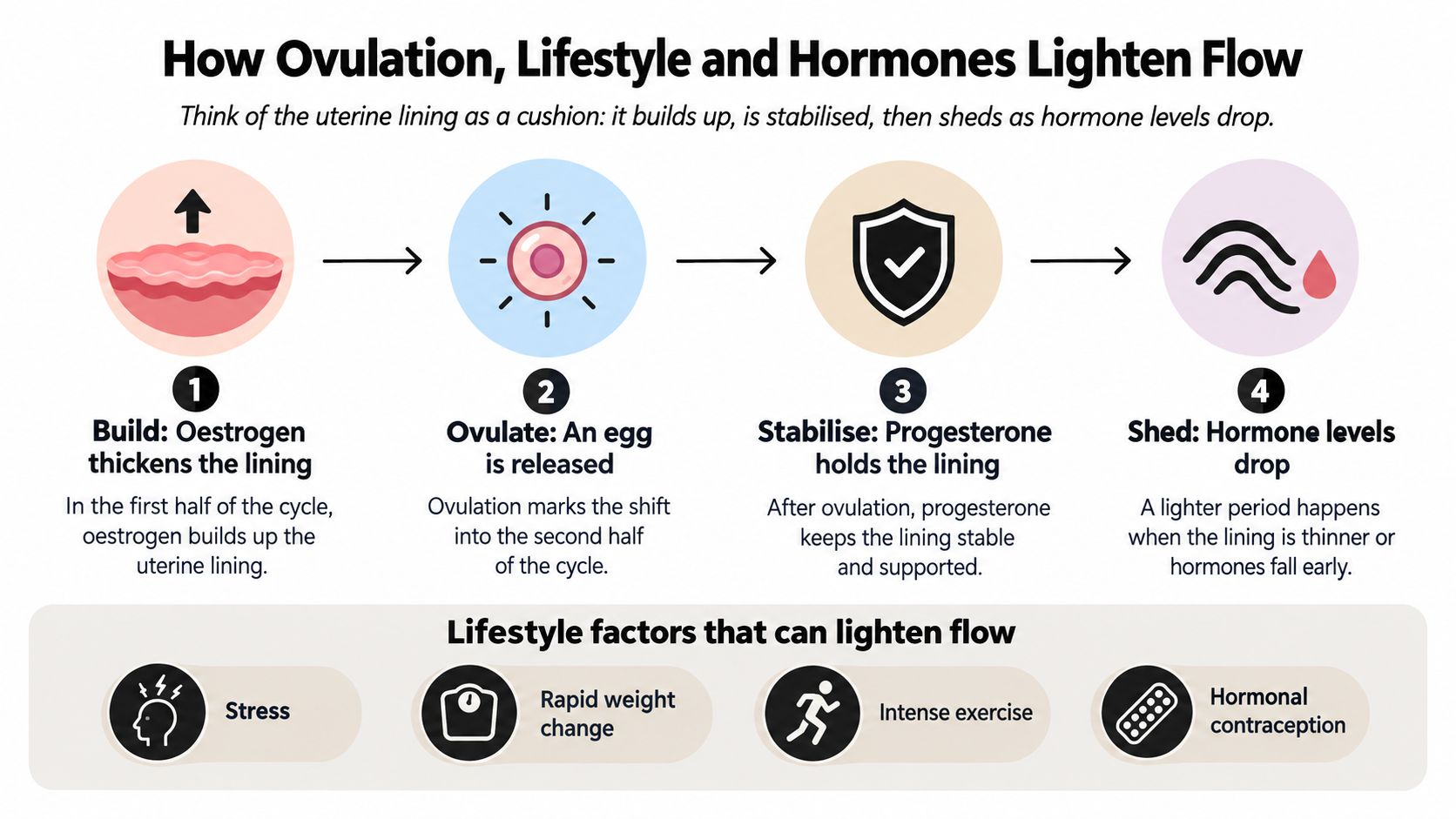
Oestrogen builds the lining, and progesterone supports it after ovulation. When hormone levels fall, the lining sheds. If ovulation is delayed or skipped, the hormone pattern changes, which can affect both the timing and amount of bleeding.
The diagram shows the usual sequence. Individual cycles can vary.
Follow the signals from brain to ovary
The hypothalamic–pituitary–ovarian axis is the communication chain linking the brain and ovaries. Its signals help coordinate ovulation and the growth of the uterine lining.
- The hypothalamus sends a signal. It releases gonadotropin-releasing hormone, or GnRH.
- The pituitary responds. It releases follicle-stimulating hormone and luteinising hormone, known as FSH and LH. These hormones help coordinate ovarian activity and ovulation.
- The ovary and lining respond. When energy availability is low, reproductive hormone signalling can slow, delaying or stopping ovulation and reducing oestrogen-driven lining growth.
- The bleed can change. A thinner lining means less tissue to shed. Disrupted ovulation can also make bleeding less predictable.
Bleeding alone can't show exactly what happened during ovulation. Light flow doesn't prove that you didn't ovulate, and disrupted ovulation does not create the same pattern in every cycle.
Healthdirect's irregular periods guidance lists sudden weight loss or gain, psychological stress, exercise changes, hormonal contraception and the post-childbirth period among possible causes of lighter or irregular periods. Repeated changes are more informative than one unusual cycle, so note the pattern across three to six cycles and seek assessment if it persists.
Why training and fuel availability matter
Return to the runner who has increased training without increasing food intake. The body needs enough energy for both exercise and reproductive function. Low energy availability suppresses GnRH, which can delay or skip ovulation and reduce the hormonal signals that build the uterine lining.
Running itself does not remove menstrual blood. The relevant link is the energy deficit and its effect on ovulation. If flow becomes unusually light or periods start disappearing after a training change, record the timing alongside training, food intake, recovery and other symptoms, then discuss the pattern with a clinician.
A lighter period after harder training does not show that the body has adapted well. Track the change and consider the wider pattern.
Stress can affect the same brain-to-ovary signalling system. Exam pressure, bereavement or a demanding stretch at work can coincide with cycle changes. Persistent changes still deserve a broader assessment rather than being attributed to stress alone.
Separate temporary triggers from persistent conditions
A recent change in training, weight or stress gives you a useful starting point for reviewing your cycle. Repeated light or missed periods, especially alongside other symptoms, call for medical assessment.
Flow by itself cannot identify the cause or show whether thyroid, prolactin, androgen or ovarian function needs testing. A clinician can assess the wider pattern and decide what to check.
For cycle awareness, record LH test results, basal body temperature patterns and cervical mucus changes. The Venus Ovulation Predictor Test Kit is one at-home option for tracking LH results. A positive LH test does not prove that an egg was released or explain why bleeding is light.
For another visual explanation of the cycle, the video below offers a different format.
How Hormonal Contraception Changes Your Flow
A period may become lighter after you start, switch or stop hormonal contraception. To understand why, follow what happens to the uterine lining: progestogen suppresses its growth, so less lining builds up to shed. The result may be a lighter bleed, spotting or no bleeding, depending on the method.
Compare the method with your own pattern
Bleeding while using hormonal contraception may follow a different pattern from a natural cycle with ovulation. A bleed by itself does not show whether ovulation occurred, so compare it with your usual pattern and note when your contraception changed.
How each contraception method usually changes bleeding
| Contraception method | Usual effect on flow | What to expect |
|---|---|---|
| Combined pill | Bleeding may become lighter or shorter | Record changes and discuss troublesome bleeding with your prescriber |
| Progestogen-only pill | Light or irregular bleeding may occur | Timing can be unpredictable |
| Hormonal IUD (levonorgestrel) | Periods may become much lighter or absent | Ask about the expected pattern for your device |
| Contraceptive implant | Bleeding may be irregular, light or absent | Your pattern may differ from another user's |
| Progestogen injection | Light or absent periods may occur | Discuss persistent concerns with the prescribing clinician |
| Copper IUD | Usually associated with heavier rather than lighter bleeding | Don't automatically attribute a new light period to this method |
The table shows common patterns, not proof that contraception is working. Follow the instructions for your specific method if you missed a dose, took a pill late or had another possible lapse.
Record changes rather than guessing
Write down the method, start date, stop date and any missed doses. This gives your prescriber a clearer view of whether the change followed a contraception change or needs separate assessment.
When starting, switching or stopping a method, ask the prescriber what bleeding pattern to expect and when to check back if it continues. Note the timing, amount and any spotting in the meantime. A change that persists for three to six cycles, or bleeding that concerns you sooner, is a reason to contact your prescriber rather than just waiting it out.
If pregnancy-testing criteria already discussed apply, follow them. A lighter bleed does not rule out pregnancy. Don't stop prescribed contraception solely because bleeding has changed. Speak with your prescriber first about your options and how to maintain pregnancy prevention.
When a Light Period Affects Fertility
When ovulation happens later than usual, the fertile window shifts too. An app that predicts ovulation from calendar dates may then mark the wrong days for trying to conceive. If ovulation does not happen in a cycle, there is no ovulatory fertile window that cycle.
The key fertility clue is whether ovulation is disrupted, not how much blood you see. A lighter bleed alongside otherwise regular cycles gives different context from a change in timing or a pattern of irregular cycles.
Focus on ovulation rather than blood volume
If you're trying to conceive, consider whether your cycle timing has changed. LH results and a sustained rise in basal body temperature can offer clues about ovulation, though home tracking cannot provide a complete assessment. PCOS, perimenopause and recent contraception changes are also possibilities to discuss with your GP if disruption continues.
After ovulation, the corpus luteum, the structure left behind by the released egg, produces progesterone. Learn more about signs and symptoms of low progesterone to understand its role in the cycle and prepare questions for your clinician.
Look for a recurring pattern across three to six cycles. A single lighter bleed offers limited information about fertility, while repeated shifts in cycle timing may suggest ovulation is less predictable.
If you're trying to conceive and light or irregular periods continue, speak with your GP. An app's predicted dates cannot confirm when ovulation occurred. For practical details on what to record, see the cycle-log section.
Track Cycles and Book the GP Visit
A useful log makes the change understandable without turning your day into a monitoring project. Compare the current bleed with your previous cycles, using whatever records you already have, rather than waiting to create a perfect history.
Dates, flow and symptoms together are more informative than a single label such as “light”. A shift in timing as well as volume gives your GP different information from an isolated reduction in bleeding.
Keep a practical cycle log
Cycle log entries and why each one matters
| Log entry | What to record | Why it matters |
|---|---|---|
| Cycle dates | Start and end date of each bleed | Shows whether timing has changed from your usual pattern |
| Daily flow | Light, medium or heavy, plus pad or tampon count if useful | Helps describe the change consistently |
| Spotting | Dates and timing of bleeding outside your expected period | Separates spotting from menstrual bleeding |
| Contraception | Method, start or stop date and missed doses | Provides context for changes in flow |
| Training and weight | Changes in exercise load, fuelling and weight | Highlights possible energy-related triggers |
| Stress and sleep | A brief, consistent weekly description | Helps you notice changes alongside cycle disruption |
| Ovulation signs | LH results, temperature patterns or mucus observations | Adds context without diagnosing the cause |
| Pregnancy tests | Test dates and results | Shows whether testing needs follow-up |
A paper calendar is enough. If you prefer digital records, this guide to choosing a period tracker app can help you decide what you'll use consistently.
For temperature recording, the Venus Smart Basal Thermometer for Ovulation - Bluetooth BBT Tracker with App is one option that syncs readings by Bluetooth. It can help organise observations, but it can't diagnose the reason for light bleeding or replace contraception.
Know when tracking should become an appointment
Book a GP review for recurring light or missed periods, bleeding between periods or after sex, pelvic pain, or any bleeding after menopause. Also mention acne, increased facial hair, nipple discharge, hot flushes or significant weight change.
Fatigue or faintness alongside a changed bleeding pattern deserves assessment too. Australian research on menstrual bleeding patterns and anaemia doesn't establish that anaemia causes light periods, so don't use either symptom to diagnose the other.
Prepare for the visit with a short checklist:
- Bring pregnancy-test details. Include when you tested, not just the result.
- Bring the cycle log you have. Don't delay an appointment because records are incomplete.
- List medications and contraception. Include recent changes and start or stop dates.
- Ask what happens next. Your GP may consider targeted thyroid, prolactin, androgen or ovarian-function assessment, depending on your history and symptoms.
Book now if the change persists or concerning symptoms appear. If this is an isolated light cycle, pregnancy has been appropriately excluded and you otherwise feel well, keep recording your pattern rather than assuming something is wrong.
Venus Health Co. offers at-home LH tests, Bluetooth basal temperature tracking and app-based cycle records to help you organise observations when your flow changes. Visit Venus Health Co. to explore tools for building a clearer cycle log, and take persistent changes or concerning symptoms to your GP.