

What Is Follicular Phase? Timing, Hormones and Variations
Dr. Adeyinka AdegbosinWhy does your period app keep circling day 14 as the big moment, even when your body clearly has other plans? If you've searched for what is follicular phase, you've probably met neat four-part diagrams that make every cycle look like a 28-day clock. Real cycles are less tidy. The pre-ovulatory stage works like a flexible runway: hormones prepare an egg, symptoms come and go, and the exact timing can shift.
That flexibility matters because a textbook average can blur two very different kinds of clues. Some signs give early warning that ovulation may be approaching. Others only confirm the timing after an egg has been released. Treating those signals as the same thing can make a fertile window feel more confusing than it needs to be.
A helpful way to read this stage is to think in layers, not dates. First, notice the cycle pattern over time. Then, pay attention to changes that suggest follicle growth is underway. Finally, use clearer signals to confirm what happened. Once those layers are separate, the follicular phase stops looking like a fixed days 1 to 13 block and starts looking like a real, responsive part of your cycle.
What the Follicular Phase Means in Plain Terms
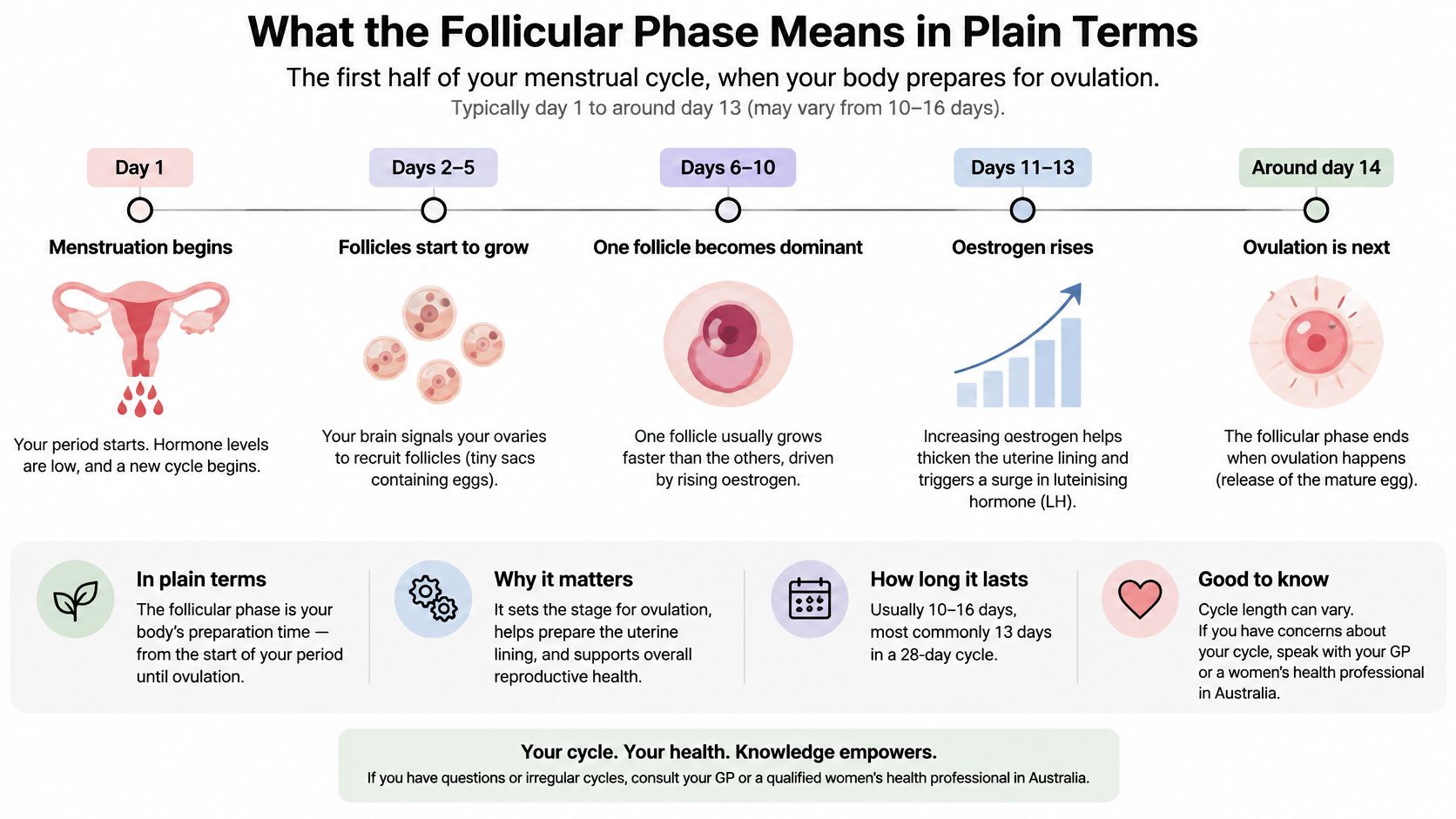
The follicular phase is the egg-preparation stage of your menstrual cycle, beginning on the very first day of full menstrual bleeding and continuing right up until ovulation. Inside your ovaries sit tiny, fluid-filled sacs called follicles, each holding an immature egg. Early in the cycle, a small group of these follicles starts to grow, and usually one pulls ahead to become the dominant follicle that will mature and release an egg.
Picture your menstrual cycle as a two-leg relay race. The follicular phase is the first leg, where your body selects and prepares the egg while rebuilding the uterine lining. Ovulation is the hand-off, passing the baton to the second leg, known as the luteal phase, which carries the cycle through to your next period.
The visual below maps out how this opening leg unfolds from day 1 through to the mid-cycle hand-off.
Where the Boundary Catches People Out
One detail trips up almost everyone who starts tracking their cycle for the first time. The follicular phase includes your period itself. It doesn't wait until bleeding stops to begin.
Say your period arrives on a Monday morning and lasts five days, finishing on Friday. Monday is day 1 of your follicular phase, not Saturday. While your uterus is shedding the lining from the previous cycle, your brain and ovaries are already recruiting the next batch of follicles behind the scenes.
Practical rule: Count day 1 from the first day of menstrual bleeding, even though your body feels like it is closing out the previous month.
In a standard 28-day teaching model, this stage sits roughly across days 1 to 13. Treat that window as a rough frame rather than a strict deadline. Right now, you can open your calendar, mark day 1 of your last period, and see exactly where your current cycle began. That single date is also the anchor point that cycle apps and urine ovulation tests use to estimate when your fertile window might open.
When the Follicular Phase Falls in Your Cycle and How It Varies
Ask a period-tracking app when ovulation happens and it will often answer day 14. Real cycles rarely cooperate so neatly. Cycle length is counted from the first day of a period to the day before the next period starts, and because the post-ovulation luteal phase holds fairly steady at about 14 days, subtracting 14 from your total cycle length gives a working estimate of your ovulation day and, by extension, the length of your follicular phase.
Follicular Phase Timing by Cycle Length
| Cycle length | Typical follicular phase | Usual ovulation day | Luteal phase |
|---|---|---|---|
| 26 days | about 11 to 12 days | around day 12 | about 14 days |
| 28 days | about 13 to 14 days | around day 14 | about 14 days |
| 30 days | about 15 to 16 days | around day 16 | about 14 days |
| 34 days | about 19 to 20 days | around day 20 | about 14 days |
A 31-day cycle makes the method concrete. Subtract 14 and ovulation lands near day 17, which puts the follicular phase at roughly 16 to 17 days, several days longer than the textbook version.
Australian health guidance reflects this gap between teaching models and lived reality. Queensland Health frames the follicular phase as approximately days 1 to 13 in a typical cycle and Healthdirect describes cycles lasting around 28 days, yet a large international cohort study in the Journal of Medical Internet Research reported that 84% of Australian women had total cycle lengths of 26 to 34 days. To see where your own monthly pattern sits within clinical ranges, our guide to normal menstrual cycle length walks through the expected variation.
Why the Day 14 Assumption Fails in Practice
Calendar maths assumes everyone clusters tightly around the middle of a 28-day month. Ovulation data spreads far wider. In an Australian mobile-app cohort analysis published in the International Journal of Environmental Research and Public Health, researchers examined 18,761 cycles with a positive luteinising-hormone test and used the day after that positive test as the estimated ovulation day: ovulation landed on cycle day 14 in only 13.08% of cycles, with day 13 at 12.13% and day 15 at 11.96%. Even in that dataset, where the follicular phase commonly ran about 12 to 14 days, nearly nine in ten cycles still released an egg on some other day.
Because the luteal phase tends to hold steadier after ovulation, most of the stretch or compression in total cycle length happens before the egg is released. Two people can both have functional cycles that look nothing alike on a calendar. Someone on a 24-day cycle may ovulate around day 10, while someone on a 40-day cycle may not ovulate until about day 26. A generic day-14 prediction misses both fertile windows by days or even weeks.
Tracking signals divide into two camps here. A positive LH urine test gives early warning, flagging the fertile window about 24 to 36 hours before ovulation begins. Calendar counting only confirms the timing in hindsight, once the next period arrives and the full cycle length is known.
Several everyday and medical factors can lengthen or shift follicular recruitment from one month to the next:
- Physical and emotional stress: High stress can slow the brain's signalling to the ovaries, delaying follicle maturation.
- Illness and energy deficit: Recovering from a virus, under-eating, or ramping up heavy training loads can push ovulation later in the cycle.
- Life stages: Adolescents establishing regular cycles and women entering perimenopause frequently see wide swings in follicular duration.
- Endocrine conditions: Conditions such as polycystic ovary syndrome (PCOS) often delay or disrupt follicle selection, creating much longer intervals between periods.
Shifting pre-ovulatory timing also explains why physical sensations do not always arrive on the same calendar date. If you notice pelvic aching or cramping between bleeding and ovulation as your timing moves around, Lake City Physical Therapy on mid-cycle pain outlines common pelvic and musculoskeletal reasons discomfort can appear during this window.
One unusual month rarely tells the whole story, because a single late follicular phase can reflect a bout of illness or a demanding week.
If your results vary from day to day, tracking them over several cycles gives the most insight. Three or more months side by side turns scattered dates into a personal baseline, and it shows whether a shift was a one-off or the start of a pattern.
How Hormones Build Up a Dominant Follicle
Nothing in the follicular phase happens by accident. Your brain and ovaries run a tightly coordinated selection contest driven by a chain of hormonal hand-offs.
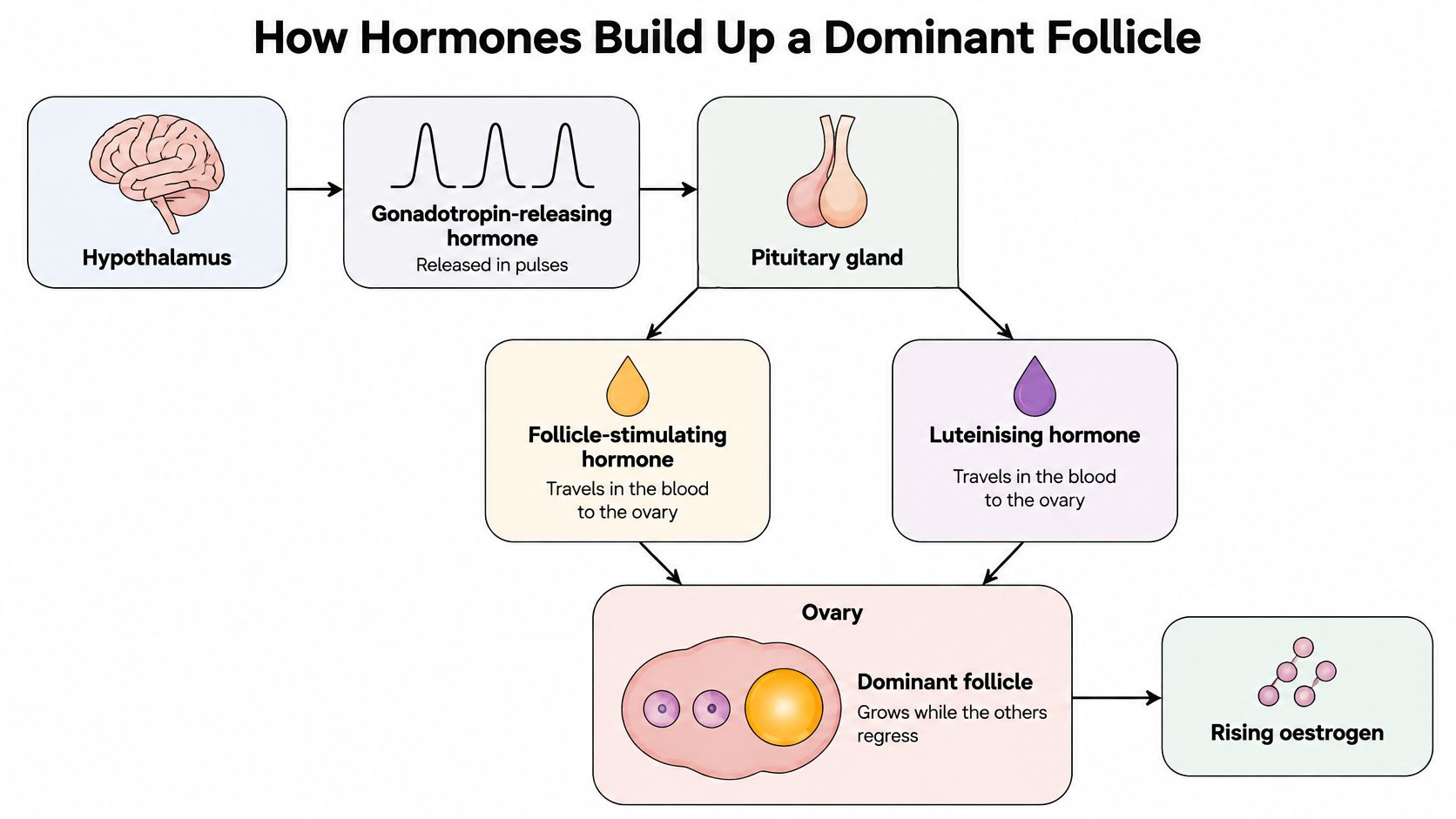
First, the hypothalamus in your brain releases pulses of gonadotropin-releasing hormone (GnRH), which instruct the pituitary gland to secrete follicle-stimulating hormone (FSH) and luteinising hormone (LH). Clinical guidance from Queensland Health describes how this hypothalamic-pituitary-ovarian feedback system coordinates follicle recruitment early in the cycle and culminates in the mid-cycle LH surge that triggers ovulation.
Here is how those signals travel from the brain down to the ovary and back again.
Inside the Follicle Selection Contest
Early in the phase, rising FSH recruits multiple follicles to start growing at the same time. Soon, the competition narrows. One follicle develops slightly faster than its neighbours and begins releasing increasing amounts of oestradiol (the main form of oestrogen during reproductive years) along with a hormone called inhibin.
That output gives the front-runner its edge. Rising oestradiol and inhibin suppress pituitary FSH, starving the slower follicles so they regress while the dominant follicle keeps growing. Research published in Human Reproduction on follicle growth shows the dominant follicle reaching at least 10 mm in diameter by mid-follicular development and commonly growing to at least 20 mm right before the LH surge initiates final maturation and rupture.
Hormones Active in the Follicular Phase
| Hormone | Source | Role in the follicular phase | Change as ovulation nears |
|---|---|---|---|
| GnRH | Hypothalamus | Pulses signal the pituitary to release FSH and LH | Pulse pattern shifts before the LH surge |
| FSH | Pituitary gland | Recruits several follicles early in the cycle | Falls as the dominant follicle suppresses it |
| Oestradiol | Developing follicle | Rises as the dominant follicle grows | Rises sharply, then triggers the LH surge |
| Inhibin | Developing follicle | Feeds back to reduce FSH | Increases as the follicle grows |
| LH | Pituitary gland | Stays low until the mid-cycle surge | Surges and triggers ovulation |
The whole system runs on feedback, so the moment oestradiol stays high enough for long enough, it flips from suppressing the pituitary to triggering it. The pituitary releases a sharp spike of LH, which causes the mature follicle to rupture and release the egg. To see how these curves rise and fall across the entire month, explore our visual breakdown of the menstrual cycle hormones graph.
Watch this short walk-through to see how the brain-to-ovary feedback loop plays out in real time.
This three-way conversation between the hypothalamus, pituitary and ovaries explains why tracking can't rely on a calendar alone. Because follicle growth depends on continuous feedback rather than a preset timer, anything that interrupts GnRH pulses or pituitary signalling pauses or slows the selection contest until the dominant follicle is ready.
How to Tell You Are in the Follicular Phase
"How do I know that I am still in the follicular phase?" Almost everyone who starts tracking their cycle asks this eventually, and a standard period calendar rarely answers it well.
The clearest way to read your body is to split tracking tools into two groups: prospective signals, which give early warning that ovulation is approaching, and retrospective signals, which confirm afterwards that ovulation has already happened and you have crossed into the luteal phase.
Tracking Signals and What They Show
| Signal | What it shows | Timing relative to ovulation | Main limit |
|---|---|---|---|
| Period dates | Day 1 of the cycle | Known only after the event | Unreliable for predicting ovulation in irregular cycles |
| LH urine test | Approaching LH surge | 24–36 hours before ovulation | A positive does not guarantee an egg will release |
| Basal body temperature | Post-ovulation progesterone rise | Confirms ovulation after it happens | Sleep loss, fever and alcohol distort readings |
| Cervical mucus | Changes linked to the fertile window | Often shifts as ovulation nears | Needs consistent daily observation |
| Cramping or breast tenderness | General hormone shifts | Shifts from person to person | Not specific to this phase |
Reading Prospective and Retrospective Clues Together
An LH urine test is your early-warning tool. It detects the natural hormone shift that typically occurs just before ovulation, and a positive result means the test has picked up the change associated with the most fertile window, so ovulation may occur soon. Two boundaries matter here. A positive test confirms ovulation timing but does not confirm implantation success, and in people with irregular cycles, an LH rise can sometimes occur without an egg releasing.
Basal body temperature (BBT) works in the opposite direction. Your waking temperature sits lower through the follicular phase and steps up only after ovulation, pushed by progesterone from the ruptured follicle. LH works like the weather forecast, while BBT works like the rain gauge on the ground: one predicts, the other proves it happened.
Combining an early-warning signal like LH strips or cervical mucus with a confirmation signal like waking temperature stops you guessing where one phase ends and the next begins.
The hardware you choose for that confirmation signal deserves scrutiny too. Guidance from Healthdirect cautions that consumer wearable monitors need validation against standard oral measurements, and wrist- or armband-style sensors have shown poor agreement with the overnight basal shift in validation checks. Many people weigh up wrist-based gadgets through fitness watch comparisons from Tinymoose for everyday activity and sleep tracking, then pair those lifestyle insights with a dedicated oral thermometer for fertility charting.
For oral tracking, the Venus Smart Basal Thermometer for Ovulation - Bluetooth BBT Tracker with App syncs readings automatically to the Venus App via Bluetooth, so your waking temperatures sit alongside your cycle data without manual logging. Whichever thermometer you use, take your reading immediately on waking, before getting out of bed, and look for a sustained shift across several mornings rather than reacting to one high reading after poor sleep, travel or alcohol.
Myths About Training and the Follicular Phase
Social media feeds often promise that the follicular phase is automatically the best window for hitting heavy personal bests, building muscle or accelerating fat loss. That tidy phase-based rule sounds appealing, yet Australian sports science paints a far more grounded picture.
Evidence summarised by the Australian Sports Commission indicates no meaningful effect of menstrual-cycle phase on acute strength performance or long-term resistance-training adaptations. The broader Australian sport-science position is similar: normal hormonal fluctuations do not prevent an athlete from responding to an appropriate resistance-training stimulus. A cycle label works like a weather forecast. It gives context, while symptoms, sleep and recent recovery decide the day's plan.
What about studies showing phase-specific perks? Occasionally a trial reports better body-composition or lipid outcomes when an aerobic intervention is timed to the follicular phase. That kind of result usually comes from one protocol and one participant group, so turning it into a blanket training rule for every athlete or body type stretches the evidence too far. The follicular phase also varies in length from person to person and cycle to cycle, which makes a fixed “high performance window” even less reliable.
The more useful question is whether your plan needs to change, and how you would check that a change helps. A symptom-led approach works better than rigid phase labels:
- Log real output and recovery: Track perceived exertion, sleep quality, pain, bleeding and weights or pace across a few cycles.
- Protect effective resistance work: Keep your planned strength sessions running whenever your body tolerates them well, regardless of which cycle day you're on.
- Adjust for symptoms: Trim volume or intensity on days when cramping, heavy bleeding or poor sleep drag recovery down; add load when recovery is strong.
Start Tracking Your Own Follicular Phase Over Several Cycles
Guessing from a single month's calendar leaves too much room for error. Starting a consistent tracking habit takes just a few minutes a day and gives you concrete data specific to your body rather than population averages.
- Mark day 1 of every period and count total cycle length. Before starting any tests, compare your recent cycle lengths against the timing table earlier so you have a realistic estimate of when ovulation usually lands.
- Time your LH testing to your own baseline. If your cycle length is unknown, start testing 11 days after your last period began, based on an average 28-day cycle.
- Test daily until you catch the surge. A negative result means the fertile window hasn't begun yet, so keep testing every day until a positive result appears. Remember that a positive LH result signals your fertile window opening rather than proving an egg has already released.
- Log waking oral temperature and daily symptoms each morning. Pairing a consistent morning temperature with cervical mucus notes lets you see the post-ovulation rise confirm that your follicular phase has wrapped up.
- Review at least three full cycles before drawing conclusions. Whether you prefer a bedside notebook or a digital app, patterns in follicular length and symptoms stand out clearly only once you have multiple cycles side by side.
If you'd like to pair temperature charting with cervical mucus observations in a structured framework, our overview of fertility awareness methods walks through how each approach combines daily signals.
When to Speak With a Doctor
Tracking helps you spot your own normal, and it also helps you recognise when professional support is warranted. Book an appointment with a GP or gynaecologist if your periods are persistently irregular, absent for months at a time, very painful, or unusually heavy. It's also worth seeking medical advice if you've been trying to conceive for a while without success, or if your tracking consistently shows unclear or missing ovulation signals.
Tracking your cycle gets far easier when your daily signals live in one clear place rather than scattered across paper charts and guesswork. At Venus Health Co., we build app-connected home health tools, including our Bluetooth basal body thermometer, One Step LH ovulation test strips and the Venus Health App, to help you map your follicular phase and fertile window with real physiological data. Visit us to explore our fertility and wellness tools and start tracking your next cycle with confidence.