

Postpartum Abdomen Belt Guide for Safer Recovery
Dr. Adeyinka AdegbosinYou're home with your baby, and getting off the couch suddenly takes planning. One hand steadies your tender abdomen while the other reaches for the armrest. Someone suggests a postpartum abdomen belt, and you wonder whether it might make moving easier or squeeze a body that's already doing enough.
When a Postpartum Abdomen Belt Enters the Picture
Perhaps coughing feels uncomfortable, your back is tired, or passing the baby to your partner leaves you feeling unsteady. At that moment, the appeal of a band isn't necessarily about appearance. You might just want your middle to feel supported while you stand.
That's a reasonable question to bring to your maternity team. A postpartum abdomen belt is best approached as a possible short-term comfort and movement aid, especially after caesarean birth, rather than something every parent needs.
Think of a supportive hand
A useful analogy is the gentle hand you place against your abdomen during a cough. You're looking for a feeling of steadiness, not trying to force your waist into a different shape. A suitable belt should serve that modest purpose without making everyday movement harder.
The distinction matters when you're tired and facing product descriptions that blur comfort, healing and reshaping. Feeling more supported while wearing something isn't the same as having stronger muscles or restored abdominal function.
Start with the task: Decide whether you want help with a particular movement, rather than buying a belt to change how your abdomen looks.
For example, you might want to ask whether support could make a short walk or getting out of a chair more manageable. That gives your clinician something concrete to assess. It also gives you a useful way to judge the belt afterwards.
Make clearance part of the purchase
In Australia, your midwife, obstetrician, GP or pelvic-health physiotherapist can help decide whether support suits your birth and current symptoms. After surgery or complications, ask before experimenting with compression or wound placement.
Your wider post-pregnancy recovery plan deserves attention beyond the garment drawer. Keep questions about walking, abdominal separation, wound care and returning to activity together, rather than treating each product as a separate solution.
You don't have to decide everything today. Start by naming the movement that feels difficult and asking whether a soft support is appropriate. Then consider evidence, rehabilitation and fit before spending money on stronger compression.
What a Postpartum Abdomen Belt Can Realistically Do
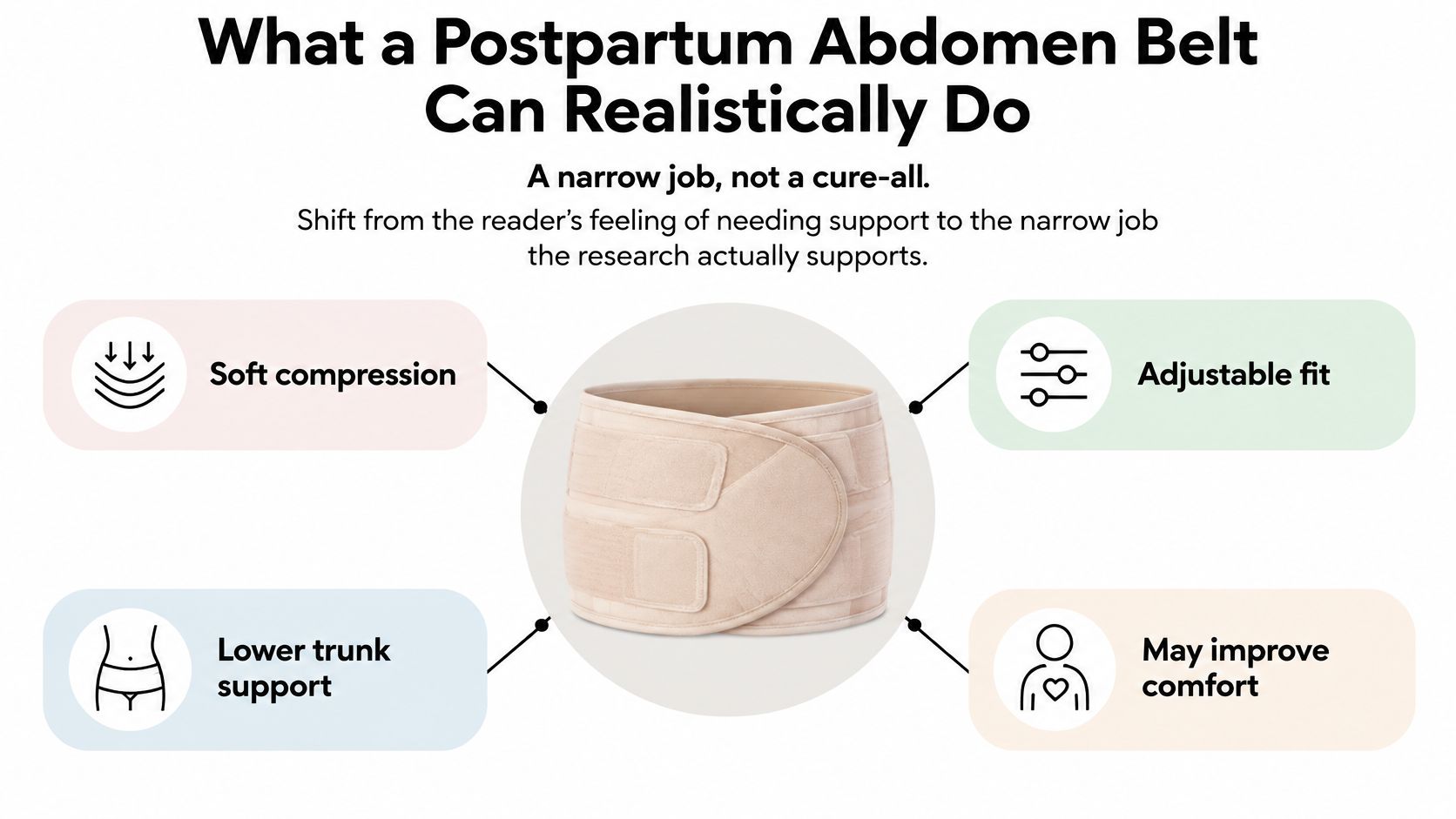
A soft, adjustable belt applies gentle compression around the lower trunk. Its practical job is to provide external support during early movement, such as walking, coughing or transferring between a bed and chair. Possible comfort is the benefit to assess, not how firmly it holds you.
The features below describe that narrow role.
What researchers measured
The findings need to be read together: a randomised trial of 86 women after caesarean delivery found that binder users walked 99.4 ± 27.3 metres, compared with 81.0 ± 22.2 metres without a binder at first mobilisation, approximately 23% farther, with lower pain at 24 hours, lower distress at 8, 24 and 48 hours, and no reported effect on postpartum bleeding; however, a meta-analysis of four randomised trials involving 601 women found no statistically significant pain reduction at 24 or 48 hours, although distress was lower at both points, as described in the caesarean abdominal-binder evidence.
That's encouraging for some aspects of early recovery, but it isn't a guarantee of pain relief. Walking distance and distress are useful outcomes. They don't establish that a belt restores anatomy, burns fat or accelerates muscle healing.
The distinction also helps explain why different parents may judge the same type of support differently. Someone may value feeling steadier during a transfer even if their pain doesn't noticeably change. Another person may find the garment uncomfortable and gain nothing useful from it.
Translate evidence into a sensible trial
If your maternity team approves a belt, agree on the activity you're trying to make easier. Compare how that activity feels with the support, rather than treating longer wear or tighter fastening as progress.
- Choose flexibility: Look for breathable, non-rigid support with adjustable tension.
- Check the result: The movement should feel more manageable without restricted breathing or altered skin sensation.
- Separate other concerns: Questions about postpartum swelling belong in your recovery discussion, not in promises that compression will fix everything.
Use the accompanying video as additional context, not personalised clearance to start wearing a binder.
You don't need to tolerate an unpleasant garment because a trial found an average benefit. Your own comfort, clinical circumstances and ability to move remain the deciding factors.
Abdominal Separation and the Limits of Binding
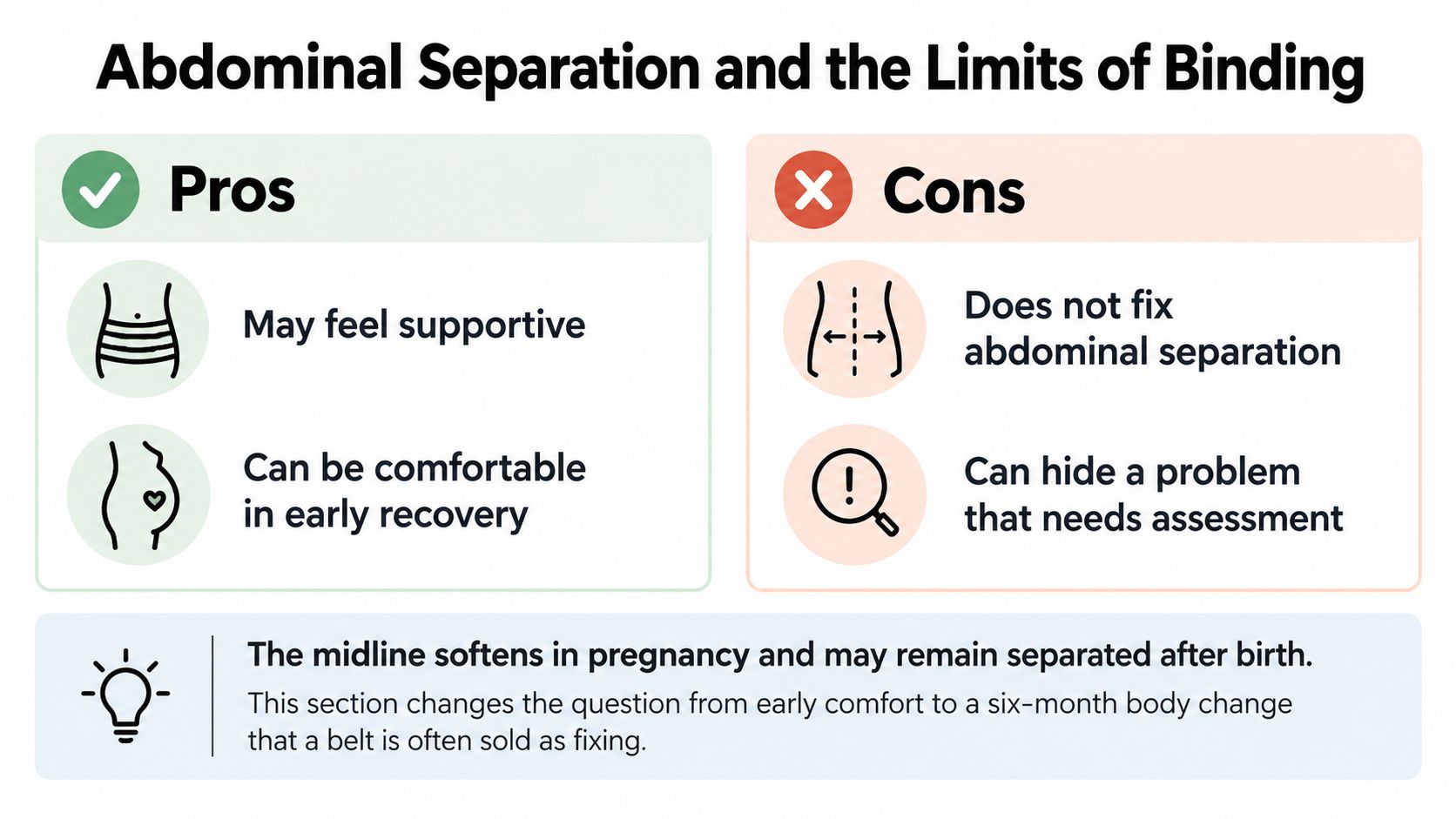
A belt isn't a proven standalone treatment for abdominal separation. That claim needs separating from the much narrower possibility of feeling supported while wearing one.
With diastasis recti, the abdominal midline softens during pregnancy and the rectus muscles sit farther apart. You may notice a ridge or doming when getting up. Think of two panels joined by a flexible centre strip: wrapping something around the outside doesn't demonstrate that the centre strip has regained its function.
What the longer-term trial actually found
A pilot randomised trial of 32 first-time mothers compared binding, targeted trunk exercise, both approaches and no intervention; after six months, binding alone or combined treatment produced small-to-moderate body-image improvements, Cohen's d 0.2–0.5, while exercise plus binding produced a larger improvement in trunk-flexion strength, d = 0.7, according to the Australian physiotherapy evidence record.
Those effect sizes describe changes in particular outcomes. They aren't percentages of recovery, and improved body image isn't proof that the distance between the muscles closed. The strength finding came from the combined intervention, so it shouldn't be presented as a result of binding alone.
The record describes the trial as feasible but preliminary. It doesn't justify promises of permanent waist reduction, faster muscle healing or diastasis correction.
Feeling held together is a useful experience for some parents. It isn't a measurement of abdominal recovery.
Match the treatment to the problem
If abdominal separation concerns you, an individual assessment is more useful than choosing a belt based on the size of the promised transformation. A pelvic-health physiotherapist can help connect what you notice during daily tasks with an appropriate rehabilitation plan.
- Deep-trunk rehabilitation: Ask for graded work matched to your current control and symptoms.
- Pelvic-floor rehabilitation: Include this in the same discussion rather than treating the abdomen in isolation.
- Persistent symptoms: Arrange assessment for ongoing doming, pelvic pressure, urinary leakage or back pain.
For example, looking smoother under a band while standing doesn't answer whether you can comfortably manage the movements you need at home. Explain those movements to your physiotherapist, including what happens when the belt is off. That information is more useful than whether the fastening can pull your waist smaller.
Deciding When a Belt Helps Rehabilitation
The useful decision isn't whether to wear a belt. It's whether wearing one helps you follow a recovery plan while remaining aware of symptoms.
Australian Pregnancy Birth and Baby guidance on abdominal separation says a supportive brace may help support the back, while recommending deeper abdominal exercises and pelvic tilts rather than crunches when separation is present. External support and active rehabilitation therefore have different jobs.
Choose support or assessment based on function
A belt may fit alongside rehabilitation when it makes an approved activity more comfortable and you can still breathe, sit and notice how your body responds. It's an addition to the plan, not permission to increase the difficulty because you feel more secure.
Use this pathway when deciding what to do next.
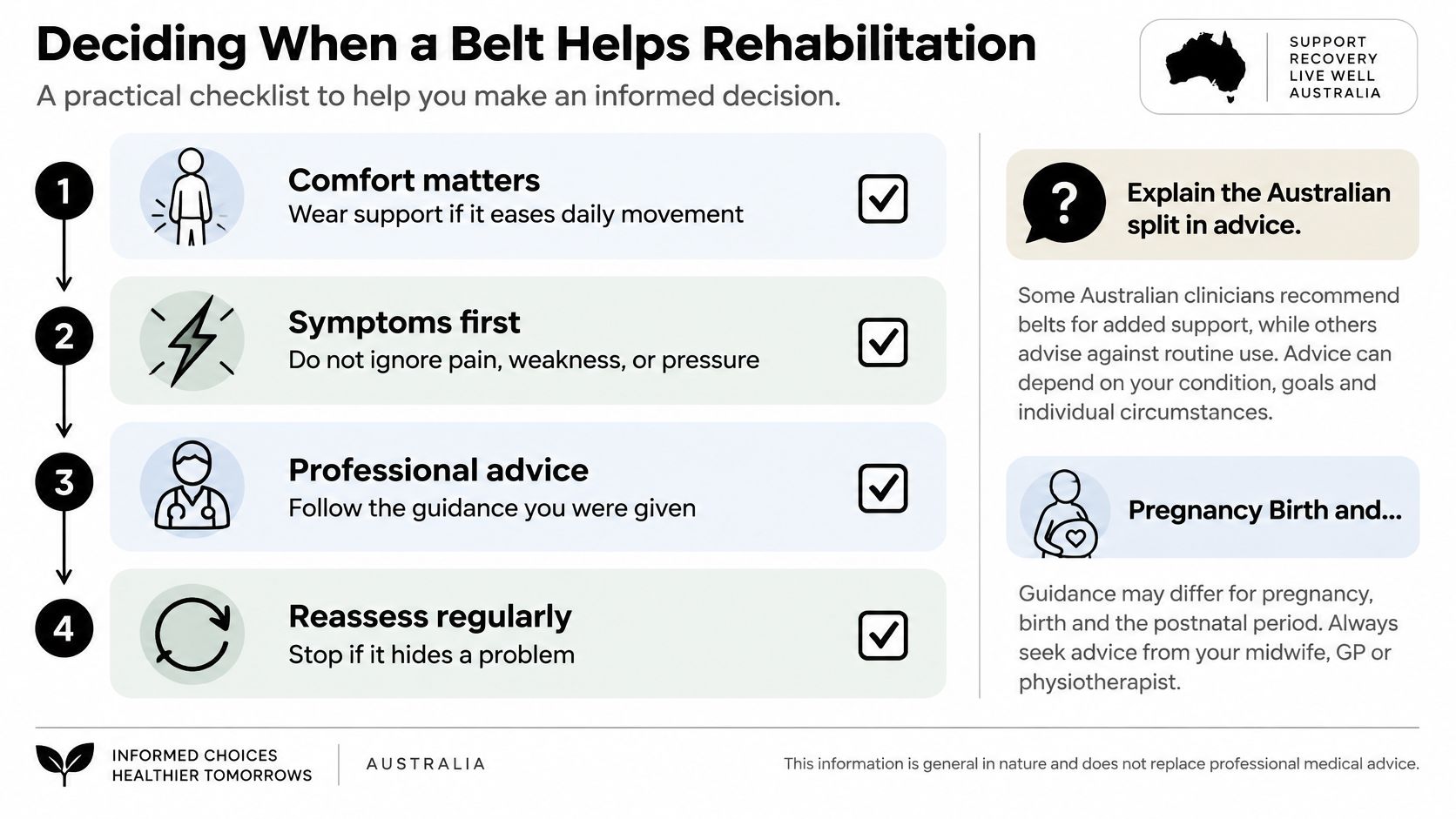
- Movement feels easier without new symptoms: Discuss keeping the belt for that specific task while continuing your prescribed exercises.
- Doming, pain or lifting difficulty persists: Ask for an assessment rather than increasing compression.
- Leakage or pelvic pressure affects activity: Tell your pelvic-health physiotherapist what brings it on and whether the belt changes what you notice.
- You feel unable to move without it: Review the underlying difficulty with your clinician instead of assuming you need a firmer garment.
These are reasons to reassess, not a home diagnostic test. Needing support doesn't prove that a belt has weakened your muscles, and noticing symptoms doesn't tell you their cause.
Can you wear it during exercises?
Ask the clinician prescribing the exercises. Explain whether the belt changes your breathing, your sitting comfort or your ability to recognise pressure and doming. Don't use a smoother-looking abdomen under fabric as the measure of a successful exercise.
Rehabilitation check: If you're relying on compression to ignore a symptom, pause and discuss the symptom rather than tightening the belt.
You may also encounter recovery advice written for cosmetic abdominal surgery, including Georgia Plastic & Reconstructive Surgery's guide. That can be a separate reading resource if you're researching that procedure, but don't transfer its recovery stages or garment instructions to postpartum rehabilitation.
Your own plan should reflect your birth, current function and clinical assessment. Progress means being able to manage appropriate activities, not just managing them inside stronger compression.
Wearing a Belt Safely After a Caesarean
After a caesarean, wound care takes priority over garment advice. A binder provided or approved by your maternity team is different from cosmetic compression purchased without an assessment. The postoperative evidence concerns early support, not a timetable for changing your waist.
Australian pelvic-health coverage of postpartum belly bands provides context for discussing postoperative comfort and safe use. Your midwife, obstetrician, GP or physiotherapist should settle the practical details for your incision.
Before putting it on
Ask your clinician to show you the intended placement and tension. Don't assume that positioning a belt higher or lower makes it suitable, and don't place a fastening or rigid edge where it presses into the wound.
Useful questions include:
- Placement: Can this particular belt sit over or near my dressing, and where should its edges rest?
- Tension: Can you check that it supports me without restricting a full breath or skin sensation?
- Timing: Which activities should I use it for, and when should I remove it?
- Wound concerns: Do drainage, altered sensation or my other complications change the advice?
Before the first use, make sure you understand the answer rather than relying on the product photograph. Unless your treating clinician specifically advises otherwise, remove it for sleep rather than treating daytime support as continuous compression.
Recheck during ordinary movement
A belt that feels acceptable while standing may behave differently when you sit or get out of bed. Test only movements your team has approved, and stop if the garment digs in, pulls or presses on the incision.
Remove it and seek medical advice for increasing pain, wound discharge, fever, increasing redness or concerning bleeding. Numbness, poor sensation, skin irritation and restricted breathing also mean the fit or use needs review. Don't keep testing a painful belt while waiting for it to become comfortable.
For activity planning, use guidance on exercise after a caesarean as a starting point for questions to your clinician. Discomfort and pelvic-floor pressure aren't instructions to push harder, and traditional abdominal exercises shouldn't replace an individual progression.
If you're gathering broader postoperative questions, MedAmerica Rehab Center's surgical recovery guidance for Deerfield Beach patients is another resource to discuss with your treating team. It isn't a replacement for maternity-specific wound or pain advice.
Choosing Size Material and Everyday Fit
Buy for the body and activities you have now, not a pre-pregnancy measurement or a promised future waist. A useful postpartum abdomen belt offers adjustment without requiring maximum tension to feel secure.
Look for a broad fitting range, soft edges, washable moisture-managing fabric and a low profile under clothing. These are practical specifications, not evidence that a particular belt will improve your recovery.
Postpartum Abdomen Belt Fit Checklist
| Fit check | Look for | Avoid |
|---|---|---|
| Support level | Gentle, flexible support | Rigid panels or a corset-like squeeze |
| Size range | Adjustment suited to your current measurements | Buying smaller to pursue reshaping |
| Breathability | Moisture-managing, washable material | Fabric that leaves you hot or irritated |
| Tension | A full comfortable breath | Breath restriction or numbness |
| Sitting | Edges that remain comfortable | Digging, rolling or wound pressure |
| Clothing profile | A low-profile shape you can tolerate | Bulky seams that press when seated |
| Carrier compatibility | Separate, comfortable placement | Overlapping pressure near an incision |
Use the manufacturer's current sizing instructions, but ask for help if your measurements fall between options. More compression isn't a sensible substitute for the right size. You should also be able to adjust or remove the belt without turning every feed or toilet visit into a complicated task.
Test it with your everyday setup
Babywearing adds another fit question. If you've been cleared to use your carrier, check the belt and carrier together rather than assuming each will work because it fits separately.
- Check overlap: A carrier waistband shouldn't force the abdominal belt against a caesarean wound.
- Check breathing: Holding your baby shouldn't require accepting uncomfortable compression.
- Check movement: Sit and stand within your approved activity limits, noticing whether either waistband shifts or digs in.
Ask your clinician or an appropriately qualified carrier adviser if you can't find a comfortable arrangement. Don't solve competing waistbands by tightening both.
Keep tracking tools in a separate category
A belt doesn't measure weight, body composition, temperature or fertility signs. Optional home tracking serves a different purpose and shouldn't be used to judge wound healing or abdominal function.
The Venus AI Smart Scale: Body Composition & Body Fat Scale is described by its manufacturer as offering body-composition tracking, app-connected reports and weekly summaries. Those features are separate from the comfort role of a belt.
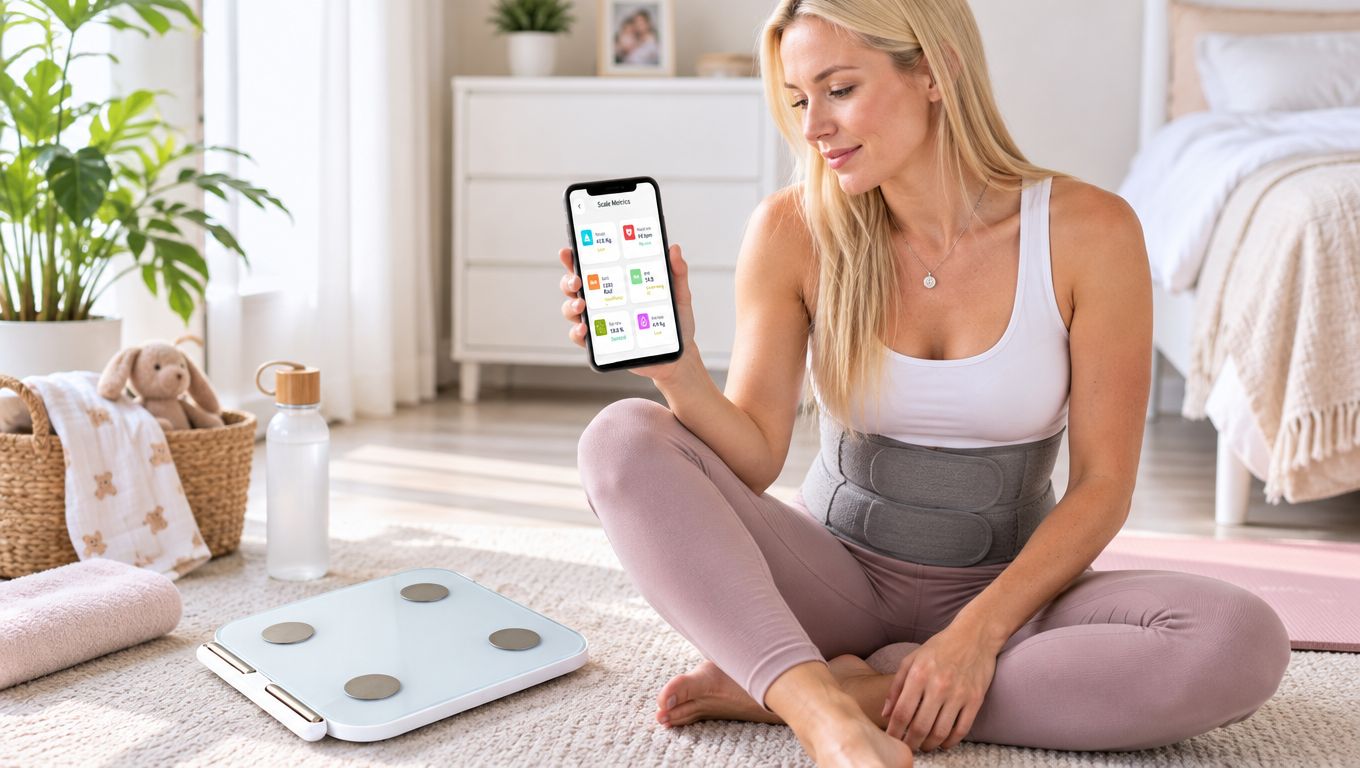
You don't need home measurements to justify resting, seeking assessment or declining a garment. Choose tracking only if it answers a question that matters to you, without adding another obligation to an already demanding day.
Your Next Step After Choosing a Belt
Make the next decision small enough to act on. You don't need a complete recovery programme before asking whether a belt is appropriate, and you don't need to buy one before requesting help with uncomfortable movement.
Write down the task that's hardest right now. Getting out of bed, coughing and carrying your baby are more useful starting points for a conversation than a general wish to feel stronger.
Put care before compression
Use this sequence when organising support:
- Ask for clearance. Tell your midwife, obstetrician, GP or physiotherapist about your birth, wound and symptoms. If you already own a belt, bring it so they can assess the actual garment.
- Agree on its job. Identify the activity it's intended to help and follow the placement, wear and removal advice you're given.
- Book rehabilitation when needed. If doming, pressure, leakage, back pain or fear of lifting still controls your day, arrange pelvic-health physiotherapy. Exercise progression belongs with that assessment, not a tighter fastening.
- Keep optional tracking optional. Decide later whether body-composition or fertility information would be useful. It doesn't need to become an early-postpartum task.
Give home information clear limits
For later cycle awareness, a Bluetooth basal body thermometer and an LH test serve different purposes from abdominal support. The Venus Ovulation Predictor Test Kit is an at-home LH testing option whose results can be logged manually in a preferred fertility app. Neither fertility tools nor body-composition reports assess whether an incision or abdominal separation needs treatment.
Before buying connected devices, review privacy information, compatibility and the applicable shipping, return and warranty terms. Ask your clinician how any readings would fit your circumstances rather than collecting numbers without a clear purpose.
Send medical symptoms back to your maternity team. Don't wait for an app trend, a different belt or a routine appointment to explain worsening symptoms. The most useful recovery purchase may be no purchase at all, just the right assessment and a manageable plan.
Venus Health Co. offers an app-connected body-composition scale, a Bluetooth basal body thermometer and LH ovulation tests for optional home tracking beyond what a belt can tell you. Visit Venus Health Co. to compare those tools and review their terms, while keeping wound concerns and rehabilitation decisions with your maternity team.