

Portable Scale for Travel: How to Weigh Bags Right
Dr. Adeyinka AdegbosinYou're standing in the check-in queue, watching the person in front of you unzip a suitcase on the floor and pull out shoes, jumpers and a hair dryer while everyone pretends not to stare. You know your own bag felt heavy in the lift. You don't know if it's 22 kg or 24 kg, and that difference is about to decide whether you pay extra, repack in public or walk straight through.
That's the job of a portable scale for travel. It's not a gadget for getting a clever number at home. It's a pre-check instrument that lets you make the repacking decision in your lounge room, while you still have choices.
Portable Scale Specs That Matter Most for Travel
A travel scale earns its place in your bag by answering one question early: what number will the check-in scale show? Answer it in your lounge room and you can move the shoes and the toiletry bag while nobody is watching. Answer it at the airport belt and you pay, argue about the reading, or repack on the floor while the queue builds.
The first decision is which type to carry. A hanging luggage scale weighs the packed bag directly, in the form the airline will weigh it. A body scale that also travels serves a different job entirely. For check-in decisions, I would pick the hanging scale every time.
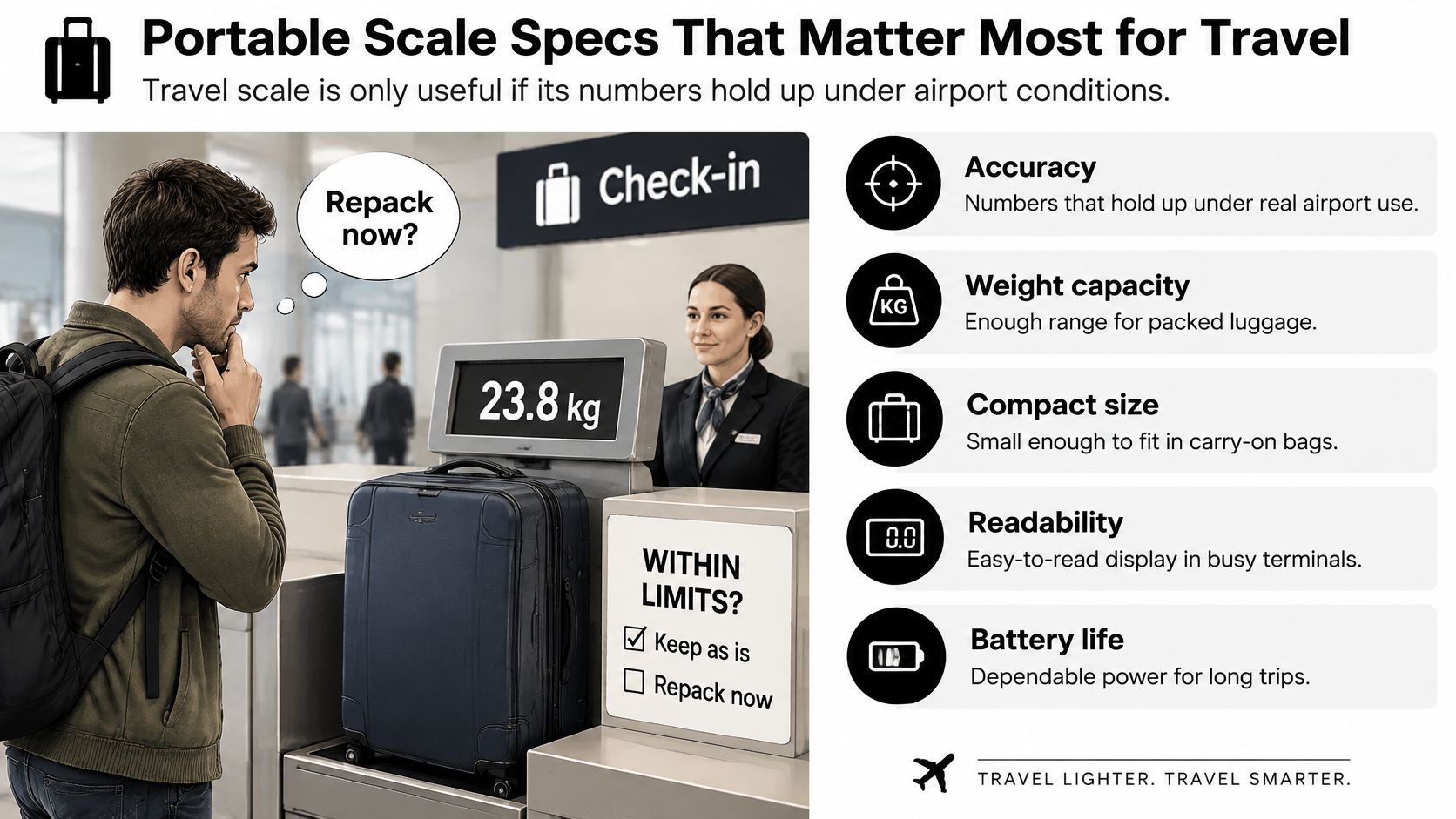
Travel Scale Specifications to Check Before Buying
| Feature | What to Look For | Why It Matters on a Trip |
|---|---|---|
| Capacity | At least 50 kg (110 lb) | Covers a full 23 kg checked bag with margin |
| Resolution | 0.1 kg or finer | Shows 100 g changes near the airline limit |
| Accuracy | Within 0.5% or 200 g, whichever is greater | Gives a tolerance you can check against the bag's limit |
| Battery | Replaceable, with a low-battery warning | Weak cells cause drifting readings |
| Hook and strap | Rated for the load, with a stable swivel | Side-loading gives false readings |
| Display | Hold and zero functions, plus overload warning | Readable in a dim hotel room |
| Scale weight | Under 300 g | Fits in a carry-on pocket |
| App connectivity | Optional | Not needed to weigh a bag; useful only for logs |
Capacity is the spec travellers check first, and it is rarely the problem. A scale that maxes out well above a checked bag still fails you if it rounds coarsely or drifts. Resolution matters because the last pair of shoes or the toiletry bag is often a few hundred grams, and you need to see that change rather than guess it.
Accuracy matters more, because a reading only helps if you know how far it can wander. The Civil Aviation Safety Authority guidance on passenger, crew and baggage weights states that checked baggage should generally be weighed, except where an approved standard weight applies. Your bag will be weighed by someone, and a display with no stated accuracy figure gives you no way to judge how close your reading sits to theirs.
Practical rule: If the box lists capacity and resolution but won't state accuracy, treat the reading as a rough guide and leave real margin below the limit.
The hook or strap is the third practical limit. It needs to sit centred on the handle, swivel without twisting, and hold the load without the strap rubbing the scale body. A weak swivel turns a straight lift into a swinging, side-loaded one, and the number moves with it.
Lifting is the hidden cost of a hanging scale. You hold the full weight of the packed bag off the floor until the display locks, which is exactly why the hold function earns its row in the table. If a heavy lift is a strain for you, that locked reading matters more than anything else on the spec sheet: you set the bag down, then read the number, instead of squinting at a swinging display mid-lift.
Battery design is less glamorous and just as real. Pick a replaceable battery you can buy at an airport shop, plus a clear low-battery warning. Rechargeable models are fine until you are in a hotel the night before a flight with the wrong cable.
Treat the finished reading as a pre-check, with the airport scale holding the final word. Aim to land under the limit with room to spare on every leg of the trip, because a bag that passes at home and fails at a transfer counter costs you twice.
If you are also weighing yourself at home, our guide to digital weighing scales and how their readings work covers the body-scale side, though the two jobs need different tools. For bags, the specs that matter most are accuracy, a stable hook and an overload warning. Everything else is convenience.
Airline Baggage Limits a Travel Scale Must Check
Weigh your bag against the number it has to pass. Anything you picked up from another traveller is a guess until you confirm it on your own fare. Australian limits have moved from simple per-bag rules to combined totals, and that shift catches people who weigh one bag and assume they're finished.
Australian Baggage Limits to Weigh Against
| Limit | Typical Value | What It Applies To |
|---|---|---|
| Standard carry-on bag | 7 kg | Per-bag limit applied by major Australian airlines in a 2018 review; confirm the current limit |
| Typical carry-on dimension | 115 cm | Maximum linear bag size reported in the same review; confirm per carrier |
| Domestic combined carry-on allowance | up to 14 kg | One standard item plus a small personal item on fares that permit both |
| Single cabin item | 10 kg | Common cap on any one cabin item where a combined allowance applies |
| Checked bag heavy-charge threshold | 23 kg | Domestic checked bags above this weight attract a heavy charge |
| Single checked item | 32 kg | Hard cap on any one checked bag |
A 2018 review of the carry-on crackdown by major Australian airlines reported a standard carry-on limit of 7 kilograms and a typical maximum linear dimension of 115 centimetres. Since then, domestic fares have added combined allowances, typically capping a standard item and a small personal item at 14 kilograms together, with 10 kilograms the usual ceiling on either piece alone. Treat those as typical figures. Your fare's allowance is the only one that counts.
The two systems fail in different ways. Under a per-bag rule, each item passes or fails on its own. Under a combined allowance, both items can look reasonable separately and still fail together. Weigh each piece, then add the numbers.
Size runs alongside weight, so solving one and ignoring the other wastes the exercise. If you're keeping a personal item under the seat, this guide on how to measure your under-seat bag from Urban Totes covers the dimensions to check before you pack it full.
For checked bags, the Qantas pre-purchase additional baggage fee schedule applies a A$64 heavy charge to each Australian domestic checked bag over 23 kg, and no individual checked item may exceed 32 kg. The first threshold is where a small scale error costs money. A bag that reads just under the line at home can read just over it at the airport.
A 200 g error is trivial in the middle of an allowance. Sitting on the threshold, it's the difference between paying and not paying.
Work backwards from the allowance printed on your booking confirmation, rather than a figure from the airline's marketing page. Subtract a 1 kg buffer for purchases and damp clothes on the way home, and treat anything inside that buffer as a repack decision. I'd rather repack at the kitchen table than in the check-in queue.
Allowances can also change across the legs of one booking. A domestic hop inside an international itinerary may carry a different limit from the long-haul segment, so confirm the figure for each flight. And if you can't safely lift a heavy bag, settle the weight plan before you pack: two lighter items inside their limits beat one bag you can't raise.
A portable scale for travel checks your bag against a number, catching a failure at home where fixing it costs minutes instead of fees. It is only as useful as the limit you feed it.
How to Weigh a Packed Bag Accurately
A case that reads under the limit at home and over it at the counter has usually been lifted badly. The sensor is rarely the problem; the swing, the angle and the surface are. Technique costs nothing to fix.
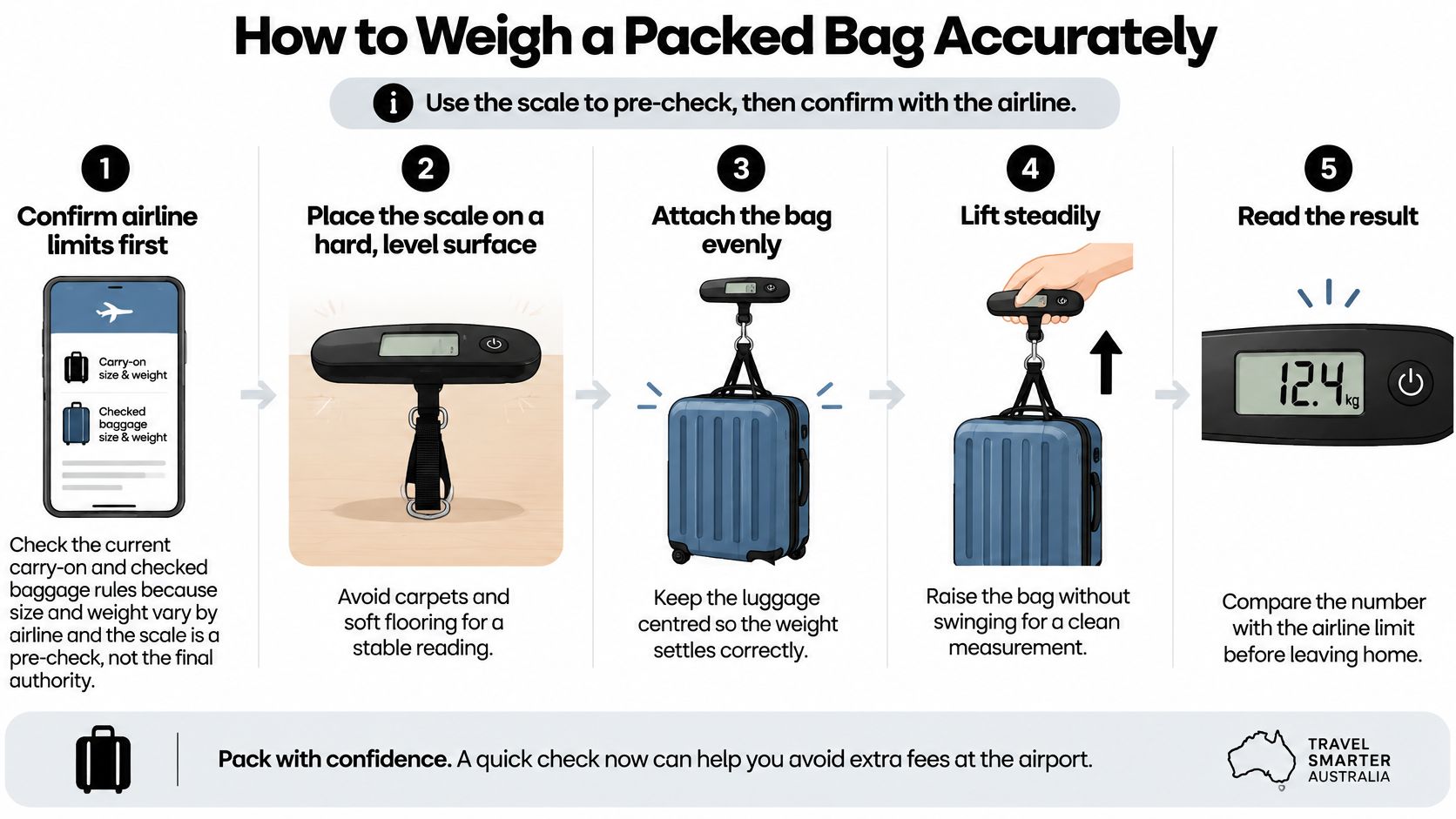
A Repeatable Weighing Routine
- Weigh the empty case first. Know what the shell consumes before you pack, because your real packing allowance is the limit minus the bag itself.
- Use a hard, level surface. Stand on tiles, concrete or floorboards. Carpet and rugs let you rock as you lift, and the reading rocks with you.
- Lift vertically and clear. Hook the handle at its centre, lift straight up, and keep the bag off the floor, furniture and its own wheels. Keep the strap clear of the scale body, because rub and angled pulling both distort the load.
- Hold still until it locks. Let the bag stop swinging before you read the display. A moving bag gives you a moving number.
- Repeat three times. Put the bag down between lifts and take the median of the three. Ignore a single outlier from a snatched lift rather than averaging it in.
- Can't lift the case safely? Stand on a bathroom scale holding the bag, then weigh yourself alone and subtract. The method is coarser, so widen the margin you'd normally leave before trusting it near a limit.
- Weigh at three points. Before you close the case, again after adding anything bought on the trip, and once more before you leave for the airport. Contents change, so the first reading expires.
The margin step deserves a number. Airport weighing equipment commonly works to a tolerance of around 0.5% or 200 g, whichever is greater. On a 23 kg checked bag, 0.5% equals 115 g, so the 200 g figure governs: a display showing 23.0 kg can already sit on the operational edge. Baggage size, weight and item rules also differ between airlines, as the Australian Government air passenger travel guide notes, so treat your scale as a pre-check. The counter's equipment makes the final call.
Watch the lifting position and hold time in the video below.
Failure modes are dull and predictable. Weighing on carpet, pulling at an angle because the bag sits beside you, letting the handle rub the scale body, and ignoring a low battery warning all produce scattered readings that look like sensor faults. Fix the lift first; blame the hardware last.
Rounding decides what you can adjust. A scale that reads to 0.1 kg lets you pull out a jumper or a pair of shoes and see the effect; one that rounds to a full kilogram hides changes of several hundred grams. The explainer on digital scale measurements and what the increments mean covers why resolution matters near a limit.
A trustworthy result looks boring: three readings within a few hundred grams of each other, a still bag on every lift, and a final figure clearly under your margin.
How to Test a Portable Scale Before You Trust It
The headline resolution on the box tells you how finely the display counts. It doesn't tell you whether the count is right. A simple reference check answers the question that matters, and it takes ten minutes at the kitchen bench.
The Five-Reading Reference Check
Zero the scale with nothing attached. Hang a known reference mass close to the load you travel with, something stable and centred like a marked weight plate or a sealed bag you've verified on a calibrated scale. Record five readings without changing the setup, then work out the mean and the range. Take the load off, reattach it, and repeat the whole sequence.
The National Measurement Institute mass and density measurement services explain that Australian mass instruments can be calibrated against national standards, with traceability extending internationally through the BIPM framework, and identify calibration as the process that provides confidence and traceability for mass measurements. Your home check isn't a calibration. It's a sanity test against that same idea, a known mass your scale either matches or doesn't.
Test at about 5 kg, 15 kg and 23 kg, because strain-gauge error can vary across the measurement range. A scale that's honest at cabin-bag weight can drift at checked-bag weight, and you'd never know from a single test. Our step-by-step on how to calibrate a digital scale covers the adjustment side if your model supports it.
Accepted Tolerance at Each Test Load
| Test Load | Accepted Tolerance | If the Reading Falls Outside |
|---|---|---|
| 5 kg | 200 g (0.5% is 25 g) | Re-zero, repeat the five readings, then review the unit |
| 15 kg | 200 g (0.5% is 75 g) | Recheck the hook and mounting, then retest |
| 23 kg | 200 g (0.5% is 115 g) | Do not rely on the scale for check-in decisions until it passes |
The pattern in that table is the point. The tolerance is the greater of 0.5% of the load or 200 g. Below about 40 kg, the 200 g figure always governs, so your pass line stays the same at every realistic luggage weight. That makes the test easy to run and hard to fudge.
Pass rule: Investigate the unit if the range of your five readings exceeds its stated repeatability, or if the mean differs materially from the reference mass.
Setup errors can fail a good scale. Keep the reference mass centred, avoid side-loading the hook, and don't test while the battery compartment is under strain from how you're gripping the body. Change one thing at a time if a result looks wrong.
Recheck after a drop, after the scale has sat in a hot car or cold store, and after replacing the battery. Mechanical shock and power instability can shift a portable instrument that passed last month.
If a scale fails, stop using it for check-in decisions until it passes again. Don't apply a mental correction like "it reads light, so I'll add a bit." Corrections drift too. Retest it, recalibrate if the model allows, or replace it.
Planning Weight Across Each Leg of Your Trip
Most scale advice treats "the airline limit" as one number. Australian trips rarely work that way. You might fly a full-service carrier to a capital city, a low-cost carrier on a regional hop, and a different fare class home, with a different allowance on every segment.
The money at stake isn't trivial. A 2025 comparison of hidden airline fees on popular airlines found that add-on charges could increase a ticket price by as much as 66%, with Jetstar's 20 kg checked-bag option adding about 25% to the ticket price, while some airlines included checked baggage. Guessing wrong on one leg can cost more than the scale by a wide margin.
Build a Per-Leg Weight Plan
- List every segment: Write down each outbound, connecting and return flight in order, including codeshares operated by a different carrier.
- Note each allowance: Take the checked and cabin limits from that segment's booking, not from the first airline you booked with.
- Set the lowest limit as your target: The tightest leg governs the whole trip, because your bag has to survive every counter, not just the friendliest one.
- Plan the return separately: Shopping, gifts and conference material only travel one way. Leave room for them under the return leg's limit, or plan to post them.
That working target is the number you pack to. It's usually lower than your headline allowance, and finding that out at home is the entire point of owning a portable scale for travel.
If You Can't Safely Lift a Packed Bag
Hanging scales assume you can lift a full suitcase one-handed and hold it steady. That's a poor fit for seniors, people with mobility limitations or recovering from injury, parents holding a child, and travellers managing medical equipment. Portability doesn't help if the method itself is unsafe.
You have workable alternatives. Stand on a bathroom scale alone, then again holding the bag against your body with both arms, and subtract the difference. It's less precise, so widen your margin. A flat platform scale at home is better still, because the bag rolls on and off without a lift at all. At the airport, ask staff for help at the weigh station rather than hoisting a bag onto a belt that's too high for you.
Safe handling and allowance planning prevent more costly mistakes than a marginal improvement in displayed precision ever will.
Copy this checklist for each trip: carrier, allowance, working target, weighing method, date to recheck before departure. Five columns on a phone note will do. Fill it in when you book, while the fare rules are on screen in front of you, and you'll never have to reconstruct an allowance from memory in a hotel room.
Packing, Care and a Travel Kit for Reliable Readings
- Pack to the buffer: Weigh before you close the case and again after shopping. If a checked bag creeps toward the heavy-charge line, move dense items first, shoes, books, toiletries and chargers, into a second bag or your cabin allowance if it has room.
- Keep cabin bags honest: Electronics are dense and add up fast. Weigh the carry-on with the laptop and camera inside, not beside it, because that's how it'll be weighed at the gate.
- Keep the scale dry and clean: Wipe grit out of the hook so the strap seats evenly. A strap sitting on sand or a bent hook reads like a fault.
- Remove batteries in storage: Take them out between trips to prevent leakage corroding the contacts while the scale sits in a drawer.
- Retest after rough treatment: A drop, a hot car or a battery change can shift a reading. Run the reference check again before you trust it for the next trip.
- Pack a small kit: Scale, spare battery, a small reference weight if you own one, and each leg's limits with your working target written beside them.
Choose Your Travel Scale and Weigh Before You Fly
Choose on accuracy first, then a stable hook and an overload warning, with capacity as the tie-breaker. A 50 kg capacity covers any checked bag you'll realistically pack, but a scale that can't hold its tolerance is no use at the counter no matter how much it can lift.
Confirm each leg's limit when you book. Then weigh before every departure, not just the first one, because the return bag is the one that grew.
Your one next step is to run the three-load test on the scale you own or the one you're considering, and pack your next trip to the working target from your leg plan. Takes ten minutes. Settles the question.
If you also want body metrics while travelling, the Venus AI Smart Scale is lightweight and travel-ready, ships worldwide, and comes with a 30-day money back guarantee. It tracks body measurements at your accommodation. It does not replace a hanging luggage scale for check-in weighing, and I wouldn't ask it to.
Before your next flight, test your portable scale for travel at home, set a working target for the tightest leg of your trip, and weigh every bag before you leave. If you want your body metrics tracked with the same discipline while you're away, visit Venus Health Co. to see the lightweight, travel-ready Venus AI Smart Scale and the app-connected tools that sit alongside it.