
How to Find Reliable Nutrition Advice Online
Dr. Adeyinka AdegbosinAustralians' use of the internet for nutrition information rose from less than 1% in 1995–2001 to 33.7% in 2012, and the internet had become the most common nutrition information source in that survey, ahead of television, magazines and books. Australian Government nutrition information confirms the shift: nutrition advice online isn't a fringe habit. It's part of everyday decision-making.
That access creates a practical problem. Anyone can publish a meal plan, promote a supplement or turn a personal experience into a universal rule, while the person searching has to decide what deserves trust. Reliable digital nutrition care therefore needs more than a list of fake influencer warning signs. It needs a system that combines credentialled human guidance, Australian benchmarks and carefully used tracking technology.
The Shift to Digital Dietary Guidance
Australians have steadily moved from passive health media towards interactive digital advice. The historical pattern is striking. In the Western Australian Nutrition Monitoring Survey, internet use as a source of nutrition and dietary information rose from less than 1% during 1995–2001 to 9.1% in 2004, then reached 33.7% in 2012. In that 2012 survey, the internet ranked first among listed nutrition information sources, ahead of television programs at 23.7%, magazine articles at 22.5%, television advertising at 22.0% and books at 19.0%. The Australian Government's food and nutrition resources provide the relevant national context.
The reason people search is understandable. Official Australian nutrition data describes a population with significant dietary challenges. The Australian Government reports that only 1 in 13 adults eat enough fruit and vegetables, while 94% of children aged 2 to 17 don't eat enough vegetables. About one-third of total energy intake comes from discretionary foods, meaning foods and drinks the body doesn't need for nutritional health. Australian Bureau of Statistics food and nutrition data also reports that 65.6% of adults had a usual sodium intake above the Suggested Dietary Target of 2,000 mg per day or less, and that 13.2% of households, or 1.3 million households, experienced food insecurity in 2023.
Why access and reliability must be considered together
The same search engine that finds an Australian Government guideline can also surface a dramatic elimination diet, an affiliate supplement page and a short video built around an unsupported claim. These results may look equally polished. A confident presenter, attractive graphics and a long comment thread don't establish accuracy.
The information gap matters because diet affects more than appearance. Poor diet accounts for more than 7% of Australia's total burden of disease, according to the ABS food and nutrition information cited above. People need advice that recognises local food availability, Australian dietary guidance, affordability and medical context, rather than blindly importing rules designed for another country.
Practical rule: Treat online nutrition content as a starting point for questions, not automatic permission to change treatment, restrict food groups or take supplements.
The consumer's role has changed. Previously, access was limited, so a small group of publishers controlled much of the available advice. Today, access is abundant, but readers must assess authorship, evidence, commercial incentives and relevance. That doesn't mean becoming a nutrition scientist. It means using a repeatable filter before acting.
Mapping Today's Online Nutrition Channels
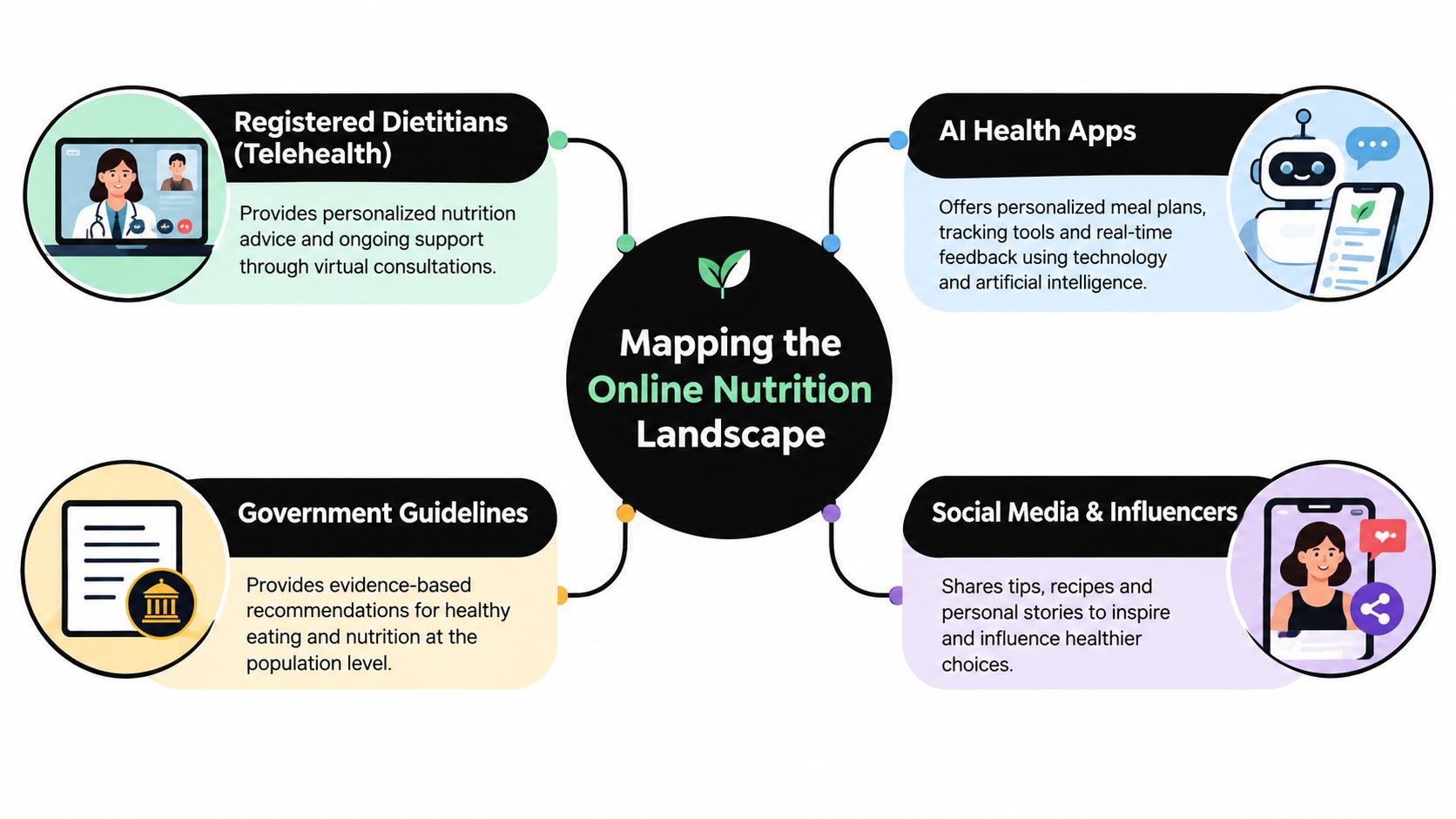
Online nutrition advice becomes easier to assess when each channel has a defined role. A telehealth dietitian works like a certified accountant who examines your circumstances before recommending a financial decision. An AI health app is closer to a robo-advisor. It can organise information and highlight patterns, but its usefulness depends on the data entered and the limits of its design. Government guidance supplies the reference framework. Social media can provide ideas, yet it should not carry the same authority as qualified care.
Registered dietitians through telehealth
Telehealth connects you with a qualified professional without requiring an in-person appointment. An Accredited Practising Dietitian can ask about symptoms, medical history, eating patterns, medications, preferences, budget and goals, then interpret those details together. That context matters for people managing gastrointestinal disease, diabetes, food allergies, disordered eating or other complex nutritional requirements.
A dietitian's value extends beyond a meal plan. It includes the reasoning behind the recommendation, the ability to identify potential risks and the flexibility to adjust advice when daily life changes. A recipe post may suggest what to eat. A clinician can assess whether that suggestion suits your health, treatment and circumstances.
AI-powered health apps
AI tools can organise information that is difficult to track manually. Depending on the platform, you may log meals, photograph food, monitor trends or ask what a measurement could mean. Repeated observations can reveal patterns that memory misses, particularly when entries are quick to record.
The boundaries still matter. An app can summarise your entries, but it cannot replace medical assessment, physical examination or a dietitian's judgement about a complex condition. Use AI for tracking, pattern recognition and preparation. A qualified professional should interpret concerning results and guide diagnosis or treatment.
Government frameworks and local benchmarks
Australian guidance provides a local reference point that generic global content may lack. Eat for Health offers the Australian Dietary Guidelines and related resources. The Australian Eating Survey and the CSIRO Healthy Diet Score can also help people compare their eating patterns with recognised Australian benchmarks.
These references help test claims that sound universal. Ask whether a creator's rule fits Australian guidance and your actual needs, rather than judging it only by how convincing it sounds. ABS data shows that 63.7% of people don't meet dietary calcium requirements, illustrating why broad advice such as “just eat clean” cannot answer the nutrient questions many Australians face.
Social media and influencers
Social platforms can help you find recipes, cooking methods and relatable ideas. They become less suitable for individual health decisions when a creator makes medical promises, sells a proprietary product or presents one eating pattern as appropriate for everyone.
Social media works like a noticeboard, not a clinic. Save useful ideas for cooking or planning, then check the underlying claim with a qualified practitioner or an Australian Government resource. Used alongside professional care and well-designed tracking tools, each channel can contribute a different piece of the nutrition picture.
Evaluating Credibility and Spotting Misinformation
A national audit of nearly 700 Instagram posts from influential Australian accounts found that 45% contained inaccurate nutrition information, while about 90% were rated low quality after researchers assessed qualifications, evidence, advertising and commercial interests. Deakin University's report on unreliable social media nutrition advice found that dietitians and nutritionists produced the most accurate content. Brand accounts and supplement-focused posts performed worst.
TikTok raises a similar concern. A 2024 Australian survey reported that 42% of Australians trust TikTok for nutrition and wellness advice, and 9 in 10 had taken nutrition advice from the platform more than once. Only 2.1% of analysed nutrition content was accurate against Australian guidelines, according to The New Daily's coverage of Australian TikTok nutrition advice. Popularity can show that a message travels widely. It cannot establish that the advice is suitable or safe.
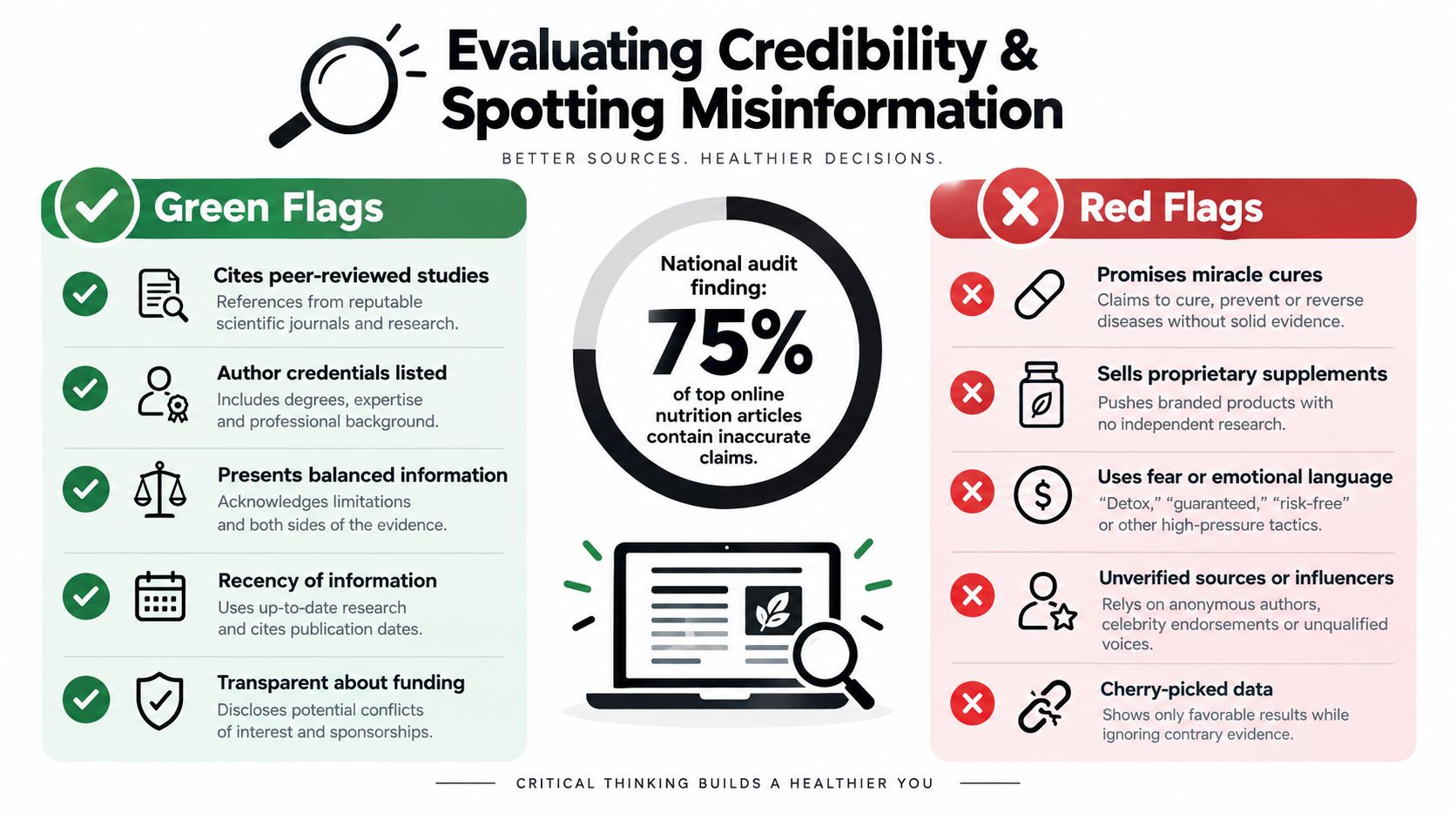
A practical verification checklist
Before acting on a post, use this sequence:
- Check the author. Look for formal qualifications, a clear professional identity and a stated scope of practice. In Australia, an Accredited Practising Dietitian credential carries more meaning than a vague label such as “nutrition expert”.
- Look for evidence. Reliable advice explains what supports its claim and separates established guidance from early research. One study rarely settles a complicated nutrition question, especially when the post omits its methods or limitations.
- Inspect the commercial relationship. Check whether the creator sells supplements, meal plans, testing kits or coaching connected to the recommendation. Disclosure does not automatically make advice wrong, but it helps you judge the incentive behind it.
- Question absolute language. Terms such as “cures”, “detoxes”, “never eat” and “works for everyone” deserve caution. Nutrition changes with health status, culture, access, preferences and goals.
- Cross-check locally. Compare the claim with the Australian Dietary Guidelines at eatforhealth.gov.au. If it concerns a medical condition, ask a dietitian rather than treating a dramatic video as clinical care.
Conflicting posts can change behaviour as well as knowledge. Australian evidence links exposure to conflicting nutrition information on social media with confusion, and confusion with backlash against dietary guidance. Separate research involving Australian young adults also associated social media use for nutrition information with diet quality and restrained eating outcomes. The Cambridge University Press survey of Australian young adults supports checking credentials and context before changing your diet.
For suspicious posts, these tools to spot misinformation can support a wider content check before you share them. Diet myths exposed offers another discussion of common nutrition claims.
A product such as the Venus AI Smart Scale: Body Composition & Body Fat Scale can organise body-composition measurements, food logging and app-based summaries. Treat those outputs as tracking information, not a diagnosis, and combine them with qualified telehealth guidance when results or symptoms raise questions.
Comparing Telehealth Dietitians and AI Health Apps
Telehealth and AI tools solve different problems. A dietitian can interpret nuance, identify clinical risk and respond to emotional or practical barriers. An app can collect observations between appointments, reduce the effort of recording meals and make trends easier to see.
The best choice depends on the question you're asking. “What does this ingredient list mean?” may be suitable for an educational tool. “How should I eat with kidney disease?” needs qualified clinical guidance. “Why does my eating pattern change during stressful work weeks?” may benefit from both, with an app showing the pattern and a dietitian helping you understand it.
| Feature | Telehealth Dietitian | AI Health App |
|---|---|---|
| Personal context | Explores medical history, symptoms, preferences and circumstances | Uses the information and measurements you enter |
| Clinical judgement | Can assess complexity and refer you when needed | Can explain or organise data within its programmed scope |
| Availability | Depends on appointment times | Designed for ongoing access |
| Tracking | Reviews records you bring to the consultation | Supports repeated meal, measurement or trend entries |
| Emotional support | Responds to concerns, motivation and difficult food experiences | Offers automated prompts and explanations |
| Best role | Strategy, medical nutrition therapy and accountability | Monitoring, reminders and preparation for professional review |
Where human care matters most
A telehealth appointment is particularly important when symptoms are persistent, eating has become distressing, a diagnosis affects food choices, or a restrictive plan is becoming difficult to control. A professional can also tell you when a measurement is misleading or when a seemingly healthy intervention isn't suitable.
Human care provides a conversation rather than only a score. The dietitian can ask why a goal matters, identify what's getting in the way and adapt the plan to family meals, shift work, cultural food practices or limited access to cooking facilities.
Where AI tools add value
AI apps are strongest between consultations. A meal log can reveal patterns you might forget by appointment day. A body-composition trend can show that a change isn't moving in the direction you expected, prompting a better question for your practitioner.
This doesn't mean every output deserves obedience. Treat automated recommendations as hypotheses. Check whether the input is accurate, whether the advice aligns with Australian guidance and whether the conclusion makes sense for your health context.
If you're comparing digital health platforms, this guide to Android health apps can help you consider compatibility and function. For people tracking reproductive health alongside broader wellness information, the Venus Smart Basal Thermometer for Ovulation, Bluetooth BBT Tracker with App records basal body temperature and syncs readings to the Venus App via Bluetooth. That type of data can complement nutrition tracking, but it doesn't turn an app into a fertility or nutrition diagnosis.
A combined workflow
Use a dietitian to establish the direction, safety boundaries and meaningful goals. Use an app to collect everyday information, identify questions and support follow-through. Then bring the pattern back to the professional, who can decide whether the plan needs adjustment.
Integrating App-Connected Tools for Personalised Insights
Generic nutrition advice often fails because it knows nothing about your routine. It doesn't know whether you're skipping breakfast because of shift work, eating differently after training, struggling with food access or responding to a medical treatment. App-connected tools can't solve every limitation, but they can add personal context to broad guidance.
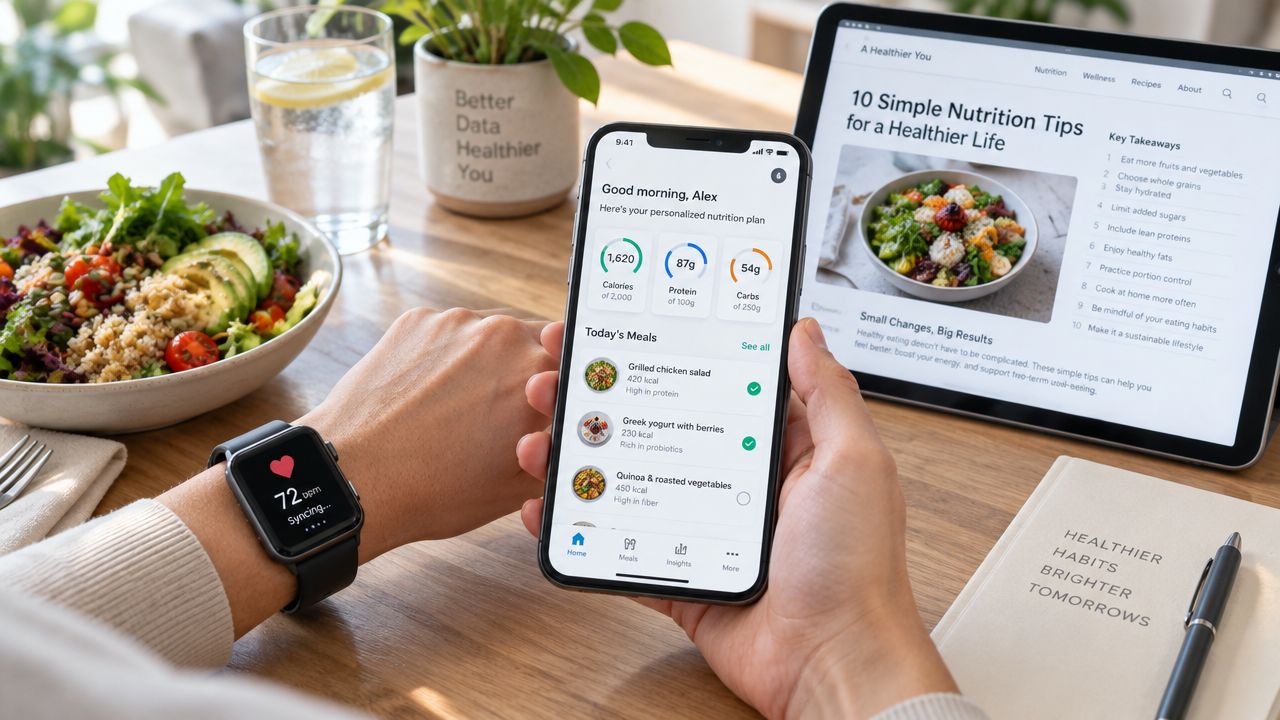
Start with a question, not a gadget
Choose one question you want to answer. It might be, “Does my eating pattern support my training?” or “What changes alongside my body-composition trend?” A clear question prevents you from collecting measurements just because an app makes them available.
Next, create a consistent observation routine. Record meals using a database, barcode scanner or meal photograph when available, and take measurements under similar conditions. Consistency makes a trend easier to interpret, while a single reading can be affected by ordinary changes in hydration, meal timing and daily routine.
Use the data as a feedback loop
The Venus AI Smart Scale is designed around weekly body tracking. Its listed features include a six-page wellness report, body-composition analysis, trend charts, risk flags, segmental muscle mapping and personalised action planning. The connected app also supports food searches, barcode scanning and meal photographs, so you can compare what you record with changes in your measurements.
That comparison should lead to a question, not a judgement. If your food log changes but the trend doesn't, check whether your entries are complete, whether the timeframe is long enough to interpret and whether another factor has changed. If an app flags a metric, ask what it measures and whether a qualified practitioner should review it.
Keep interpretation human
AI coaching can translate a number into plain language and help you notice patterns. It can't establish a diagnosis or replace a professional who understands your medical history. Share relevant summaries with a dietitian, especially when a recommendation involves restriction, supplements, significant weight change or symptoms.
A useful system has three layers:
- Reference layer: Australian Dietary Guidelines and local nutrition tools.
- Observation layer: meal records, body-composition readings and personal notes.
- Interpretation layer: an APD or other appropriate health professional who can assess meaning and safety.
That structure turns online nutrition advice into a testable process. You start with a credible principle, observe how it fits your life and seek expert interpretation before making a major change.
Protecting Your Privacy and Health Data
Meal photographs, weight records, body-composition readings, fertility information and health questions all reveal personal details. Convenience shouldn't make you careless about where that information goes or who can use it.
Before joining a platform, read its privacy policy in practical terms. Look for clear explanations of data collection, storage, sharing, deletion and account access. Ask whether the service uses information for advertising, sells aggregated insights, shares data with external providers or requires permissions unrelated to the feature you want.
A safer selection filter
- Purpose limitation: The app should explain why it needs each category of information.
- Access control: You should be able to manage permissions and connected services.
- Retention clarity: The provider should explain what happens when you delete an account.
- Security transparency: Look for understandable information about protection and incident handling.
- Subscription independence: A platform that offers core functionality without requiring ongoing payments may make its commercial model easier to evaluate, but you still need to read the policy.
Health professionals also need disciplined data practices. Organisations creating formal governance around personal information can use resources such as this guide to build a privacy compliance program. For home users, best practices for data management offers a useful reminder to review permissions and avoid sharing more information than a service needs.
Don't upload identifiable medical documents to an unfamiliar chatbot. Don't assume that an app is private just because it looks professional. Treat privacy as part of health quality, not a technical extra.
Building a Sustainable Online Nutrition Strategy
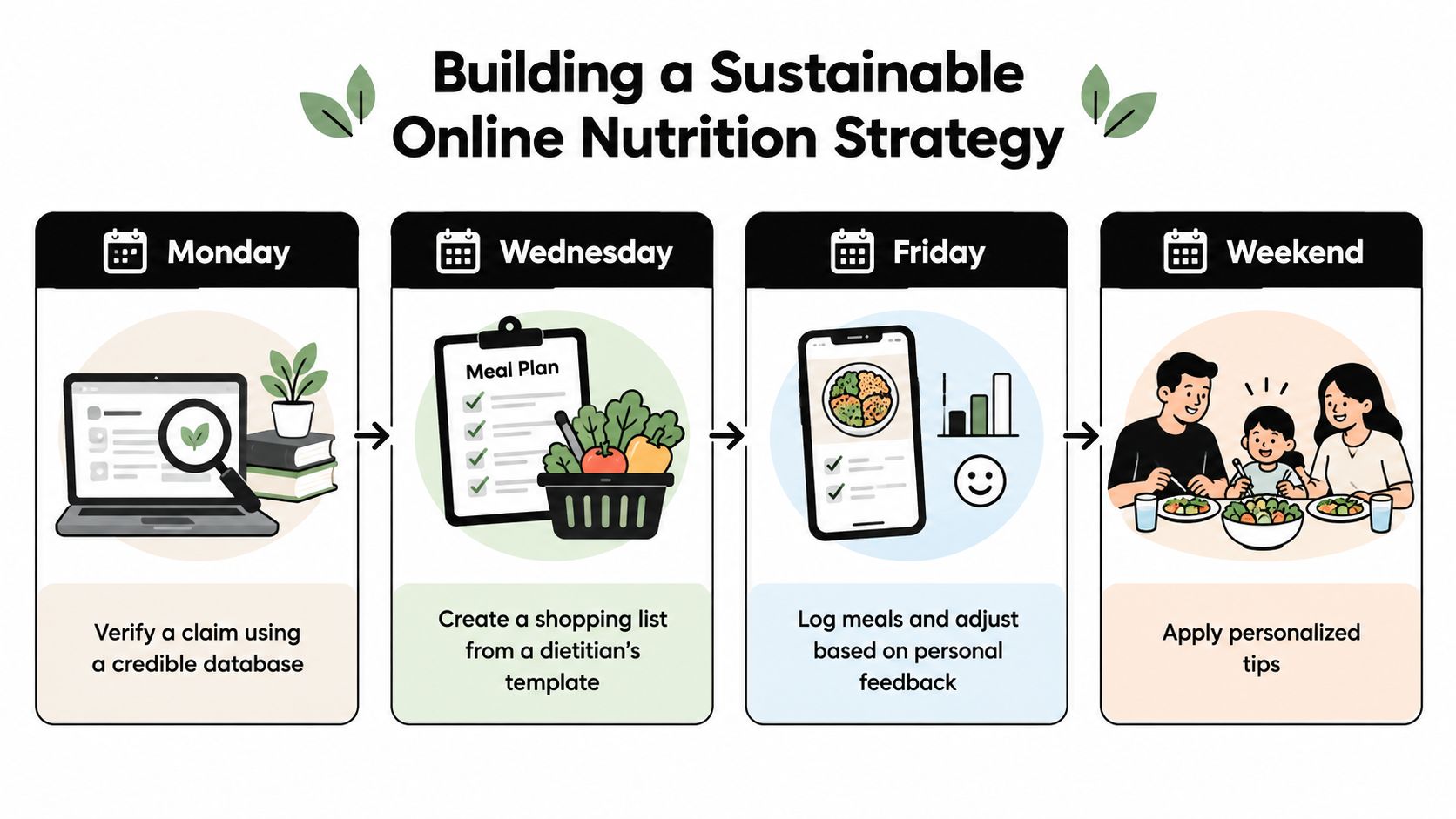
A workable routine might look like this for a busy parent. On Monday, they save a nutrition claim from social media, check the author's credentials and compare it with Australian guidance. On Wednesday, they use a dietitian's template to plan meals and create a shopping list. During the week, they log meals when practical rather than chasing perfect records.
On Friday, they review the app's summary alongside energy, hunger, symptoms and schedule. A body-composition trend may suggest a question, but it doesn't decide what the person should do. At the next telehealth appointment, they bring the pattern to a dietitian, who can separate a useful signal from ordinary variation and adjust the plan.
Keep the system small enough to repeat
A sustainable strategy doesn't require constant measurement. Choose a few behaviours you can maintain, such as checking the source of a claim, recording meals during selected days and reviewing trends at a regular time. If tracking increases anxiety or encourages restriction, stop and discuss that response with a qualified professional.
Use this decision sequence:
- Verify the advice. Identify the author, evidence and commercial interests.
- Anchor it locally. Compare it with Australian Government guidance.
- Track selectively. Record information connected to a clear question.
- Review patterns. Avoid making decisions from one isolated result.
- Escalate appropriately. Ask a dietitian or doctor about symptoms, medical conditions or risky restrictions.
- Protect your information. Recheck permissions and data-sharing settings.
The purpose of nutrition advice online isn't perfection. It's a repeatable way to move from a claim, to evidence, to personal observation, to informed professional discussion.
Venus Health Co. offers app-connected tools for home body-composition tracking, nutrition logging and AI-generated wellness summaries, alongside Bluetooth basal body-temperature tracking for reproductive health. Visit Venus Health Co. to explore tools that can help you pair credible nutrition guidance with organised personal data.