

Natural Cycles Thermometer: BBT Tracking for Fertility
Dr. Adeyinka AdegbosinYou wake before sunrise, reach for the thermometer on your bedside table, and wonder whether today's number will finally make your cycle easier to understand. Yesterday's reading looked higher, but you slept poorly. Your app shows a changing fertility status, and the temptation is to treat one result as a definite answer.
That uncertainty is common. Australian research found that 37.1% of women surveyed were actively trying to improve their fertility-awareness knowledge, while only 2.1% correctly identified the fertile period of the menstrual cycle (RACGP research). A natural cycles thermometer can make daily measurement easier, but its readings still need to be collected consistently and interpreted with care.
Introduction to Natural Cycles Thermometer
A natural cycles thermometer is designed to measure basal body temperature, or BBT, soon after waking, before normal morning activity changes your temperature. The aim isn't to diagnose ovulation from one reading. It's to build a daily record that can reveal a sustained temperature pattern across the cycle.
Connected models can send a reading to a fertility app, reducing the need to type numbers into a chart. The app may then combine temperature data with period information, symptoms, cervical mucus observations or LH test results to provide cycle insights. Those insights are useful, but they shouldn't be treated as more reliable than the quality of the data behind them.
This guide focuses on the practical details that often get missed. You'll learn how the temperature shift works, why measurement location matters, how connected features reduce recording errors, and how to label readings affected by illness, travel or broken sleep. You'll also see how a home BBT thermometer differs from equipment used for clinical monitoring, and how to choose a device that fits your routine.
The central idea is simple: temperature tracking works best as a consistent pattern, not a collection of isolated numbers.
Understanding Key Concepts
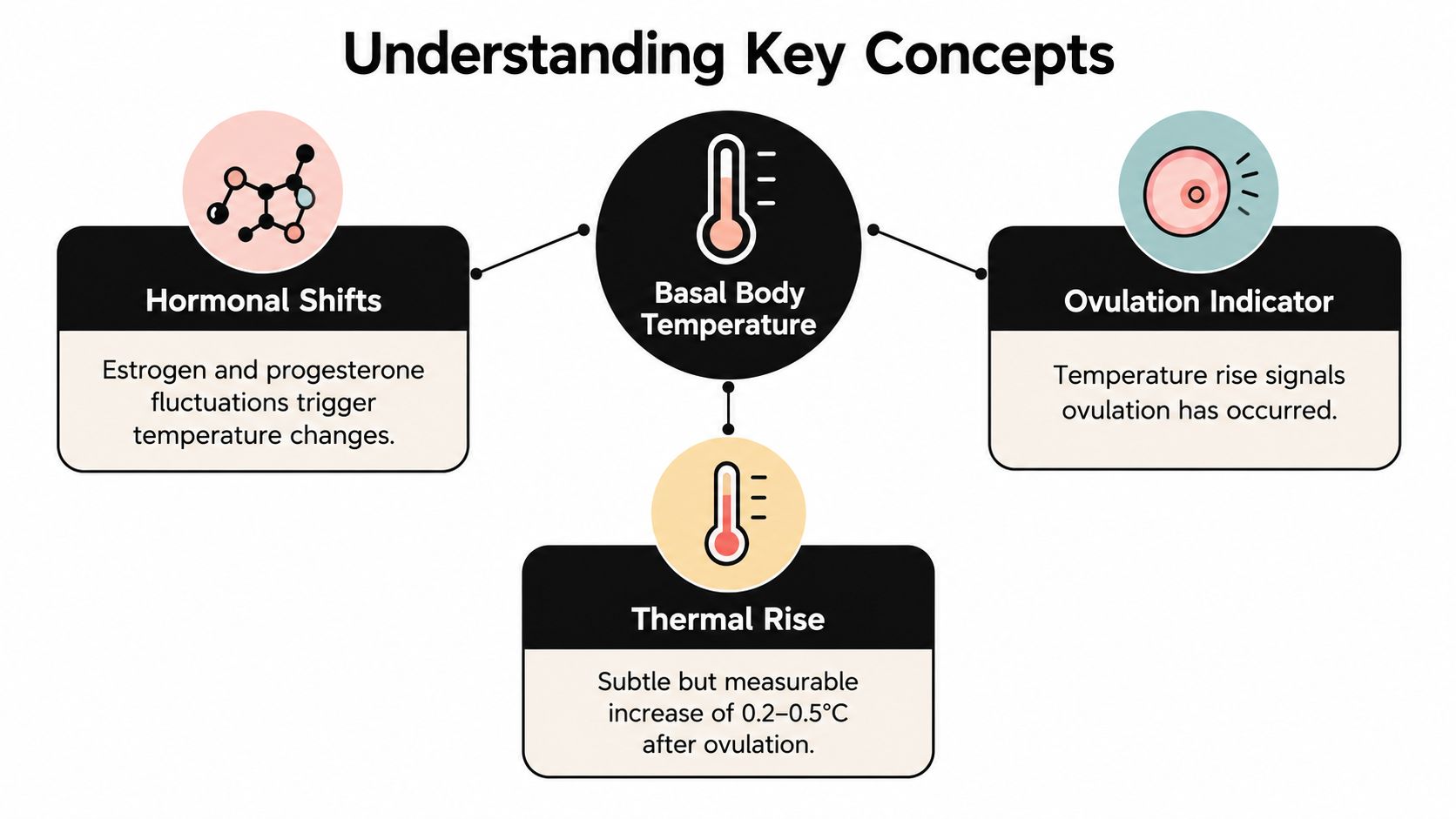
After ovulation, hormonal changes can raise resting body temperature by approximately 0.2–0.5°C, with the higher level often continuing until menstruation, as described in Healthdirect's fertility-awareness guidance. The change is subtle, more like a thermostat shifting slightly than a fever you can feel.
A cycle chart works like a quiet listening exercise. The temperature pattern is a soft signal, while late waking, getting out of bed, alcohol, illness, broken sleep or a different measurement site can add louder interference. A reliable thermometer helps, but repeatable conditions are just as important as device precision.
What the rise can and cannot tell you
A sustained rise usually suggests that ovulation has already occurred. It does not reliably identify the start of the fertile window as it happens. This matters when trying to conceive, because the most useful days often occur before the temperature change becomes visible.
Temperature tracking is one fertility-awareness approach used alongside calendar observations and cervical-mucus observations. For a clearer explanation of the method, see what basal body temperature means.
Why consistency matters more than a single result
Take the measurement immediately after waking, before sitting up, eating, drinking or moving. Use the same anatomical site each day, such as oral, vaginal or rectal measurement, following the device instructions. Switching sites during a cycle can make an ordinary difference look like a hormonal shift.
If a reading follows illness, travel, alcohol, unusually short sleep or a late wake-up, mark it as potentially unreliable rather than treating it as proof. In Australia, combining the temperature trend with cervical mucus, cycle timing and, where appropriate, LH testing gives a broader basis for decisions. Persistent irregularity or health concerns should be discussed with a qualified clinician. For people assessing broader menstrual patterns, lab tests for complex chronic illness provide clinical information that home tracking cannot. The two approaches answer different questions.
A connected option such as the Venus Smart Basal Thermometer for Ovulation, Bluetooth BBT Tracker with App can record BBT and send readings to a phone, reducing manual transcription.
Practical rule: Treat BBT as a trend line. One high reading is a clue, not proof of ovulation.
Core Features of Natural Cycles Thermometer
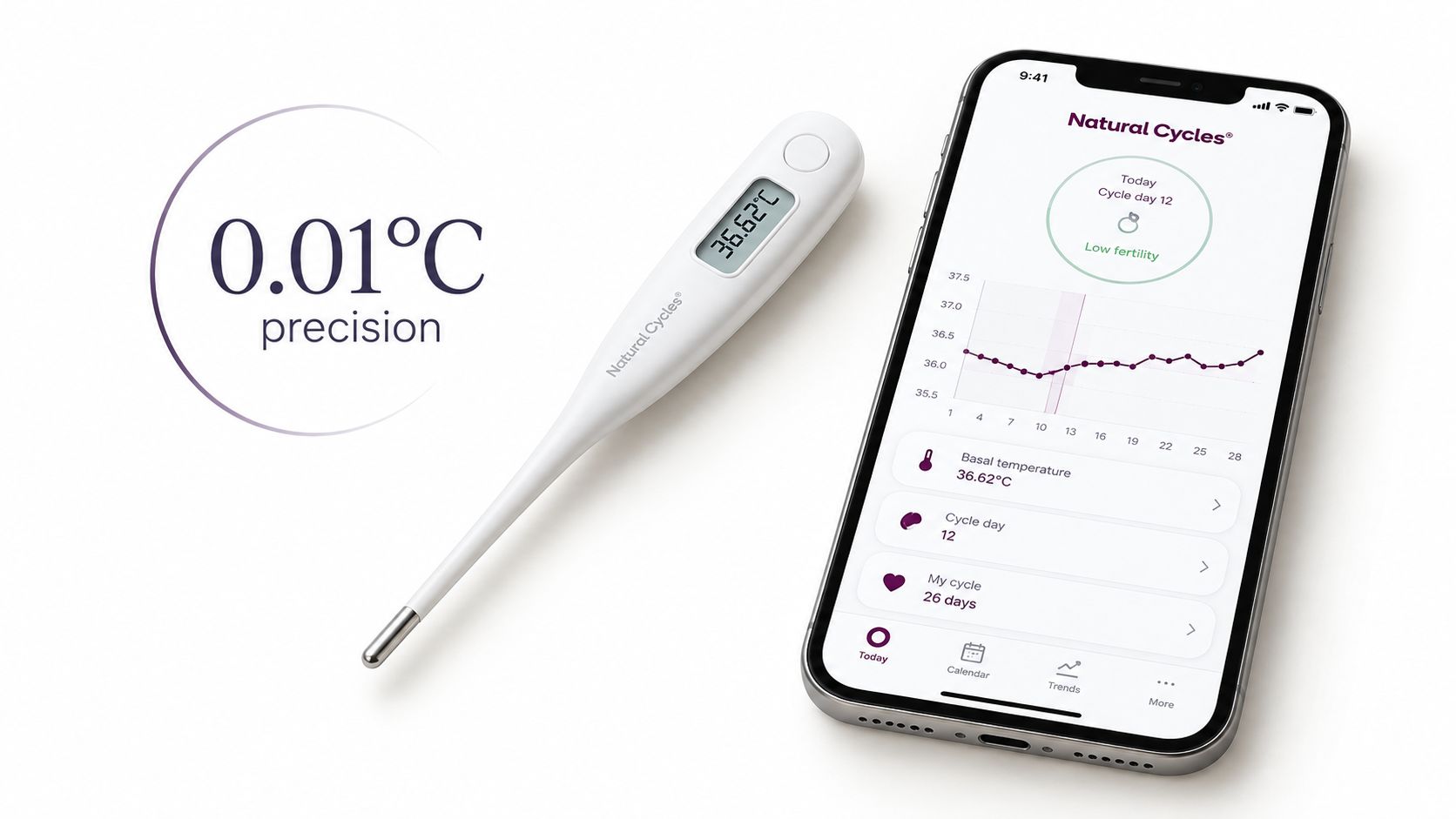
The useful features of a fertility thermometer aren't just technical specifications. Each one should remove a specific source of uncertainty from your morning routine.
Precision for a narrow biological signal
A BBT device needs to show small changes clearly. A thermometer that reports only broad whole-degree readings may hide the subtle rise you're trying to follow. The Venus product catalogue describes its smart basal thermometer as measuring to 0.01°C, with a digital display and a flexible tip.
That level of display precision doesn't make every reading automatically accurate. If you measure after walking around, use a different site or wake at a very different time, the extra decimal places can create false confidence. Precision is most valuable when paired with a stable protocol.
Bluetooth syncing removes a manual step
Manual entry creates an avoidable gap between taking a reading and recording it. You might forget the number, type it incorrectly or enter it under the wrong date. Bluetooth syncing can transfer the reading to an app, where the data can be viewed alongside cycle information and other observations.
The benefit is similar to using a photo timestamp rather than relying on memory. It preserves the measurement and its timing, while still leaving you responsible for noting unusual circumstances.
Device consistency protects the chart
Australian observational research found different results from conventional oral thermometers and multisensor armbands. The reported mean values were 36.4°C and 34.6°C, respectively, and the study found no agreement between the devices (Australian Sexual Health Quarters guidance). The practical lesson is clear: don't mix device types or body sites in one cycle chart and then compare their absolute values.
A dedicated digital BBT thermometer can support a cleaner personal baseline. The app should focus on changes within your own readings, rather than treating another sensor's reference range as interchangeable.
Comfort supports adherence
A thermometer that's easy to keep beside the bed is more likely to become part of your routine. Look for a clear display, a comfortable tip, straightforward cleaning instructions and a measurement process you can complete without fully waking yourself. Connected logging is helpful, but it won't compensate for readings taken inconsistently.
How to Use a Fertility Thermometer
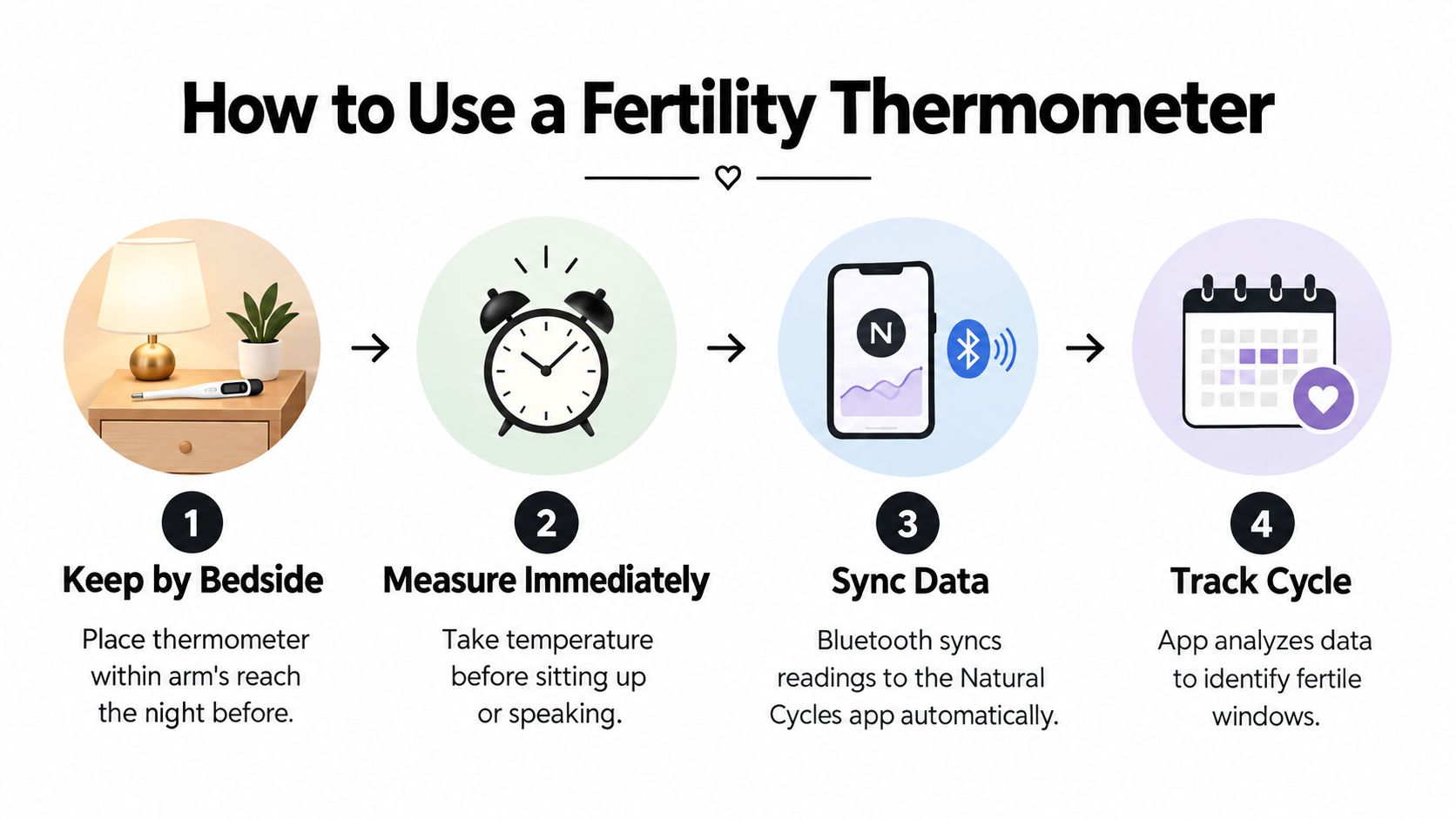
A dependable routine starts the night before. Put the thermometer within arm's reach, keep your phone available if syncing is required, and decide which measurement site you'll use. The fewer decisions you make at dawn, the less likely you are to alter the conditions accidentally.
The morning workflow
- Measure before activity. Take your temperature as soon as you wake, before getting out of bed, speaking, eating or drinking. Follow the manufacturer's instructions for placement and allow the device to complete its reading.
- Keep the method stable. Aim for the same general waking window and the same anatomical site. The goal isn't perfection at every minute. It's reducing avoidable variation so that a small hormonal signal remains visible.
- Sync or record immediately. Let Bluetooth transfer the reading if your device supports it. If you're entering it manually, check the date and time before saving.
- Add context. Record fever, illness, medication, alcohol, travel, unusually broken sleep or another event that may have affected the result. Australian guidance identifies these factors as potential sources of distorted BBT readings (Australian fertility-awareness information).
A decision protocol for questionable readings
Few people need to discard an entire cycle because one morning went badly. Instead, label the reading according to the conditions around it.
- Valid reading: You had at least three hours of rest, measured immediately after waking, used your usual site and had no obvious disturbance. Keep it in the main trend.
- Questionable reading: Sleep was interrupted, you woke much earlier or later, travelled, drank alcohol, felt unwell or took medication that may affect temperature. Keep the value visible, but mark it as disturbed and avoid using it alone to confirm a shift.
- Clinically concerning temperature: A high temperature appears alongside symptoms of illness or continues in a way that concerns you. Don't interpret it as a fertility signal. Follow appropriate medical advice.
A later reading may still be useful if it was taken under normal conditions, but it shouldn't be swapped in place of the usual measurement. The purpose of the label is to preserve context, not to make the chart look tidy.
For a practical refresher on setup and daily technique, use this guide on how to use a BBT thermometer.
If the conditions changed, the interpretation should change too.
When three consecutive readings are high compared with your personal baseline, the pattern can support retrospective confirmation of ovulation. During shift work, newborn sleep disruption or jet lag, temperature-only interpretation becomes less dependable. Use conservative fertility-awareness rules and consider cervical mucus or LH testing rather than allowing an algorithm to turn uncertain data into false certainty.
Comparing Natural Cycles Thermometer and Medical Graded Devices
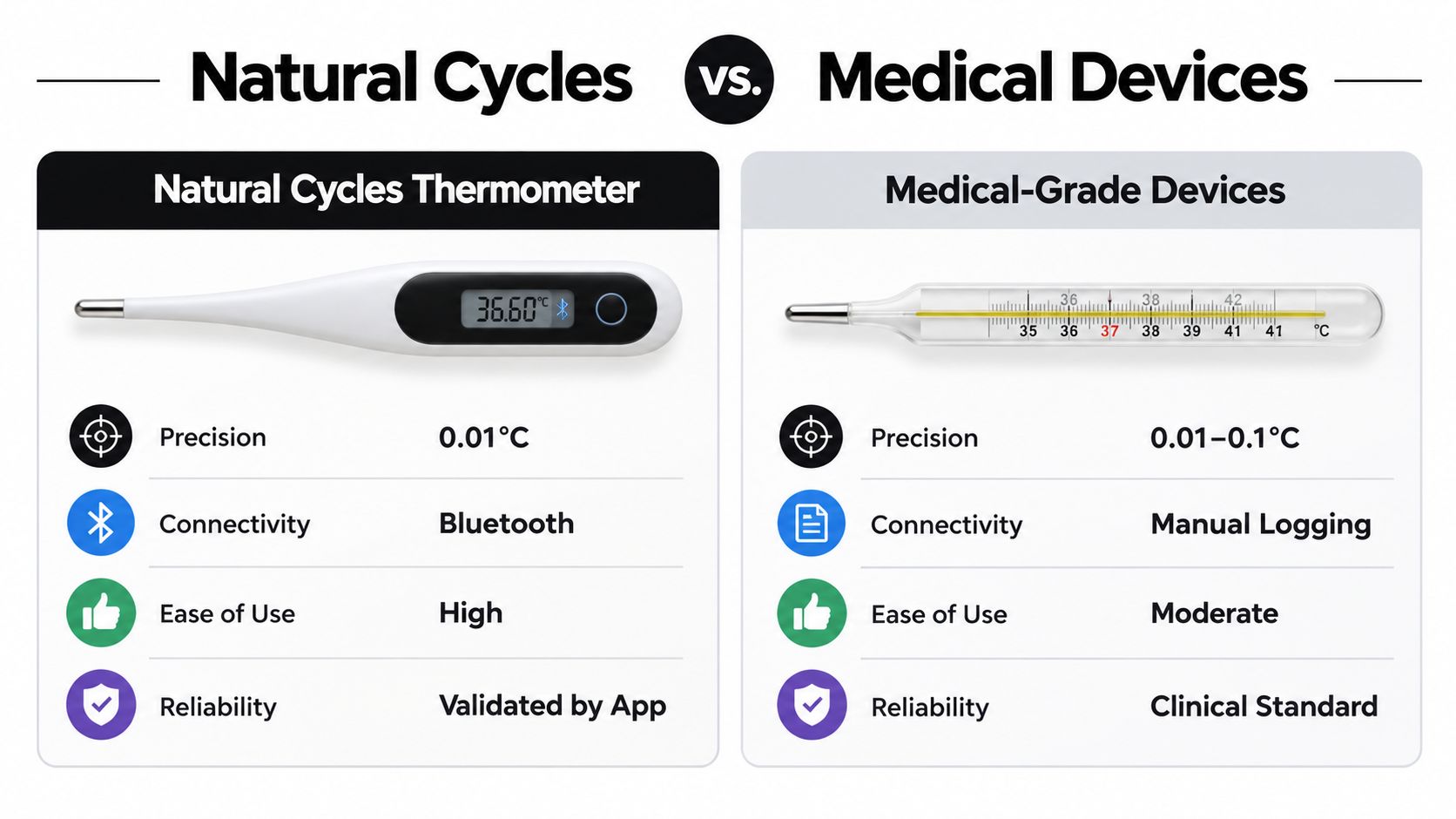
A home natural cycles thermometer and a medical-grade clinical device may both display temperature, but they're built for different jobs. A home BBT thermometer prioritises repeatable morning measurement, personal trend tracking and convenient data transfer. Clinical equipment may be selected for diagnostic monitoring, broader medical assessment or use under professional supervision.
That difference doesn't mean a home device is a substitute for a clinical assessment. It means the right tool depends on the question you're asking. “Has my personal temperature pattern shifted after ovulation?” is different from “Do I have a fever or a medical condition requiring examination?”
Accuracy is more than the display
The Australian device-comparison findings show why users should avoid switching between sensors during a cycle. A wearable, an oral thermometer and another sensor may produce different absolute values even when used on the same person. A useful app therefore needs personal trend logic, visible outlier flags and clear information about the measurement method.
The device should also make it easy to identify readings affected by disrupted sleep or illness. Without that context, an algorithm may mistake an ordinary disturbance for a cycle event.
Apps can't repair weak assumptions
Monash University researchers surveyed 204 women attending assisted-reproductive-technology clinics, and only 13% correctly identified the specific fertile days immediately before and around ovulation (Monash University fertility-timing research). The same report states that 87% had tried to improve their fertility knowledge, showing how motivation and understanding can diverge.
In a separate analysis of 36 commonly downloaded fertility apps, only 42.7% predicted the correct ovulation date. Those results don't prove that every app is ineffective, but they do show why calendar estimates shouldn't be treated as biological measurements.
| Consideration | Home BBT thermometer | Clinical device |
|---|---|---|
| Main purpose | Daily personal cycle tracking | Medical assessment or monitoring |
| Data collection | User-led, usually at home | Often supervised or clinically specified |
| Trend interpretation | Personal baseline and cycle pattern | Clinical context and professional review |
| Best use | Repeated morning measurements | Questions requiring healthcare assessment |
For more detail on the difference between consumer BBT tools and medical thermometers, see this explanation of a medical-grade thermometer.
Choosing the Right Fertility Thermometer
Start with your routine, not the marketing language. If you wake at inconsistent times, travel across time zones or care for a newborn, the best device is the one whose instructions clearly explain how to handle disrupted readings. A polished app can't remove the biological noise created by broken sleep.
Use this checklist when comparing options:
- Measurement resolution: Can it show small changes appropriate for BBT tracking?
- Measurement site: Does the device specify oral, vaginal or rectal use, and can you keep that method consistent?
- Data handling: Does it timestamp readings or sync them automatically?
- Disturbance logging: Can you flag illness, medication, travel, alcohol and unusual sleep?
- App compatibility: Does the app let you add cervical mucus, LH results and symptoms?
- Travel practicality: Is it battery-powered, compact and easy to clean?
- Clinical boundaries: Does the manufacturer explain that BBT confirms ovulation retrospectively rather than predicting it alone?
Price matters, but the cheapest option can become expensive in time if it requires repeated manual entry or produces charts you can't interpret. Conversely, extra connectivity isn't useful if the app hides disturbed readings or presents a daily fertility status without explaining uncertainty.
For conception planning, combine BBT with a sign that can provide information before the temperature rise. Cervical mucus observations and LH tests can help identify the approach to ovulation, while BBT can later show whether a sustained shift probably occurred. If you're avoiding pregnancy, use conservative rules during ambiguous cycles and seek guidance from a qualified Australian healthcare professional.
Conclusion and Next Steps
A natural cycles thermometer works best as a pattern-building instrument, not an oracle. A temperature shift can support the interpretation that ovulation has already occurred, but one reading cannot establish that conclusion. Treat each measurement like one tile in a mosaic, useful when viewed alongside the surrounding pattern and its context.
Use the labels from the earlier sections for the next two cycles: valid, questionable or concerning. Then review whether your chart shows three consecutive higher readings or repeated disturbance flags. If uncertainty remains, decide whether to add LH testing or cervical mucus observations rather than forcing a conclusion from temperature alone.
Temperature has a defined boundary. It usually provides information after ovulation, so it cannot reliably identify the start of the fertile window by itself. Cervical mucus and LH tests can offer earlier clues. If cycles remain persistently irregular, concerning or apparently anovulatory, seek advice from a qualified Australian healthcare professional.
Your thermometer should suit the mornings you have. Consistent measurement, automatic logging and clear disturbance flags can reduce avoidable interpretation errors. An app should make uncertainty visible, like a weather forecast showing confidence levels, rather than presenting every result as certain.
Venus Health Co. offers a Bluetooth basal thermometer that records morning BBT and syncs readings with its app. Users can also log LH tests, cervical mucus and symptoms. Visit Venus Health Co. to explore its fertility-tracking tools and compare the setup with your cycle goals.