

Luteinising Hormone Test: What It Reveals About Fertility
Dr. Adeyinka AdegbosinYou're crouched in the bathroom early in the morning, holding a test strip under the light and comparing two pink lines. One is darker than the other, but which line matters? Is the result negative, nearly positive, or a sign that ovulation is about to happen?
A luteinising hormone test, often called an LH or ovulation test, can make this part of trying to conceive more predictable. It detects the rise in LH that happens before ovulation, helping you identify when your fertile window is approaching. But the strip isn't a complete fertility diagnosis, and a positive result doesn't prove that ovulation occurred.
The detail that causes the most confusion is that LH isn't a one-number hormone. Australian pathology guidance shows that the expected result changes dramatically according to cycle stage, from the follicular phase to the mid-cycle surge, the luteal phase, and after menopause (Royal Melbourne Hospital pathology handbook). The meaning depends on when the sample was taken, how it was taken, and what question you're trying to answer.
Why an LH Test Matters When You're Trying to Conceive
An LH test gives you a practical signal before ovulation rather than asking you to rely only on an app's estimate or a calendar prediction. Australian fertility guidance describes a positive urine LH test as predicting ovulation in the following 24 to 36 hours, although the surge itself doesn't confirm that ovulation will take place (RACGP fertility assistance review).
That timing matters because sperm and egg need to meet during a relatively short biological window. A positive test tells you that the body is sending the hormonal signal associated with the final preparation for ovulation, so you can plan intercourse around the coming days instead of waiting for a missed period or guessing from an average cycle.
What the strip can and can't tell you
Think of LH as a dispatch signal, not a delivery receipt. The pituitary gland releases LH in pulses, and the larger mid-cycle rise signals the ovary that ovulation is approaching. A urine strip detects LH after it has passed into the urine, which makes it useful for home timing.
It doesn't directly show that an egg was released. The RACGP explains that urine LH identifies the pre-ovulatory surge, while serum progesterone is preferred when the clinical question is whether ovulation occurred. In practical terms:
- A positive LH test: Ovulation may be approaching, commonly within the next 24 to 36 hours.
- A negative LH test: The surge wasn't detected in that sample. You may be testing before the rise, after it, or with diluted urine.
- A positive result followed by no other evidence of ovulation: Further assessment may be needed, particularly with irregular cycles.
Practical rule: Use an LH test to time the fertile window, not to declare the whole cycle successful or unsuccessful.
Why context matters more than the brand
A test strip can be well designed and still give you an unhelpful answer if you start testing too late, test at inconsistent times, or miss a short surge. The same issue applies to people managing PCOS, irregular cycles, or changing reproductive hormones. A strip isn't interpreting your result in isolation. You are.
If you have PCOS and are trying to make sense of changing hormone patterns, tracking symptoms, meals, and cycle dates together may feel more useful than looking at LH alone. An AI Meal Planner for PCOS can be one supplementary resource for organising meal ideas, but it doesn't replace medical assessment or fertility testing.
The most useful mindset is simple: LH testing narrows the timing problem. It can help you identify when to have intercourse, when to add confirmation testing, and when repeated unclear results deserve a conversation with a GP or fertility specialist.
How Luteinising Hormone Drives the Fertile Window
Imagine a race that starts only after a starter pistol fires. The follicle is preparing, the body is building towards ovulation, and then the pituitary gland sends a concentrated LH signal. That signal doesn't release the egg instantly. It starts a sequence that leads towards ovulation.
Australian pathology guidance describes LH secretion as pulsatile, which means the hormone is released in bursts rather than at one perfectly steady level. A single blood result can therefore be misleading, especially without cycle information (RCPA Manual guidance on luteinising hormone).
From baseline to surge
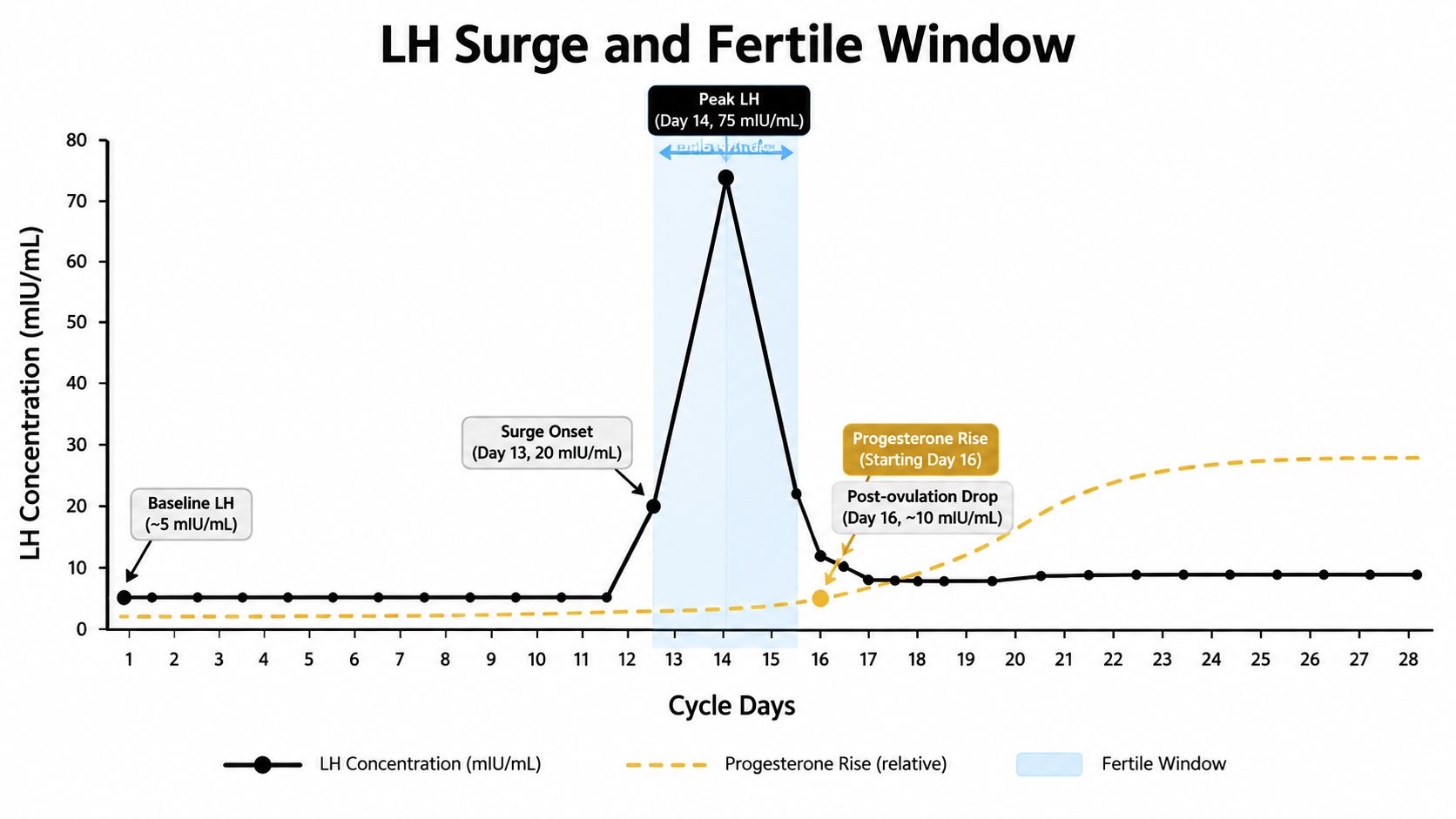
During much of the cycle, LH sits closer to its baseline pattern. Near mid-cycle, the concentration rises sharply. A urine test doesn't measure the hormone in the same way as a laboratory blood test. Instead, it detects LH that has collected in urine and signals when the concentration reaches the test's detection threshold.
That explains why a strip can look blank or faint one day and much stronger the next. You aren't necessarily seeing a smooth climb. You may be catching different points in a pulsatile hormone pattern, with urine concentration also affected by fluid intake and the time since your last urination.
Australian laboratory reference intervals show how much cycle stage changes the interpretation of LH. The Royal Melbourne Hospital lists adult female intervals of 1.8 to 12.0 IU/L in the follicular phase, 7.6 to 89.0 IU/L at mid-cycle, 0.6 to 14.0 IU/L in the luteal phase, and 5.2 to 62.0 IU/L after menopause (Royal Melbourne Hospital pathology handbook). These are laboratory reference intervals, not a direct translation of what a home strip should display.
How this appears on a urine strip
Most line tests have a control line and a test line. The control line shows that the test worked. The test line reflects the LH detected in that urine sample.
- Lower LH: The test line is usually lighter than the control line.
- Rising LH: The test line becomes more visible.
- Detected surge: The test line reaches the interpretation point specified in the instructions, commonly equal to or darker than the control line for visual strips.
Blood LH testing is different because a clinician or laboratory measures the hormone concentration in a controlled sample and reports a value with a reference interval. Urine testing remains convenient for frequent home monitoring because you can repeat it across several days without arranging a blood draw.
For a visual explanation of how the hormones change across the cycle, see this menstrual cycle hormones graph.
You can also watch a practical demonstration before using a kit:
A home option such as the Venus Ovulation Predictor Test Kit uses urine strips to help identify the fertile window without requiring a prescription. The important point isn't the packaging or device format. It's whether you use the test consistently and interpret the result alongside cycle timing.
Urine Strips Versus Digital LH Readers
Both formats look for the same basic biological event, but they ask you to read the result in different ways. A strip leaves the final judgement to your eyes. A digital reader uses an internal sensor and displays an interpretation, such as a negative or positive symbol, depending on the device.
The practical trade-off
Urine strips suit people who want to test frequently and record the changing line intensity. They usually make it easier to compare today's result with yesterday's result, but line darkness can be affected by urine concentration, lighting, timing, and the way different test batches appear.
Digital readers reduce the need to compare two lines. That can be helpful if a faint result causes anxiety, if more than one person is checking the result, or if you find visual interpretation difficult. Some digital systems provide a simple positive or negative display, while others may show a numerical or staged result. Always follow the instructions for the specific reader.
| Feature | Urine LH Strips | Digital LH Readers |
|---|---|---|
| Result format | Visible control and test lines | Symbol, text, or device display |
| Main judgement | User compares line intensity | Reader applies its detection rule |
| Frequent testing | Practical when testing across several days | May be less convenient for repeated testing |
| Record keeping | Easy to photograph or log visually | Easy to record as displayed |
| Main uncertainty | Faint or borderline lines | Device-specific interpretation |
| Best fit | People comfortable watching line changes | People who prefer a clearer display |
A strip doesn't become more medically meaningful because it costs more, and a digital reader doesn't remove the need for cycle context. Both can miss a surge if you start too late or test at an unsuitable time.
Choosing a format for your routine
Choose strips if you want a simple, repeatable method and you're comfortable recording gradual changes. Choose digital if comparing line darkness makes you second-guess every result. If your cycles are irregular, the bigger issue is usually when you begin testing and how long you continue, rather than whether the display uses lines or symbols.
The best ovulation kit guidance can help you compare the practical features of different formats before buying. If you want another fertility signal to log alongside LH, the Venus Smart Basal Thermometer for Ovulation records basal body temperature and syncs readings with its app, according to the product information.
Don't treat a reader's positive symbol as proof that ovulation happened. It still represents a detected hormone pattern. Confirmation requires a different kind of evidence.
Timing Your Test Around Your Cycle
Testing works best when you plan around your own cycle rather than assuming every person ovulates on the same day. A common starting point is to estimate ovulation by counting back from the expected next period, then begin LH testing several days before that estimate. The exact start day should remain flexible, especially if your cycle length changes.
Australian laboratory guidance asks clinicians to record the last menstrual period, and Australian fertility guidance places strong emphasis on timing when progesterone is used for confirmation (Austin Pathology LH testing information). That same principle applies at home. The test is only useful if the window you choose gives you a reasonable chance of seeing the rise.
A starting framework
The table below is a planning guide, not a diagnosis or a guarantee of the day you'll ovulate.
| Cycle Length | Start Testing On Cycle Day | Typical Positive Window |
|---|---|---|
| 21 days | Around day 5 | Around the middle of the cycle |
| 28 days | Around day 10 | Around the middle of the cycle |
| 30 days | Around day 12 | Around the middle to later part of the cycle |
| 35 days | Around day 17 | Later in the cycle |
These estimates can shift. If your previous cycle produced a positive result earlier or later, use that personal information to adjust the next starting point. If you have irregular periods, you may need to test for longer, use another ovulation sign, or discuss a clinician-led approach rather than repeatedly buying strips without a plan.
For wider background on what home hormone tests can measure, you can browse hormone test insights. The resource may help you distinguish an at-home screening signal from a clinical hormone assessment.
Making each sample more useful
Many people test with first-morning urine because it's easy to remember. Yet some home instructions recommend testing later in the day, particularly when the surge may be starting. Follow your kit's directions, then keep the testing time as consistent as you reasonably can.
Near your expected fertile window, testing twice in a day may help you avoid missing a short rise. You don't need to test endlessly after a clearly positive result. Record it, plan intercourse around the fertile window, and shift your attention to confirmation signs.
A practical routine looks like this:
- Keep timing steady: Test at roughly the same time each day.
- Avoid heavy hydration immediately beforehand: Very diluted urine can make a rising result harder to see.
- Record medication use: Fertility medicines and other hormone treatments can affect interpretation.
- Extend the window when needed: If your cycle is late or your previous surge came later, continue rather than assuming the result is negative for the entire cycle.
For a step-by-step timing routine, see this guide to the best time to use an ovulation test.
Reading Positive, Negative, and Faint Results
A visual strip often creates confusion because “a line is present” doesn't always mean “the result is positive”. Most line-based LH tests require the test line to be equal to or darker than the control line before you call the surge detected. A faint test line may show that some LH is present, but it usually doesn't meet the positive threshold.
What each result means
A negative result means the test hasn't detected enough LH in that urine sample to meet the kit's stated threshold. It doesn't tell you that ovulation won't happen. You could be testing too early, have tested after the surge, or have collected a diluted sample.
A positive result means the test has detected an LH pattern that the kit interprets as a surge. It helps predict the timing of ovulation, but it doesn't confirm the egg was released. A result that fades the next day may indicate the surge has passed. It isn't automatically a second surge.
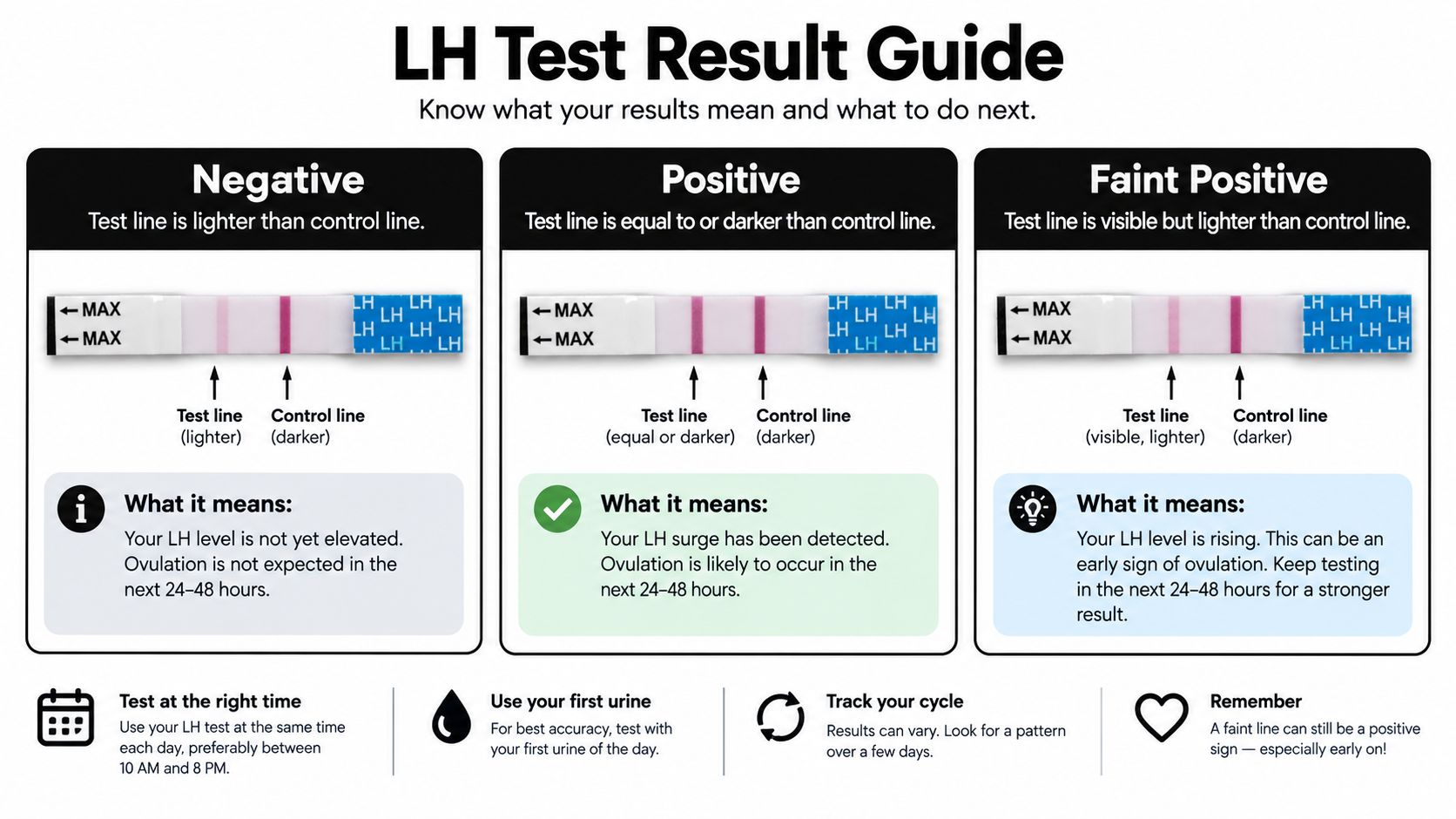
A faint line is best treated as a watching point, not a final answer. Test again according to the kit instructions and compare the line with the control line under similar lighting. Taking a photograph at the same time each day can make changes easier to see, although a photo can't correct a poorly timed or diluted sample.
Why a single strip can mislead
LH secretion is pulsatile, and Australian pathology guidance warns that one result can be misleading (RCPA Manual guidance on luteinising hormone). Home results can also vary because of:
- Early testing: You began before your usual rise.
- Late testing: The surge occurred before you tested.
- Diluted urine: Fluids reduced the hormone concentration in the sample.
- Irregular cycles: Calendar estimates don't match the body's timing.
- Hormone-related conditions or medicines: The underlying pattern may need clinical interpretation.
Digital readers can reduce the visual argument over whether a line is “dark enough”, but they still apply a threshold to a urine sample. If results stay positive for an unexpectedly long period, remain negative across cycles, or don't fit your bleeding pattern and symptoms, take the record to a healthcare professional.
Pairing LH Tests With BBT and Cycle Apps
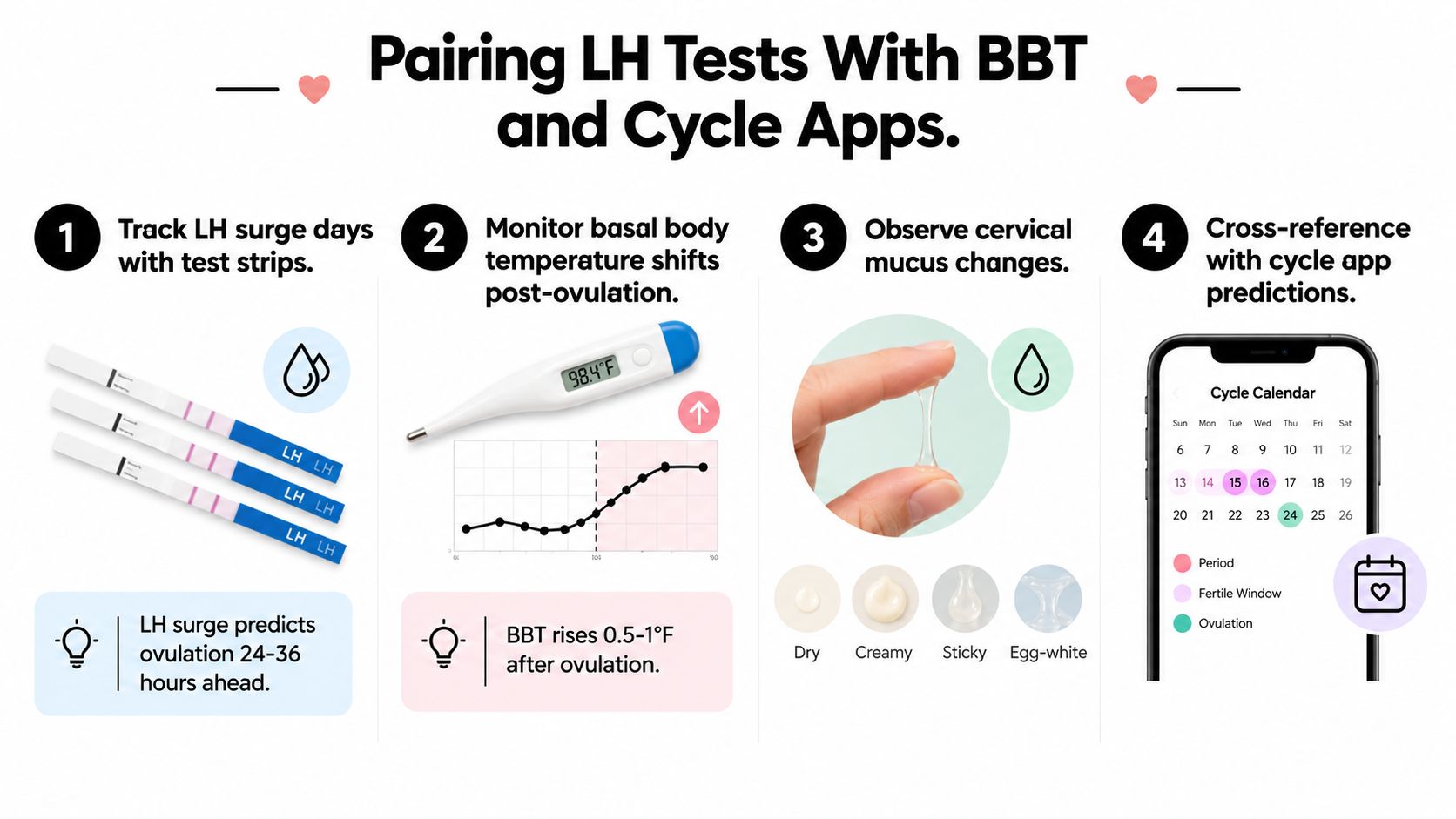
LH gives you a forward-looking signal. Basal body temperature, or BBT, gives you a retrospective clue that ovulation may already have occurred. Cervical mucus adds another observation about changing fertility conditions, while an app can help you store the information in one place.
This combination is more useful than asking any single sign to answer every question. LH can help you decide when to have intercourse. BBT can help you review the cycle afterwards. Progesterone testing can provide clinical confirmation when a healthcare professional considers it appropriate.
A simple daily record
Keep the log small enough that you'll use it:
| Entry | What to record |
|---|---|
| LH test | Negative, faint, positive, or reader display |
| Temperature | BBT reading taken under consistent conditions |
| Cervical mucus | Dry, sticky, creamy, watery, or slippery observations |
| Cycle day | Day counted from the first day of bleeding |
| Intercourse | Timing in relation to the fertile window |
| Notes | Illness, disrupted sleep, medicines, or unusual symptoms |
An app can turn strip photos and BBT readings into a visual timeline, but its prediction is still based on the information you provide. Keep the raw observations rather than relying only on a coloured fertile-window label. If the app's prediction conflicts with your test results, your cycle history and clinical context matter more than the graphic.
Using the signals together
Start by recording LH before the expected fertile window. When the result changes, note cervical mucus and plan intercourse around the predicted window. Continue taking BBT so you can look back for a sustained pattern after the suspected ovulation date.
A connected tool can reduce manual entry. For example, a body-composition product such as the Venus AI Smart Scale is designed for weekly body tracking and app-based health reports, but it isn't an ovulation test and can't replace LH, BBT, or clinical hormone testing.
A clear fertility picture comes from several observations that agree, not from forcing one test to explain everything.
If your LH result is positive but your temperature pattern remains unclear, don't assume the strip failed. The two measures answer different questions. Bring your logged results to a clinician if you need help deciding whether ovulation is occurring.
Your Practical LH Testing Plan Going Forward
A useful plan doesn't need to be complicated. It needs to tell you when to begin, what to record, and what to do when the result doesn't match your expectation.
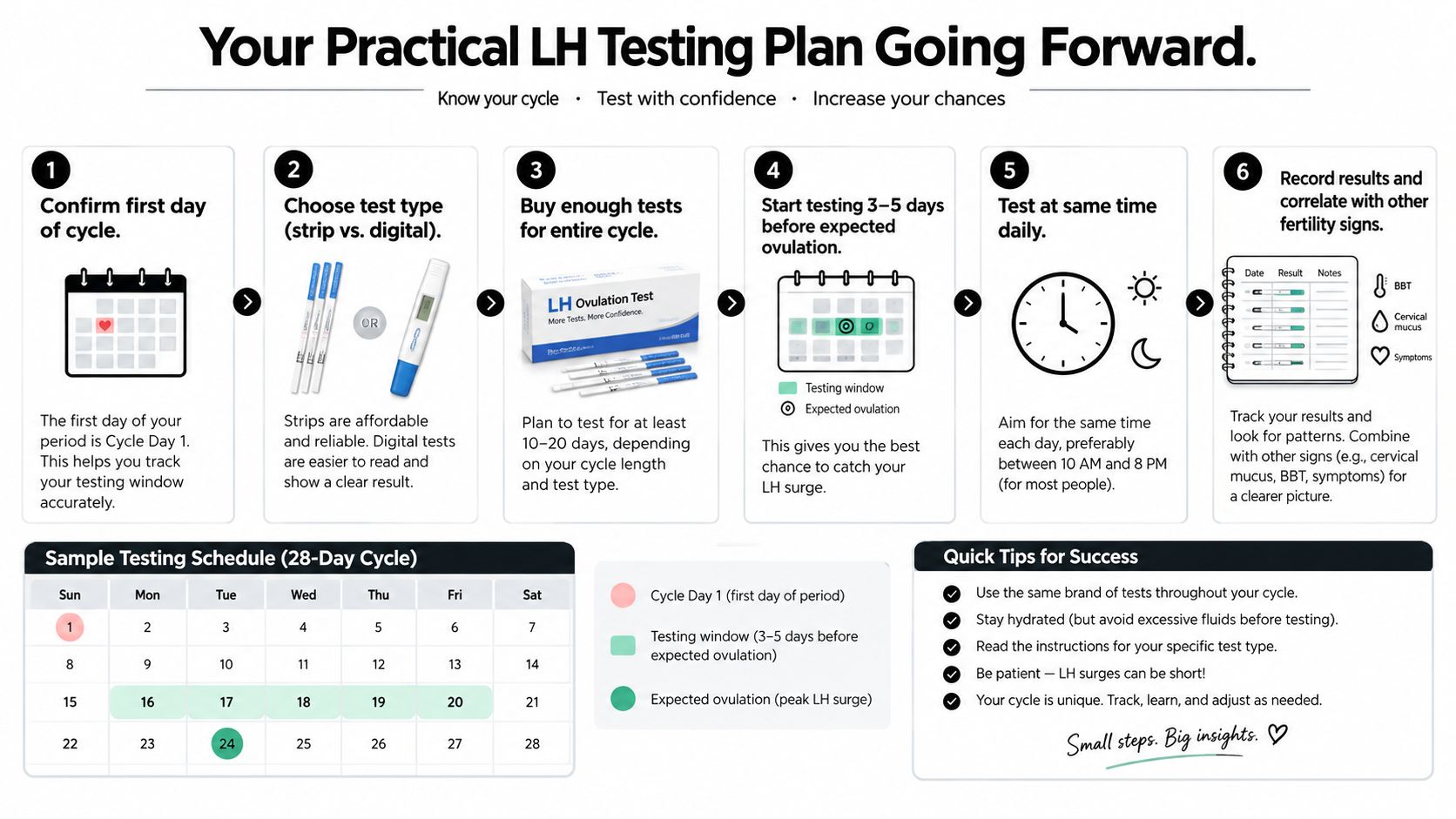
Before the next cycle starts, choose your format and set up one place to log results. Mark the first day of bleeding as cycle day one, check the instructions for your chosen kit, and estimate your testing start date from your usual cycle length. If your cycles vary, start earlier and expect to test for longer.
A five-day routine
Day one, prepare. Confirm the cycle day, choose strips or a digital reader, check that you have enough tests, and decide whether you'll use a notebook, spreadsheet, or app.
Day two, begin before the guess. Start testing several days before your estimated ovulation rather than waiting for obvious symptoms. Use a consistent time and avoid making one early negative result the conclusion.
Day three, watch the direction. Compare the test line with the control line or record the digital display. Note any change in cervical mucus and keep the rest of your routine as normal as possible.
Day four, respond to a positive. If the test meets the kit's positive definition, plan intercourse during the coming fertile window. Record the result and continue with any confirmation method you've chosen.
Day five, review rather than panic. A fading line may indicate that the detected rise has passed. If no positive appeared, consider whether you started too late, used diluted samples, or need a longer testing window next cycle.
One positive cycle gives you a useful signal. Two or three carefully logged cycles can reveal your personal pattern more clearly, especially when the expected timing doesn't match a generic calendar. If results remain confusing, irregular, or persistently negative, bring the records to your GP or fertility clinician.
Keep the question clear: Are you trying to predict ovulation at home, or confirm that ovulation occurred? The test and timing may be different.
Seek medical advice when cycles remain irregular, bleeding is absent or unusual, or conception isn't happening despite well-timed attempts. A clinician can decide whether serum progesterone, LH and FSH assessment, ultrasound, or other investigations are appropriate. Australian guidance also uses LH within broader endocrine assessments, including evaluation of reproductive dysfunction and male hypogonadism, rather than treating it as a standalone answer (Endocrine Society of Australia information via the RCPA Manual).
Venus Health Co. offers at-home LH testing alongside connected fertility tools that can help you record ovulation signals and basal body temperature in one place. If you want a clearer routine for tracking your fertile window, visit Venus Health Co. to explore the available options.