

Losing Weight While Pregnant Safe Guidance and Tips
Dr. Adeyinka AdegbosinYou might be here because you stepped on the scale, saw a number you didn't expect, and felt your stomach drop.
That reaction is common. Early pregnancy can make your body feel unfamiliar very quickly. Some people notice weight going up before they thought it would. Others lose a little at first because nausea, food aversions, or exhaustion make eating harder. If you started pregnancy in a larger body, you might also be wondering whether losing weight while pregnant would be safer than gaining more.
In Australian care, the answer is usually more specific than a simple yes or no. The usual goal is not intentional weight loss. The goal is to stay within a BMI-based weight gain range that supports both you and your baby. That sounds less dramatic than “lose weight”, but it's the framework clinicians use.
Understanding Safety Around Weight Changes in Pregnancy
You might have had a week like this. Your clothes feel tighter, the scale is up, and your first thought is, “Do I need to stop gaining before this gets out of hand?” In pregnancy care, that question needs a safety lens first.
Weight change in pregnancy is less like a pass or fail test and more like following the right lane on a long road. One scale reading can shift because of fluid, constipation, bloating, nausea, or the time of day. Clinicians look for the direction over time, then compare that pattern with your starting BMI, your symptoms, and how the pregnancy is progressing.

What safety means in practice
Australian guidance does not treat pregnancy as a time for intentional dieting. Queensland Health states that weight loss is not recommended during pregnancy, and its guidance uses pre-pregnancy BMI to set weight gain ranges for singleton pregnancies.
That matters because the safer goal is usually steady gain within the right clinical band, not trying to make the number on the scale go down. Even if you began pregnancy in a larger body, the usual plan is still based on staying within a recommended gain trajectory, with medical review if your pattern is outside it.
Better Health Victoria says this plainly too. If you're pregnant and overweight, pregnancy is not the time to start dieting or trying to lose weight.
A simple check helps here. If your plan involves skipping meals, cutting intake sharply, fasting, or aiming for active weight loss, it sits outside standard pregnancy guidance.
What often causes confusion
People often hear “don't try to lose weight” and then worry that any gain must be fine. That is not how antenatal care works. The goal is measured, appropriate gain for your BMI category, not unrestricted eating and not self-directed weight loss.
Early pregnancy can muddy the picture. Some people gain quickly because hunger, fatigue, and nausea change what feels manageable to eat. Others lose some weight because food aversions or vomiting make regular meals hard. Neither pattern tells the full story on its own.
What matters is whether the pattern settles into an expected range or starts drifting far above or below it.
When to ask for medical review instead of changing your diet alone
This is the point many people need spelled out clearly. If weight is dropping without you trying, or rising much faster than expected, the next step is not a stricter diet plan. The next step is to speak with your GP, midwife, obstetrician, or dietitian.
Seek review sooner if you cannot keep food or fluids down, feel faint or weak, notice signs of dehydration, or are worried your weight trend does not match what your care team expected. Rapid swelling or sudden jumps on the scale also deserve review, because not every increase is about body fat.
That approach is safer for you and your baby. It also keeps the focus where it belongs: nourishment, growth, and checking for problems early, rather than chasing weight loss during pregnancy.
A calmer question to ask is this: “Am I tracking within the gain range for my pre-pregnancy BMI, and do I need support to get back on course?”
How to Find Your Healthy Weight Gain Target
At your first antenatal visit, a common moment of panic sounds like this: “I know I should not try to lose weight, but how do I know what amount to gain?” A clear target helps because pregnancy care in Australia does not use one number for everyone. It uses a weight gain range based on your pre-pregnancy BMI.
Start with your pre-pregnancy BMI
BMI is a simple height-and-weight calculation used to place you in a starting category before pregnancy. That starting category then points to a recommended gain band for the months ahead.
Pre-pregnancy weight is the best baseline to use. If you do not know it, your first pregnancy weight is sometimes used instead, but that can place someone in the wrong category and shift the target range. The Women's pregnancy weight guidance brings together the BMI categories, total gain bands, expected later-pregnancy rates, and notes that first trimester gain is often only about 1 to 2 kg.
BMI and body composition are not the same. BMI is a screening tool. Body composition describes what body weight includes, such as fat, muscle, bone, and fluid. If you want a clearer explanation of that difference, this guide on body composition gives a useful plain-English overview.
Use the Australian target bands
For a singleton pregnancy, the usual Australian guide bands are:
| Pre-pregnancy BMI Category | Total Gain Target | Expected Trimester 2 and 3 Rate |
|---|---|---|
| Under 18.5 | 12.5 to 18.0 kg | about 0.51 kg per week |
| 18.5 to 24.9 | 11.5 to 16.0 kg | about 0.42 kg per week |
| 25.0 to 29.9 | 7.0 to 11.5 kg | about 0.28 kg per week |
| 30.0+ | 5.0 to 9.0 kg | about 0.22 kg per week |
A practical way to read this table is to treat it like a road lane, not a single painted line. You do not need to hit one exact number each week. You are aiming to stay within the band for your BMI category over time.
Turn the numbers into a usable plan
Here is how to apply the chart without getting lost in it.
- Use your best starting weight. Pre-pregnancy weight is ideal.
- Work out your BMI category. That sets your gain band.
- Match the time in pregnancy. Early gain is usually modest, then the pattern becomes more steady in the second and third trimesters.
- Watch the trend, not one reading. Weekly or fortnightly checks are usually more useful than daily weighing.
- Ask whether you are on trajectory. That is the safer question than asking whether you should try to lose weight.
That last step matters. The goal is not “keep gain as low as possible.” The goal is “stay within the expected range for your starting BMI, and get help early if your pattern moves well outside it.”
For some people, a home tool makes trend tracking easier because it reduces guesswork. The Venus AI Smart Scale: Body Composition & Body Fat Scale records weight and other body metrics, syncs with the app, and provides weekly summaries. In pregnancy, any such device should be used for trend awareness only, not to justify dieting or override medical advice.
Two mistakes that cause unnecessary stress
Two patterns come up often in antenatal care.
- Using the wrong baseline: If your first clinic weight was taken after nausea, vomiting, fluid shifts, or early gain, your target band may be less precise.
- Judging yourself by the total too early: A number at ten or twelve weeks can feel alarming without showing the full picture of trimester timing.
If your weights seem far above or below your expected band, or the pattern changes quickly, that is a prompt to check in with your GP, midwife, obstetrician, or dietitian. A review is safer than trying to correct the trend with a stricter diet on your own.
Why Excess Gain Happens Early and What It Means
You step on the scale at an early antenatal visit and the number is higher than you expected. It is easy to jump straight to, “I need to lose this now.” In pregnancy, the safer question is different: am I still close to the weight gain path expected for my starting BMI, or do I need a review?
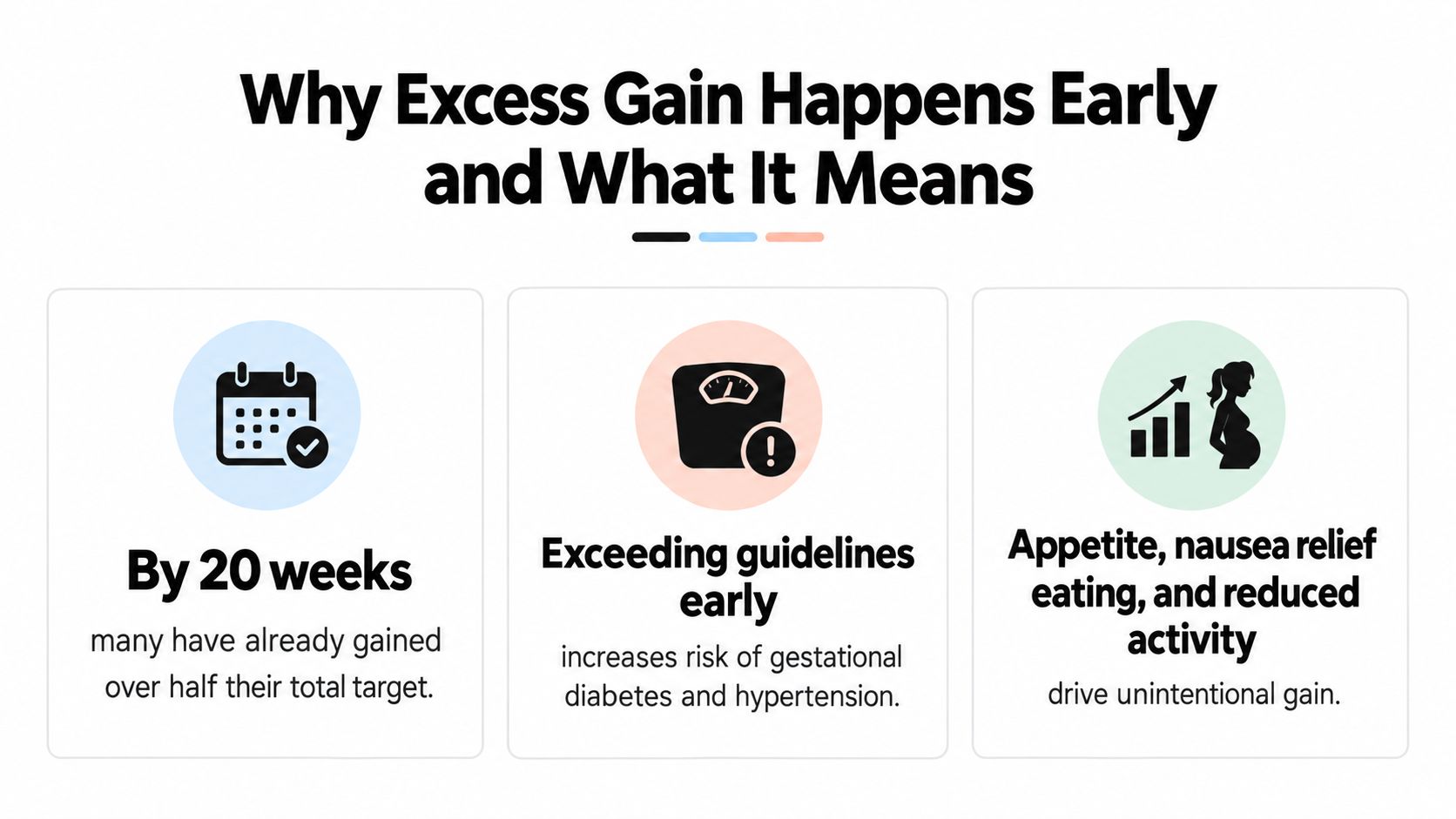
Early gain above your band is common. Australian research in a diverse antenatal population found that 34.2% of women had already gained more weight than recommended by 22 completed weeks of gestation, and the same paper noted that nearly 49% of participants started pregnancy above the healthy-weight range, including 25.2% with overweight and 23.6% with obesity. In that study, women who were overweight before pregnancy had 1.69 times the odds of excess early gain, women with obesity had 1.64 times the odds, and women from lower socio-economic areas had 1.89 times the odds compared with the reference groups, as reported at PubMed.
Why this can happen so quickly
Early pregnancy often changes eating and activity in practical, not moral, ways. Nausea may settle when you eat often, but frequent grazing can add up. Fatigue can shrink your usual movement. Bland foods may feel safest, yet they are sometimes less filling, so you end up eating again sooner.
It helps to picture the first trimester as a time when your usual routine gets shuffled. If meals, appetite, sleep, and activity all move at once, weight can drift upward before you have had time to notice the pattern.
Life outside pregnancy matters too. Shift work, caring for other children, stress, cost of food, and poor sleep can all push someone away from regular meals and toward whatever is easiest in the moment.
What an early above-band pattern usually means
An early rise above your BMI-based gain band does not automatically mean you should diet. It usually means the pattern needs checking while there is still plenty of time to guide it gently.
A helpful comparison is steering a car. If you notice yourself drifting slightly out of the lane, you correct early with a small adjustment. You do not yank the wheel. Pregnancy weight care works the same way. The aim is to return to a steady trajectory, not to force the number down.
Useful questions include:
- Was my pre-pregnancy or early pregnancy baseline accurate?
- Am I eating more often to manage nausea or heartburn?
- Has tiredness or feeling unwell changed how active I am?
- Is this a trend over several weeks, or one short-term jump?
- Do I need review from my GP, midwife, obstetrician, or a pregnancy dietitian?
If your gain is already well above the expected range for your starting BMI, or it starts rising quickly, seek medical review rather than trying to lose weight on your own.
Why this matters
The practical message is simple. Early excess gain is common, especially in people who begin pregnancy above the healthy-weight range, and it is usually a signal for earlier support. In Australian antenatal care, the safer goal is staying as close as possible to your BMI-specific gain range and getting help if the pattern moves clearly above it.
That approach is calmer and safer than chasing weight loss during pregnancy.
Practical Nutrition and Activity for Steady Healthy Gain
Once you stop asking “How do I lose weight while pregnant?” the daily question becomes much easier: How do I eat and move in a way that supports steady gain, not runaway gain?
That answer doesn't usually involve a special pregnancy diet. It usually means getting more organised, more regular, and less reactive.
Build meals that are steadying
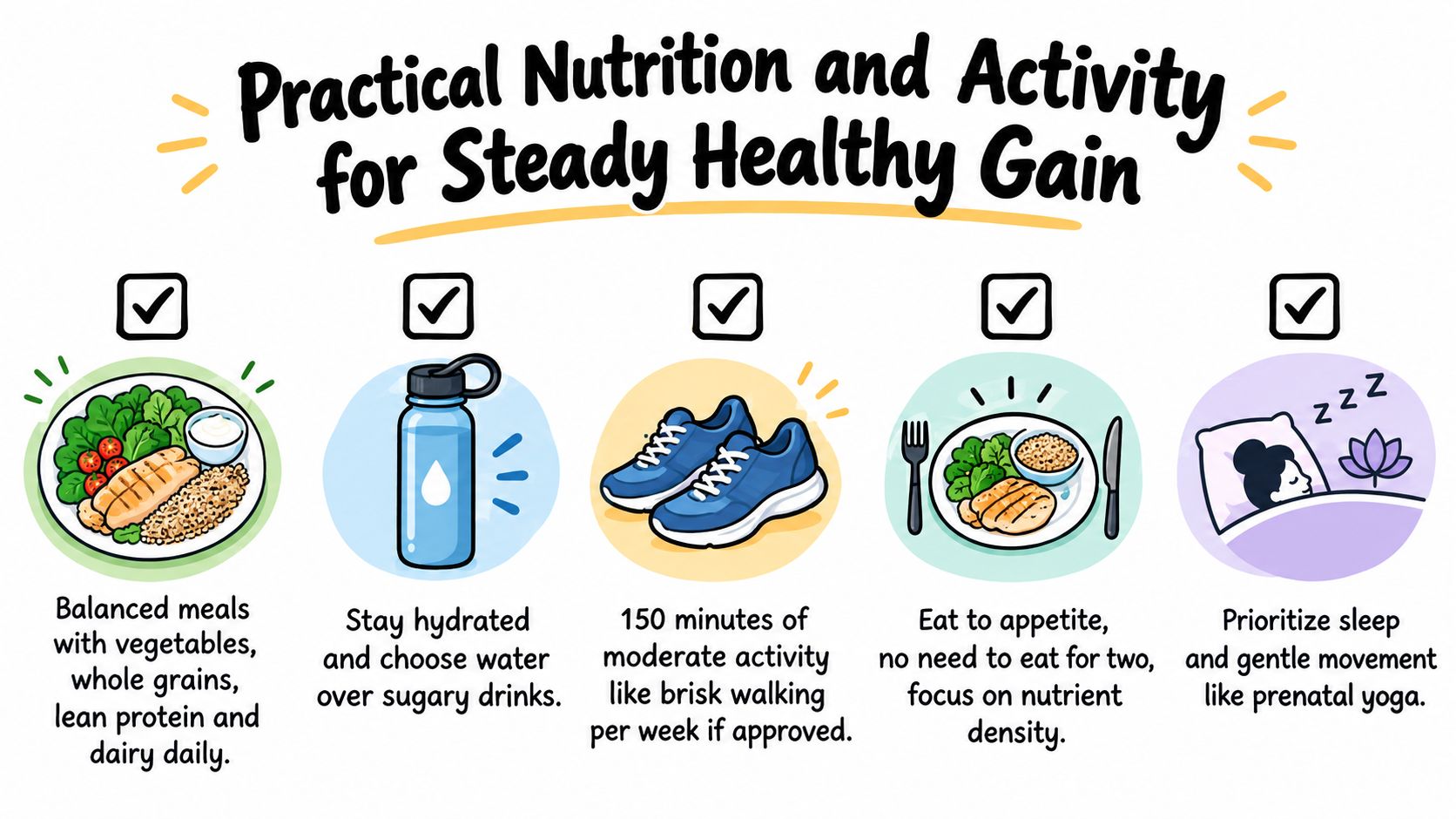
A useful meal often has four parts: protein, fibre-rich carbohydrate, colour, and something satisfying.
That might look like toast with eggs and tomato, yoghurt with fruit and oats, chicken with rice and vegetables, or a bean soup with wholegrain bread. If dinner is a scramble because you're tired, aim for “good enough and balanced” rather than perfect. A sandwich with cheese, salad, and a side of fruit is still a decent meal.
Small patterns help more than heroic effort.
- Eat regularly: Long gaps can trigger nausea, shakiness, then rebound eating.
- Pair foods: Carbs alone may leave you hungry again quickly. Add protein or fat.
- Make the easy choice visible: Keep simple foods you can tolerate in reach.
- Use snacks on purpose: A planned snack is different from grazing all afternoon.
Handle hunger, nausea, and cravings without swinging to extremes
Pregnancy can make appetite feel unpredictable. Some days you're hungry all morning. Some days nothing sounds right. The goal isn't to control every urge. It's to stop one difficult day turning into a difficult week.
Try practical swaps like these:
- If mornings are rough: Keep a plain snack beside the bed and eat before getting up.
- If you crave sweet foods: Add structure first. A proper lunch often softens the evening drive for sugary snacks.
- If takeaway is happening often: Add, don't just subtract. Include vegetables, a protein source, or a side that makes the meal more filling and balanced.
- If you're too tired to cook: Rotate a few low-effort standbys so you're not deciding from scratch every night.
For a broader food-focused guide, this article on nutritional needs and diet tips during pregnancy is a useful companion.
Here's a short movement guide that some readers find easier to follow when they need a visual reset:
Move in a way your body can keep repeating
The best pregnancy activity plan is often the one you can still do on a flat, ordinary Wednesday.
Walking, swimming, gentle strength work, and prenatal yoga are common options. The key is consistency and comfort. If your pelvis hurts, your plan may need changing. If you're dizzy, faint, bleeding, or have been told to restrict activity, follow your clinician's advice instead of general fitness advice.
Small habit: Pick one repeatable movement anchor, such as a walk after lunch or a prenatal class twice a week. Routine removes a lot of negotiation.
Don't ignore sleep and hydration
Poor sleep can make appetite, cravings, and fatigue harder to manage. Dehydration can make nausea, headaches, and constipation worse. Neither issue is glamorous, but both can influence your weight pattern.
If you're trying to stay within your gain range, the most effective changes are often simple ones repeated often: regular meals, practical snacks, water nearby, and movement that doesn't leave you wiped out.
Safe Monitoring Versus Risky Dieting Approaches
You step on the scale after a big week of swelling, nausea, and odd meals, and the number jumps more than you expected. It is easy to panic and search for ways to bring it back down. In pregnancy, the safer question is different. Ask whether your weight trend is still sitting within your BMI-based gain range, and whether anything about the pattern needs a review from your care team.
What safe monitoring looks like
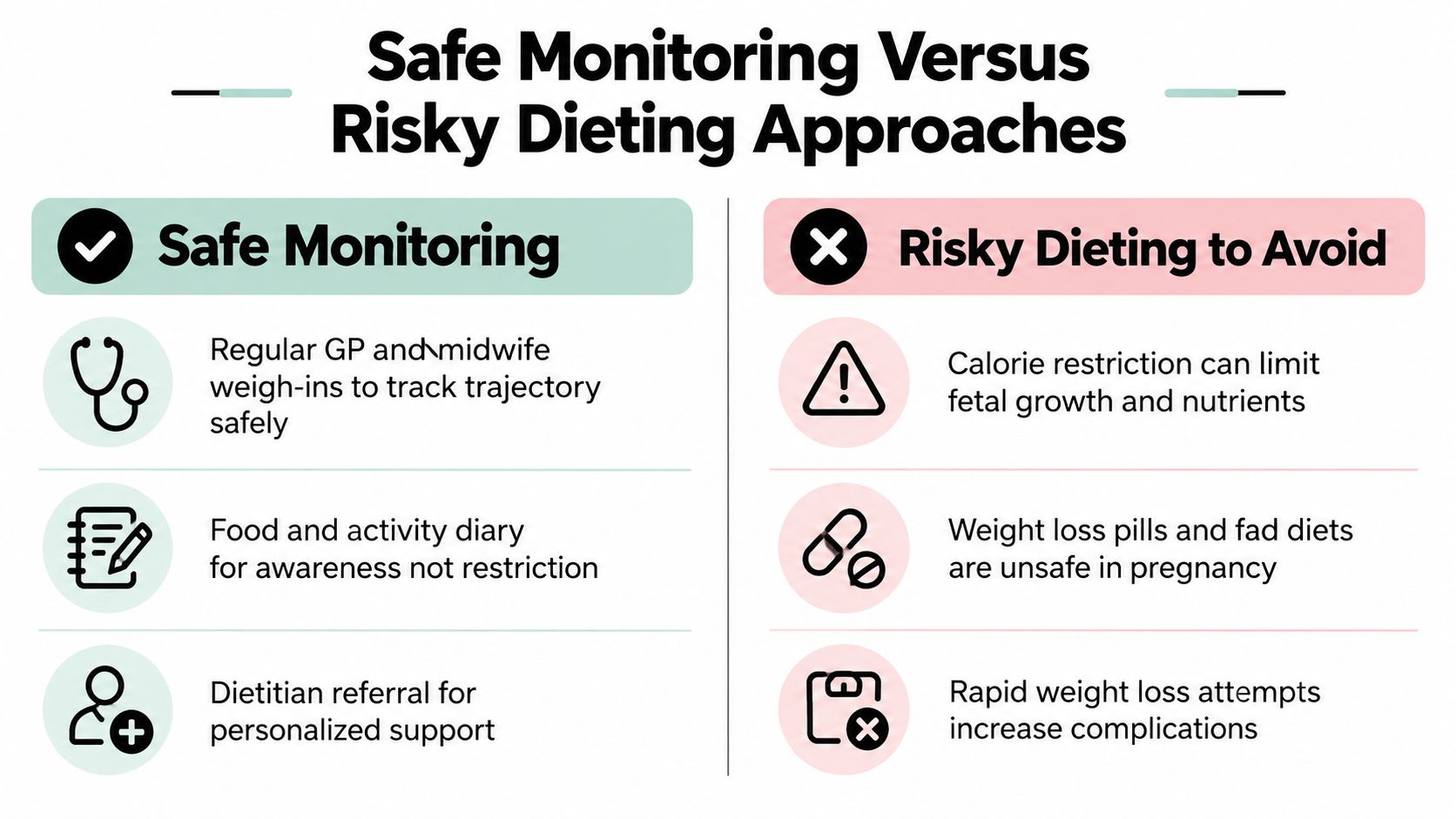
Safe monitoring works like using a road map rather than reacting to every bend in the road. One weigh-in on its own can reflect fluid shifts, constipation, timing, or clothing. A trend over time is far more useful.
That usually means weighing at a regular interval, checking the pattern against your Australian BMI band, and adding context such as vomiting, food aversions, reduced appetite, swelling, or a sudden drop in movement. If the line starts drifting clearly above or below the expected path, the next step is clinical review, not self-directed dieting.
Your midwife, GP, obstetrician, or an antenatal dietitian can help interpret what the change means. Weight going down is not automatically positive in pregnancy. Weight going up faster than expected is not automatically a failure either. Both are signals to look more closely at nourishment, symptoms, and the health of the pregnancy.
Useful monitoring habits include:
- Track the pattern: Weekly or fortnightly is usually enough for home monitoring.
- Write down the context: Nausea, constipation, oedema, low appetite, and medication changes all affect the picture.
- Use your BMI-specific range: The goal is staying near your target trajectory, not pushing the scale lower.
- Ask for review early: Seek help if weight is falling without trying, rising quickly over a short period, or sitting well outside your expected band.
If you want a simple way to record trends at home, this guide on how to track your weight and body metrics with the Venus AI Smart Scale can help you keep the focus on patterns rather than daily emotion.
What risky dieting looks like
Risky dieting usually starts with fear.
It can look tidy on paper. Skipping meals after a higher-calorie day. Cutting dairy, grains, or carbohydrates without a medical reason. Trying to "make up for" a holiday or weekend. Weighing several times a day and changing your eating based on each result. Following online pregnancy weight loss plans that treat every body the same.
The problem is not just the rule itself. The problem is the goal behind it. Dieting tries to force the number down. Pregnancy care aims to support you and your baby while keeping weight gain within an appropriate range for your starting BMI.
Important Australian nuance
Australian care is not one-size-fits-all. The target range depends on your pre-pregnancy BMI, and some services also use Asian-specific BMI cut-offs. That can change which gain band applies to you.
Safer Care Victoria notes that for women with extreme obesity (BMI more than 50), more restrictive gain and possibly no gain may sometimes be appropriate in individualised care, according to its obesity during pregnancy guidance. That still does not mean starting a do-it-yourself weight loss plan. It means a clinician sets the target and monitors it with you.
A simple rule helps here. If you are trying to shrink the number on the scale, you are outside the usual pregnancy goal. If you are checking whether your gain is staying within your assigned band, you are much closer to a safe approach.
A practical decision test
Ask yourself four plain questions:
- Do I know my BMI-specific gain range, or am I reacting to a single weigh-in?
- Would I feel comfortable showing this plan to my midwife, GP, or obstetrician?
- Is this approach helping me eat regularly enough to support pregnancy?
- Have I booked a review before adding stricter food rules?
Meal planning tools can still be useful if they help with structure rather than restriction. Some readers use Recipe One weight loss planner tips to organise meals ahead. During pregnancy, any planner should be adjusted with your clinician or dietitian so the focus stays on adequate nourishment and a steady gain pattern within your target band.
Your Next Steps for a Confident Healthy Pregnancy
If you came here looking for advice on losing weight while pregnant, the safer takeaway is this: pregnancy usually isn't the time to aim for weight loss. In Australian care, the more useful goal is to stay within your personal BMI-based gain trajectory and get help early if your trend drifts well above or below it.
That approach is more compassionate than dieting, and more precise too. It makes room for nausea, appetite changes, body image worries, and the fact that pregnancy is not a controlled lab setting. It also gives you something practical to do this week.
Your simple action plan
Keep it straightforward.
- Know your starting point: Use your pre-pregnancy weight if possible.
- Know your band: Ask your midwife, GP, or obstetrician what gain range applies to you.
- Watch the pattern: Weigh at a steady interval, not constantly.
- Eat with structure: Regular meals and snacks beat reactive grazing or restriction.
- Move gently and consistently: Choose activity that feels safe and repeatable.
- Ask for support early: Especially if weight is falling, rising quickly, or food feels hard to manage.
You do not need to solve this alone. You need a plan that makes clinical sense for your body and your pregnancy.
When to contact your care team sooner
Reach out promptly if you're losing weight without trying, can't keep food or fluids down, feel weak or dizzy, or you're becoming increasingly anxious and tempted to restrict food. Those are moments for review, not self-blame.
If you started pregnancy at a higher BMI, don't assume the answer is to push harder on yourself. Your care may need more individual tailoring, not more pressure. That's particularly true if your team is considering different BMI cut-offs or discussing whether weight maintenance is appropriate in your situation.
A healthy pregnancy rarely comes from “being good” with food. It comes from steady nourishment, sensible monitoring, and support that fits real life.
Venus Health Co. offers app-connected tools that can help you track health trends at home, including weight, body metrics, and nutrition patterns in one place. If having clearer week-to-week data would help you stay focused on monitoring rather than dieting, visit Venus Health Co. and explore the tools that fit your routine.