

CoQ10 Benefits for Fertility: What the Evidence Shows
Dr. Adeyinka AdegbosinMost advice about CoQ10 makes it sound like a universal fertility booster. That's too broad.
A more accurate way to think about CoQ10 benefits for fertility is this: it may be useful for some people in some situations, especially around assisted reproduction, low ovarian reserve, and certain male-factor cases. It is not the same as saying it helps everyone who is trying to conceive, and it's not the same as saying it improves live birth outcomes.
That distinction matters because fertility supplements often get discussed as if all outcomes are equal. They aren't. Better lab markers, better embryo development, higher clinical pregnancy rates, and live birth are related, but they're not interchangeable. If you understand that early, the evidence becomes much easier to interpret.
What CoQ10 Actually Does in Eggs and Sperm
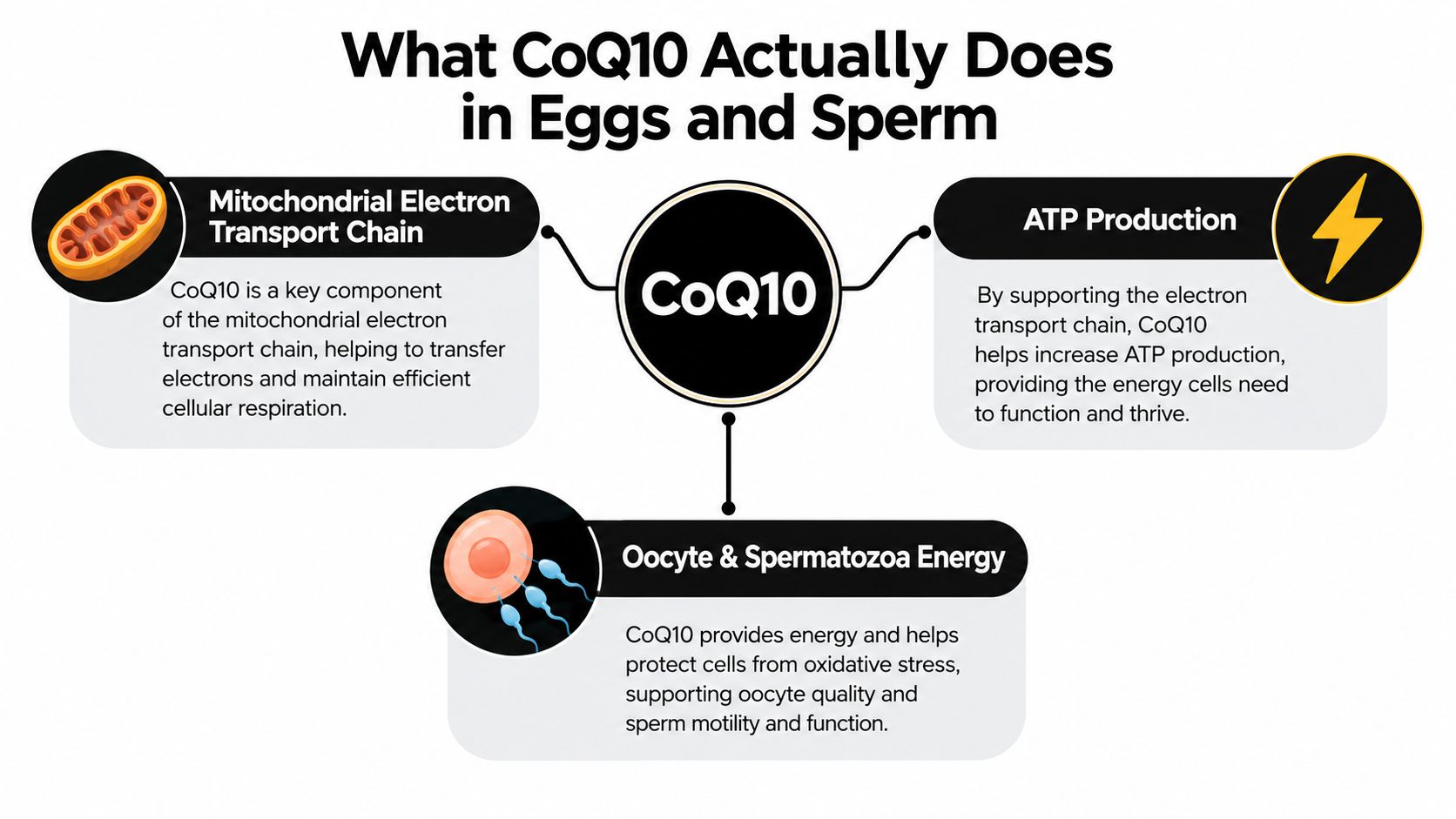
CoQ10, short for coenzyme Q10, works inside mitochondria. These are the parts of cells that help turn food into usable energy, called ATP. Reproductive cells are especially dependent on that energy.
Eggs need large amounts of energy to mature properly, complete chromosome division, support fertilisation, and help early embryo development. Sperm need energy for movement. If mitochondrial function is poor, both egg and sperm performance can suffer.
Why energy production matters
CoQ10 sits in the mitochondrial electron transport chain, where it helps shuttle electrons so the cell can generate ATP efficiently. That sounds technical, but the simple version is that CoQ10 helps cells do high-energy jobs.
Eggs are a good example. An oocyte has to stay metabolically steady for years, then suddenly complete energy-intensive steps in the short window leading to ovulation and fertilisation. Sperm face a different problem. They have to generate enough energy to swim and function while carrying relatively little cellular machinery.
Why antioxidant protection matters too
CoQ10 also acts as an antioxidant. That means it helps neutralise reactive oxygen species before those molecules damage cell membranes, proteins, or DNA.
This is especially relevant in fertility because both eggs and sperm are vulnerable to oxidative stress. Sperm membranes are rich in fats that can be damaged by lipid peroxidation. Eggs also face cumulative wear over time, including mitochondrial DNA damage that tends to become more relevant with age.
CoQ10 shifts between two states, ubiquinone and ubiquinol. That redox cycling is part of how it participates in both energy production and antioxidant defence. Readers often get confused here and assume the “active form” automatically means “works for everyone.” It doesn't. The form may affect absorption, but the bigger question is whether mitochondrial support is likely to matter in your specific fertility picture.
For some people, especially those with a normal workup and no obvious egg or sperm issue, supplementation may be less important than identifying causes that haven't yet been clarified. That's one reason broader investigation matters in problems such as common causes of unexplained infertility.
CoQ10 makes the most biological sense when fertility is being limited by energy production, oxidative stress, or both. That's why it tends to be discussed more in ageing eggs, poor ovarian response, IVF, and sperm quality.
What the Evidence Shows for Female Fertility Outcomes
CoQ10 is often discussed as if it raises every fertility outcome at every stage. The evidence is narrower than that.
In women, the clearest signal so far is a higher clinical pregnancy rate, mainly in assisted reproduction settings. A 2020 systematic review of five randomised controlled trials involving 449 infertile women found that oral CoQ10 increased clinical pregnancy rate from 14.1% to 28.8%, with an odds ratio of 2.44 and 95% confidence interval 1.30 to 4.59. The same review did not find a statistically clear benefit for live birth rate or miscarriage rate, so the stronger finding is about getting to a confirmed pregnancy rather than proving a better final birth outcome (systematic review on PubMed).
Clinical pregnancy and live birth answer different questions
This distinction matters.
A clinical pregnancy usually means a pregnancy confirmed by ultrasound or other medical assessment. A live birth is the outcome patients care about most. Those are related, but they are not interchangeable.
A simple way to understand it is to picture fertility treatment as a series of checkpoints. You have to reach fertilisation, embryo development, implantation, ongoing pregnancy, and then delivery. CoQ10 may help at earlier checkpoints in some women, especially in IVF, without yet showing clear proof that it improves the final checkpoint.
That is why clinicians read these studies cautiously. A supplement can improve embryo-related measures or clinical pregnancy rates and still leave uncertainty about live birth.
A 2024 systematic review made that point clearly. It found that evidence for supplements in female infertility was insufficient for broad recommendations. For CoQ10, the apparent benefit was limited to clinical pregnancy in medically assisted reproduction, with very low-certainty evidence, and there was still no clear proof of improved live birth or miscarriage outcomes (2024 review in PMC).
What IVF studies usually show
Individual trials often report better intermediate outcomes. In IVF, that can mean more eggs retrieved, better fertilisation, better embryo quality, or fewer cancelled cycles. Those outcomes matter because they can increase the number of usable embryos or the chance of making it to transfer.
They still do not answer the same question as live birth.
| Trial | Population | Dose | Outcome |
|---|---|---|---|
| 2020 meta-analysis summary | Infertile women undergoing ART | Varied across trials | Clinical pregnancy improved. No statistically clear live birth or miscarriage benefit |
| Bentov et al., 2014, randomised trial in IVF poor responders | Women with previous poor ovarian response undergoing IVF-ICSI | CoQ10 pretreatment before cycle, protocol varied by study arm | Better ovarian response and embryo-related outcomes were reported, but live birth remained uncertain |
The practical takeaway is selective, not universal. CoQ10 looks more reasonable as a targeted adjunct for women in assisted reproduction, especially where egg yield or egg quality is already a concern, than as a blanket supplement for every woman trying to conceive naturally. That subgroup point becomes even more important once you separate early pregnancy signals from live birth outcomes.
Who Responds Best, Including IVF and Poor Ovarian Reserve
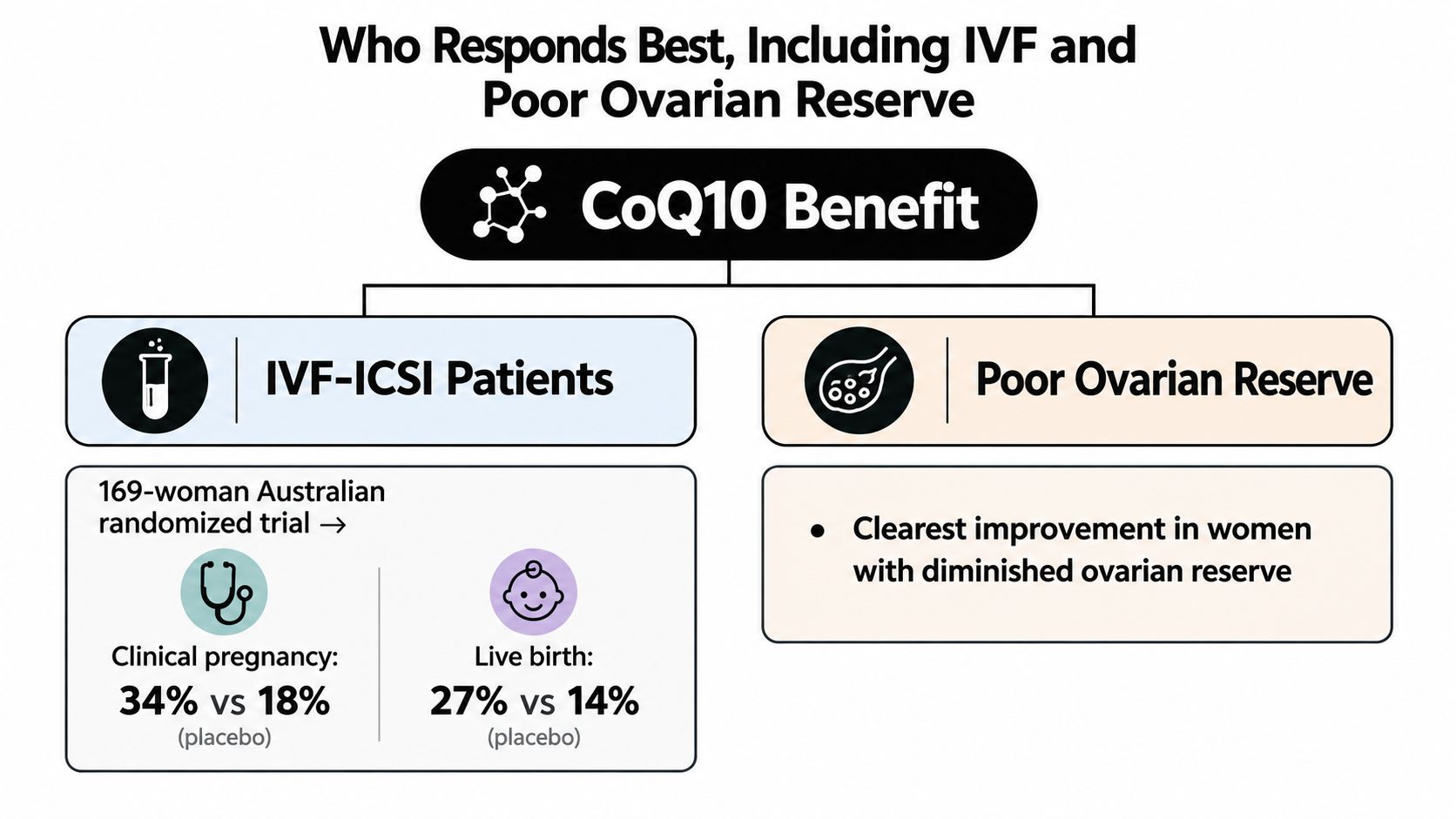
The most credible use case for CoQ10 in women is not “everyone trying to conceive.” It is selected subgroups.
A randomised trial summarised in an Australian professional medicine association white paper looked at 169 women under age 35 with poor ovarian reserve who took CoQ10 for 60 days before IVF-ICSI. Compared with no pretreatment, the CoQ10 group had more eggs retrieved, higher fertilisation rates, and more high-quality embryos. Cycle cancellation due to poor embryo development was 8.33% versus 22.89%, and frozen embryos were produced in 18.42% versus 4.3% of cases (Australian CoQ10 white paper).
The subgroup logic
Why would women with poor ovarian reserve or a history of poor response be more likely to benefit?
Because mitochondrial support has the clearest biological logic. If the ovarian environment or the oocyte itself is struggling with energy production, giving a compound involved in mitochondrial function may matter more. The same logic often gets applied to age-related egg quality decline, where accumulated oxidative damage and mitochondrial inefficiency become more relevant.
Women with normal ovarian reserve may still choose to take CoQ10, but the case is less clear. If the main problem is tubal disease, severe endometriosis, timing, or an undiagnosed male factor, a mitochondrial supplement may not address the bottleneck.
Decision rule: CoQ10 makes more sense when your fertility plan already points to an egg-quality or response issue, not when it's being used as a vague “can't hurt” add-on.
A low AMH result often leads people straight to supplements, but test interpretation matters. If you're trying to understand whether diminished reserve is part of your picture, it helps to review anti-Müllerian hormone levels and age alongside your antral follicle count, cycle pattern, and treatment history.
For people trying naturally rather than through IVF, tracking ovulation is still useful because it clarifies whether timing is the problem. One factual, non-promotional option is the Venus Smart Basal Thermometer for Ovulation - Bluetooth BBT Tracker with App, which records basal body temperature and syncs it to a phone app.
This explainer may help if you want a clinician-style overview of where CoQ10 tends to fit in treatment planning.
Why it still isn't universal advice
Even with encouraging subgroup data, guidelines haven't embraced universal supplementation because the studies are often small, protocols vary, and the strongest findings tend to sit in narrower populations. That doesn't make the research useless. It means the evidence supports selective use, not routine use for everyone.
The Overlooked Case for Male Fertility
CoQ10 is often talked about as an egg-quality supplement. That misses half the story.
Sperm are highly dependent on mitochondrial energy for motility. They also have membranes that are vulnerable to oxidative injury. If oxidative stress damages the sperm membrane or sperm DNA, fertilisation and embryo development can be affected even when the basic conversation is framed as “female fertility.”
Why the male side deserves more attention
A 2025 study reported that CoQ10 supplementation increased total sperm count, total and progressive motility, and normal morphology, alongside higher testosterone and inhibin B. The authors still called for larger, well-designed randomised trials before firm conclusions, so this should be treated as promising rather than definitive (male fertility study on PubMed).
That's an important corrective to the usual marketing. If a couple has male-factor findings, CoQ10 may be more evidence-backed there than the average “egg quality” article suggests.
What the trial pattern looks like
The literature on male use usually reports changes in semen parameters after a sustained supplementation period, rather than instant effects.
| Sperm Parameter | Reported Change with CoQ10 | Timeframe |
|---|---|---|
| Total sperm count | Improvement reported | Usually assessed after weeks to months |
| Progressive motility | Improvement reported | Usually assessed after weeks to months |
| Morphology | Improvement reported | Usually assessed after weeks to months |
Sperm production takes time, so men often want to know, “How long before this could matter?” The practical answer is that semen changes are usually assessed after weeks to months, not after a few days of taking a supplement. That's one reason short, inconsistent use isn't a good test of whether it helps.
Male-factor fertility support shouldn't be an afterthought. If semen parameters are the weak point, that's where the intervention should be judged.
If you're thinking about preconception supplements as a couple rather than a solo project, this guide to prenatal vitamins for men is a useful companion read.
How to Take CoQ10 When You Are Trying to Conceive
Most confusion about CoQ10 comes down to three questions. Which form, how much, and how long?
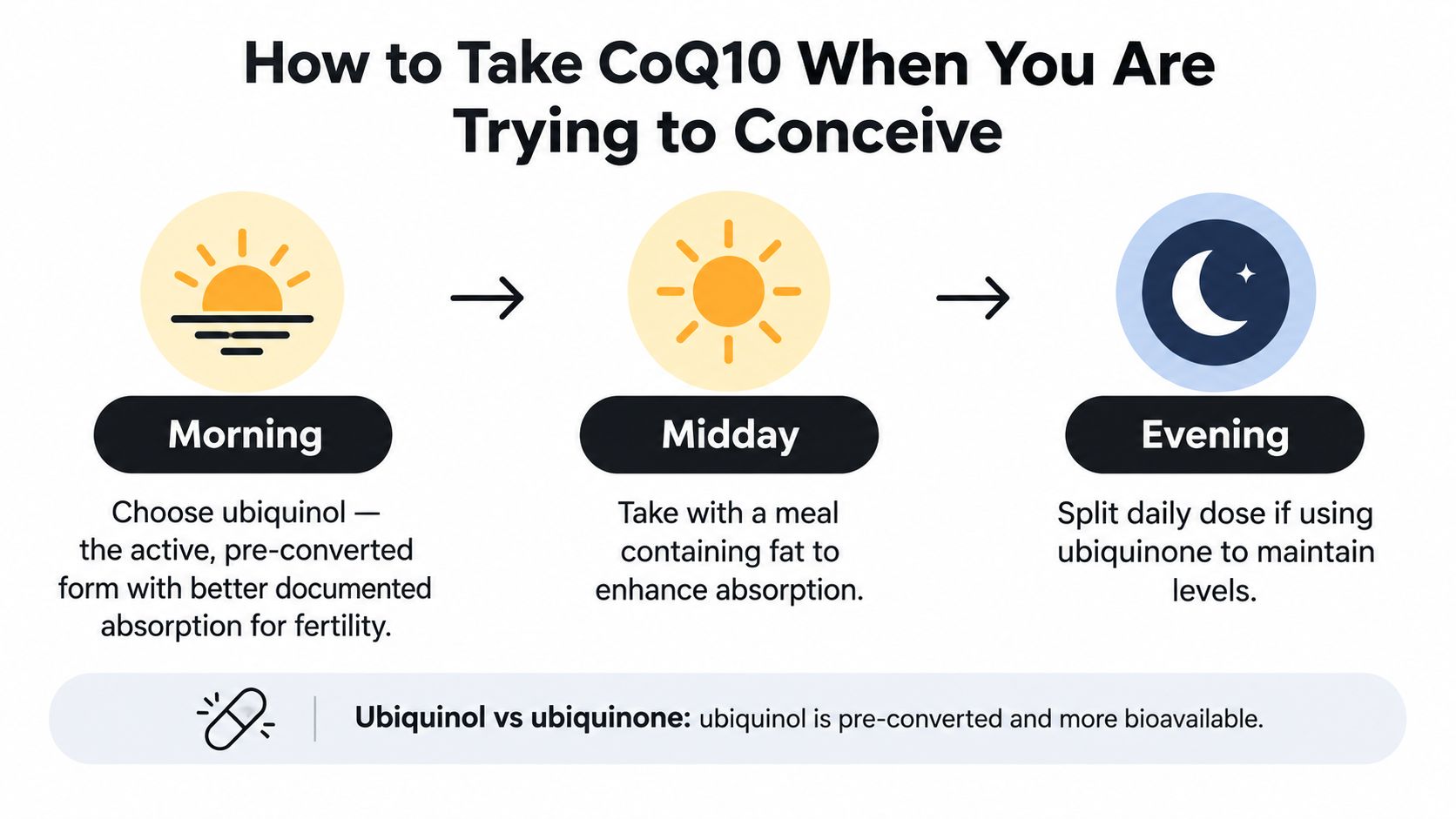
The first distinction is ubiquinone versus ubiquinol. Ubiquinone is the oxidised form. Ubiquinol is the reduced form that is already converted. In plain language, ubiquinol is often chosen when people want the pre-converted form, while ubiquinone is commonly used because it's widely available and often less expensive.
Form and absorption
For older adults or people who've had trouble tolerating or absorbing supplements, clinicians sometimes prefer ubiquinol. For younger adults, ubiquinone is often still a reasonable choice. The key practical point is simpler than the chemistry: take it with food that contains fat, because CoQ10 is fat-soluble.
If you take it on an empty stomach and then decide it “didn't work,” you may not have given it the best chance to be absorbed well.
Practical dosing ranges
The fertility literature uses varied dosing protocols, so there isn't one universal chart that fits everyone. A practical approach often looks like this:
- For women planning IVF or managing diminished ovarian reserve: many clinicians use a higher daily range, often split across the day.
- For men with a sperm-quality concern: a moderate daily range is commonly used.
- For general preconception use without a defined indication: the rationale is less clear, so it's worth asking whether the supplement is solving a known problem or adding another variable.
Some people split the total daily amount into morning and evening doses. That can improve tolerance, especially if larger single doses upset the stomach.
Timing matters more than people expect
CoQ10 is not like taking pain relief and waiting for a same-day effect. It's usually approached as a preconception support supplement, which means giving reproductive cells time to develop under improved metabolic conditions.
Practical rule: If you're using CoQ10 for fertility, think in months, not days.
For women, that usually means starting well before an IVF cycle rather than once stimulation has already begun. For men, it means allowing time for a fresh wave of sperm development before repeating semen analysis or judging effect.
If your clinic has you on multiple supplements, ask for a simple written schedule. That reduces the chance of taking everything at once, forgetting evening doses, or doubling products that already contain CoQ10 in a fertility blend.
Safety, Interactions, and When to Talk to Your Clinician
CoQ10 is generally well tolerated, but “natural” doesn't mean risk-free.
The more common problems are mild. Some people report gastrointestinal upset, nausea, or feeling too alert if they take it late in the day. If that happens, taking it with food or earlier in the day may help. But side effects aren't the main reason to involve a clinician. Drug interactions are.
Medicines and situations that need extra care
CoQ10 can affect blood pressure and blood glucose. That means people taking medicines for hypertension, nitrates, or glucose-lowering therapy should check first before starting. The concern isn't that everyone will have a problem. The concern is that adding a supplement can shift a treatment balance that was already carefully set.
The most important interaction to flag clearly is warfarin and other vitamin K antagonists. CoQ10 may reduce anticoagulant effect, which can raise clotting risk. That is not a casual interaction.
Fertility-specific reasons to disclose it
If you're seeing a fertility clinic, tell them about every supplement you're taking, even over-the-counter ones. That includes CoQ10, herbal blends, powders, and “egg quality” formulas.
A clinic may want to know because supplements can influence lab interpretation, overlap with existing protocols, or complicate cycle planning. People who are preparing for surgery, undergoing chemotherapy, or managing a known mitochondrial disorder also need individual medical advice before starting.
A good rule is simple:
- Before IVF or ICSI: send your clinic the full supplement list.
- If you take prescription medicines: ask your GP or pharmacist to screen for interactions.
- If you feel unwell after starting: stop self-adjusting the dose and get advice.
You don't need to be alarmed. You do need to be organised.
A Practical CoQ10 Plan for Couples Trying to Conceive
The most useful way to use CoQ10 is as part of a shared preconception plan, not as a last-minute female-only add-on.
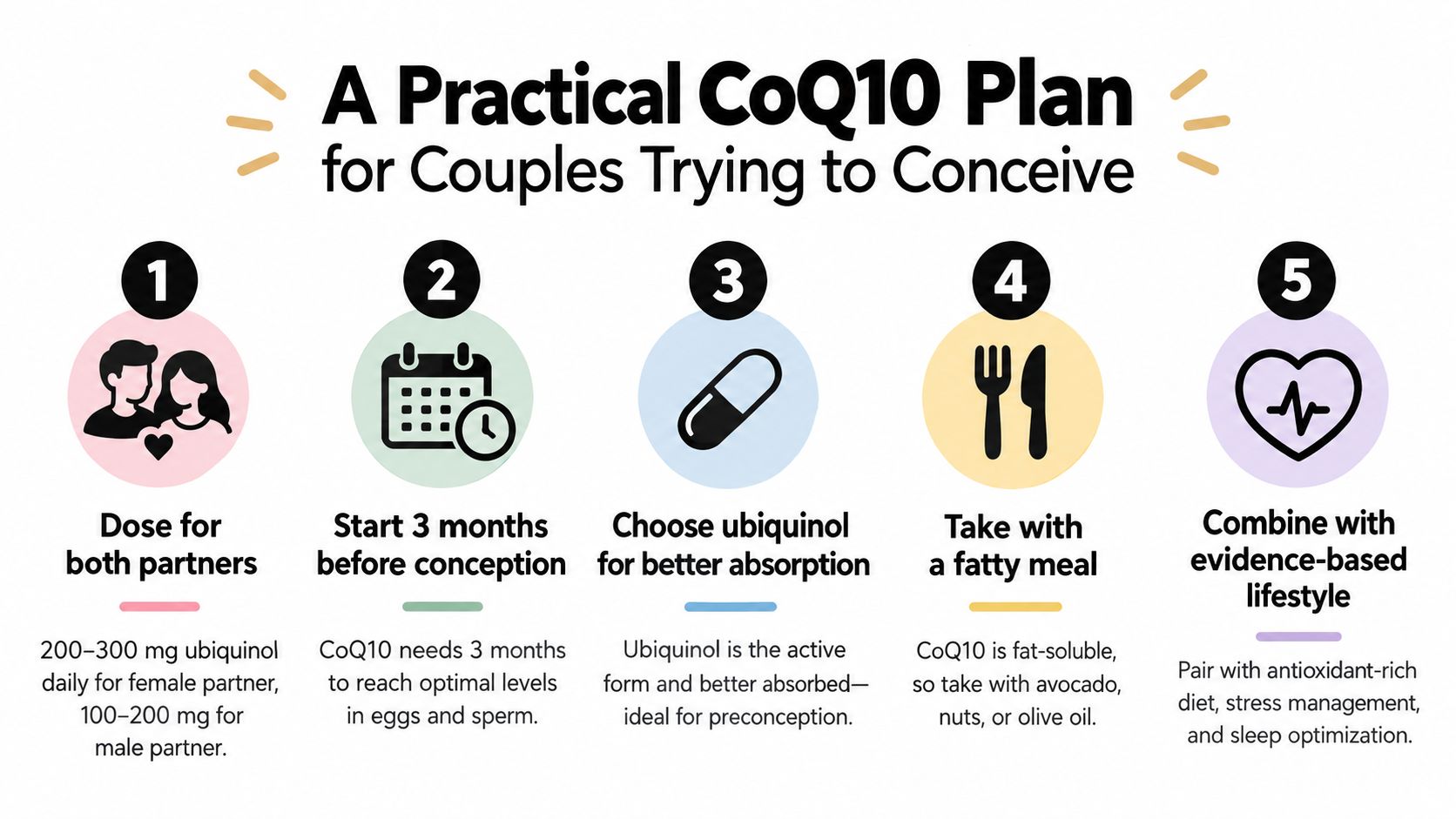
If there's a clear reason to use it, such as poor ovarian reserve, IVF preparation, or a male-factor issue, start early enough that the timing matches reproductive biology. Random use for a week or two usually won't tell you much. Consistent use over a proper preconception window is what makes the plan coherent.
A sensible couple-based checklist
- Choose the indication first: Use CoQ10 because there is a plausible target, such as IVF response, low reserve, or sperm quality. Don't use it just because fertility content online treats it as mandatory.
- Pick one form and stay consistent: Ubiquinol and ubiquinone can both fit into a plan. The better choice is often the one you'll take regularly with food.
- Start before the attempt, not during the scramble: Build it into the months before a planned conception attempt or IVF cycle.
- Let both partners be assessed: If semen analysis is abnormal, the male partner may have at least as much reason to use CoQ10 as the female partner.
- Reassess with your clinician: After an IVF cycle, repeat semen testing, or further workup, decide whether the supplement still fits the picture.
What not to expect
CoQ10 won't reverse ovarian ageing. It won't fix blocked tubes. It won't correct every cause of low sperm quality. And it shouldn't replace ovulation tracking, semen analysis, tubal evaluation, or treatment for endocrine problems.
What it may do is support mitochondrial function in situations where that seems relevant. That's a narrower claim, but it's the more honest one.
For many couples, the smartest fertility plan looks less like supplement stacking and more like combining a few targeted steps: accurate cycle tracking, semen testing when indicated, treatment-specific support, good sleep, moderate alcohol intake, weight management where relevant, and a clinic-reviewed supplement list.
That's the frame that makes CoQ10 useful instead of confusing.
Venus Health Co. offers science-based tools that can help you track the parts of fertility that supplements can't answer on their own, including ovulation timing and cycle patterns. If you're trying to turn a broad preconception plan into something measurable at home, visit Venus Health Co. to explore their connected fertility tracking tools.