

Breakthrough Spotting on the Pill: What It Means in 2026
Dr. Adeyinka AdegbosinYou're midway through a pill pack, you go to the bathroom, and there it is. A streak of brown or pink on the toilet paper, or a light mark in your underwear that wasn't due today. For a lot of people, that moment triggers the same chain of thoughts. Did I mess up a pill? Is this normal? Does this mean the pill isn't working? Could I be pregnant?
That mix of confusion and worry is common. So is the bleeding itself.
The helpful question usually isn't “Is any spotting bad?” It's “What pattern am I seeing, and what should I do next?” That's where most quick guides stop too early. They reassure you that spotting can happen, especially early on, but they don't always tell you how to sort normal adjustment from a clue that needs attention.
What Is Breakthrough Spotting on the Pill
Breakthrough spotting on the pill means light bleeding that happens at a time you weren't expecting it while taking the pill. Most often, people mean spotting or light bleeding between their usual scheduled withdrawal bleeds.
If you take a combined oral contraceptive, you may still have a bleed during the placebo or pill-free days. That scheduled bleed is different. Breakthrough spotting happens outside that window. It may look like a few drops, a smear when you wipe, or light brown staining over a day or two.
What it is, and what it isn't
A simple way to break it down:
- Scheduled withdrawal bleed means the bleed you expect during placebo pills or the pill-free interval.
- Breakthrough spotting means unscheduled light bleeding while you're taking active pills.
- Abnormal bleeding unrelated to the pill means bleeding that may have another cause, especially if it is persistent, heavy, painful, or linked with other symptoms.
The pill can still be doing its job even if spotting shows up. Light bleeding does not automatically mean contraceptive failure. That's one of the most common misunderstandings.
Why people get confused
Spotting feels alarming because bleeding often gets interpreted as a sign that something “broke”. But the body doesn't work that neatly. The lining of the uterus can react to hormone changes with a small amount of shedding even when ovulation is still being suppressed.
In Australian guidance, unscheduled bleeding on the combined pill is described as common early in use. The RACGP notes that it occurs in up to 30% of women in the first cycle, is most common in the first 3 to 4 months, and for lower-dose pills falls to around 10% by 12 months (RACGP guidance).
Main point: One episode of light spotting matters less than the overall pattern. Timing, duration, heaviness, and whether anything changed with your pill routine tell you far more than a single spot of blood.
What to pay attention to
Keep the first questions simple:
- When did it happen? Early in starting the pill, mid-pack, or after a missed pill?
- How much was it? Spotting on wiping, liner-only bleeding, or something closer to a period?
- What else is going on? Pain, unusual discharge, bleeding after sex, or a long stretch of previous stability?
Those details are what turn a scary surprise into a useful clue.
How the Pill and Your Cycle Respond to Change
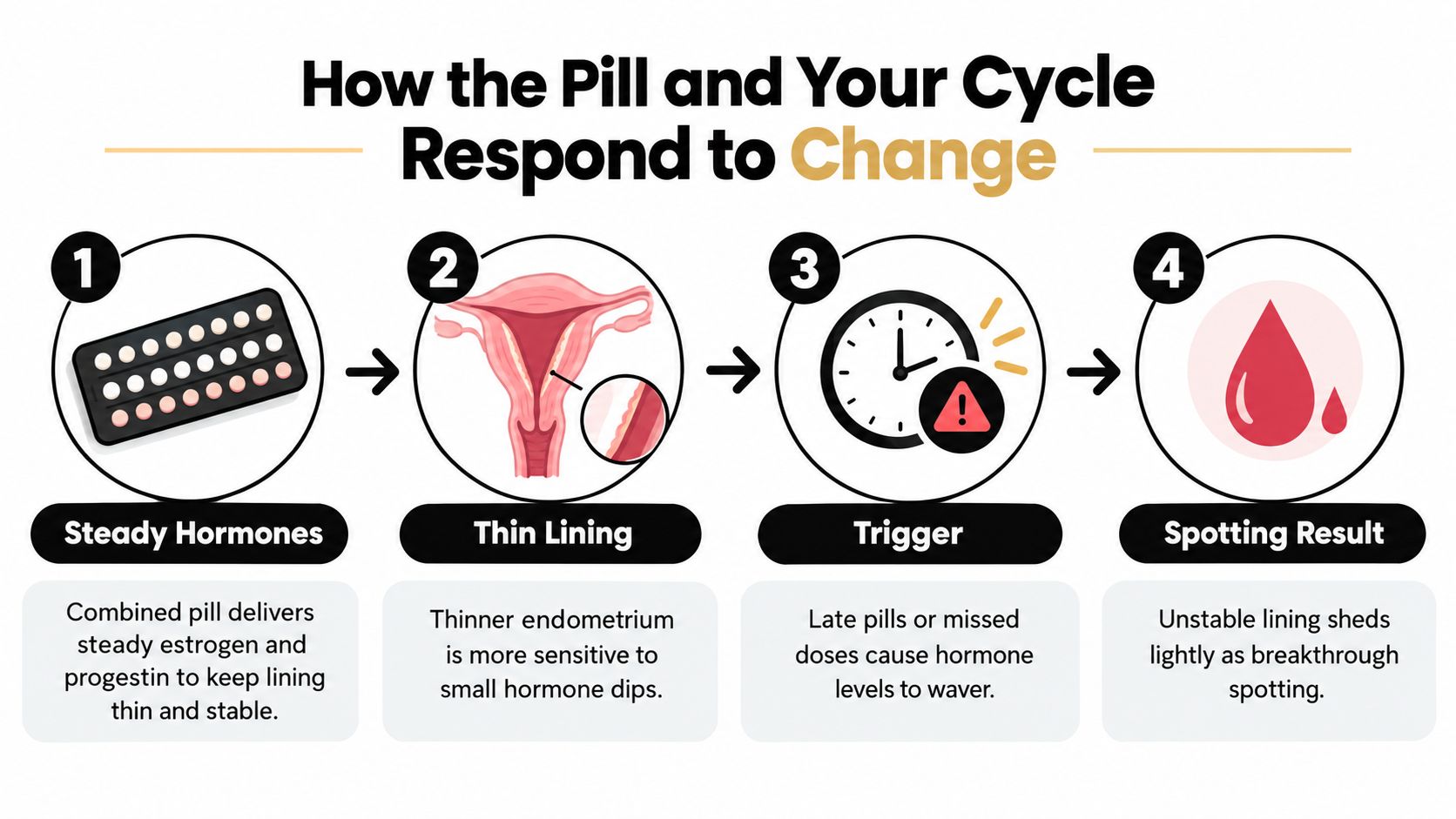
The combined pill works by giving your body a steady dose of oestrogen and progestogen. Those hormones change how your uterine lining behaves. Instead of building up and shedding in the usual natural cycle, the lining stays thinner.
A thinner lining is often helpful. It can mean lighter bleeding overall. But it also means the lining can be a bit more sensitive to hormone dips, especially when you first start, switch pills, or take pills late.
A simple way to picture it
Think of the uterine lining like a thin coat of paint on a wall. If the paint goes on evenly and stays protected, it looks smooth. If there are tiny gaps in coverage, you may see patchy areas.
With the pill, steady hormone coverage helps keep the lining even. If hormone levels wobble, the lining can shed a little. That light shedding is breakthrough spotting.
Why early months are different
At the start, your body is adapting to a new hormone pattern. The endometrium, which is the uterine lining, hasn't fully settled into that new routine yet. That's why spotting is often front-loaded.
Australian guidance is very consistent on this point. The Australian Commission on Safety and Quality in Health Care reports that with the progestin-only pill Slinda, withdrawal bleeding was highest in the early cycles at less than 40% of users, then dropped to less than 20% after 9 months of use. The same source reports mean bleeding or spotting days of 13.1 ± 13.0 in cycles 2 to 4, falling to 9.7 ± 10.4 in cycles 7 to 9. A separate Australian Commission monograph for Yaz says irregular bleeding or spotting commonly occurs in the first few months and usually stops after about 3 months once the body adjusts (Australian Commission summary via RCH).
That settling process is why many clinicians ask first: how long have you been on this exact pill?
Small formulation differences matter
Not all pills behave the same way. Lower-dose formulations can leave less room for error if you take pills late or your body is sensitive to small hormone fluctuations. People often compare options before starting or switching, including practical details such as the TheMedicineKart Yasmin price, but cost and brand are only one part of the decision. Bleeding pattern, side effects, and your medical history matter just as much.
If you're trying to understand how your cycle behaves after changing or stopping hormonal contraception, this guide to signs of ovulation after stopping the pill can help make sense of what your body does once pill hormones are no longer directing the pattern.
Common Causes of Breakthrough Spotting
A random spot of bleeding can have several explanations. Some are simple and pill-related. Others have little to do with the pill at all. The useful move is to match the pattern with the clue.
The most common triggers
| Cause | Practical Clue |
|---|---|
| Missed or late pills | Spotting starts after you took one late, forgot one, or had several pills taken at inconsistent times |
| Lower-dose pill formulation | Bleeding keeps happening despite otherwise careful use, especially after starting a low-dose option |
| Hormone adjustment after starting or switching | Spotting began soon after changing to a new pill or restarting after a break |
| Drug interactions | Bleeding appeared after starting a new medication or supplement |
| Vomiting or significant diarrhoea | Spotting happened after a dose may not have been absorbed properly |
| Cervical irritation, STI, or vaginal infection | Bleeding comes with discharge, odour, irritation, pain, or bleeding after sex |
| Pregnancy | Bleeding follows missed pills, very light or absent withdrawal bleeding, or pregnancy symptoms |
Missed or late pills
This is the first thing to check because timing changes are a very common reason for unscheduled bleeding. Even if you rarely miss a pill, one or two late doses can be enough to unsettle the lining.
It doesn't always cause heavy bleeding. Often it's just a small amount of brown or pink spotting a day or two later. The body is reacting to less consistent hormone exposure.
Lower-dose pills
Australian guidance notes that lower-dose oestrogen and progestogen pills can increase breakthrough bleeding risk, even though they may improve some other side effects. The RACGP also notes that raising the oestrogen dose can reduce bleeding by improving endometrial stability (RACGP clinical review).
That matters because “I'm taking my pill properly but still spotting” doesn't always mean user error. Sometimes it means the formulation may not be the best fit for your body.
Bleeding that persists despite good adherence can still be pill-related. It may reflect the dose or formulation, not anything you did wrong.
Medication and supplement interactions
Some medicines and supplements can interfere with contraceptive hormones. This is one reason clinicians ask not just about prescription drugs, but also about over-the-counter products and herbal supplements such as St John's Wort.
If spotting began soon after starting a new medicine, that timing matters. It doesn't prove the cause, but it gives your clinician a clear place to investigate.
A broader women's wellness guide can be useful for general reproductive health reading, but spotting decisions are best made by looking closely at timing, symptoms, and the exact pill you take.
Infection or cervical causes
Not all spotting on the pill is from the pill. Cervicitis, sexually transmitted infections, and vaginal infections can all cause bleeding.
Practical clues include:
- Bleeding after sex
- New pelvic discomfort
- Unusual discharge
- Odour or irritation
If those are present, “wait and see” becomes less helpful.
For readers who are trying to distinguish cycle-related spotting from bleeding at other times in the month, this explainer on spotting before ovulation may help you separate pill-related bleeding from non-pill cycle patterns.
Could it be pregnancy
Pregnancy should come onto the list if spotting happens after missed pills, vomiting, medication changes that may interfere, or a stretch of sex without reliable cover after a mistake. It's also worth thinking about if your expected withdrawal bleed becomes much lighter than usual or doesn't arrive.
A pregnancy test is a practical tool here. It won't explain every case of spotting, but it can rule in or rule out one important possibility.
Building a Pill Routine That Reduces Spotting
If spotting keeps happening, the most useful fix is often boring. Tighten the routine. The pill works best when your habits are easy enough to repeat without thinking.
Build a routine your real life can handle
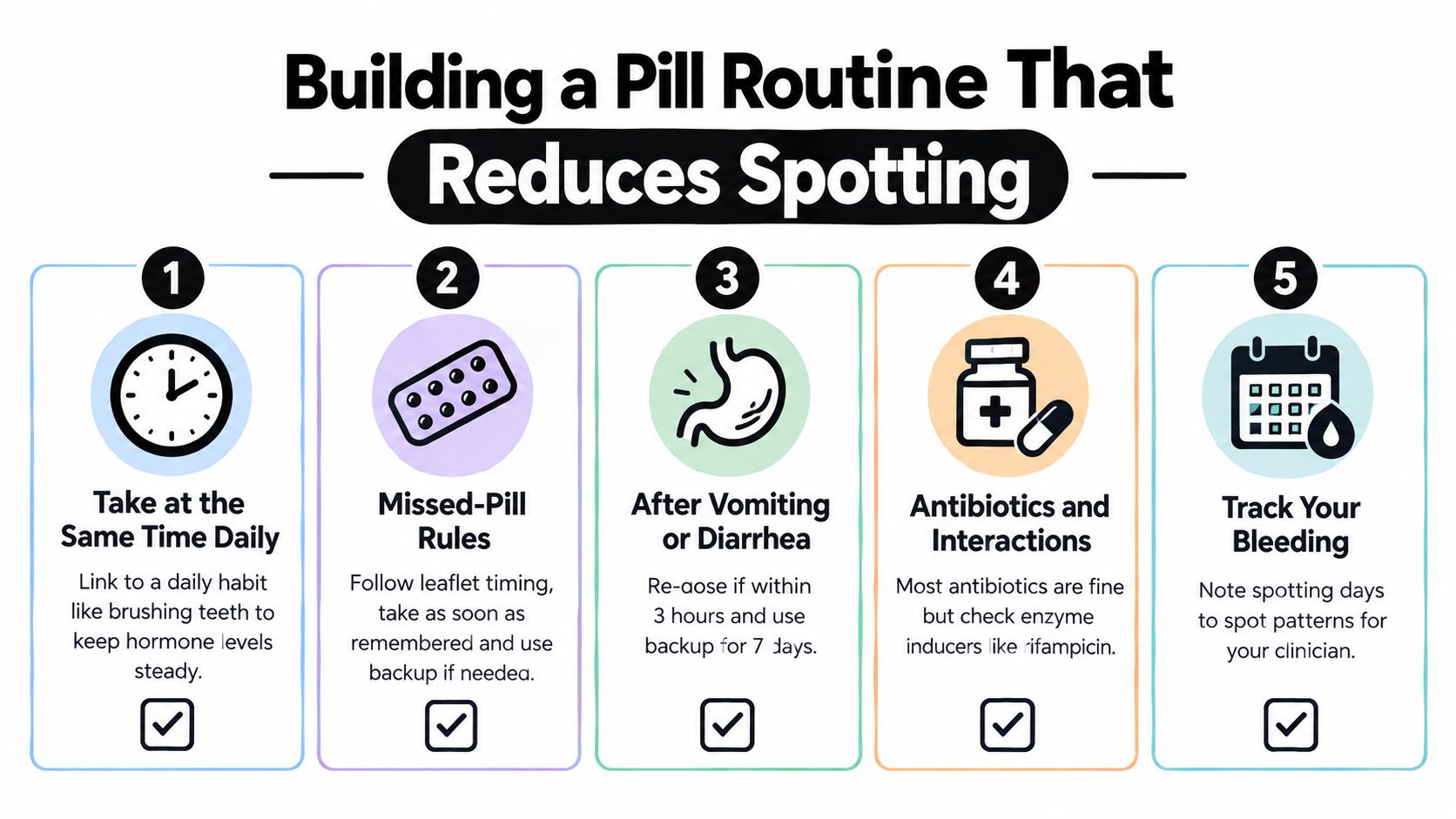
Choose a time that already has an anchor. Breakfast, brushing your teeth, locking the front door, or plugging in your phone at night all work better than a vague plan to “take it sometime today”.
Then make the routine visible.
- Use one main reminder: a phone alarm you don't routinely swipe away.
- Keep the pack in one reliable place: not loose in different bags.
- Track the blister pack itself: if today's pill is still there, you have your answer.
Know what counts as a pill problem
People often worry about spotting but haven't checked whether a dose was effectively missed.
Practical examples include:
- You took it much later than usual and this keeps happening.
- You forgot a tablet entirely and only noticed the next day.
- You vomited soon after taking it and may not have absorbed the dose.
- You had significant diarrhoea around the time of taking active pills.
Follow the missed-pill instructions in your own pill leaflet, including any advice about backup contraception. Leaflets differ by product, so the pack instructions matter.
A digital tracking option can help if your routine is variable. For example, the Venus Health Co. app-connected tools are designed for at-home tracking, and some people use the app alongside reminders and cycle notes to log bleeding patterns in one place.
Here's a practical demonstration of pill routine habits and missed-pill thinking:
A short routine checklist
Practical rule: If spotting is recurring, act like a detective before you act like it's an emergency.
- Take it at the same time daily: consistency helps keep hormone levels steadier.
- Use backup if your leaflet says you should: especially after missed pills or absorption issues.
- Treat vomiting seriously: if it happened soon after a dose, check the leaflet instructions.
- Review new medicines and supplements: especially if spotting started after a change.
- Store pills sensibly: heat, moisture, and loose storage make routines less reliable.
Good routines don't guarantee zero spotting. They do make the pattern easier to interpret.
When to Worry and When to Seek Care
Most spotting on the pill is annoying rather than dangerous. The harder part is knowing when it has crossed the line from “observe it” to “book an appointment”.
When waiting is reasonable
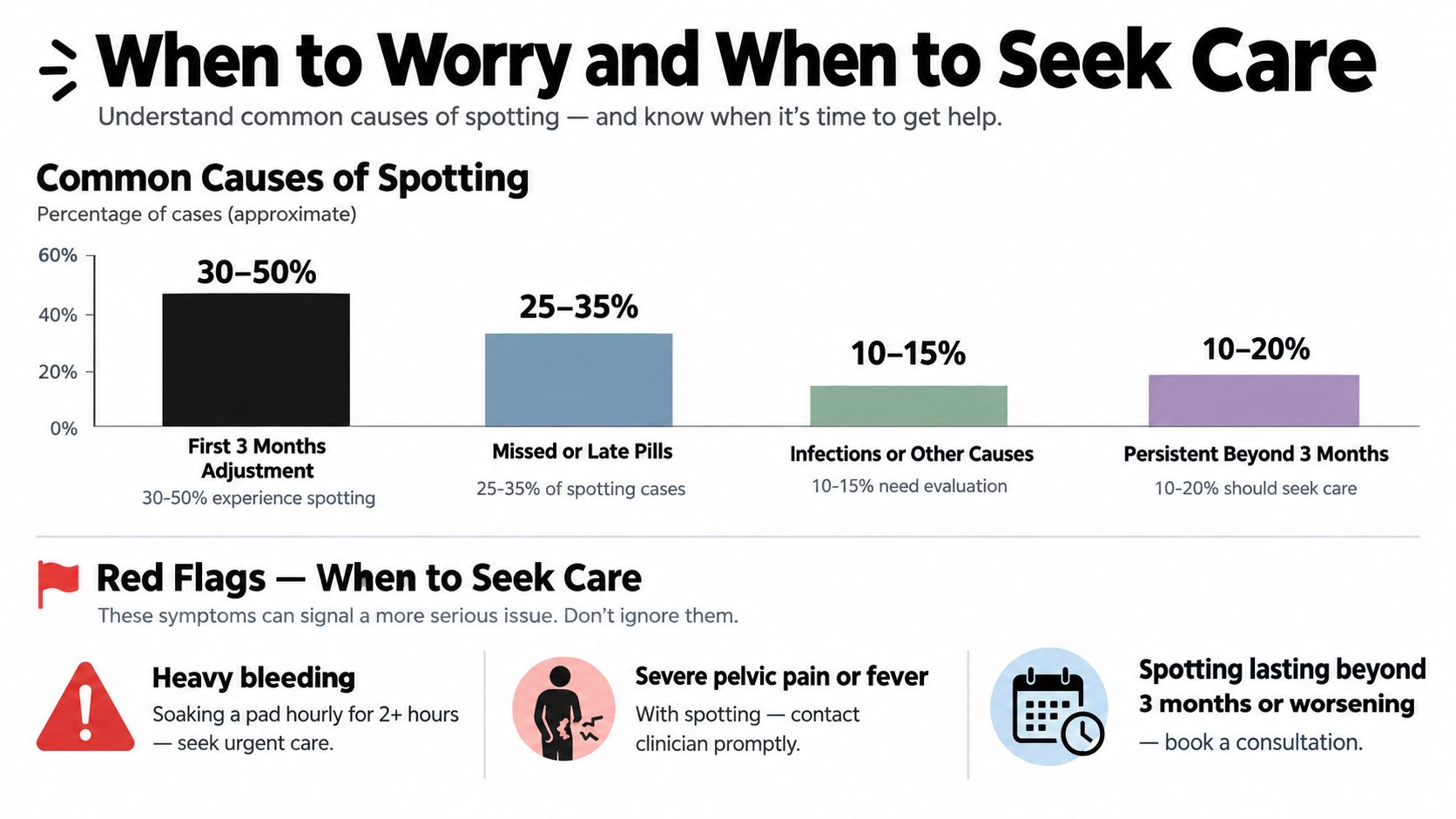
If you've recently started the pill or changed formulations, light spotting without other symptoms is often watched for an adaptation period. Australian guidance aimed at filling this common gap notes that evaluation is usually most meaningful after about three cycles, and that persistent bleeding beyond about 3 cycles, heavy bleeding, bleeding after sex, pain, or bleeding that starts after a long stable period should prompt review (Australian GP guidance summary).
People often need a clearer rule. Early spotting can be normal. Ongoing or changing spotting deserves a second look.
Clear reasons to seek care
Contact a clinician sooner if any of these apply:
- The bleeding is heavy: more like a period than light spotting.
- It's lasted beyond the expected settling phase: especially if you've been careful with pills.
- You have pain, fever, or unusual discharge: these raise the possibility of infection or another cause.
- You bleed after sex: this needs proper assessment.
- The pattern starts after a long stable stretch: new bleeding after months of stability is different from early adjustment.
- Pregnancy is possible: especially after missed pills, vomiting, or a possible interaction.
- You have concerning symptoms such as chest pain, leg swelling, severe headache, or visual changes: these need urgent medical attention.
What the appointment usually involves
A review for breakthrough spotting is often straightforward. Your clinician will usually ask about:
- How you take the pill
- Whether any pills were missed or delayed
- New medications or supplements
- Sex, infection risk, and bleeding after sex
- The exact bleeding pattern
- Whether a pregnancy test is needed
You may need an examination, swabs, or further tests depending on the story. Some people need no testing at all. Others may need evaluation for cervical or uterine causes.
The possible outcomes vary. Your clinician might suggest staying the course a bit longer, changing dose, switching formulation, or looking for a non-pill cause. If you've been wondering whether symptoms reflect hormone imbalance more broadly, this article on signs and symptoms of low progesterone can help you frame questions, though spotting on the pill needs its own assessment.
New spotting isn't automatically a problem. New spotting with red flags is a reason to get help.
Spotting While Skipping or Extending Cycles
Some spotting happens in a very specific situation. You're taking active pills back-to-back because you want to skip a bleed, and then light bleeding starts anyway. That feels unfair, but it's a known pattern.
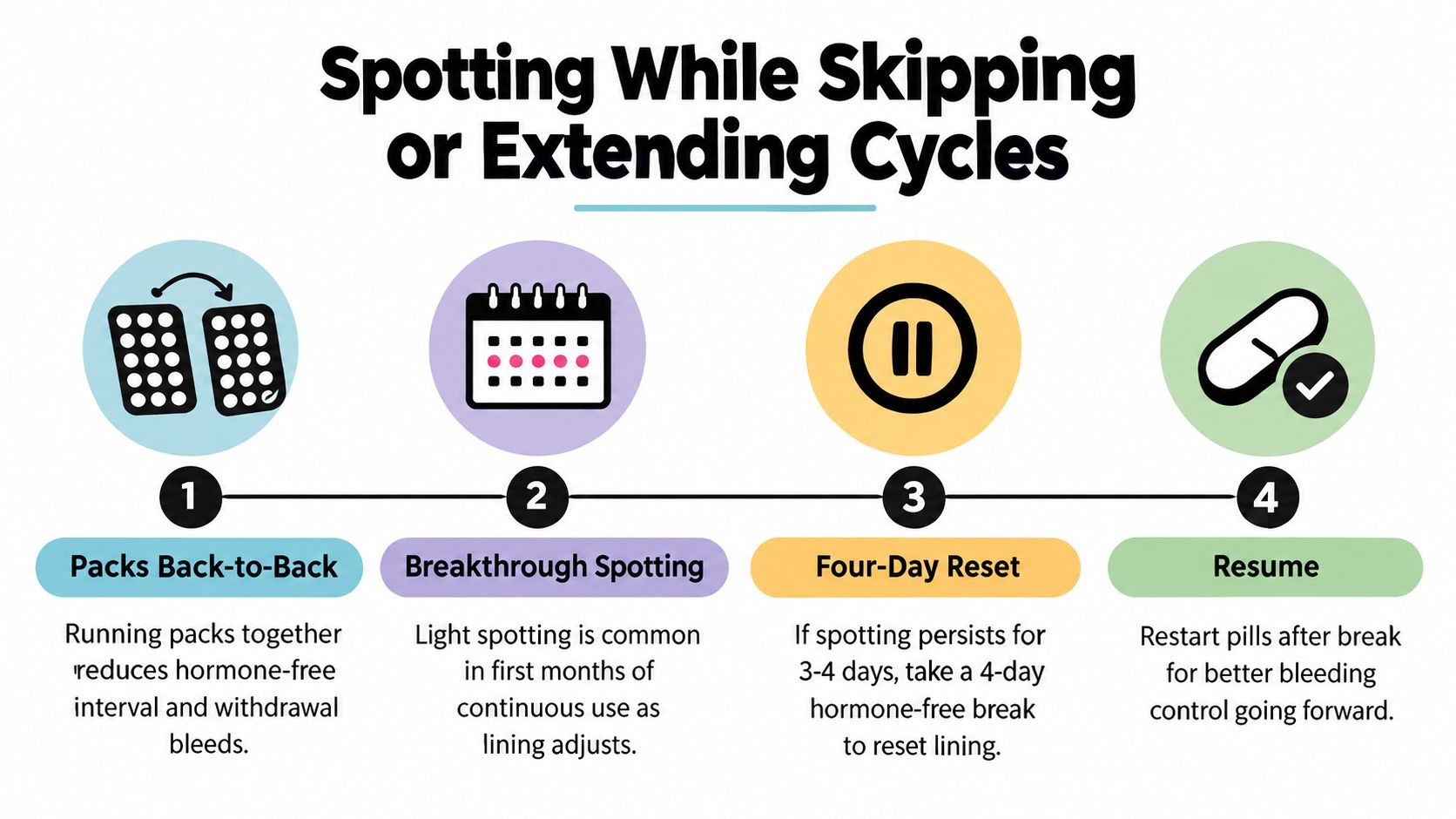
Continuous or extended pill use reduces or delays withdrawal bleeds by removing the usual hormone-free interval. For many people that's convenient. But in some users, it also increases the chance of breakthrough spotting at first.
Why spotting can happen when you skip periods
When you run packs together, the lining is exposed to a prolonged hormone pattern without the usual break. That can still lead to light unscheduled shedding while the lining adjusts.
Australian guidance addresses a practical question that many generic articles skip. If breakthrough bleeding becomes troublesome for 3 or more days during an extended-cycle regimen, a 4-day hormone-free break may help reset bleeding control, provided you've already taken enough active pills to maintain contraceptive cover (RACGP contraception guidance).
When a short reset may help
This strategy is sometimes called a reset because it allows a short, controlled bleed before restarting active pills.
A few practical points matter:
- It's generally discussed for monophasic pills, where active pills have the same hormone dose.
- It should follow product guidance, because not every pill is used the same way.
- It's for troublesome spotting, not for every tiny streak.
- Timing matters, especially if you are trying to avoid bleeding for travel, sport, or a major event.
If you haven't taken enough active pills to maintain cover, don't improvise. Get advice from your pill instructions or a clinician.
When extended use may not be the right fit
Some people love back-to-back pill use once the early spotting settles. Others find the bleeding pattern more annoying than the scheduled withdrawal bleed they were trying to avoid.
That doesn't mean you failed at using the pill correctly. It may just mean your current regimen isn't the best fit.
Your Practical Next Steps
If you remember one thing, make it this: light spotting in the first few months on the pill is often a normal adjustment. The next step is to respond calmly, not guess wildly.
Check the basics this week
- Review adherence: have you been taking it at a consistent time?
- Read your own pill leaflet: especially the missed-pill and vomiting instructions.
- Look at other factors: new medicines, supplements, illness, or absorption problems.
- Use backup contraception if your leaflet advises it: particularly after missed pills.
Track the pattern for the next couple of cycles
Open a phone note or calendar and record:
- Which day spotting happened
- Whether it was pink, red, or brown
- How much there was
- Any pain, discharge, or bleeding after sex
- Any late pills or other possible triggers
That record is often more useful than memory alone.
Decide whether you need follow-up
Book a review if:
- Spotting keeps going beyond the settling period
- The bleeding is heavy
- You have pain, unusual discharge, fever, or bleeding after sex
- The bleeding started after a long stable period
- Pregnancy is possible
A clinician can help you work out whether the answer is to wait, tighten the routine, do a pregnancy test, change the dose, switch pill type, or investigate another cause. Sometimes finding the right pill takes adjustment. That's normal.
Venus Health Co. offers app-connected tools for home health tracking, including cycle and fertility-focused devices that can help you keep clearer records when your bleeding pattern feels confusing. If you want a more organised way to track changes and understand your body over time, visit Venus Health Co..